NCERT Solutions: Exercise 10.1 - Conic Sections

Q1: Find the equation of the circle with centre (0, 2) and radius 2
Ans: The equation of a circle with centre (h, k) and radius r is given as
(x - h)2 + (y - k)2 = r2
It is given that centre (h, k) = (0, 2) and radius (r) = 2.
Therefore, the equation of the circle is
(x - 0)2 + (y - 2)2 = 22
⇒ x2 + (y - 2)2 = 4
⇒ x2 + (y2 - 4y + 4) = 4
⇒ x2 + y2 - 4y = 0.
Q2: Find the equation of the circle with centre (-2, 3) and radius 4
Ans: The equation of a circle with centre (h, k) and radius r is given as
(x - h)2 + (y - k)2 = r2
It is given that centre (h, k) = (-2, 3) and radius (r) = 4.
Therefore, the equation of the circle is
(x + 2)2 + (y - 3)2 = 42
⇒ (x2 + 4x + 4) + (y2 - 6y + 9) = 16
⇒ x2 + y2 + 4x - 6y + 13 = 16
⇒ x2 + y2 + 4x - 6y - 3 = 0.
Q3: Find the equation of the circle with centre

and radius

Ans: The equation of a circle with centre (h, k) and radius r is given as
(x - h)2 + (y - k)2 = r2
It is given that centre (h, k) =


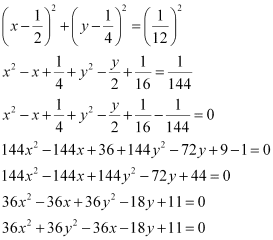
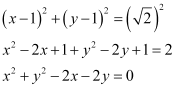
Q4: Find the equation of the circle with centre (1, 1) and radius

(x - h)2 + (y - k)2 = r2
It is given that centre (h, k) = (1, 1) and radius (r) =
 .
.
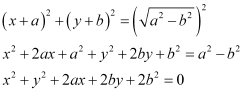
Q5: Find the equation of the circle with centre (-a, -b) and radius

(x - h)2 + (y - k)2 = r2
It is given that centre (h, k) = (-a, -b) and radius (r) = .

Q6: Find the centre and radius of the circle (x + 5)2 + (y - 3)2 = 36
Ans: The equation of the given circle is (x + 5)2 + (y - 3)2 = 36.
Rewrite as (x - (-5))2 + (y - 3)2 = 62, which is of the form (x - h)2 + (y - k)2 = r2.
Therefore h = -5, k = 3 and r = 6.
Thus, the centre is (-5, 3) and the radius is 6.
Q7: Find the centre and radius of the circle x2 + y2 - 4x - 8y - 45 = 0
Ans: The equation of the given circle is x2 + y2 - 4x - 8y - 45 = 0.
Group terms and complete the square:
(x2 - 4x) + (y2 - 8y) = 45
Complete squares:
{x2 - 4x + 4} + {y2 - 8y + 16} = 45 + 4 + 16
⇒ (x - 2)2 + (y - 4)2 = 65.
Thus h = 2, k = 4 and r2 = 65, so r = √65.
Thus, the centre is (2, 4) and the radius is √65.

Q8: Find the centre and radius of the circle x2 + y2 - 8x+ 10y - 12 = 0
Ans: The equation of the given circle is x2 + y2 - 8x + 10y - 12 = 0.
Group and complete the square:
(x2 - 8x) + (y2 + 10y) = 12
Add and subtract squares:
{x2 - 8x + 16} + {y2 + 10y + 25} = 12 + 16 + 25
⇒ (x - 4)2 + (y + 5)2 = 53.
Therefore h = 4, k = -5 and r= √53.



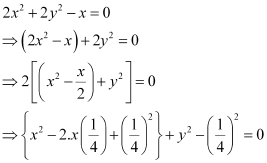
Q9: Find the centre and radius of the circle 2x2 + 2y2 - x = 0
Ans: The equation of the given circle is 2x2 + 2y2 - x = 0.
Divide both sides by 2:
x2 + y2 - (1/2)x = 0
Rewrite the x-terms and complete the square:
x2 - (1/2)x + y2 = 0
Add and subtract (1/4)2 = 1/16 to complete square in x:
{x2 - (1/2)x + 1/16} + y2 = 1/16
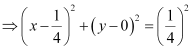
⇒ (x - 1/4)2 + y2 = (1/4)2.
Hence the centre is (1/4, 0) and the radius is 1/4.


 .
.Ans: Let the required circle be (x - h)2 + (y - k)2 = r2.
Since it passes through (4,1) and (6,5):
(4 - h)2 + (1 - k)2 = r2 ... (1)
(6 - h)2 + (5 - k)2 = r2 ... (2)
Centre (h, k) lies on 4x + y = 16:
4h + k = 16 ... (3)
Subtract (1) from (2):
(6 - h)2 - (4 - h)2 + (5 - k)2 - (1 - k)2 = 0
Compute differences:
(36 - 12h + h2) - (16 - 8h + h2) + (25 -10k + k2) - (1 -2k + k2) = 0
⇒ (20 - 4h) + (24 - 8k) = 0 ⇒ 4h + 8k = 44 ⇒ h + 2k = 11 ... (4)
Solve (3) and (4):
4h + k = 16
h + 2k = 11
Multiply second by 4 and subtract first×1 to eliminate h or solve directly:
From (4): h = 11 - 2k. Substitute in (3): 4(11 - 2k) + k = 16 ⇒ 44 - 8k + k = 16 ⇒ -7k = -28 ⇒ k = 4 ⇒ h = 3.
Substitute in (1): (4 - 3)2 + (1 - 4)2 = r2 ⇒ 1 + 9 = r2 ⇒ r2 = 10.
Therefore the circle is (x - 3)2 + (y - 4)2= 10.

x2 + y2 - 6x - 8y+ 15 = 0.

Q11: Find the equation of the circle passing through the points (2, 3) and (-1, 1) and whose centre is on the line x - 3y - 11 = 0.
Ans: Let the required circle be (x - h)2 + (y - k)2 = r2.
Since it passes through (2,3) and (-1,1):
(2 - h)2 + (3 - k)2 = r2 ... (1)
(-1 - h)2 + (1 - k)2 = r2 ... (2)
Centre (h, k) lies on x - 3y - 11 = 0 ⇒ h - 3k = 11 ... (3)
Subtract (2) from (1):
(2 - h)2 - (-1 - h)2 + (3 - k)2 - (1 - k)2 = 0
Compute differences:
(4 - 4h) - (1 + 2h) + (9 - 6k) - (1 - 2k) = 0
⇒ (4 - 4h - 1 - 2h) + (9 - 6k - 1 + 2k) = 0
⇒ (3 - 6h) + (8 - 4k) = 0 ⇒ -6h - 4k +11 = 0 ⇒ 6h + 4k = 11 ... (4)
Solve (3) and (4):
h - 3k = 11
6h + 4k = 11
Multiply first by 6: 6h - 18k = 66. Subtract the second: (6h - 18k) - (6h + 4k) = 66 - 11 ⇒ -22k = 55 ⇒ k = -55/22 = -5/2.
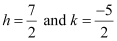
Then h = 11 + 3k = 11 + 3(-5/2) = 11 - 15/2 = 22/2 - 15/2 = 7/2.
Thus centre (h, k) = (7/2, -5/2).
Find r2 using (1):
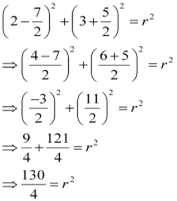
(2 - 7/2)2 + (3 + 5/2)2 = r2
(-3/2)2 + (11/2)2 = 9/4 + 121/4 = 130/4 = 65/2.
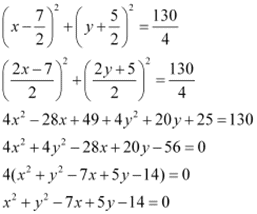
Therefore the circle is (x - 7/2)2 + (y + 5/2)2= 65/2.
Q12: Find the equation of the circle with radius 5 whose centre lies on x-axis and passes through the point (2, 3).
Ans: Let the required circle be (x - h)2 + (y - k)2 = r2.
Centre lies on the x-axis ⇒ k = 0 and r = 5.
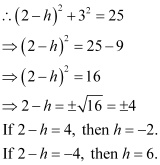
So (x - h)2 + y2 = 25. The circle passes through (2,3):
(2 - h)2 + 32 = 25 ⇒ (2 - h)2 = 16 ⇒ 2 - h = ±4.
If 2 - h = 4 ⇒ h = -2, giving (x + 2)2 + y2 = 25 ⇒ x2 + y2 + 4x - 21 = 0.
If 2 - h = -4 ⇒ h = 6, giving (x - 6)2 + y2 = 25 ⇒ x2 + y2 - 12x + 11 = 0.
Hence there are two such circles.
Q13: Find the equation of the circle passing through (0, 0) and making intercepts a and b on the coordinate axes.
Ans: Let the required circle be (x - h)2 + (y - k)2 = r2.
Since it passes through (0,0): h2 + k2 = r2.
Therefore equation becomes (x - h)2 + (y - k)2 = h2 + k2.
The circle passes through (a, 0) and (0, b). From (a, 0):
(a - h)2 + (-k)2 = h2 + k2 ⇒ a2 - 2ah = 0 ⇒ h = a/2 (since a≠ 0).

(-h)2 + (b - k)2 = h2 + k2 ⇒ b2 - 2bk = 0 ⇒ k = b/2 (since b≠ 0).

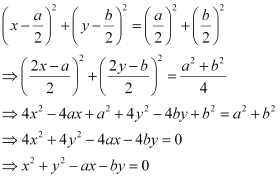
Thus centre is (a/2, b/2) and r2 = (a/2)2 + (b/2)2 = (a2 + b2)/4.
Therefore the equation is (x - a/2)2 + (y - b/2)2 = (a2 + b2)/4.
Q14: Find the equation of a circle with centre (2, 2) and passes through the point (4, 5).
Ans: The centre is (h, k) = (2, 2).
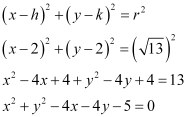
Radius squared = distance2 between (2,2) and (4,5):
(4 - 2)2 + (5 - 2)2 = 22 + 32= 4 + 9 = 13.

(x - 2)2 + (y - 2)2= 13.
Q15: Does the point (-2.5, 3.5) lie inside, outside or on the circle x2 + y2 = 25?
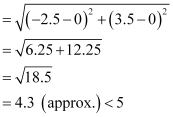
Ans: The given circle is x2 + y2 = 25, so its centre is (0, 0) and radius = 5.
Distance of (-2.5, 3.5) from (0, 0) = √[(-2.5)2 + 3.52] = √[6.25 + 12.25] = √18.5 = √(37/2) ≈ 4.30.
FAQs on NCERT Solutions: Exercise 10.1 - Conic Sections
| 1. What are the different types of conic sections? |  |
| 2. How are conic sections used in real life? | |
| 3. What is the general equation of a conic section? | |
| 4. How do you determine the type of conic section from its equation? | |
| 5. What is the focus-directrix property of conic sections? | |





