NCERT Solutions: Principles of Inheritance & Variation

Q1: Mention the advantages of selecting pea plant for experiment by Mendel.
Ans: Mendel selected the garden pea (Pisum sativum) because it combined several practical features that made it ideal for studying inheritance.
- Peas show many clear, contrasting characters such as tall/dwarf plants, round/wrinkled seeds, green/yellow pods and purple/white flowers. These contrasts made scoring of traits easy and unambiguous.
- Pea flowers are bisexual and normally self-pollinate, so true-breeding lines could be maintained generation after generation without accidental contamination.
- Cross-pollination is easy to perform experimentally by emasculation (removing stamens) and manual pollination, allowing controlled hybridisations.
- Pea plants have a relatively short life cycle and produce many seeds per cross, giving large progeny numbers for reliable statistical analysis.
Q2: Differentiate between the following:
(a) Dominance and Recessive
(b) Homozygous and Heterozygous
(c) Monohybrid and Dihybrid.
Ans: (a) Dominance and Recessive
| Feature | Dominant | Recessive |
|---|---|---|
| Expression | Expressed in phenotype even in single copy (heterozygous) | Expressed only when present in two copies (homozygous) |
| Representation | Capital letter (e.g., T, R) | Small letter (e.g., t, r) |
| Masking effect | Masks the effect of recessive allele | Gets masked by dominant allele |
(b) Homozygous and Heterozygous
| Feature | Homozygous | Heterozygous |
|---|---|---|
| Alleles | Two identical alleles (AA or aa) | Two different alleles (Aa) |
| Breeding | True-breeding | Not true-breeding |
| Phenotype | Shows only one type of trait | Usually shows dominant trait |
(c) Monohybrid and Dihybrid
| Feature | Monohybrid Cross | Dihybrid Cross |
|---|---|---|
| Number of traits | One pair of contrasting traits | Two pairs of contrasting traits |
| Example | TT × tt (height) | TtYy × TtYy (height & seed colour) |
| F2 Phenotypic Ratio | 3 : 1 | 9 : 3 : 3 : 1 |
Q3: A diploid organism is heterozygous for 4 loci, how many types of gametes can be produced?
Ans:
- Definition: A locus is a fixed position on a chromosome occupied by a gene. A heterozygous organism has different alleles at a locus (for example, Aa).
- If an organism is heterozygous at four independent loci, for example Aa, Bb, Cc and Dd, each locus can contribute two possible alleles to a gamete. The number of different gametic types produced is 2n, where n is the number of heterozygous loci. Therefore 24 = 16 different gametes can be formed when the genes assort independently.
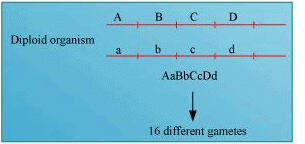
- If the genes are linked (located close together on the same chromosome) they may be inherited together and the number of different gametes will be reduced; recombination between linked genes depends on the distance between them.
Q4: Explain the Law of Dominance using a monohybrid cross.
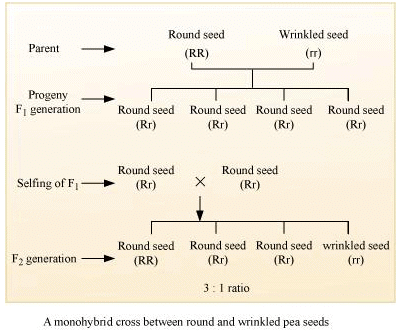
Ans: Mendel's Law of Dominance states that when two contrasting alleles are present in a heterozygote, the dominant allele is expressed in the phenotype while the recessive allele is masked, though not lost. For example, when true-breeding round seeded plants (RR) are crossed with true-breeding wrinkled seeded plants (rr), all F1 offspring are Rr and show the round seed phenotype (dominant). When F1 plants (Rr) are self-fertilised, the F2 generation shows a phenotypic ratio of 3 round : 1 wrinkled and a genotypic ratio of 1 RR : 2 Rr : 1 rr. This demonstrates that the recessive allele remains present in the F1 but is masked by the dominant allele and reappears in the F2 generation.
Q5: Define and design a test-cross?
Ans:
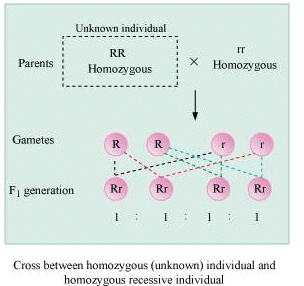
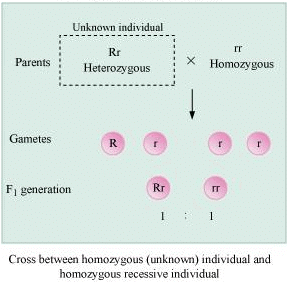
- Definition: A test cross is a cross between an individual showing a dominant phenotype but with unknown genotype and an individual that is homozygous recessive for the trait. It is used to determine whether the unknown is homozygous dominant or heterozygous.
- Design and interpretation: Cross the unknown (for example, RR) with a homozygous recessive (rr). If all progeny show the dominant phenotype, the unknown parent is likely homozygous dominant (Rr). If approximately half the progeny show the dominant phenotype and half the recessive phenotype (1:1), the unknown parent is heterozygous (Rr).
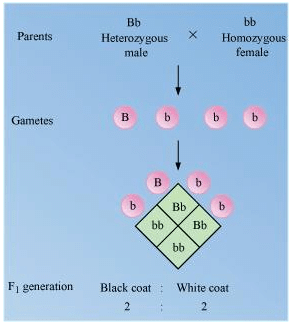
Q6: Using a Punnett square, work out the distribution of phenotypic features in the first filial generation after a cross between a homozygous female and a heterozygous male for a single locus.
Ans: Consider coat colour in guinea pigs where the male is heterozygous black (Bb) and the female is homozygous white (bb). The male produces gametes B and b; the female produces only b gametes. A Punnett square gives the progeny genotypes Bb and bb in equal numbers. Thus the genotypic ratio in F1 is 1 Bb : 1 bb and the phenotypic ratio is 1 black : 1 white (i.e., 50% black, 50% white).
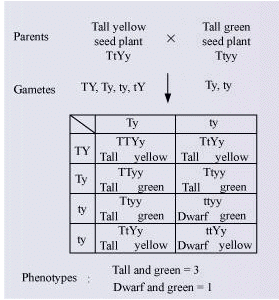
Q7: When a cross in made between tall plants with yellow seeds (TtYy) and tall plant with green seed (TtYy), what proportions of phenotype in the offspring could be expected to be
(a) Tall and green.
(b) Dwarf and green.
Ans: A cross TtYy × TtYy is a dihybrid cross and, when the two loci assort independently, produces phenotypes in a 9:3:3:1 ratio (out of 16). Here T = tall (dominant), t = dwarf (recessive); Y = yellow (dominant), y = green (recessive).
(a) Probability of tall and green = probability of tall (T_) × probability of green (yy) = (3/4) × (1/4) = 3/16.
(b) Probability of dwarf and green = probability of dwarf (tt) × probability of green (yy) = (1/4) × (1/4) = 1/16.
Q8: Two heterozygous parents are crossed. If the two loci are linked what would be the distribution of phenotypic features in F1 generation for a dihybrid cross?
Ans: When two genes are linked (on the same chromosome and close together), they tend to be inherited together and parental combinations of alleles appear more frequently in progeny than recombinant combinations. Thus, in a cross between two heterozygous parents, the majority of F1 individuals will show the parental phenotypes and relatively few will show recombinant phenotypes. The exact proportions depend on the recombination frequency: if there is no crossing over, only parental types occur; if crossing over occurs, recombinant types appear at a lower frequency proportional to the distance between the genes.
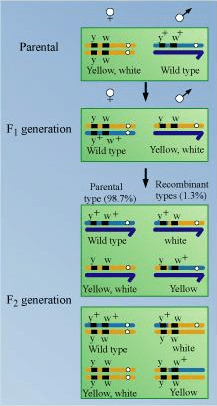
For example, in Drosophila a cross involving genes for body colour and eye colour that are linked may give predominantly parental phenotypes (wild type and yellow-white) because those genes are inherited together when linkage is strong.
Q9: Briefly mention the contribution of T.H. Morgan in genetics.
Ans: Thomas Hunt Morgan used Drosophila melanogaster (fruit fly) to show that genes are located on chromosomes. He provided experimental proof for the chromosomal theory of inheritance and discovered sex-linked inheritance. Morgan demonstrated genetic linkage - that genes close together on the same chromosome are usually inherited together - and showed that crossing over produces recombination between linked genes. His work laid the foundation for genetic mapping using recombination frequencies.
Q10: What is pedigree analysis? Suggest how such an analysis, can be useful.
Ans: Pedigree analysis is the study and charting of the occurrence of a trait or disorder in several generations of a family, usually shown as a family tree with standard symbols. It helps to determine the pattern of inheritance (autosomal dominant/recessive or sex-linked), identify carriers, and estimate the risk of a trait appearing in future offspring. Genetic counsellors use pedigrees to advise families about the likelihood of inherited disorders (for example, haemophilia or sickle cell anaemia) and to guide decisions about testing, management and prevention strategies.
Ques 11: How is sex determined in human beings?
Ans: Human sex determination is by male heterogamy. Females are XX and produce only X-bearing eggs. Males are XY and produce two types of sperm (X-bearing and Y-bearing). The sex of the child depends on which sperm fertilises the egg: X sperm gives XX (female) and Y sperm gives XY (male). Because there is an approximately equal chance of X or Y sperm fertilising the egg, the expected sex ratio is about 1:1.
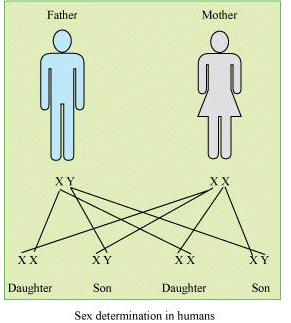
Genetically, this can be shown by a simple Punnett square between XX (mother) and XY (father) giving one XX and one XY on average in each pair of offspring.
Q12: A child has blood group O. If the father has blood group A and mother blood group B, work out the genotypes of the parents and the possible genotypes of the other off springs.
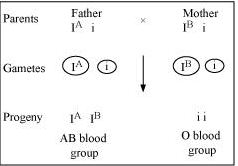
Ans: Human ABO blood groups are controlled by three alleles: IA, IB (co-dominant) and i (recessive). A child with blood group O must be genotype ii. For parents with phenotypes A and B to have an O child, each parent must carry the recessive i allele, so the likely parental genotypes are IAi (father) and IBi (mother).
Crossing IAi × IBi gives four possible genotypes in offspring with equal probability:
- IAIB → blood group AB (25%)
- IAi → blood group A (25%)
- IBi → blood group B (25%)
- ii → blood group O (25%)
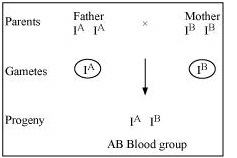
A cross between homozygous parents will produce progeny with AB blood group.
A cross between heterozygous parents will produce progenies with AB blood group (IAIB) and O blood group (ii).
Q13: Explain the following terms with example
(a) Co-dominance
(b) Incomplete dominance
Ans: (a) Co-dominance: Co-dominance occurs when two different alleles at a locus are fully expressed in a heterozygote, so both contribute independently to the phenotype. A classic example is the AB blood group in humans: an individual with genotype IAIB expresses both A and B antigens and shows the AB phenotype. Both alleles are equally expressed and neither masks the other.
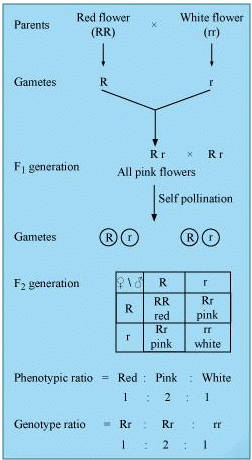
(b) Incomplete dominance: Incomplete dominance occurs when the heterozygote shows an intermediate phenotype between the two homozygotes because neither allele is completely dominant. For example, in Antirrhinum (snapdragon), a cross between red-flowered (RR) and white-flowered (rr) plants produces pink (Rr) F1 progeny. The heterozygote shows a phenotype that is intermediate between the two parents.
Q14: What is point mutation? Give one example.
Ans: A point mutation is a change affecting a single nucleotide base in DNA, caused by substitution, insertion or deletion of one base. An important example is sickle cell anaemia, caused by a single base substitution in the beta-globin gene (HBB) on chromosome 11. This substitution changes the codon for the sixth amino acid from glutamic acid to valine, altering haemoglobin structure and causing red cells to assume a sickle shape under low oxygen.
Q15: Who had proposed the chromosomal theory of inheritance?
Ans: Sutton and Boveri proposed the chromosomal theory of inheritance in 1902. They suggested that chromosomes are the carriers of genes and that their behaviour during meiosis explains Mendelian inheritance.
Q16: Mention any two autosomal genetic disorders with their symptoms.
Ans: Two autosomal genetic disorders are as follows.
Sickle cell Anaemia: Sickle cell anaemia is an autosomal recessive disorder caused by a point mutation in the beta-globin gene (HbS allele). Homozygotes (HbSHbS) show the disease; heterozygotes (HbAHbS) are carriers and may have mild symptoms under stress.
Symptoms: Rapid heart rate, breathlessness, delayed growth and puberty, jaundice, weakness, fever, excessive thirst, chest pain, and decreased fertility are the major symptoms of sickle cell anaemia disease.
Down's syndrome: Down's syndrome is an autosomal chromosomal disorder caused by trisomy of chromosome 21 (three copies of chromosome 21).
Symptoms: Individuals typically show characteristic facial features (round face, upward slanting eyes, short neck), short stature, hypotonia, and varying degrees of intellectual disability. Congenital heart defects and other health issues are also common.
FAQs on NCERT Solutions: Principles of Inheritance & Variation
| 1. What are the principles of inheritance? |  |
| 2. What is variation in genetics? | |
| 3. How do genes determine inheritance patterns? | |
| 4. What is the role of alleles in inheritance? | |
| 5. How do mutations contribute to variation in inheritance? | |





