CBSE Class 11  >  Class 11 Notes  >  Binomial Theorem, Chapter Notes, Class 11, Mathematics

Binomial Theorem, Chapter Notes, Class 11, Mathematics

Binomial Theorem

A. Binomial Theorem

The formula by which any positive integral power of a binomial expression can be expanded in the form of a series is known as Binomial Theorem. If Binomial Theorem, Chapter Notes, Class 11, Mathematics then

Binomial Theorem, Chapter Notes, Class 11, Mathematics

This theorem can be proved by induction.

Observations :

(a) The number of terms in the expansion is (n + 1) i.e. one more than the index.

(b) The sum of the indices of x & y in each term is n.

(c) The binomial coefficients of the terms (nC0, nC1.........) equidistant from the beginning and the end are equal.

 

Binomial Theorem, Chapter Notes, Class 11, Mathematics


Sol. The numerator is of the form a3 + b3 + 3ab (a + b) = (a + b)3 where a = 18, and b = 7

Binomial Theorem, Chapter Notes, Class 11, Mathematics Nr = (18 + 7)3 = (25)3. Denominator can be written as

Binomial Theorem, Chapter Notes, Class 11, Mathematics


B. IMPORTANT TERMS IN THE BINOMIAL EXPANSION ARE

(a) General term : The general term or the (r + 1)th term in the expansion of (x + y)n is given by

Tr+1 = nCrxn-r. yr

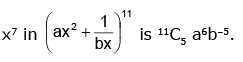
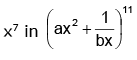
Ex.2 Find : (a) The coefficient of x7 in the expansion of CBSE, Class 11, IIT JEE, Syllabus, Preparation, NCERT, Important, Binomial Theroem

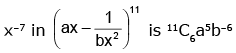
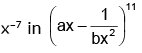
(b) The coefficient of x-7 in the expansion of CBSE, Class 11, IIT JEE, Syllabus, Preparation, NCERT, Important, Binomial Theroem

Also, find the relation between a and b, so that these coefficients are equal.


Sol.

 (a) In the expansion of   CBSE, Class 11, IIT JEE, Syllabus, Preparation, NCERT, Important, Binomial Theroem  the general terms is CBSE, Class 11, IIT JEE, Syllabus, Preparation, NCERT, Important, Binomial Theroem
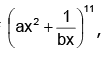
putting 22 – 3r = 7 ⇒  3r = 15 ⇒  r = 5 CBSE, Class 11, IIT JEE, Syllabus, Preparation, NCERT, Important, Binomial Theroem  
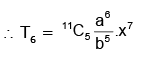
Hence the coefficient of CBSE, Class 11, IIT JEE, Syllabus, Preparation, NCERT, Important, Binomial Theroem

(b) In the expansion of   CBSE, Class 11, IIT JEE, Syllabus, Preparation, NCERT, Important, Binomial Theroem   , general terms is   CBSE, Class 11, IIT JEE, Syllabus, Preparation, NCERT, Important, Binomial Theroem

putting 11 – 3r = – 7 ⇒ 3r = 18  ⇒  r = 6 CBSE, Class 11, IIT JEE, Syllabus, Preparation, NCERT, Important, Binomial Theroem
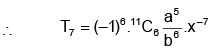
Hence the coefficient of CBSE, Class 11, IIT JEE, Syllabus, Preparation, NCERT, Important, Binomial Theroem

Also given coefficient of     CBSE, Class 11, IIT JEE, Syllabus, Preparation, NCERT, Important, Binomial Theroem   = coefficient of   CBSE, Class 11, IIT JEE, Syllabus, Preparation, NCERT, Important, Binomial Theroem

CBSE, Class 11, IIT JEE, Syllabus, Preparation, NCERT, Important, Binomial Theroem ⇒  ab = 1 ( ∴ 11C5 = 11C6). Which is a required relation between a and b.

Binomial Theorem, Chapter Notes, Class 11, Mathematics


Ex.3 Find the number of rational terms in the expansion of (91/4 + 81/6)1000.


Sol.

Binomial Theorem, Chapter Notes, Class 11, Mathematics

Binomial Theorem, Chapter Notes, Class 11, Mathematics

The possible set of values of r is {0, 2, 4, ..........1000}. Hence, number of rational terms is 501


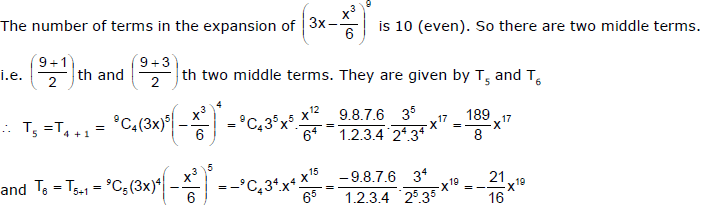
(b) Middle term : The middle term(s) in the expansion of (x + y)n is (are)

(i) If n is even, there is only one middle term which is given by T(n + 2)/2 = nCn/2. xn/2. yn/2

(ii) If n is odd, there are two middle terms which are CBSE, Class 11, IIT JEE, Syllabus, Preparation, NCERT, Important, Binomial Theroem & CBSE, Class 11, IIT JEE, Syllabus, Preparation, NCERT, Important, Binomial Theroem


Ex.4 Binomial Theorem, Chapter Notes, Class 11, Mathematics

Sol.

Binomial Theorem, Chapter Notes, Class 11, Mathematics


(c) Term independent of x : Term independent of x contains no x ; Hence find the value of r for which the exponent of x is zero.

Ex.5 The term independent of x in Binomial Theorem, Chapter Notes, Class 11, Mathematics is
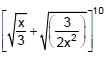
 

Sol.

Binomial Theorem, Chapter Notes, Class 11, Mathematics


(d) Numerically greatest term : To find the greatest term in the expansion of (x + a)n.
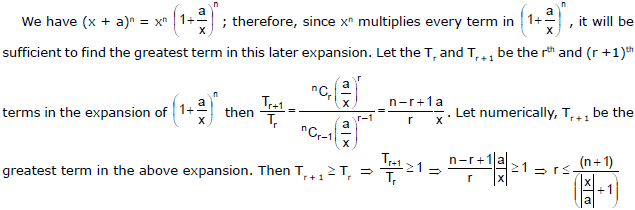
Binomial Theorem, Chapter Notes, Class 11, Mathematics

Binomial Theorem, Chapter Notes, Class 11, Mathematics


Ex.6 Find numerically the greatest term in the expansion of (3 -5x)11 when x = 1/5


Sol.
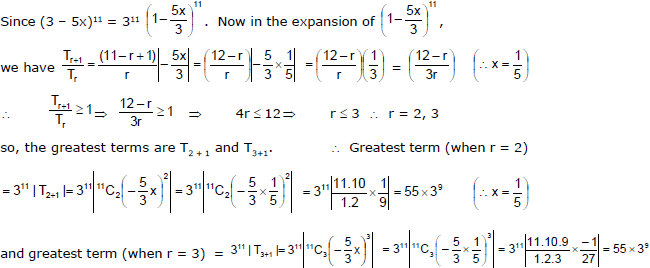
Binomial Theorem, Chapter Notes, Class 11, Mathematics

From above we say that the value of both greatest terms are equal.


C.

Binomial Theorem, Chapter Notes, Class 11, Mathematics

Ex.7

Binomial Theorem, Chapter Notes, Class 11, Mathematics


Sol.

Binomial Theorem, Chapter Notes, Class 11, Mathematics

 ==================================================================

D. Some Results on Binomial Coefficients

(a) C0 + C1 + C2 + ............+ Cn = 2n

(b) C0 + C2 + C4 + ............= C1 + C3 + C5 + .......... = 2n -1

Binomial Theorem, Chapter Notes, Class 11, Mathematics

Binomial Theorem, Chapter Notes, Class 11, Mathematics

Remember : (2n) ! = 2n. n! [1.3.5........(2n -1)]


Ex.8 If (1 + x)n = C0 + C1x + C2x2 +.................+ Cnxn then show that the sum of the products of the Binomial Theorem, Chapter Notes, Class 11, Mathematics Binomial Theorem, Chapter Notes, Class 11, Mathematics


Sol.

Binomial Theorem, Chapter Notes, Class 11, Mathematics


Ex.9  Binomial Theorem, Chapter Notes, Class 11, Mathematics


Sol.

Binomial Theorem, Chapter Notes, Class 11, Mathematics


E. Binomial theorem for negative or fractional indices

Binomial Theorem, Chapter Notes, Class 11, Mathematics


Note :

(i) When the index n is a positive integer the number of terms in the expansion of (1 + x)n is finite i.e. (n + 1) & the coefficient of successive terms are : nC0, nC1, nC2, .........., nCn

(ii) When the index is other than a positive integer such as negative integer or fraction, the number of terms in the expansion of (1 + x)n is infinite and the symbol nCr cannot be used to denote the coefficient of the general term.
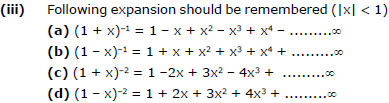
Binomial Theorem, Chapter Notes, Class 11, Mathematics

(iv) The expansions in ascending powers of x are only valid if x is 'small'. If x is large i.e. |x| > 1 then we may find it convenient to expand in powers of 1/x, which then will be small.

 =======================================================================

F. Approximations

CBSE, Class 11, IIT JEE, Syllabus, Preparation, NCERT, Important, Binomial Theroem

If x < 1, the terms of the above expansion go on decreasing and if x be very small, a stage may be reached when we may neglect the terms containing higher powers of x in the expansion. Thus, if x be so small that its squares and higher powers may be neglected then (1 + x)n = 1 + nx, approximately,

This is an approximate value of (1 + x)n


Ex.10 If x is so small such that its square and higher powers may be neglected then find the approximate value of CBSE, Class 11, IIT JEE, Syllabus, Preparation, NCERT, Important, Binomial Theroem
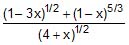
 

Sol.

CBSE, Class 11, IIT JEE, Syllabus, Preparation, NCERT, Important, Binomial Theroem

Binomial Theorem, Chapter Notes, Class 11, Mathematics


Ex.11 The value of cube root of 1001 upto five decimal places is


Sol.

CBSE, Class 11, IIT JEE, Syllabus, Preparation, NCERT, Important, Binomial Theroem

= 10 {1 + 0.0003333 -0.00000011 + ......} = 10.00333


Ex.12 The sum of CBSE, Class 11, IIT JEE, Syllabus, Preparation, NCERT, Important, Binomial Theroem is
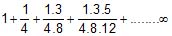


Sol. Comparing with 1 + nx + CBSE, Class 11, IIT JEE, Syllabus, Preparation, NCERT, Important, Binomial Theroem+ ......         ⇒ nx = 1/4              ...(i)

& CBSE, Class 11, IIT JEE, Syllabus, Preparation, NCERT, Important, Binomial Theroem or CBSE, Class 11, IIT JEE, Syllabus, Preparation, NCERT, Important, Binomial TheroemCBSE, Class 11, IIT JEE, Syllabus, Preparation, NCERT, Important, Binomial TheroemCBSE, Class 11, IIT JEE, Syllabus, Preparation, NCERT, Important, Binomial TheroemCBSE, Class 11, IIT JEE, Syllabus, Preparation, NCERT, Important, Binomial Theroem ...(ii) {by (i)}

putting the value of x in (i) ⇒ CBSE, Class 11, IIT JEE, Syllabus, Preparation, NCERT, Important, Binomial Theroem ⇒ n = CBSE, Class 11, IIT JEE, Syllabus, Preparation, NCERT, Important, Binomial Theroem

Binomial Theorem, Chapter Notes, Class 11, Mathematics sum of series = (1 + x)n = (1 -1/2)-1/2 = (1/2)-1/2 = CBSE, Class 11, IIT JEE, Syllabus, Preparation, NCERT, Important, Binomial Theroem


G. Exponential series

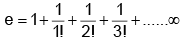
(a) e is an irrational number lying between 2.7 & 2.8. Its value correct upto 10 places of decimal is 2.7182818284.

(b) Logarithms to the base 'e' are known as the Napierian system, so named after Napier, their inventor. They are also called Natural Logarithm.

(c)
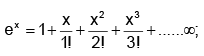
CBSE, Class 11, IIT JEE, Syllabus, Preparation, NCERT, Important, Binomial Theroem where x may be any real or complex number & CBSE, Class 11, IIT JEE, Syllabus, Preparation, NCERT, Important, Binomial Theroem
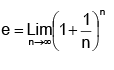
(d)
CBSE, Class 11, IIT JEE, Syllabus, Preparation, NCERT, Important, Binomial Theroem 

(e)
CBSE, Class 11, IIT JEE, Syllabus, Preparation, NCERT, Important, Binomial Theroem


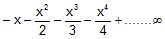
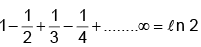
H. Logarithmic series


(a) ln (1 + x) = x -CBSE, Class 11, IIT JEE, Syllabus, Preparation, NCERT, Important, Binomial Theroem where Binomial Theorem, Chapter Notes, Class 11, Mathematics
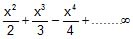
(b) ln (1 -x) = CBSE, Class 11, IIT JEE, Syllabus, Preparation, NCERT, Important, Binomial Theroem where Binomial Theorem, Chapter Notes, Class 11, Mathematics


Remember :

(i) CBSE, Class 11, IIT JEE, Syllabus, Preparation, NCERT, Important, Binomial Theroem

(ii) eln x = x

(iii) ln2 = 0.693

(iv) ln 10 = 2.303

The document Binomial Theorem, Chapter Notes, Class 11, Mathematics is a part of Class 11 category.
All you need of Class 11 at this link: Class 11

FAQs on Binomial Theorem, Chapter Notes, Class 11, Mathematics

1. What is the Binomial Theorem?
Ans. The Binomial Theorem is a formula that allows us to expand the power of a binomial expression. It states that for any positive integer n, the expansion of (a + b)^n can be written as the sum of terms of the form C(n, r) * a^(n-r) * b^r, where C(n, r) represents the binomial coefficient and can be calculated using the formula n! / (r! * (n-r)!).
2. How do we find the term independent of x in the expansion of (2x + 3)^5?
Ans. To find the term independent of x in the expansion of (2x + 3)^5, we need to consider the term where the power of x is zero. In this case, the power of x in each term is (5-r), where r represents the term number starting from 0. So, we need to find the term where (5-r) = 0, which is the 5th term. Using the formula for the term in the binomial expansion, the term independent of x can be calculated as C(5, 5) * (2x)^0 * (3)^(5-5) = 1 * 1 * 3^0 = 1.
3. How many terms are there in the expansion of (a + b + c)^7?
Ans. The number of terms in the expansion of (a + b + c)^7 can be calculated using the binomial coefficient formula. In this case, we have three variables (a, b, c) and the power is 7. The number of terms is given by the sum of the binomial coefficients for each variable with powers ranging from 0 to 7. So, the number of terms is C(7+3-1, 7) = C(9, 7) = 36.
4. Can the Binomial Theorem be applied to expressions with more than two terms?
Ans. No, the Binomial Theorem is specifically applicable to binomial expressions, which have two terms. It cannot be directly applied to expressions with more than two terms. However, if the expression can be rearranged or grouped in a way that it can be expressed as a binomial, then the Binomial Theorem can be applied to each binomial separately.
5. What is the significance of the binomial coefficients in the Binomial Theorem?
Ans. The binomial coefficients in the Binomial Theorem represent the number of ways to choose r items from a set of n items, without considering the order. They play a crucial role in determining the coefficients of each term in the expansion. The binomial coefficients can be calculated using the formula n! / (r! * (n-r)!), where n represents the power of the binomial and r represents the term number. These coefficients help in simplifying the expansion and determining the specific values of each term.
Download as PDF

Top Courses for Class 11

Related Searches
Class 11, pdf , Exam, Previous Year Questions with Solutions, Chapter Notes, Binomial Theorem, Extra Questions, Objective type Questions, study material, Class 11, Chapter Notes, Binomial Theorem, Mathematics, MCQs, ppt, Binomial Theorem, practice quizzes, past year papers, Semester Notes, Free, Mathematics, Summary, Mathematics, Sample Paper, Viva Questions, video lectures, Important questions, shortcuts and tricks, Chapter Notes, mock tests for examination, Class 11;