Magnetic Effects of Electric Current

In this document, under the topic of Magnetic field due to electric current, we are going to study all about the Magnetic properties of Electric current from the very start to end.
In this document, we will cover:
- Magnetism
- Magnetic Field and Magnetic Field Lines (Magnetic Lines of force)
- Magnetic field due to current carrying conductor: Wire, Circular coil, Solenoid
- Electromagnet
Magnetism
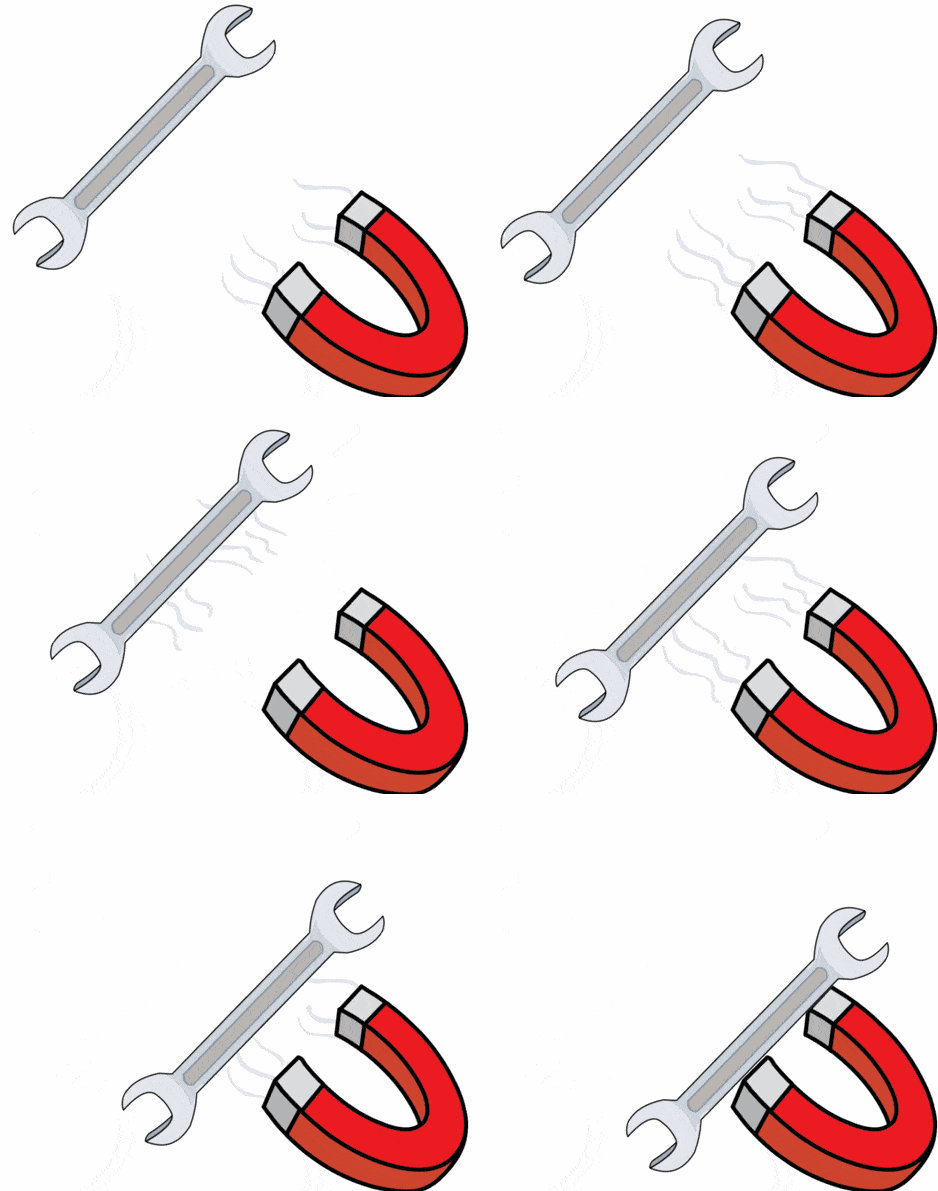
- The property, due to which a substance attracts pieces of iron, nickel and cobalt towards itself, is called magnetism.
- A naturally occurring iron ore (black iron oxide - Fe2O3) having properties of attracting iron pieces, was found in Magnesia in the upper part of Greece. The name magnetism has been taken from the name of that place.
- The substance having the property of magnetism is called a magnetic substance, and the body made up of a magnetic substance, is called a magnet.
 Magnet
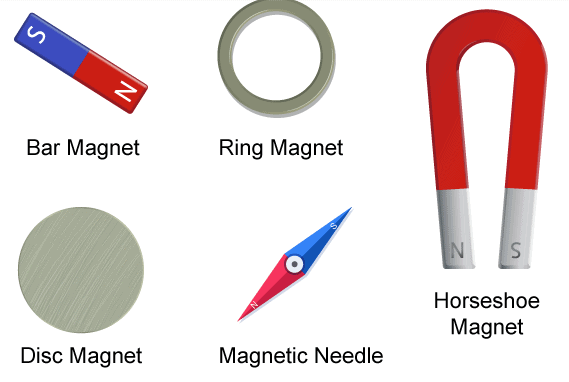
 - Magnets are found in various shapes and sizes. A bar magnet is a long rectangular bar of uniform cross-section, which can attract pieces of iron, steel, cobalt and nickel. The magnet can be natural or artificial.
 Different Types of Magnet
(a) Poles of a Magnet
- When a magnet is dipped in iron filings, then maximum filings stick to its ends, and almost no filings stick to its centre. It means that in magnets, centres of attraction are located near the ends only.
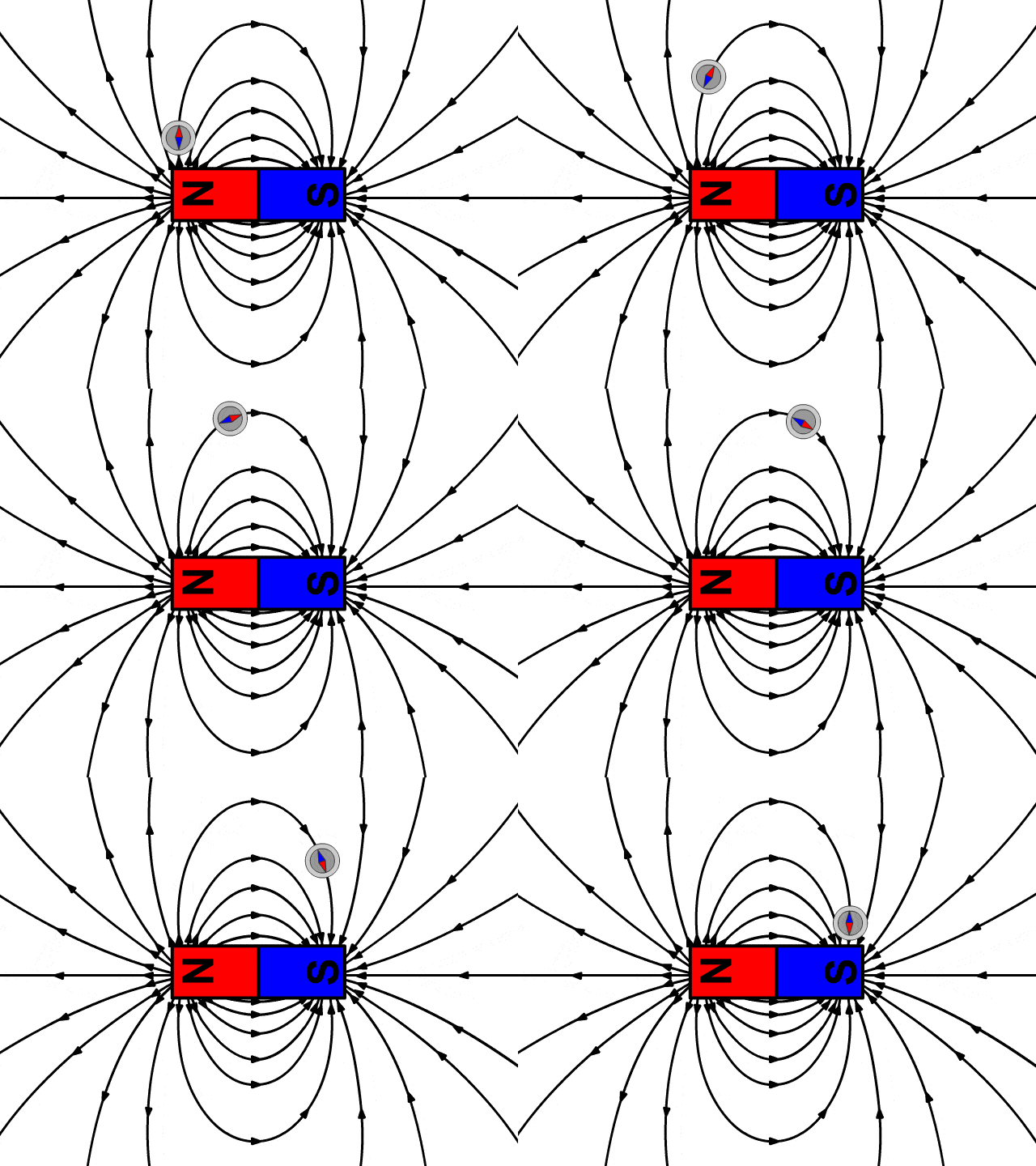
- These centres of attraction near the ends of a magnet are called poles. Since a magnet has two poles, hence it is also called a magnetic dipole.
 Magnetic Dipole with Field Lines
 - When this magnet is freely suspended, its two ends point in the north-south direction.
- The pole near the end pointing towards North (north-seeking end) is called North pole.
- The pole near the end pointing towards South (south-seeking end) is called South pole.
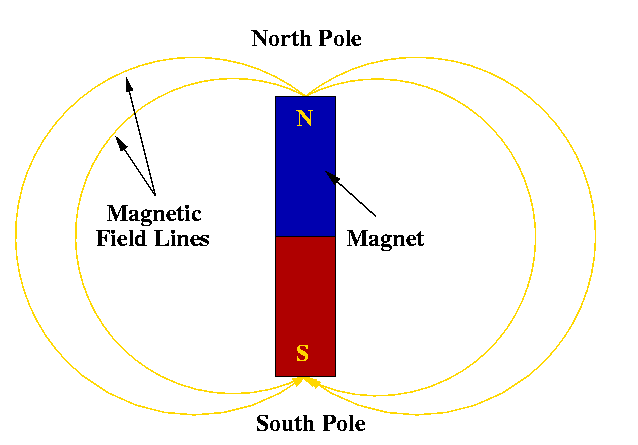
- The magnetic poles exert forces on each other.
- Like poles repel each other, i.e., a north pole will repel another north pole or a south pole will repel another south pole.
- Unlike poles attract each other, i.e., a south pole will attract a north pole and vice versa.
(b) The Magnetic Field of Earth
- Earth behaves as a huge magnet (or a giant solenoid). The source of this huge magnetism is given as the molten charged metallic fluid giving rise to a current flowing inside the core of the earth. This core has a radius of about 3500 km (Earth's radius is 6400 km).
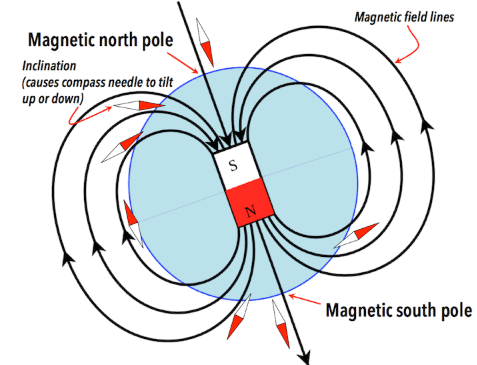 Earth's Magnetic Field
- Its strength is of the order of one gauss. The shape of the earth's magnetic field resembles with that of a bar magnet of length one-fifth of earth's diameter buried at its centre.
- It is believed that earth's magnetism is due to the magnetic effect of current, which is flowing in the molten core at the centre of the earth. Hence, the earth is a huge electromagnet.
Magnetic Field and Magnetic Field Lines (Magnetic Lines of force)
(a) Magnetic Field
- It is the space around a magnetic pole or a magnet in which another magnetic pole or magnet experiences its effect.
- The magnetic field is a quantity which has both direction and magnitude.
(b) Magnetic Field Lines (Magnetic Lines of Force)
- A magnetic line of force is a line, straight or curved, in the magnetic field tangent to which at any point gives the direction of the magnetic field at that point.
Or
A line such that the tangent at any point on it gives the direction of the magnetic field at that point is called a magnetic field or magnetic line of force. - A free unit north pole (test pole) will move along the magnetic line of force in the direction of the field if it is free to do so.
- The direction of the magnetic line of force at any point in the direction of the force acting on the unit (north) pole (unit magnetic pole) when placed at that point.
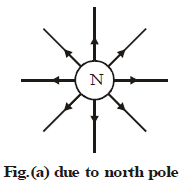
- Since a free unit north pole (test pole) will move away from a north (N) pole, magnetic lines of force have outward direction [Fig. (a)].
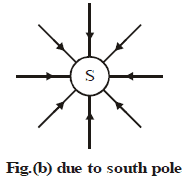
- Since the free unit north pole will move towards a south (S) pole, magnetic lines of force have inward direction [Fig. (b)].
- When moved along the line of force, a small magnetic compass always sets itself parallel to the line of force.
(c) Properties of Magnetic lines of forces
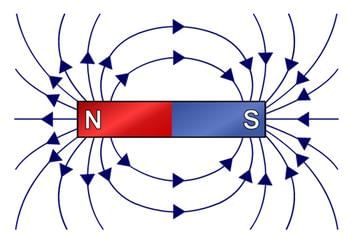
- All field lines are closed curves. They come out of the magnet from the side of the north pole and go into it on the side of the south pole. i.e. they start from a north (positive) pole and end at a south (negative) pole. They continue inside the magnet too. Inside the magnet, the direction of field lines is from its south pole to its north pole.
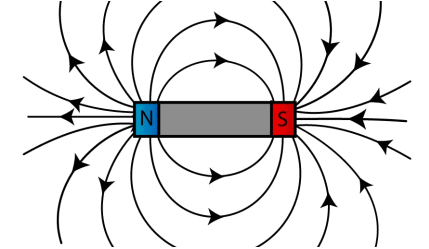 Magnetic Field Lines Around a Bar Magnet
 - They are always normal to the surface of the magnet at every point.
- Two lines of force do not intersect each other. If they intersect at a point, it would mean that the compass needle placed at the point of intersection would point towards two directions at that point which is not possible.
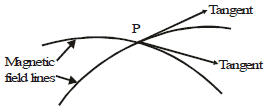
- The field lines are close together near the poles and spread out away from them. The field is stronger where the field lines are more closely spaced. So the field is stronger near the poles than at other points.
- The number of magnetic lines of force passing normally per unit area about a point gives the intensity of the magnetic field at that point.
Try yourself: Inside the magnet, the field lines moves
Magnetic Field Due to a Current-Carrying Conductor
- Oersted (1820) was the first to discover the magnetic effect of current.
- He found that if a compass needle is placed near a current-carrying wire, a needle gets deflected. He said that a compass needle is a tiny magnet and can be deflected only by some other magnetic field, hence a current-carrying wire produces some magnetic field around itself.
- Magnetic effect of current is also known as electromagnetism. Magnetic effect of current is very useful in electric motors, generators, telephone etc.
The experimental arrangement used by Oersted is shown in Fig: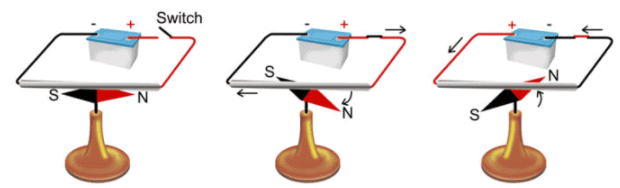
- A straight wire is connected to a battery and switch. The wire is held horizontally north-south over a magnetic needle.
- In this arrangement, when the key is closed, current flows in the wire in the direction, as shown in fig. The north pole of the needle gets deflected towards west. When the key is taken out, and current in the wire becomes zero, the needle returns to its initial position (S - N). This shows that a magnetic field is associated with an electric current.
- When the direction of current in the wire is reversed, the direction of deflection of the needle also gets reversed. If the direction of current is kept the same and the wire is put under the needle then, the direction of deflection of the needle again gets reversed.
- Amount of deflection depends on the distance of the needle from the current-carrying wire.
- But we know that a magnetic needle is deflected by a magnetic field only. Hence we can conclude that current flowing in a wire gives rise to some magnetic field around it.
- Position of the wire (conductor) carrying the current, direction of current and direction of deflection of the needle can be related by SNOW rule given below.
Note: If current flows in the conductor from South towards North, with conductor, kept over the needle, then North pole of the needle will be deflected towards West.
(a) Magnetic Field Due to Current through a Straight Conductor (Wire)
- When the current-carrying conductor is Straight, Magnetic Field is Circular. It means that when the current flows in a straight wire, the magnetic field produced has circular lines of force surrounding the wire, having their centres at the wire, as shown in the figure given below.
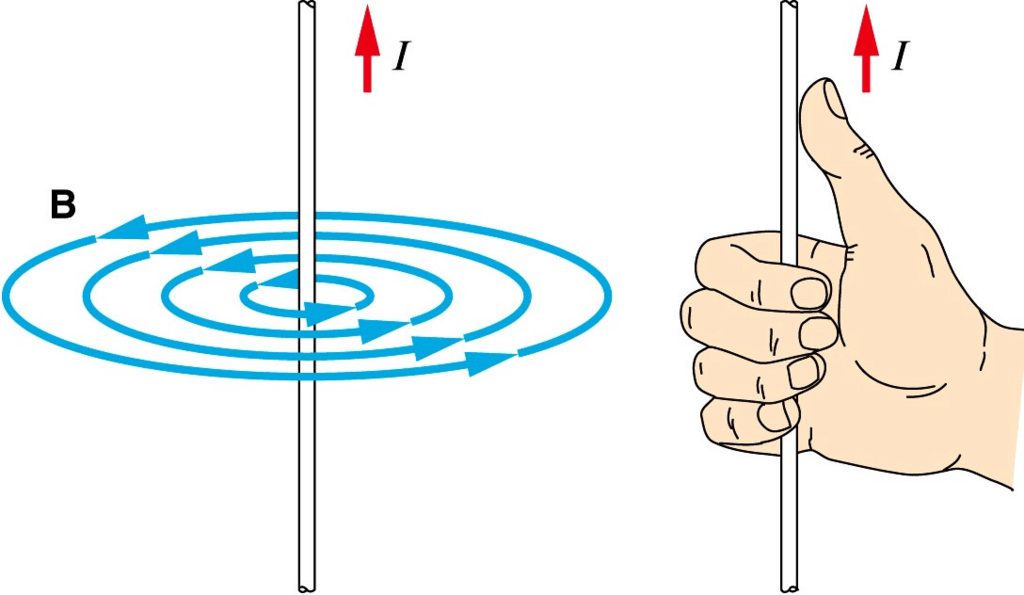
- This can be shown by sprinkling iron filings on the cardboard in the figure below.
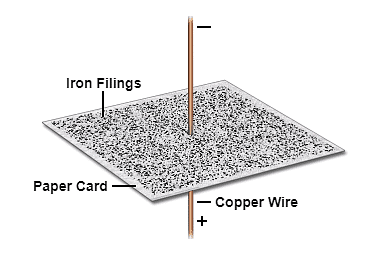
- When current flows through the conductor, iron filings get magnetised and now if the cardboard C is tapped gently iron filings arrange themselves in circles around the wire, the same is shown in the figure below.
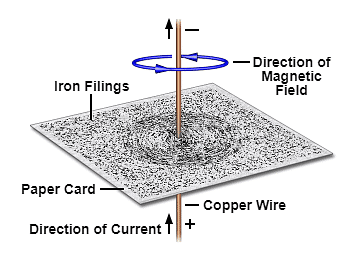
- Hence we can say that magnetic lines of force around a straight current-carrying conductor are circular. The plane of circular lines is perpendicular to the length of the wire. Arrows mark their direction.
- When current I flows through a straight wire, the magnetic field strength (B) at a small distance r from it is given by:

- From the above expression, we see that magnitude of the magnetic field produced by a straight current-carrying wire at a given point is:
(i) Directly proportional to the quantity of current flowing through the wire.
(ii) Inversely proportional to the distance of that point from the wire. Thus, if the current is more, the magnetic field will be stronger and vice versa. - The direction of Magnetic Field: The direction of the magnetic lines of force is related to the direction of the current by the right-hand thumb rule.
- This rule states that:
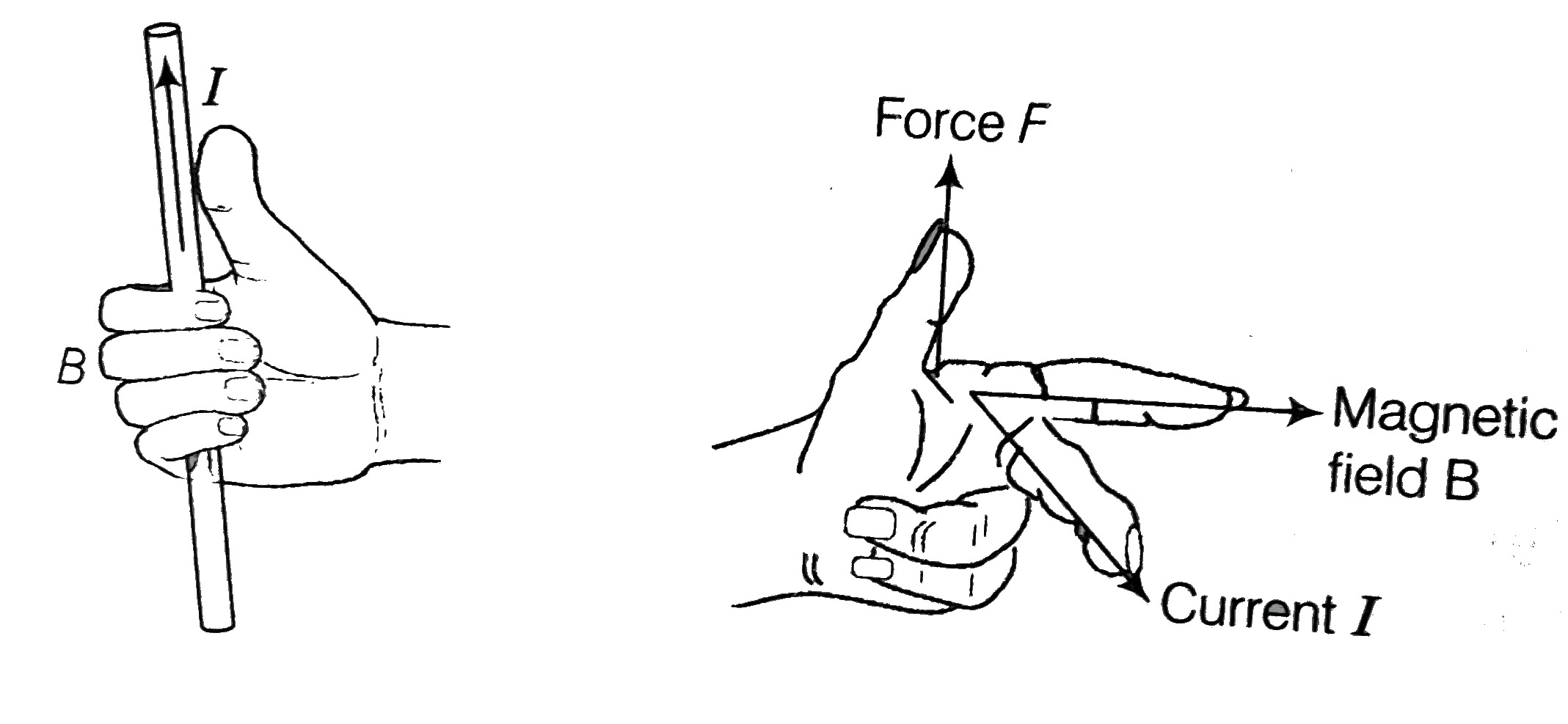
Curl the four fingers of the right hand on the palm, keeping the thumb stretched out at right angles. The thumb is straight, and the fingers are circular, then:
(i) If thumb represents the direction of the current in the straight wire, then curling of fingers represents the direction of the circular magnetic lines of force. (Fig. (a))
(ii) If curled fingers represent the direction of the current in the circular wire, then thumb represents the direction of the straight magnetic lines of force. (Fig. (b))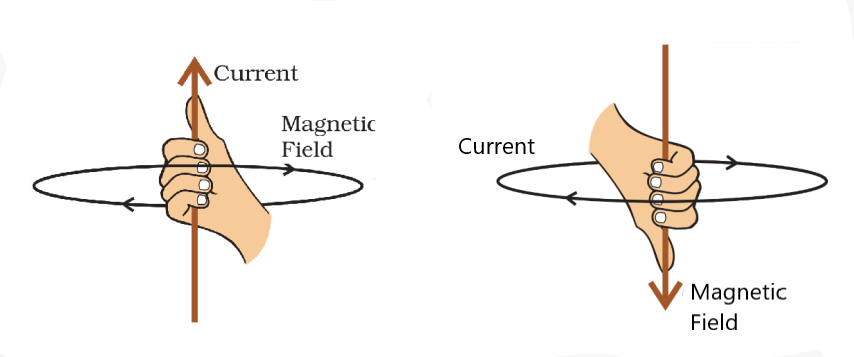 (a) and (b) Right Hand Thumb Rule for Direction of Magnetic Field
 - Maxwell's right-hand thumb rule is also known as Maxwell corkscrew rule. Corkscrew is a device consisting of a handle and a spiral metal rod, as shown in fig.(c).
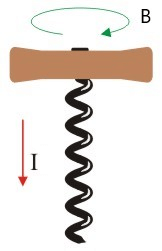 (c) Cork Screw
 - When the corkscrew is moved in the direction of the current, then the direction in which its handle is turned gives us the magnetic field direction. In short, we can say that when current flows vertically upward, then the direction of the magnetic field produced is anticlockwise and when current flows vertically downward, then the direction of the magnetic field is clockwise.
Try yourself: The pattern of the magnetic field produced by the straight current carrying conducting wire is
(b) Right-Hand Thumb Rule
Imagine that you are holding a current-carrying straight conductor in your right hand such that the thumb points towards the direction of current. Then your fingers will wrap around the conductor in the direction of the field lines of the magnetic field. This is known as the right-hand thumb rule. This rule is also called Maxwell's corkscrew rule. If we consider ourselves driving a corkscrew in the direction of the current, then the direction of the rotation of corkscrew is the direction of the magnetic field.
(c) Magnetic Field Due to Current through a Circular Loop
- When Current is Circular, Magnetic Field is Straight.
- When the current flows in a circular wire (coil), the magnetic field produced has straight lines of force near the centre of the coil, as shown in Fig. The parallel lines are in a plane perpendicular to the plane of the coil. The arrows mark their direction.
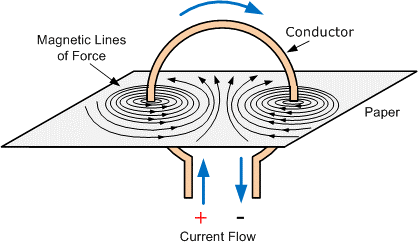 Current Circular, Magnetic Field is Straight
 - Straight lines at the middle of the coil are due to the fact that the magnetic lines of force surround each small segment of the circular coil.
- At the centre of the coil, all lines of force add to each other resulting in the increase in strength.
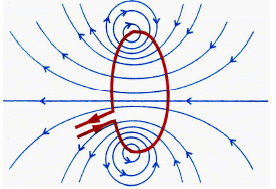 Magnetic Lines of Force around a Circular Coil
 - It is found that the magnitude of the magnetic field (B) at the centre of a circular coil carrying currents is directly proportional to the amount of current flowing through the wire (I), inversely proportional to the radius of the coil (r) and directly proportional to the number of turns in the coil.
Mathematically:

- Here, n is the number of turns of the coil.
(d) Magnetic Field Due to Current in a Solenoid
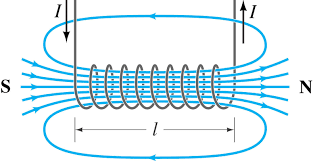
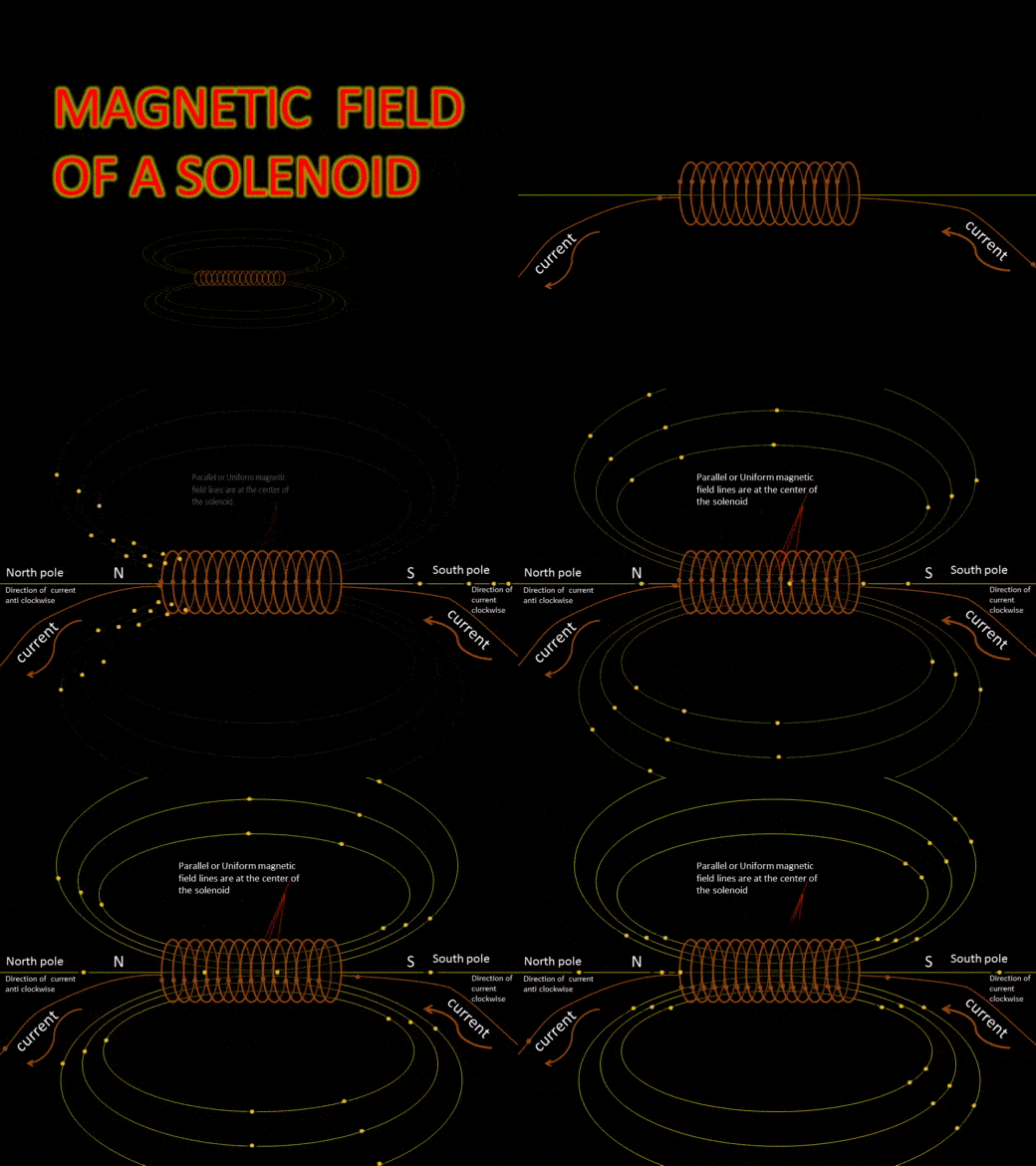
- A coil of many turns of wire wrapped in the shape of a cylinder is called a solenoid, i.e., a solenoid is a long cylindrical coil wound over a hollow cylinder (non-conducting). It is shown in Fig.(a).
- A solenoid differs from a circular coil in that the length of the solenoid is much greater than its diameter.
- A solenoid behaves as if a large number of coils have been put one behind the other on the same axis over a length, i.e., the magnetic field produced by a current-carrying solenoid is similar to the magnetic field produced by a bar magnet. Current in solenoid produces a magnetic field in each turn, which becomes additive.
- The polarity of the magnetic field exists only at the ends of the solenoid, as shown in Fig.(a).
- One end of the coil acts as a north pole while the other end acts as a south pole.
- Inside the solenoid, the magnetic field is uniform (same at all points). It is represented by parallel and straight field lines. Magnetic field outside the solenoid is non-uniform.
 Magnetic Field Lines around a Solenoid
 - Magnetic lines of force inside the solenoid are from south pole to north pole, while outside the solenoid these lines are from north pole to south pole.
- The rule for Polarity at the ends: If at any end, the current in the coil (or loop) is clockwise, the face of the coil towards the observer behaves as a south pole. [Fig. (b)]
- If the current in the coil is anticlockwise at any end, the face of the coil towards the observer behaves as a north pole. [Fig. (c)].
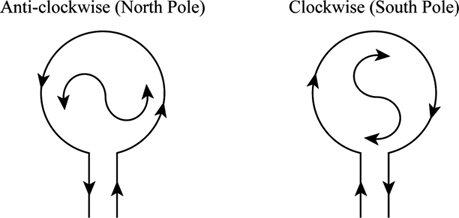 (b) & (c) Direction of Current in Loop
 - Fig. (d) shows the magnetic field around a current-carrying solenoid.
Magnetic field intensity B depends upon the following factors:
(i) Number of turns per unit length (n) of the solenoid and B ∝ n
(ii) Strength of the current (I) in the solenoid and B ∝ I
(iii) Nature (relative permeability, μr ) of the core material of the solenoid.
B ∝ μr or B ∝ μr nI or
B = μ0μrnI
Where μ0 represents the permeability of free space.
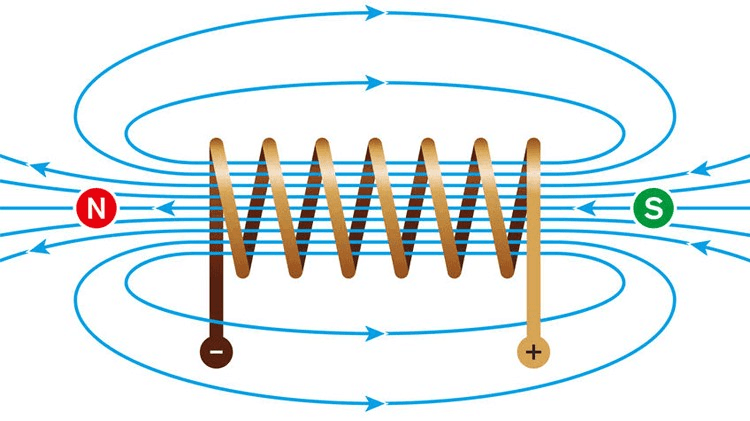 (d) Magnetic Field around a Solenoid: The Field is Straight inside it.
Note: Permeability is a magnetic property of material related to magnetism.
Ques: How are the fields of a current-carrying solenoid and coil different?
Sol: The field inside a current-carrying solenoid is quite uniform for the most part. It only decreases near the ends. The field of a current-carrying coil is not uniform. It changes with distance from the centre.
Try yourself: The factors on which one magnetic field strength produced by current carrying solenoids depends are
Introduction
When an electric current flows through a conductor, it creates a magnetic field around it. This magnetic field can exert a force on a nearby magnet. A French scientist named Andre Marie Ampere proposed that the magnet also exerts an equal and opposite force on the current-carrying conductor.
Force on a current-carrying conductor in a magnetic field
Demonstrating the Force on a Current-Carrying Conductor
To illustrate the force exerted on a current-carrying conductor by a magnetic field, let's consider the following activity:
Materials Needed:
- A small aluminium rod (about 5 cm long)
- Two connecting wires
- A strong horse-shoe magnet
- A battery
- A key
- A rheostat
Procedure:
1. Suspend the aluminium rod horizontally using the connecting wires, as shown in the diagram.
2. Place the horse-shoe magnet with the rod positioned between the two poles, ensuring the magnetic field is directed upwards. This can be achieved by placing the north pole of the magnet vertically below the rod and the south pole vertically above it.
3. Connect the aluminium rod in series with the battery, key, and rheostat.
4. Pass a current through the aluminium rod from end B to end A.
5. Observe the direction of displacement of the rod.
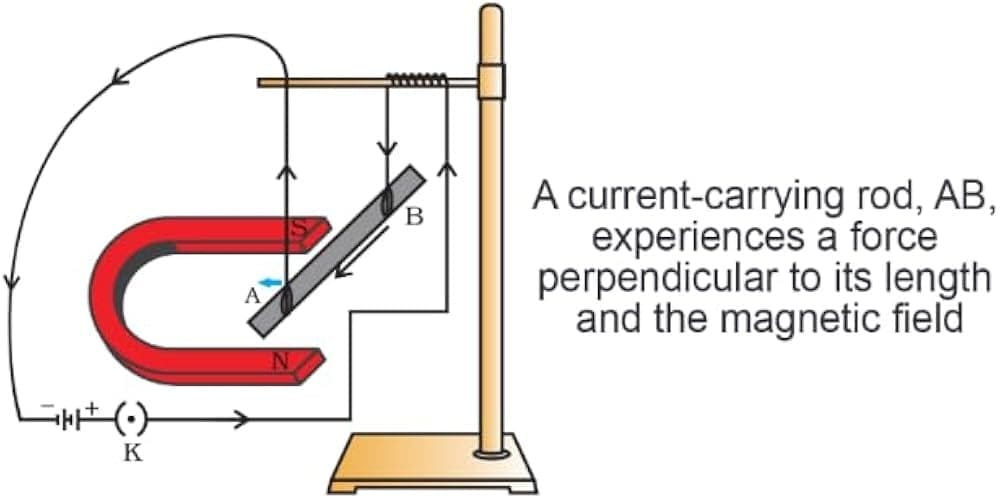
Observations:
- When current flows through the aluminium rod from end B to end A, the rod gets displaced towards the left.
- When the direction of current is reversed (from end A to end B), the rod is displaced towards the right.
Explanation:
- The displacement of the rod indicates that a force is exerted on the current-carrying aluminium rod when it is placed in a magnetic field.
- The direction of the force is reversed when the direction of current through the conductor is reversed.
- When the direction of the magnetic field is changed to vertically downwards (by swapping the poles of the magnet), the direction of force on the current-carrying rod also reverses.
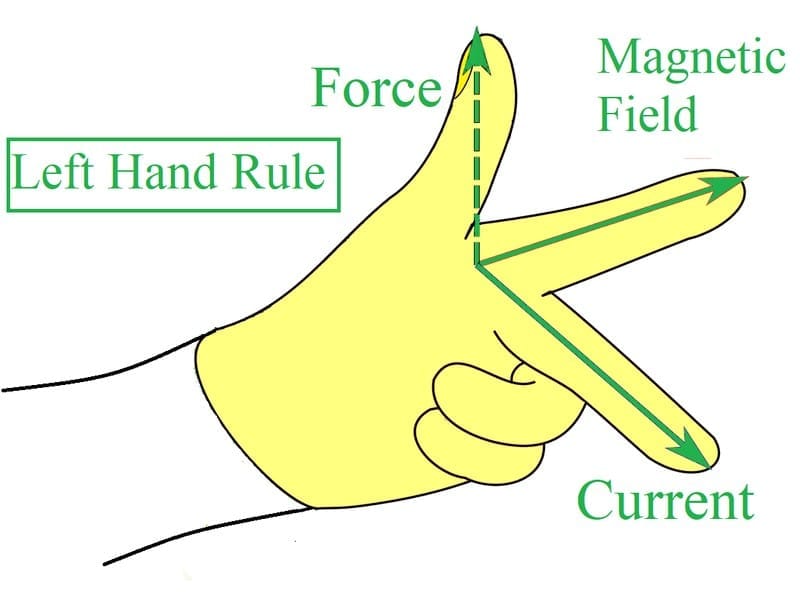
Fleming's Left-Hand Rule
Understanding the Direction of Force on a Conductor
- The displacement of the rod is maximum when the direction of the current is at right angles to the direction of the magnetic field.
- This phenomenon can be explained using Fleming's left-hand rule. According to this rule, if you stretch the thumb, forefinger, and middle finger of your left hand so that they are mutually perpendicular,
- and if the first finger points in the direction of the magnetic field and the second finger points in the direction of the current, then the thumb will point in the direction of the motion or the force acting on the conductor.
Applications of Current-Carrying Conductors and Magnetic Fields
- Devices such as electric motors, electric generators, loudspeakers, microphones, and measuring instruments utilize the principle of current-carrying conductors and magnetic fields to function effectively.
Magnetism in Medicine
Magnetism also has important applications in the field of medicine.
- Electric Currents and Magnetic Fields in the Body: When an electric current flows through a conductor, it generates a magnetic field around it. This principle holds true even for weak ion currents that travel along the nerve cells in our body. These ion currents produce weak magnetic fields, which are about one-billionth the strength of the Earth's magnetic field.
- Role of Nerves and Muscles: When we touch something, our nerves transmit an electric impulse to the muscles that need to be activated. This electric impulse creates a temporary magnetic field. Although these magnetic fields are weak, they play a role in the overall functioning of our body.
- Magnetic Fields in the Heart and Brain: The heart and brain are two organs in the human body where the magnetic fields generated are more significant. The magnetic field produced inside the body forms the basis for a medical imaging technique called Magnetic Resonance Imaging (MRI). MRI is used to obtain images of different body parts for diagnostic purposes.
- Magnetic Resonance Imaging (MRI): MRI is a non-invasive imaging technique that uses strong magnetic fields and radio waves to create detailed images of the organs and tissues inside the body. The magnetic field produced by the body, along with the external magnetic field used in MRI, helps in generating these images.
- Diagnostic Applications: The images obtained through MRI are analyzed by medical professionals to diagnose various medical conditions and diseases. MRI is particularly useful for imaging soft tissues, such as the brain, spinal cord, joints, and internal organs.
Conclusion: Magnetism plays a crucial role in both the functioning of our body and in medical diagnostics. The ability to generate and detect weak magnetic fields is utilized in various applications, including MRI, to aid in the diagnosis and treatment of medical conditions.
Domestic Electric Circuits
Introduction:
- Electric power is supplied to our homes through a main supply, which can be either overhead electric poles or underground cables.
- The supply consists of two wires: the live wire (usually with red insulation) and the neutral wire (usually with black insulation). In our country, the potential difference between these two wires is 220 V.
Meter-Board and Circuit Distribution:
- At the meter-board in the house, the live and neutral wires pass through an electricity meter and a main fuse before being connected to line wires in the house.
- These line wires distribute electricity to separate circuits within the house.
Circuit Types:
- There are typically two separate circuits in a household:
- 15 A Circuit: Used for appliances with higher power ratings, such as geysers and air coolers.
- 5 A Circuit: Used for lower power appliances like bulbs and fans.
Earth Wire and Safety:
- The earth wire, which has green insulation, is connected to a metal plate deep in the ground near the house. This serves as a safety measure, especially for appliances with metallic bodies, such as electric presses, toasters, table fans, and refrigerators.
- The metallic body of these appliances is connected to the earth wire, creating a low-resistance path for any leakage current. This ensures that the potential of the metallic body remains the same as that of the earth, preventing severe electric shocks to users.
Schematic Diagram:
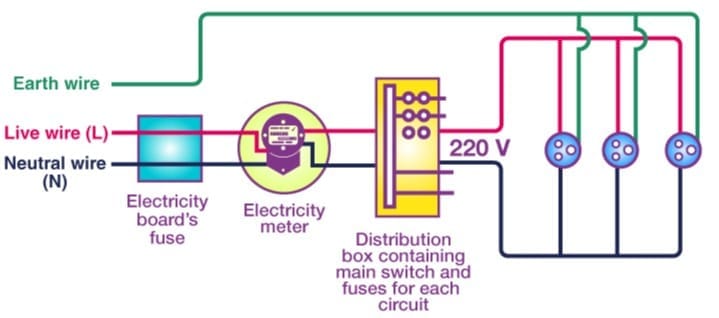
The schematic diagram of a common domestic circuit shows how different appliances are connected across the live and neutral wires. Each appliance has a separate switch to control the flow of current.
Electric Fuse:
- An electric fuse is an important component of all domestic circuits. It prevents damage to appliances and the circuit due to overloading.
- Overloading can occur when the live wire and neutral wire come into direct contact, leading to a sudden increase in current, known as short-circuiting.
- The fuse melts due to the Joule heating effect, breaking the circuit and stopping the flow of excessive electric current.
- Overloading can also happen due to an accidental increase in supply voltage or by connecting too many appliances to a single socket.
FAQs on Magnetic Effects of Electric Current
| 1. What is the magnetic field due to electric current? |  |
| 2. How is the magnetic field of a current-carrying conductor determined? | |
| 3. What is an electromagnet? | |
| 4. What is a solenoid? | |
| 5. How do magnetic field lines help in understanding the magnetic field? | |





