Sexual Reproduction in Flowering Plants, Chapter Notes, Class 12, Biology, Part -2

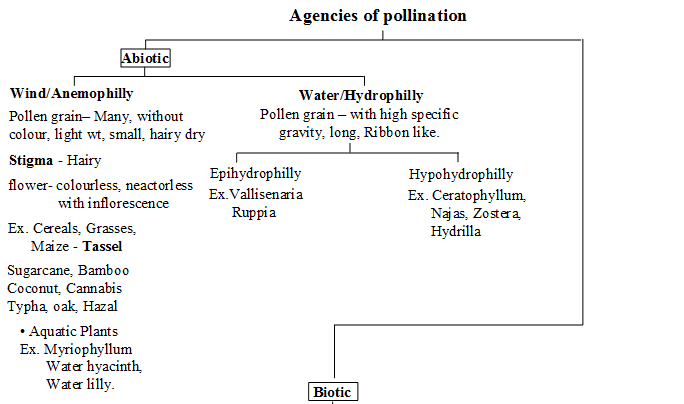
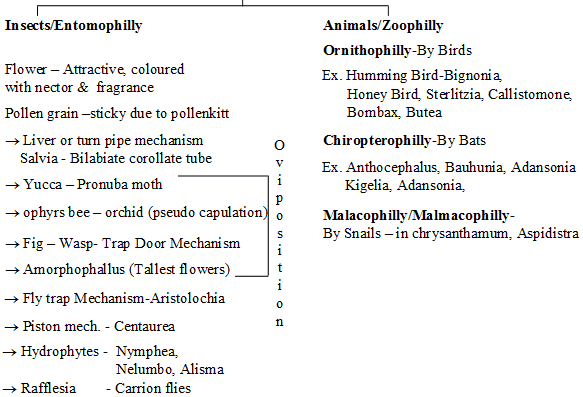
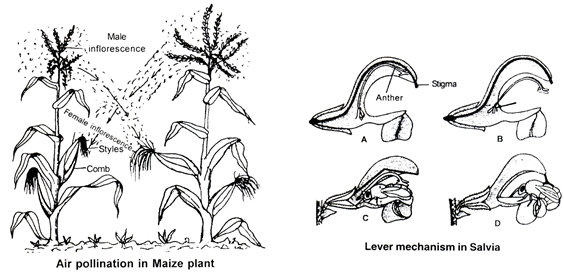
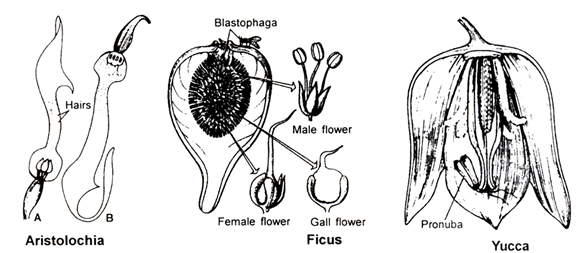
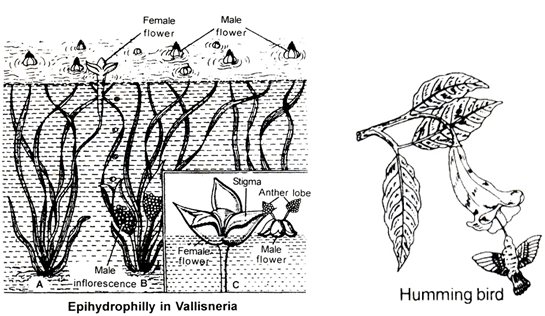
METHODS OF CROSS POLLINATION
FERTILIZATION
The fusion of male gamete with female gamete is called fertilization. First of all fertilization
was discovered by Strasburger (1884) in Monotrapa plant. This process is completed in the following steps -
GERMINATION OF POLLEN GRAINS :
After pollination, pollen grains germinate on the stigma. They absorb moisture and sugar contents from stigma and swell up. The intine of pollen grain grows out through the any one germinal pore of exine, in the form of tube like out growth is called pollen tube. One pollen tube develops in Capsella and most of Angiospems is called monosiphonous condition, but more than one pollen tubes develops in Malvaceae and Cucurbitaceae family. It is called polysiphonous.
When the pollen tube comes down from the stigma into the style, first of generative cell, into the pollen tube then it is followed by vegetative nucleus. Mean while, the generative cell divide mitotically to form two male gametes. Both of the male gametes are non motile.
Boron element and calcium ions (mainly Boron) are essential for the growth of pollen tube and best temperature for growth of pollen tube is 20 – 30ºC. Pollen tube shows apical growth and chemotropic movement.
ENTRY OF POLLEN TUBE INTO OVULE :
Finally, then pollen tube enters in the ovary at that time, ovule becomes mature. Inside the ovule obturators guides the passage of pollen tube towards the micropyle in some Angiosperms. A mature ovule in which embryo sac also mature, has three paths for the entry of pollen tube.
Porogamy – In this, pollen tube enters into the ovule through the micropyle. It is known as porogamy. It is found in most of Angiosperms [Capsella].
Chalazogamy – In this method, the pollen tube enter into the ovule through the chalaza. This method discovered in Casuarina by Treub [1891] Example – Betula and Juglans (walnut).
Mesogamy – In this method, pollen tube enter into the ovule either through integuments – Curcurbita or through the funiculus – Pistacia and Populus.
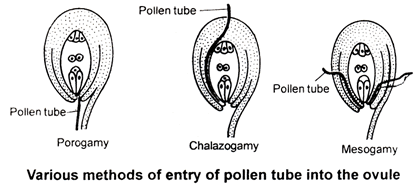
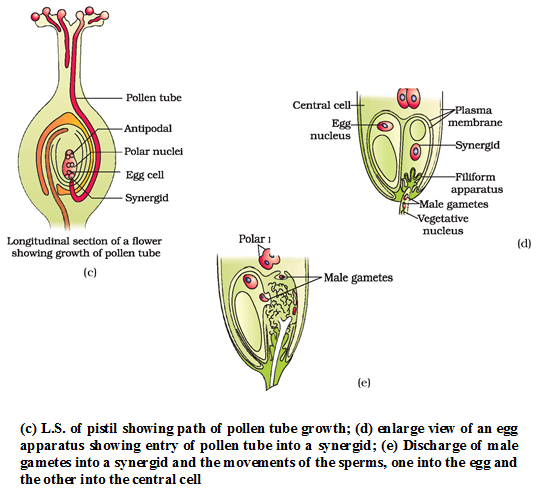
Pollen tube can enter into the ovule thorough the any passage but inside embryo sac, only enter through the egg apparatus. After the entrance inside the ovule, it grows towards the egg apparatus because synergids cells secrete the chemical (hormones) which attracts the growth of pollen tube. It means pollen tube shows chemotropic movement in ovule.
Any one synergid starts degenerating when the pollen tube comes near egg apparatus. The pollen tube enter into the embryo sac through the synergids, helped by filiform apparatus.
When tip of the pollen tube enters into the embryo sac vegetative nucleus degenerates. The tip of the pollen tube swells and burst [endosmosis] after reaching inside the embryo sac. The pollen tube release all contents including both male gametes inside the synergid which further degenerate and whole content come in central cell of embryo sac.
Two dark granules appears in the region of degenerating synergids. These are known as X-bodies. They are two in no. and both X-bodies are formed by the degenerating nucleus of tube cell and synergids.
FUSION OF GAMETES :
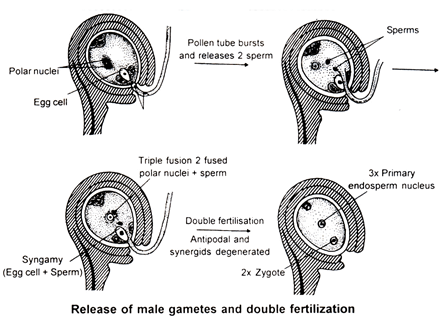
Before or after the entrance of pollen tube into the embryo sac, both polar nuclei of the central cell fused together to form a diploid nucleus. It is known as secondary nucleus or definitive nucleus.
Out of two, one male gamete fertilized with egg cell and to form a diploid zygote. This fusion is known as syngamy. This is true mechanism of fertilization process.
The second male gamete fused with diploid secondary nucleus which is formed by the fusion of two polar nuclei. This fusion is known as triple fusion resulting, a triploid (3n) structure is formed. It is called primary endosperm nucleus.
Fertilization takes place twice at a time in Angiosperm is called double fertilization.
Double fertilization was discovered by Nawaschin in Lillium and Fritillaria plants.
Double fertilization and triple fusion is the specific or universal characteristic of Angiosperm. There are five nuclei (2 polar nuclei, 1 egg nuclei, 2 male gametes) and three gametes (2 male gametes, one egg cell) participate in double fertilization.
A zygote is formed by true fertilization (syngamy) develops into embryo. Triploid primary endosperm nucleus is formed by triple fusion develops into the endosperm which is used as nutrition for growing embryo.
All the remaining cells of embryo sac like antipodal cells, synergids degenerate excluding zygote and primary endosperm nucleus after the fertilization. At this time, zygote obtains food from degenerating synergids and antipodal cells.
The fertilization in which non motile gametes are carried to female gamete through pollen tube is known as Siphonogamy.
Entry of more than one pollen tube into the ovule leading to occurrence of supernumerary male gametes is called Polyspermy.
DEVELOPMENT OF ENDOSPERM
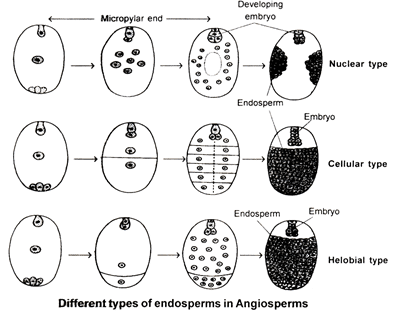
First of all endosperm develops from the primary endosperm nucleus after the fertilization which store food materials. It is utilizes by the embryo during the early development and at the time of seed germination. Food is present in the form of starch in endosperm. The endosperm is of three types on the basis of development:-
NUCLEAR ENDOSPERM :
This type of endosperm mostly found in Dicotyledon [Polypetalae]. Nuclear endosperm is also present in Capsella.
Such type of endosperm develops by free nuclear divisions of nucleus of primary endosperm nucleus, resulting multinucleated endosperm is formed. Later on cytokinesis takes place, so that multicellular endosperm is formed.
This type of endosperm is the most common in Angiosperms.
The milky fluid is found in green Coconut is example of nuclear endosperm, which is called liquid syncytium.
In Melastoma, cytokinesis never take place so that it is always remains nuclear endosperm
CELLULAR ENDOSPERM :
This type of endosperm is found in Gamopetalae group. During the development, each division of primary endosperm nucleus is followed by cytokinesis. So that endosperm remains cellular from the beginning.
HELOBIAL ENDOSPERM :
During the development of this type of endosperm, first division of primary endosperm nucleus is followed by unequal cytokinesis so that two unequal sized cells are formed (Cell towards the micropyle is large). Now free nuclear division takes place in each cells, results it becomes multinucleated. Eventually cytokinesis takes place at a time so that is changed into a cellular endosperm. This type of endosperm is found in Monocots. It is intermediate type of endosperm.
Food supply to developing embryo as embryo sac has very little stored food. So zygote developes into embryo after the proper development of endosperm in most of angiosperms
Young endosperm is rich in auxins, Gibberellins and cytokinins. Zeatin is obtained from maize endosperm. Auxin-B is also obtained from maize endosperm.
In mature or germinating seeds the reserve food of endosperm is utilized till the development of photosynthetic tissue.
Aleurone layer :
In cereals one or few outer most layers of endosperm become highly specialized morphologically as well as physiologically and form aleuron tissue. It is characterized by thick wall and non vacouled cytoplasm.
The cells have aleuron granules or grains which are rich in protein and spherosomes and glyoxysomes. Aleuron grains have protein, phospholipids and some carbohydrates.
During seed germination the reserve food in endosperm cells is digested by activity of hydrolytic enzymes like protease, amylase which are secreted by aleuron cells.
Gibberellin induce the synthesis or denovo synthesis of these enzymes in aleuron cells.
After the observation of first two division of primary endosperm nucleus, endosperm can be identified whether it would be nuclear, or cellular endosperm.
Endosperm is absent in some of Angiosperms e.g. in Orchidaceae, Podostemaceae and Trapaceae.
Exceptionally, some of the plants have diploid endosperm instead of triploid such as in Oenothera.
Maize and Tomato have mosaic endosperm in which patches of different colours are present.
The endosperm in Betel nut is rough surfaced. It is known as ruminate endosperm.
The drinking portion is nuclear endosperm and edible portion is cellular endosperm in Coconut.
DEVELOPMENT OF EMBRYO IN DICOT
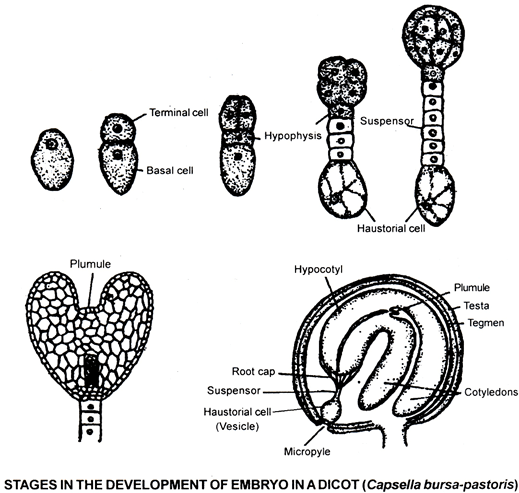
Development of embryo in Capsella is first time discovered by Hanstein
In Angiosperm, Zygote undergoes in resting phase. When the endosperm is formed, development of zygote starts. In the beginning it absorb food from the endosrperm and increase in size then after a layer sectreted by itself. Now it is called Oospore.
The first division of Oospore is transverse, results two cells are formed. The one cell lies towards micropyle is called basal cell or suspensor cell. The other cell is formed towards the Chalaza is called apical cell or terminal cell or embryonal cell.
The basal cell and embryonal cell divide simultaneously.
The basal cell divides transversly and apical cell divides vertically resulting, two suspensor cells and two embryonal cell are formed. This stage is made up of four cells which are arranged in 'T' Shape structure. Embryonal cells divided vertically to form four Embryonal cells. This is the quadrant state of embryo.
The two suspensor cells divided by the transverse divisions forming a 6-10 celled long filament like structurecalled suspensor. The main function of suspensor is to push the developing embryo into food laden endosperm to provide nutrition.
The micropyler cell of the suspensor swells up. This cell of suspensor is known as haustorial-cell.
The cell of suspensor lies near the embryonal cells is called hypophysis. This cell combined with radicle to form the apex of root [Root cap].
This four cell quadrent embryo further divide transversely to produce eight cells. The eight celled stage of embryo is called octant stage. The eight cells of octant are arranged in two tiers.
The four cells of the octant embryo lies near the hypophysis is known as hypobasal cells and four cells present towards the chalaza termed epibasal cells.
The hypobasal cells give rise to radicle and hypocotyl and epibasal cells give rise to two cotyledons and plumule of the embryo.
All the cells of octant divided by periclinal division so that a 16 cells globular embryo is formed [Proembryo].
Due to fast division of embryonal cells of globular embryo, a heart shaped embryo is formed. All the cells of this embryo are meristematic.
Due to the fast growth in two lobes of heart shaped embryo, they develop into two cotyledons. Both the growing cotyledons turn in downwards due to the curved position of body of ovule of Capsella.
The tissues are present below the joining place of both the cotyledons are responsible to form plumule and behind it epicotyl is formed.
The tissues present opposite to the plumule near the hypophysis give rise to radicle. The apex root [root cap] is formed by hypophysis.
This curved position of the embryo is called Torpedo or Chordate stage.
An axis is present between plumule and radicle is called embryonal axis. It is also called Tigellum [main embryonal axis]
Both the cotyledons are present at lateral position of embryonal axis and plumule is formed in terminal position in Dicotyledon embryo.
This type of development of embryo is know as Crucifer type or Onagrad type. It is the most common type of development in Dicots.
Crucifer type of development is also found in Capsella, so that it is considered as typical Angiosperm for the study of embryonic development of Angiosperms.
When embryo is formed, suspensor dries and degenerates so it is known as meroblastic development.
modified into seed in which testa is formed by outer integument and tegmen is formed by inner integument.
Only micropyle of ovule remains unchanged and also pesent in seed.
Entire ovary modified into fruit. This fruit is formed by frertilized ovary so that it is called true fruit.
In some of the angiosperm fruit is formed by ovary without fertilization know as parthenocarpic fruit.
In some fruit parthenocarpy is senseless (If edible part is endosperm or seed)
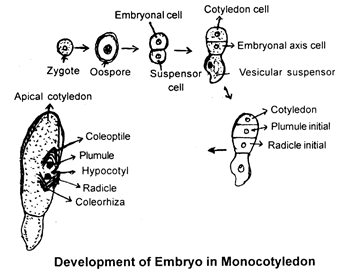
DEVELOPMENT OF EMBRYO IN MONOCOTYLEDON
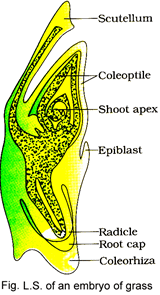
The Lilium type of embryonic development is found in monocotyledons. The first division is transverse division in oospore. Results two cells are formed the upper cell chalazal is called embryonal cell and lower micropylar cell is termed as basal cell. The basal cell does not divide further and later on it increases in size and form single celled vesicular suspensor.
Only embryonal cell divides transversly in which terminal cell is called cotyledon cell and lower (middle) cell is known as embryonal axis cell.
A transverse division takes place in embryonal axis cell to gives rise two cells.
The onecell out of two, gives rise to plumule initial and another gives rise to radicle initial.
The plumule initial divides to form the plumule of the embryo.
Radicle initial divide to form the radicle. In this both the initials are responsible to form embryo in lateral position.
An apical cotyledon is formed by the continuous division of cotyledon cell.
This apical cotyledon is known as Scutellum.
The plumule and radicle is covered by cap like hard protective structures. The covering of plumule is called coleoptile and covering of radicle is known as coleorhiza. These structure broken during the germination. The plumule lies in lateral position and cotyledon in terminal position in monocotyledons.
In angiosperm, development of embryo is meroblastic and endoscopic [towards the chalaza]
Summary of events that take place in an ovary, leading to formation of fruits and seeds
Ovary - Fruit
Ovary wall - Pericarp
Ovule - Seed
Funicle - Stalk of seed (may be left or broken)
Hilum - Hilum
Nucellus - Usually degenerates but in some cases persists in
the form of a thin layer called perisperm.

Micropyle - Micropyle
Embryo sac
Synergids - Degenerate
Egg cell (After Fertilization) - Oospore – Embryo
Antipodals - Degenerate
Secondary nucleus - Endosperm
(After fusing with male gamete) Nucleus – Endosperm
ASEXUAL REPRODUCTION
In asexual reproduction, the new individual are produced by any means other than the fusion of sex gametes. It means a reproduction in which new individuals are formed without meiotic division and fusion of gametes is called asexual reproduction. In this way asexual reproduction is also known as apomixis.
[Greek – Apo = without; mixis = mixing] Apomixis term suggested by Winkler.
The Apomixis is characterized by quick multiplication and reproduction of genetically similar plants from the single parent. Such a population produced from single individual is called clone and each member of the clone is called remet.
According to P. Maheshwari :
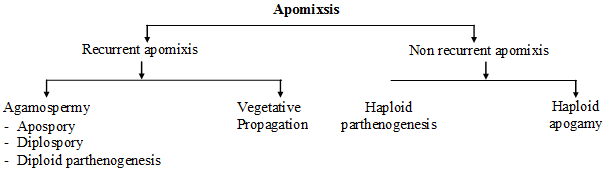
Agamospermy ⇒
In this type embryo is formed without fertilization and meiotic division is called agamospermy. It means plants belonging in this category propagated through seeds but the embryo formation does not involve meiosis and syngamy.
There are three different type of agamospermy -
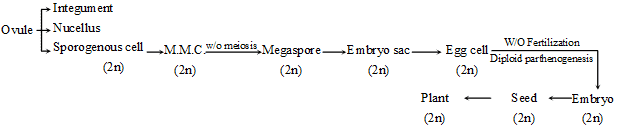
M.M.C → Megaspore Mother Cell
W/0 → Without

Diplospory ⇒
In this method archesporium differentiates to form a megaspore mother cell but this megaspore mother cell directly gives rise to an embryo sac without meiosis. This embryo sac is diploid and a diploid embryo is formed without fertilization from diploid egg of this embryo sac.
Ex. Parthenium, Taraxacum.
Diplospory is also known as diploid parthenogenesis.
Apospory ⇒ Ex. Heiracium, Ranunculus, Rubus.
It is discovered by Rosenberg in Heiarcium plant. In this method embryo sac or female gametophyte is directly formed from any diploid cell of the ovule (nucellus/integument) except megaspore mother cell without meiosis is known as apospory. In this gametophyte always remains diploid.

Adventive Embryony ⇒
In this method, an embryo is formed from any diploid cells (Nucellus or integuments) of the sporophyte. This diploid cell behave like a zygote and develop (No embryo sac formation) Adventive embry.
Ex. from Nucellus – Citrus, Mangifera, Opuntia, Mamillaria
from Integuments – Spiranthus australis.

Parthenogenesis : In this process haploid egg cell of female gametophyte is responsible to form a haploid embryo without fertilization.
Apogamy : In this process any haploid cell of female gametophyte except egg cell is responsible to form a haploid embryo without fertilization.
Parthenogenesis and Apogamy both are not included in agamospermy.
Note : If both gametophyte and sporophyte are diploid in Parthenogenesis and apogamy then it is called diploid Parthenogenesis and diploid apogamy.
POLYEMBRYONY
Many embryos are formed inside the single seed is called polyembryony. First of all, it is observed by Leeuwenhoek in Citrus (Orange) seeds. Polyembryony is commonly found in Gymnosperm but it is also found in some of Angiospermic plants such as Orange, Lemon and Nicotiana etc.
If polyembryony develops naturally then it is called spontaneous polyembryony [self], and if develops artificially is called induced polyembryony.
When many embryos are formed from separate-separate embryosacs [more than one] inside the ovule is called false or pseudo polyembryony.
When many embryos are formed inside the single embryo sac of the seed is called "true poly embryony". It is either develops from –
Clevage of Zygote or budding – e.g. Cymbidium, Exocarpus, Nymphaea, Nicotiana, Orchids etc.
By the fertilization of synergids – e.g. Anemone, Aristolochia, Sagittaria etc.
Fertilization of antipodal cells – e.g. Paspalum, Ulmus etc.
Note : In Lilium all three types of polyembryony are present.
Adventive embryony is also example of polyembryony in which additional number of embryos are formed from nucellus or integuments
ANDROGENIC HAPLOID PLANTS
This concept was given by Haberlandt and practically proved by Steward. It is based on totipotency.
Anther of the Datura plant grown on culture medium by Guha and Maheshwari. As a result of this culture, haploid and diploid two different type of plants are formed. Diploid plants developed from the wall of the anther and haploid plants developed from the pollen grains. Such type of haploid plants obtained from the tissue culture are known as androgenic plants.
Fast vegetative multiplication through the tissue culture from any part [cell or tissue] of the plant in the field of Agroforestry and Horticulture is called micropropagation.
P.Maheshwari established – Research centre of Angiosperm Embryology at Delhi University.
Book published by Maheshwari – An Introduction to the Embryology of Angiosperms.
Significance of Apomixis over hybrid seeds -
Generally hybrid seeds are utilized in cultivation of most of crops and vegetables. The hybrid seeds have to be produced every year. If the seeds collected from hybrid are sown, the plants in the progeny will segregate and do not maintain hybrid characters. The production of hybrid seeds is costly so cost of hybrid seeds is too expensive to farmers.
So if these hybrid made into apomicts, there is no segregation of characters in the hybrid progeny. Then the farmers can keep on using the hybrid seeds to raise new crop year after year and be does not have to buy hybrid seeds every year.
Because of the importance of apomixis in hybrid seed industry, active research is going on in many laboratories around the world to understand the genetics of apomixies and to transfer apomictic genes into hybrid varieties.
ANGIOSPERMIC SEED
STRUCTURE OF SEED
The miniature plant exists in a seed. Plant is the main base of whole living world. So it can be say that seed is the most important structure. In angiosperm, after the fertilization, fertilized egg cell changed into embryo, ovary changed into fruit and ovule change into seed.
Morphologically, fertilized ovule is known as seed. In other words, seed is a mature, integumented megasporangium.
Seed is characteristic of Spermatophytes (Gymnosperms and Angiosperms). Typical mature seed have three main parts : (i) Seed coat(ii) Embryo(iii) Cotyledon
SEED COAT :
Outer, protective covering of the seed is called seed coat, which develops from integuments of ovule. The seeds which develops from bitegmic ovule, there are two distinct layers in seed coat. The outer layer is thick, hard and leathery (developing from outer integument), called testa, whereas inner layer is thin and papery or membranous (developing from inner integument), called tegmen. In seeds developing from unitegmic ovule there is single layered seed coat.
The seed coat performs usual protective function.
The seed is attached to the fruit wall or pericarp by means of a stalk called funicle or funiculus. The point of attachment of funiculus to the body of mature seed is called hilum. A small opening or pore called micropyle is present just near the hilum, which is the way of entry of water into the seed. As most of the ovules in angiosperms are inverted or anatropous, so a ridge called raphe is also present is seed.
EMBRYO :
Embryo is the most important part of the seed, which represents mini or tiny future plant. The development of embryo occurs from fertilized egg [zygote].
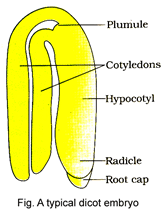
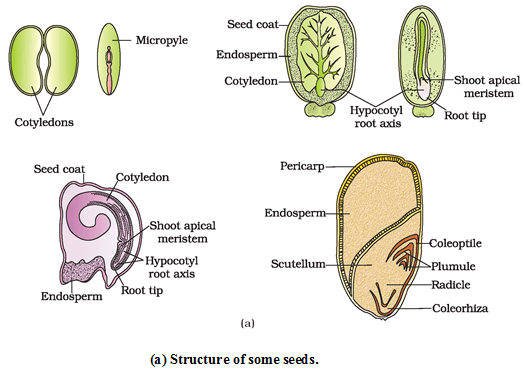
The embryo having an embryonal axis or main axis called tigellum, to which one or two cotyledons (seed leaves) are attached, depending upon whether the seed is monocot or dicot. The portion of embryonal axis or tigellum below the point of attachement of cotyledons, is called hypocotyl, which bears radicle or future root at its tip. Similarly, portion of embryonal axis or tigellum above the point of attachment of cotyledons, is called epicotyl, which bears plumule (future shoot) at its tip.
The scutellum is attached laterally to the embryonal axis. One end of the embryonal axis points towards the pointed end of the grain. It is called radicle. The radicle is covered by a protective sheath called coleorhiza. The other end of embryonal axis, which faces towards the broader end of the grain, is called plumule. The plumule is surrounded by a conical protective sheath, called coleoptile. The coleoptile is capable in growth and covers the growing shoot tip till it passes out through the soil during germination.
In Monocot embryo, there is a single cotyledon called scutellum. In some grasses like Wheat, on opposite side of scutellum is a tongue shaped outgrowth which represents the remains of second cotyledon is present called epiblast.
COTYLEDONS (SEED LEAVES) :
In some seeds (e.g. legumes), reserve food is stored in cotyledon, whereas in other (e.g. cereals), there is special nutritive tssue called endosperm. The seeds having endosperm are called endospermic or albuminous seed, e.g. Cereals, Castor etc., whereas seeds in which endosperm is fully consumed by embryo and no endosperm is left, are called non-endospermic or ex-albuminous seeds, e.g., Gram, Pea, Sem, Cucumber, Tamarind, etc. The reserve food material in seeds may be carbohydrate (e.g. Wheat, Rice) or proteins (legumes) or fats (Castor, peanut, Sunflower), etc.
Some time, some part of nucellus remains unused which is present in the form of thin layer around the endosperm is called perisperm e.g. Beet, Black pepper.
In Dicot albuminous seed-castor (Ricinus communis), there is a specific outgrowth called caruncle or strophiole, present over micryopyle. It is formed by proliferation of cells of outer integument at tip. Caruncle is somewhat spongy and helps in absorption of water during germination of seed.
On the basis of cotyledon in the seed the angiosperm are called Monocotyledon (monocot) [one cotyledon] and dicotytedons / Dicot [Two cotyledon].
The angiospermic seed are classified into two categories on the presence or absence of endosperm in seeds –
Non Endospermic or Ex-albuminous seed :
Such type of seeds do not have an endosperm at maturity, therefore are called non endospermic or Exalbuminous seeds. The endospermic tissues are absorbed during the development of embryo. The absorbed food materials from the endosperm is stored in cotyledons, thats why they become so large and fleshy e.g. Capsella and in most of dicotyledons. But Castor seed is endospermic.
Endospermic or Albuminous seed :
This type of seeds, food is stored in endosperm. Such seeds are called endospermic seed or albuminous seed. The endospermic tissue in these seeds utilize during the germination of seed and their cotyledons are thin and membranous e.g. most of Monocot seeds e.g. Wheat, Rice, and Maize etc. Castor [dicot] is also endospermic seed.
Endospermic dicot seeds : e.g., Castor, Papaya, Cotton.
Non-endospermic dicot seeds : e.g., Gram, Bean, Pea, cucumber, Tamarind.
Endospermic monocot seeds : e.g. Maize, Rice, Wheat and Coconut.
Non-endospermic monocot seeds : Pothos (money plant), Vallisneria, Alisma, Amorphophallus.
STRUCTURE OF SEED
GERMINATION OF SEED
The embryo of seed grows into a sporophyte plant. The radicle produces primary root. The plumule develops shoot and later on cotyledons degenerates.
Types of seed Germination :
Germination is basically of two types, depending upon behaviour of cotyledons but viviparous germination also found :
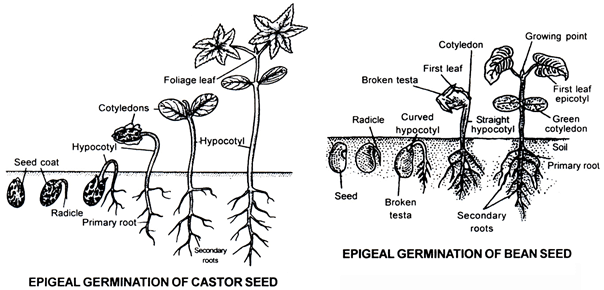
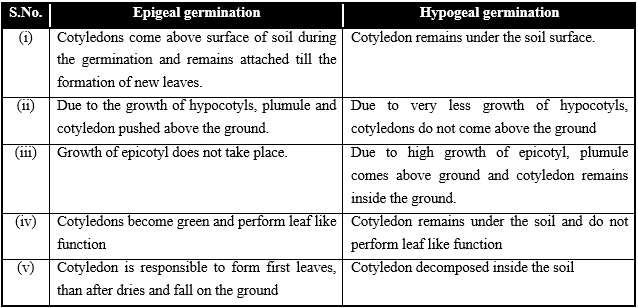
Epigel germination :
Here due to faster hypocotyl growth or elongation than epicotyl the cotyledons are pushed out of soil. This is called epigeal germination. This type of germination occurs in Cotton, Papaya, Castor, Onion, Cucurbits, Tamarind, French bean, mustard, etc. In some cases, these above ground cotyledons become green leaf like (cotyledonary leaves) and perform photosynthetic function till the seedling assumes independency (e.g., castor, cotton, onion, papaya, etc.). In other plants, cotyledons do not assume leaf like shape and fall off (e.g., French bean and Tamarind).
Hypogeal germination :
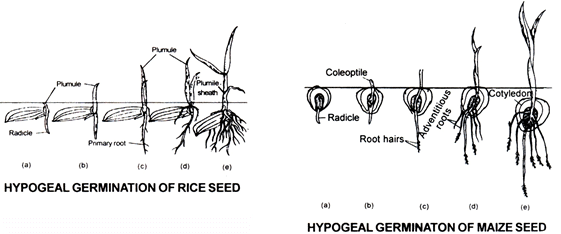
Here due to faster epicotyl elongation, than hypocotyl the plumule comes out of the ground and cotyledons remain underground. This is called hypogeal germination. This type of germination occurs in most of the monocotyledons and few dicotyledons, e.g., Maize, Rice, Wheat, Cocount, Gram, Pea, Peant and Mango, etc.
Vivipary :
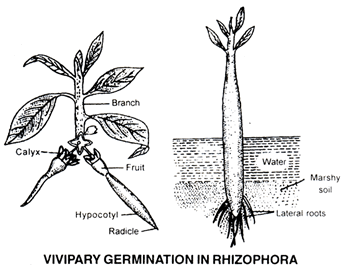
A special type of seed germination is characteristic of Mangrove vegetation, found in muddy, saline conditions, seed does not imbibe water as water potential is highly negative and O2 availability is low e.g., Rhizophora, Avicennia, Sonneratia, etc. Here there is no resting period of embryo and germination occurs inside the fruit, while it is attached to the parent plant, i.e., "In-situ germination". The seedling is separated in the mud with the help of lateral roots developing from basal end of radicle. This is called viviparous germination or vivipary.
Significances of seed :
In angiosperms the process of pollination and fertilization are independent of water. Seed formation is very important for plant dispersal.
Seeds posses better adaptive strategies for dispersal to new habitat and help in colonisation of these species in new areas.
Posses sufficient food so nourish the young seedling till the formation of photosynthetic tissues.
Hard seed coat provide protection to young embryo.
Seed is product of sexual reproduction & generate new genetic combination leading to variations
Seeds are basis of agriculture as dehydration and dormancy of mature seed are crusial for storage of seed which can be used throughout the year and also to raise crop in next year or season.
Vaibility of Seeds
Period of viability of seeds in angiosperms is variable. In some angiosperms seeds are viable only for few months.
In many species seeds are viable for years. In some species seeds are viable for hundreds of years.
In Lupine (Lupinus arcticus) excavated from Arctic Tundra, the seeds germinated and flowered after an estimated records of 10000 years of dormancy Date palm (phoenix dactylifera) seeds discovered during archeological excavation at king the Herod's palace near Dead Sea are 2000 year old viable seeds.
Lotus seeds are viable for 1,000 years.
FACTORS AFFECTING SEED GERMINATION
The process by which the dormant embryo wakes up [becomes active] and begins to grow is known as germination of seed. The seed germination takes place in the presence of favourable condition such as temperature, moisture, and air. This is a very delicated stage in the life of the plant. An minute change in the environment have harmful effect on growing embryo. So favourable environment should be essential for germination. The following factors are essential for germination of seed.
Moisture :
First step of seed germination is imbibition of water by seed surface.
The moisture or water is the most important factor for germination of seed. Generally, the cells of embryo contain about 10-15% water in the dormancy period. The vital activities like growth and development is unable to continue in this less amount of water. For active life processes, water must be present about 75-90%. The seed imbibe enter through water and swell up to increase in size before the germination. Water imbibe by seed coat and enter through microypyle. The following effects have been observed in seed due to imbibition of water -
The seed coat becomes soft and imbibed or adsorbed water reaches to the cells of embryo. When the ratio of water increases in the cells, the protoplasmic contents become more active.
The size of embryo increased due to water adsorption results, seed coat breaks up and radicle and plumule easily comes out. Seed coat imbibe water, it becomes soft and increase its permeability. Resulting it increases rate of exchange of oxygen and CO2. The rate of respiration increases in active cells of embryo. Thus it requires more oxygen.
The enzymes are present in the cells of endosperm or cotyledons which are only active in the presence of water. The stored food changed in to dissolved form by the activity of enzyme Gibberellin and it reaches to the active embryo.
Oxygen [O2]
The process like cell division, cell elongation etc. of the embryo require energy. This energy is released by the oxidation of organic substances by the process of respiration. Oxygen is essential for oxidation process. The upper
surface of soil contains sufficient amount of O2. The healthy germination does not take place in the absence or scarcity of oxygen in deep soil so crop seed sown in the soil by the farmers upto 5-7 c.m deep.
Temperature :
The suitable temperature is essential for germination of seed. The protoplasm of the cell remains active at certain range of temperature. Most of seed do not germinate in between the range of 0ºC to 5ºC and above the 45ºC. The favourable range of temperature is 20-25ºC for germination of seed in the majority of seeds.
Food or Nutrition :
The growing embryo requires nutrition during germination. The embryo depends upon stored food materials in cotyledons or endosperm in the germination period upto the formation of primary root from the radicle and first leaf from the plumule.
Light :
Light produces different effect in different variety of seeds. The most of the plants do not require light up to the formation of first leaf. Adversely, the rate of germination very fast is the absence of light. But for some plants light is very essential for germination.
They will not germinate in the dark. For example seed of Orchids, Tobacoo, Lettuce etc called photoblastic seeds. After the development of new leaves on shoot light becomes very essential factor. The chlorophyll is not formed in the absence of light and this newly formed plant [Juvenile] will die in the absence of photosynthesis and deficiency of food.
DORMANCY OF SEED
DEFINIION OF DORMANCY OF SEED
The presence of dormancy in a seed is the most important characteristic feature. Because of this character, seeds remain viable for many years. The seeds are dispersed very far places through water, air or insects. Most of the seeds are unable to germinate just after dispersal. They germinate after some time. The time between the maturation and germination of seed is known as "Dormancy period".
The sate of inhibited germination as a result of internal factors is usually called 'dormancy' while by external factors in called quiscence. This seed dormancy is of considerable advantage to the plant which helps in adverse environmental conditions. The embryo remains inactive in this period and all the growth processes suspended temporarily. These are three main basic reasons of dormancy of seed.
REASONS OF SEED DORMANCY
Impermeability of seed coat
The seed coats of many species of Leguminosae and Convolulaceae families are completely impermeable to moisture [water] and oxygen at the time of their maturity. Seed coats, in these are thick and hard. Their cell wall is covered by a layer of lignin which is water proof coating. Such seeds take more time for germination. The dormancy of seeds break by different artificial methods -
By making minute hole/pores with help of pointed sharp apparatus on the seed coat.
The seeds are rubbed on hard object so that seed coat become thin.
The partial degeneration of seed coat is carried by the action of sulphuric acid.
Under natural conditions seed dormancy is gradually over come by the action of microbes [bacteria] in soil, in the alimentary canal of fruit eater birds and due to the presence of high cold or high temperature.
Dormant Embryo
In many species, although, the embryo completely not matured when the seed is ripe, even than it fails to germinates when ever the environmental conditions are favourable or even seed coat is removed. This is known as "Embryo dormancy". Normally embryo dormancy occurs in many fruit yielding plants of forest. This condition is achieved due to physiological action of seed. Such type of seed must complete their enzymatic and chemical reaction before the germination of seed. In the lack of these reactions, seeds are unable to germinate. Such seed are kept in low temperature and in desirable moisture. Due to this seed dormancy can be broken. The low temperature is the main reason for germination of seeds of Apple, Peaches, pears, Mapple and Pine etc.
Germination Inhibitors
Germination of some seeds is sometimes checked or prevented by the presence of some chemical compounds are called Germination Inhibitors such as Ferulic acid present in Tomato juice, Caumarin, Abscisic Acid, Dormin and Para ascorbic acid etc. These germination inhibitors washed away with water is known as Leaching.
Scarification : The hard seed coat is broken in this method so that water and oxygen enter into the seed coat.
Stratification : The seed kept at low temperature and in the presence of oxygen and water for some time, so that embryo can completes its germination period.
Light Requirement : The plants which seed germination requires light are known as Photoblastic seeds. Such as Lettuce, Capsella, Lepidium and Tobacco etc. Seeds in which germination not affected by light are called nonphotoblastic seeds
The dormancy of photoblastic seeds can be broken by the treatment of red light. The phytochrome red, absorbs red light and convert into phytochrome far red which increase the germination of seed.
Seed + R [red light] → Germination
Seed + R + FR → No germination
Seed + R + FR + R → Germination
Seed + R + FR + R + FR → No germination
Alternative Temperature : Seeds are trated with high and low temperature alternatively at high pressure to increase the germination of seed. e.g. The seed of Malilotus (Sweet clover) and Alfa-alfa are treated at 2000 atmospheric pressure and 18ºC temperature.
Viability : This is called existence of life in a seed. The viability of seed can be found out by 2, 3, 5, triphenyl tetrazolium chloride. The embryonal axis of living seed becomes pink in colour in the solution of T.T.C.
Seed dormancy also broken by the treatment of Gibberellin.
BUD DORMANCY
REASONS OF BUD DORMANCY
The buds are of two types -
Vegetative bud
Floral bud
Before showing their respective growth, the bud of many plants undergoes a dormant phase.
Causes of Bud Dormancy -
According to Hemberg in woody plant, the bud dormancy is caused by Abscisic acid. The level of endogenous ABA increases with the onset of dormant period and decreases when it is broken. In non woody plant like Potato, the bud dormancy is again due to the presence of an inhibitor. Bannet Clark and Kefford (1953) identified this substance as Inhibitor-b. It present in the peel of dormant Potato tuber, which is actually ABA.
The inhibitor-b is responsible for checking the sprouting of buds located in the 'eyes' of Potato tuber.
Perception of Dormancy by Buds -
According to Wareing. The bud dormancy, at least in woody plant, is caused by short day length, while it is broken by long day.
BREAKING OF BUD DORMANCY
Chilling : The bud dormancy of some plant can be broken, if they are given cold temperature treatment for specific duration.
Alternating temperature treatment : The dormancy of buds of some plants can be broken, if they are subjected to low temperature (0º-10ºC) for a brief duration and then high treatment.
High temperature treatment : If dry Potato tubers are stored at 35ºC or moist at 20ºC, the dormancy of tubers buds is broken.
Chemicals : Some chemicals like 2-chloro ethanol, Gibberellin and Thiourea are capable of breaking of dormancy of buds. Of these 2-chloro ethanol is very effective in breaking the dormancy of Potato tuber's buds. Endogenous Gibberellin plays a very significant role in conrolling the dormancy of Potato tubers.
Gene De-represssion : The genome of the dormant potato bud lacks the ability of DNA dependent RNA synthesis. By treating the bud with Ethyl chlorohydrin or Gibberellin, the ability of RNA synthesis is achieved. Thus causing derepression of a repressed gene.
SPECIAL POINT
FLOWER IS A MODIFIED SHOOT
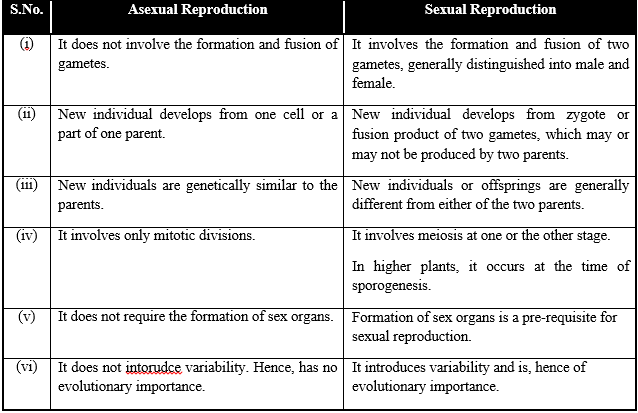
Difference between asexual and sexual reproduction :
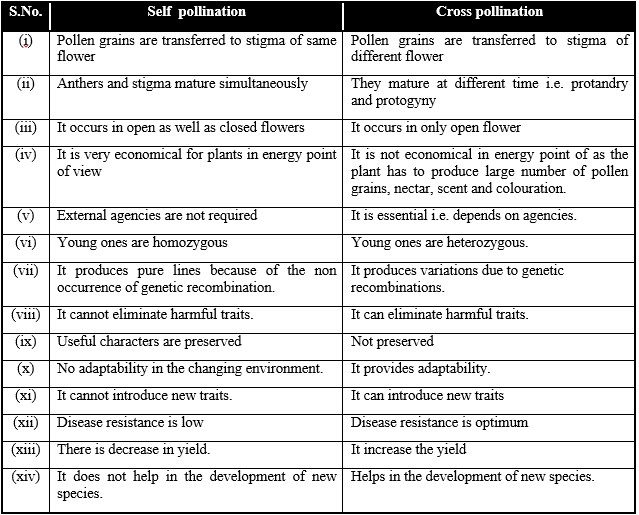
Difference between Self and Cross pollination :
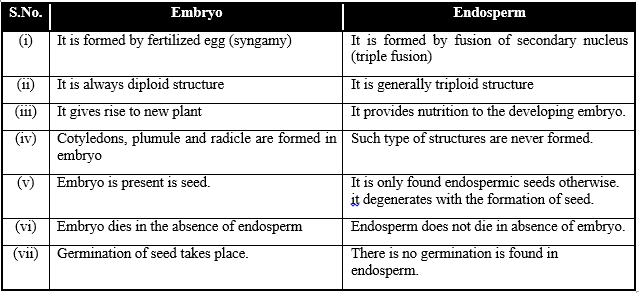
Difference between Embryo and Endosperm :
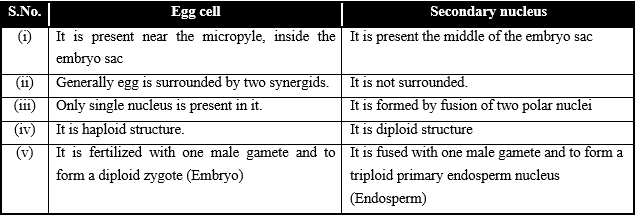
Difference between Egg cell and secondary nucleus :
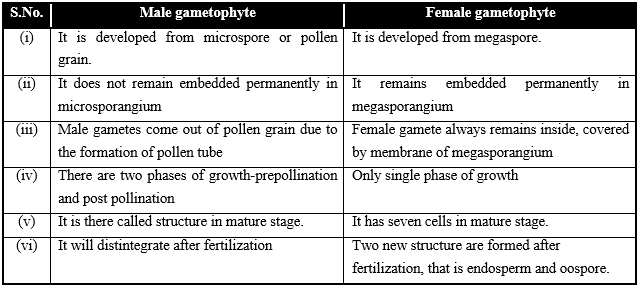
Difference between Male and Female gametophyte :
Difference between Epigeal and Hypogeal germination :
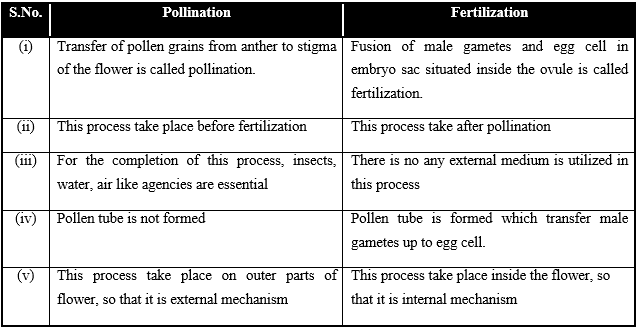
Difference between Pollination and Fertilization :
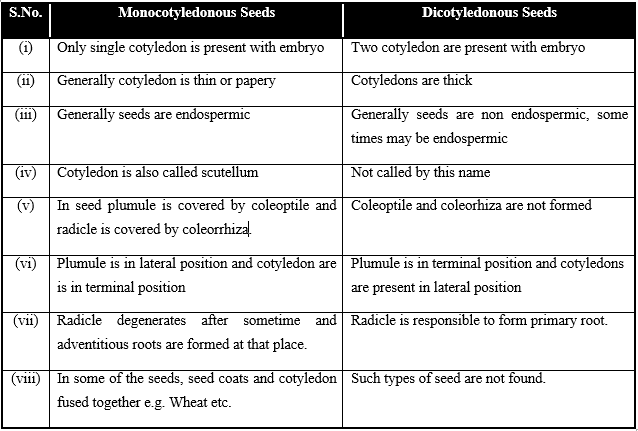
Difference between Monocotyledonous and Dicotyledonous seed :
Self incompatibility –
It is recognized in 66 families of angiosperms.
Morphologically self in compatibility is of two types :
(A) Heteromorphic self incompatibility
(B) Homomorphic self incompatibility
(A) Heteromorphic self incompatibility – Occurrence of two (distyly) or three (tristyly) morphologically distinct mating type within a species, which can be easily recognized without a breeding test.
- The difference in the mating type is generally in the relative length of stamen and style
Ex. Primula, Lathyrum
(B) Homomorphic self incompatibility – In this type all the mating type within a species are morphologically similar and requires proper breeding test, for their recognization.
Depending upon the origin of factors determining the mating type on pollen side it is of two types
(i) Gametophytic self incompatibility (GSI)
(ii) Sporophytic self incompatibility (SSI)
When two pollen tubes enter in an ovule and release their contents, it is possible that the egg may be fertilized by one male gamete from one tube and triple fusion may involves participation of male gamete from another tube.
This pnenomenon is called Heterofertilization eg. Zea mays.
When the entry of male gamete is not accompanied by fusion. This phenomenon is called semigamy.
The percentage of pollen germination and tube growth is better in large populations. This is called as 'population effect' or 'crowding effect'
B-Ca-inositol of Sugar complex acts as chemotropic agent for pollen tube growth.
Highest amount of fat is found in endosperm of Coconut.
Embryonic development of Capsella is endoscopic because it is developed towards chalazal region of the zygote.
Single celled suspensor is found in Triticum [wheat] and Caryophyllum. Their seeds are caryopsis fruit.
Suspensor is absent in Sunflower and Marigold.
125 meiotic divisions are essential for development of 100 grains of Wheat.
Heaviest seed (6 k.g.) is found in Lodoshia. Its fruit is 1 meter in lenth and wt. of fruit is 18 kg.
Edible part of Betelnut is endosperm.
Abscisic acid is the natural germination inhibitor of seed.
Light induces germination in Lettuce/(Lactuca sativa )
Smallest or minute seeds are found in Orchids which are lightest in plant kingdom and are called "Dust seeds" [wt. 20.33 µg].
Xenia (by Focke) – Effect of pollens inside Embryo sac on Endosperm (except Embryo) → Maize.
Metaxenia – Effect of pollen out side the Embryo sac on seed coat or pericarp. Datepalm – maturity time as well as size of fruits can be changed by using different pollens.
The longest pollen tube is found in Maize.
The endosperm is formed after the fertilization in Angiosperms. It is triploid while in Gymnosperm, endosperm is formed before the fertilization and haploid in nature.
The ovules of some parasitic plants do not have integument e.g. Sandal [Santalum] and Viscum.
The polysiphonous condition is found in families of Malvaceae and cucurbitaceae.
Those plants which live immortal through the seeds are known as therophytes.
The synergids are absent in the embryo sac of Plumbago.
The pollination in 60% of angiosperms takes place at two celled structure of pollen grains.
Monosporic embryo sac extensively found in Angiosperm. It is discovered by Strasburger in Polygonum divarictum. It develops only from a functional megaspore.
The seed of Cuscuta and Santalum lacks of cotyledon.
The endosperm of Monocotyledons such as Zea mays, wheat, and Grasses bear aleurons granules.
Costum and Nicodia plants have multilayered tapetum.
The dormancy is absent in the seed of Mangrove plants like Rhizophora.
The fruit formed from the ovary without fertilization is called Parthenocarpic fruits.
Lotus, Nymphaea and Alisma like aquatic plants are entomophilous.
All the microspores of anther of Calotropis are joined together to form a special, structure called Pollinium. These staminal structures are called translator apparatus.
In some plants like Typha, Drosera, Cryptostegia all four microspores joined together and they are called Compound pollen.
When two pollen tube enter into an ovule and release their contents. It is possible that the one male gamete of one pollen tube fertilize with egg cell and one male gamete of another pollen tube participate in triple fusion (with secondary nucleus) is called heterofertilization. Because of this xenia effect in Zea mays.
The white fluid is found in green coconut is nuclear endosperm which is known as "liquid syncytium".
In Cereals [Monocots] outer layer of endosperm is thick walled with dense cytoplasm, which is mainly filled aleurone grains [highly protein rich] and hence called Aleurone Layer. This layer secrete some hydrolytic enzymes like protease and amylase induced by gibberellin.
Hard and impermeable seed coat is found in most of legume plants which is the main reason of seed dormancy.
A hard lignin water resistant layer [seed coat] is present on seed of some Leguminosae plants.
Growth inhibitors are present in seed coat of Cucurbita and in the embryo of Xanthium.
Strong mineral acids have been used successfully to break seed dormancy caused by resistant or hard impermeable seed coat. Such as potassium nitrate, Ethylene, Chlorohydrine and Thiourea etc.
FAQs on Sexual Reproduction in Flowering Plants, Chapter Notes, Class 12, Biology, Part -2
| 1. What is the significance of sexual reproduction in flowering plants? |  |
| 2. What are the different types of pollination? | |
| 3. What is the role of the ovule in sexual reproduction in flowering plants? | |
| 4. How does the process of double fertilization occur in flowering plants? | |
| 5. What are the advantages and disadvantages of asexual reproduction in flowering plants? | |


