JEE Exam > JEE Notes > Mathematics (Maths) Main & Advanced > NCERT Solutions Exercise 4.5: Determinants
NCERT Solutions Exercise 4.5: Determinants

Q1: Examine the consistency of the system of equations.
x + 2y = 2
2x + 3y = 3
Ans: The given system of equations is:
x + 2y = 2
2x + 3y = 3
The given system of equations can be written in the form of AX = B, where
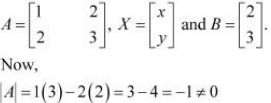

det(A) = |1 2
2 3| = 1×3 - 2×2 = 3 - 4 = -1 ≠ 0.
Since det(A) ≠ 0, A is non-singular and A-1 exists.
Therefore the system has a unique solution and is consistent.
Q2: Examine the consistency of the system of equations.
2x - y = 5 x
x + y = 4
Ans: The given system of equations is:
2x - y = 5 x
+ y = 4
The given system of equations can be written in the form of AX = B, where
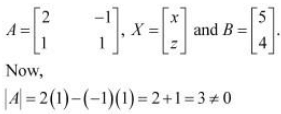

Therefore A-1 exists and the system has a unique solution.
Hence the system is consistent.
Q3: Examine the consistency of the system of equations.
x + 3y = 5
2x + 6y = 8
Ans: The given system of equations is:
x + 3y = 5
2x + 6y = 8
The given system of equations can be written in the form of AX = B, where
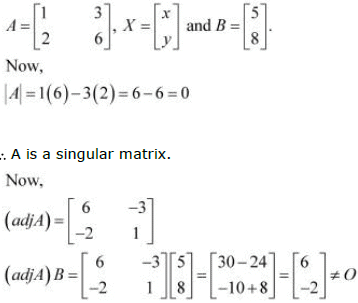
Compute the determinant of the coefficient matrix A:
det(A) = |1 3
2 6| = 1×6 - 3×2 = 6 - 6 = 0.
So A is a singular matrix. Check consistency by comparing proportionality of equations:
The left-hand sides satisfy 2×(x + 3y) = 2x + 6y, but the constants give 2×5 = 10, whereas the second equation has 8 on the right-hand side.
Since the left-hand sides are proportional but the right-hand sides are not, the system is inconsistent (no solution).
Q4: Examine the consistency of the system of equations.
x + y + z = 1
2x + 3y + 2z = 2
ax + ay + 2az = 4
Ans: The given system of equations is:
x + y + z = 1
2x + 3y + 2z = 2
ax + ay + 2az = 4
This system can be written in the form of AX = B, where
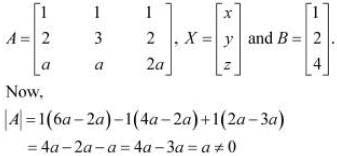

det(A) = a × det |1 1 1
2 3 2
1 1 2|.
Evaluate the 3×3 determinant: det |1 1 1; 2 3 2; 1 1 2| = 1.
Hence det(A) = a × 1 = a.
Therefore:
- If a ≠ 0, det(A) ≠ 0, so A is non-singular, A-1 exists and the system has a unique solution (so it is consistent).
- If a = 0, the third equation becomes 0 = 4 which is impossible; hence the system is inconsistent for a = 0.
Q5: Examine the consistency of the system of equations.
3x - y - 2z = 2
2y - z = -1
3x - 5y = 3
Ans: The given system of equations is:
3x - y - 2z = 2
2y - z = -1
3x - 5y = 3
This system can be written in the form of AX = B, where
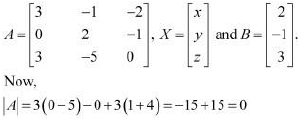
Compute det(A):
det(A) = |3 -1 -2
0 2 -1
3 -5 0| = 0 (calculation: 3×(2×0 - (-1)(-5)) - (-1)×(0×0 - (-1)×3) + (-2)×(0×(-5) - 2×3) = -15 + 3 + 12 = 0).
Thus A is singular. Check consistency by elimination:
From the second equation, z = 2y + 1.
Substitute into the first: 3x - y - 2(2y + 1) = 2 ⇒ 3x - y - 4y - 2 = 2 ⇒ 3x - 5y = 4.
The third equation gives 3x - 5y = 3.
These two results for 3x - 5y are contradictory (4 ≠ 3), so the system is inconsistent (no solution).
Q6: Examine the consistency of the system of equations.
5x - y + 4z = 5
2x + 3y + 5z = 2
5x - 2y + 6z = -1
Ans: The given system of equations is:
5x - y + 4z = 5
2x + 3y + 5z = 2
5x - 2y + 6z = -1
This system can be written in the form of AX = B, where
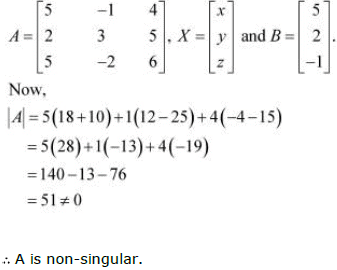
Compute the determinant of A:
det(A) = 5×|3 5
-2 6| - (-1)×|2 5
5 6| + 4×|2 3
5 -2| = 140 - 13 - 76 = 51 ≠ 0.
Since det(A) ≠ 0, A is non-singular and A-1 exists.
Therefore the system has a unique solution and is consistent.
Q7: Solve system of linear equations, using matrix method.

Ans: The given system of equations can be written in the form of AX = B, where
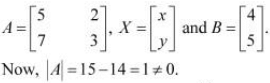
As shown in the image, A is non-singular and its inverse exists.
Compute the solution by X = A-1B (details of the inverse and multiplication are shown in the images):
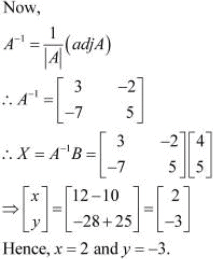
The unique solution is obtained from the multiplication shown above.
Q8: Solve system of linear equations, using matrix method.

Ans: The given system of equations can be written in the form of AX = B, where
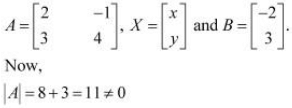
As shown in the image, A is non-singular and its inverse exists.
Compute the solution by X = A-1B (the steps for finding A-1 and the product are provided in the image):
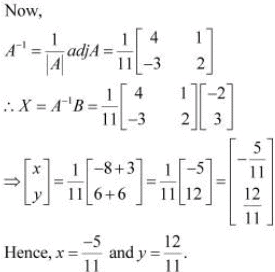
The unique solution follows from the calculation displayed above.
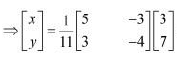
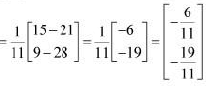
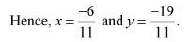
Q9: Solve system of linear equations, using matrix method.

Ans: The given system of equations can be written in the form of AX = B, where
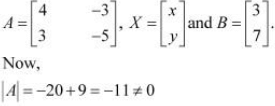
As shown in the working images, A is non-singular and A-1 exists.
Perform X = A-1B as demonstrated in the images to obtain the unique solution:
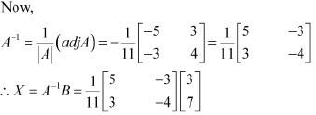
Q10: Solve system of linear equations, using matrix method.
5x + 2y = 3
3x + 2y = 5
Ans: The given system of equations can be written in the form of AX = B, where
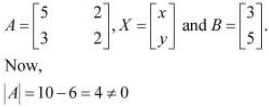
Coefficient matrix A = |5 2
3 2|. Compute det(A): det(A) = 5×2 - 2×3 = 10 - 6 = 4 ≠ 0.
Hence A is non-singular and A-1 exists.
Compute A-1 = (1/det(A)) × |2 -2
-3 5| = (1/4) × |2 -2
-3 5|.
Now X = A-1B with B = |3
5| gives:
x = (1/4)[2×3 + (-2)×5] = (1/4)(6 - 10) = (1/4)(-4) = -1.
y = (1/4)[(-3)×3 + 5×5] = (1/4)(-9 + 25) = (1/4)(16) = 4.
Therefore the solution is x = -1, y = 4.
Q11: Solve system of linear equations, using matrix method.
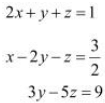
Ans: The given system of equations can be written in the form of AX = B, where
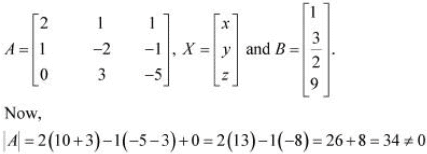
As shown in the image, A is non-singular and its inverse exists.
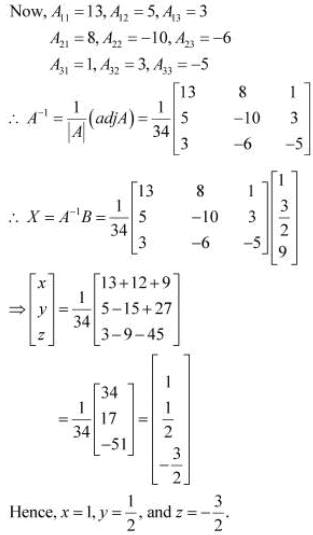
The solution is obtained by X = A-1B; the detailed inverse and multiplication are displayed in the image:
Q12: Solve system of linear equations, using matrix method.
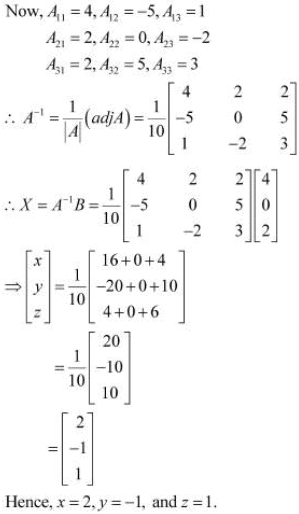
x - y + z = 4
2x + y - 3z = 0
x + y + z = 2
Ans: The given system of equations can be written in the form of AX = B, where
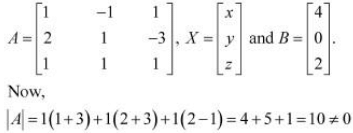
As the coefficient matrix is non-singular (see image), its inverse exists.
Solving (either by A-1B or by substitution):
From x - y + z = 4 ⇒ x = 4 + y - z.
Substitute into x + y + z = 2 ⇒ (4 + y - z) + y + z = 2 ⇒ 4 + 2y = 2 ⇒ y = -1.
Then x = 4 + (-1) - z = 3 - z.
Substitute into 2x + y - 3z = 0 ⇒ 2(3 - z) + (-1) - 3z = 0 ⇒ 6 - 2z - 1 - 3z = 0 ⇒ 5 - 5z = 0 ⇒ z = 1.
Thus x = 3 - 1 = 2.
Therefore the solution is x = 2, y = -1, z = 1.
Q13: Solve system of linear equations, using matrix method.
2x + 3y + 3z = 5
x - 2y + z = -4
3x - y - 2z = 3
Ans: The given system of equations can be written in the form of AX = B, where
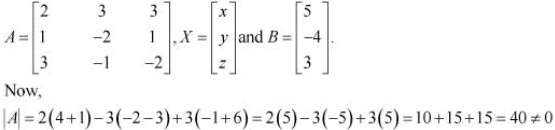
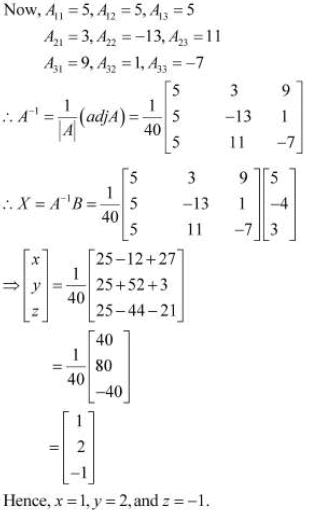
As shown, A is non-singular and A-1 exists. Solve by substitution or using A-1B.
Using substitution from x - 2y + z = -4 ⇒ x = -4 + 2y - z.
Substitute into the first and third equations to eliminate x:
First: 2(-4 + 2y - z) + 3y + 3z = 5 ⇒ -8 + 4y - 2z + 3y + 3z = 5 ⇒ 7y + z = 13. (1)
Third: 3(-4 + 2y - z) - y - 2z = 3 ⇒ -12 + 6y - 3z - y - 2z = 3 ⇒ 5y - 5z = 15 ⇒ y - z = 3. (2)
From (2), z = y - 3. Substitute into (1): 7y + (y - 3) = 13 ⇒ 8y - 3 = 13 ⇒ 8y = 16 ⇒ y = 2.
Then z = 2 - 3 = -1 and x = -4 + 2(2) - (-1) = -4 + 4 + 1 = 1.
Therefore the solution is x = 1, y = 2, z = -1.
Q14: Solve system of linear equations, using matrix method.
x - y + 2z = 7
3x + 4y - 5z = -5
2x - y + 3z = 12
Ans: The given system of equations can be written in the form of AX = B, where
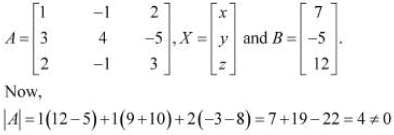
As shown, A is non-singular and A-1 exists. Solve by substitution or A-1B.
From x - y + 2z = 7 ⇒ x = 7 + y - 2z.
Substitute into the other two equations:
3(7 + y - 2z) + 4y - 5z = -5 ⇒ 21 + 3y - 6z + 4y - 5z = -5 ⇒ 7y - 11z = -26. (A)
2(7 + y - 2z) - y + 3z = 12 ⇒ 14 + 2y - 4z - y + 3z = 12 ⇒ y - z = -2 ⇒ y = z - 2. (B)
Substitute (B) into (A): 7(z - 2) - 11z = -26 ⇒ 7z - 14 - 11z = -26 ⇒ -4z = -12 ⇒ z = 3.
Then y = 3 - 2 = 1 and x = 7 + 1 - 2×3 = 8 - 6 = 2.
Therefore the solution is x = 2, y = 1, z = 3.
Q15: If
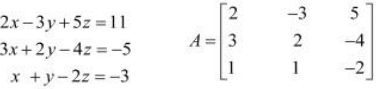
find A-1. Using A-1 solve the system of equations
Ans:
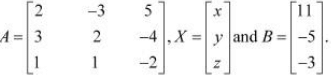
Now, the given system of equations can be written in the form of AX = B, where
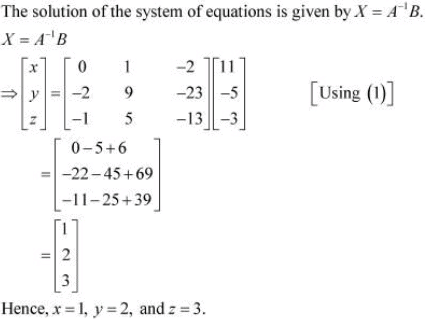
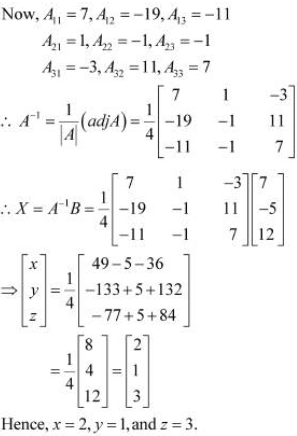
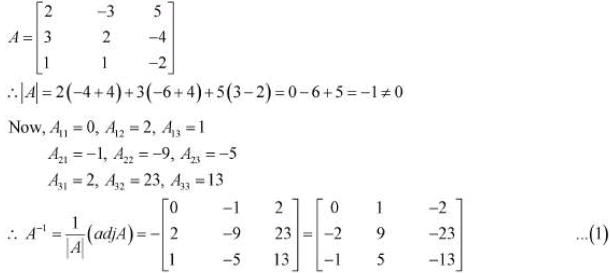
Compute A-1 as demonstrated in the image and then obtain the solution by X = A-1B; the steps and the resulting values are shown in the provided workings.
Q16: The cost of 4 kg onion, 3 kg wheat and 2 kg rice is Rs 60. The cost of 2 kg onion, 4 kg wheat and 6 kg rice is Rs 90. The cost of 6 kg onion 2 kg wheat and 3 kg rice is Rs 70. Find cost of each item per kg by matrix method.
Ans: Let the cost per kg of onion, wheat and rice be Rs x, Rs y and Rs z respectively.
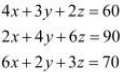
Then the system is:
4x + 3y + 2z = 60
2x + 4y + 6z = 90
6x + 2y + 3z = 70
Write in matrix form AX = B where A = |4 3 2
2 4 6
6 2 3|, X = |x
y
z|, B = |60
90
70|. (See
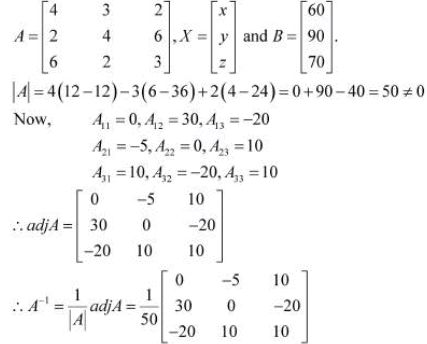
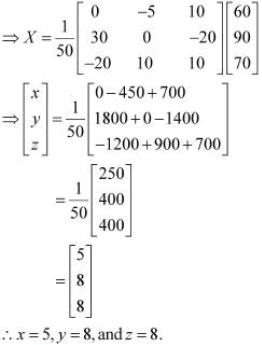
Solving (by elimination or by computing A-1 and multiplying) we obtain:
From elimination: Multiply second equation by 2 and subtract first×1 gives y + 2z = 24. (i)
Eliminate x using suitable multiples of equations 1 and 3 gives y = 8. Substituting in (i) yields 8 + 2z = 24 ⇒ z = 8.
Substitute y and z in the first equation: 4x + 3(8) + 2(8) = 60 ⇒ 4x + 24 + 16 = 60 ⇒ 4x = 20 ⇒ x = 5.
Hence the cost per kg is: onion = Rs 5, wheat = Rs 8, rice = Rs 8.
The document NCERT Solutions Exercise 4.5: Determinants is a part of the JEE Course Mathematics (Maths) for JEE Main & Advanced.
All you need of JEE at this link: JEE
FAQs on NCERT Solutions Exercise 4.5: Determinants
| 1. What are determinants in mathematics? |  |
Ans. Determinants are mathematical objects that are used to solve systems of linear equations, calculate areas and volumes, and determine whether a matrix is invertible or not. They are denoted by vertical bars or double vertical bars enclosing a square matrix.
| 2. How do determinants help in solving systems of linear equations? | |
Ans. Determinants help in solving systems of linear equations by providing a criterion for the existence and uniqueness of solutions. If the determinant of the coefficient matrix is non-zero, then the system has a unique solution. If the determinant is zero, then either the system has infinitely many solutions or no solution at all.
| 3. Can determinants be negative? | |
Ans. Yes, determinants can be negative. The sign of the determinant depends on the number of row interchanges required to reduce the matrix to its upper triangular form. If the number of row interchanges is odd, the determinant is negative; if it is even, the determinant is positive.
| 4. How can determinants be used to calculate areas and volumes? | |
Ans. Determinants can be used to calculate areas and volumes by considering the coordinates of the vertices of a polygon or the vertices of a parallelepiped. By forming a matrix with the coordinates as rows or columns, taking its determinant gives the area of the polygon or the volume of the parallelepiped.
| 5. What is the importance of determinants in JEE exams? | |
Ans. Determinants are an important topic in the JEE exams as they form the basis for solving problems related to linear algebra and coordinate geometry. Questions related to determinants are frequently asked in the exams, and a good understanding of determinants is essential for scoring well in the mathematics section of JEE.
About this Document

2.4K Views

4.83/5 Rating

Apr 21, 2026 Last updated
Document Description: NCERT Solutions Exercise 4.5: Determinants for JEE 2026 is part of Mathematics (Maths) for JEE Main & Advanced preparation. The notes and questions for NCERT Solutions Exercise 4.5: Determinants have been prepared according to the JEE exam syllabus. Information about NCERT Solutions Exercise 4.5: Determinants covers topics like and NCERT Solutions Exercise 4.5: Determinants Example, for JEE 2026 Exam. Find important definitions, questions, notes, meanings, examples, exercises and tests below for NCERT Solutions Exercise 4.5: Determinants.
Introduction of NCERT Solutions Exercise 4.5: Determinants in English is available as part of our Mathematics (Maths) for JEE Main & Advanced for JEE & NCERT Solutions Exercise 4.5: Determinants in Hindi for Mathematics (Maths) for JEE Main & Advanced course. Download more important topics related with notes, lectures and mock test series for JEE Exam by signing up for free. JEE: NCERT Solutions Exercise 4.5: Determinants
Description
NCERT Solutions Exercise 4.5: Determinants of Maths provides all the questions of NCERT textbook with detailed solutions. Download free PDF from EduRev.
Information about NCERT Solutions Exercise 4.5: Determinants
In this doc you can find the meaning of NCERT Solutions Exercise 4.5: Determinants defined & explained in the simplest way possible. Besides explaining types of NCERT Solutions Exercise 4.5: Determinants theory, EduRev gives you an ample number of questions to practice NCERT Solutions Exercise 4.5: Determinants tests, examples and also practice JEE tests



Related Searches
practice quizzes, Exam, Extra Questions, video lectures, pdf , study material, past year papers, NCERT Solutions Exercise 4.5: Determinants, mock tests for examination, Summary, MCQs, NCERT Solutions Exercise 4.5: Determinants, Sample Paper, shortcuts and tricks, Important questions, NCERT Solutions Exercise 4.5: Determinants, Objective type Questions, Semester Notes, ppt, Viva Questions, Free, Previous Year Questions with Solutions;