Short Notes & Important Questions - Sources of Business Finance

CHAPTER - 7
SOURCES OF BUSINESS FINANCE
The term finance means money or fund. The requirements of funds by business to carry out its various activities is called business finance.
NATURE OF BUSINESS FINANCE :-
1. Fixed Capital Requirement :- In order to start a business funds are needed to purchase fixed assets like land and building, plant and machinery. This is called fixed capital requirement.
2. Working Capital Requirement :- A business needs funds for its day to day operation. This is known as working Capital requiements. Working capital is required for purchase of raw materials, to pay salaries, wages, rent and taxes.
3. Diversification :- A company needs more funds to diversify its operation to become a multi-product company e.g. ITC.
4. Technology upgradation : Finance is needed to adopt modern technology for example uses of computers in business.
5. Growth and expansion : Higher growth of a business enterprise requires higher investment in fixed assets. So finance is needed for growth and expansion.
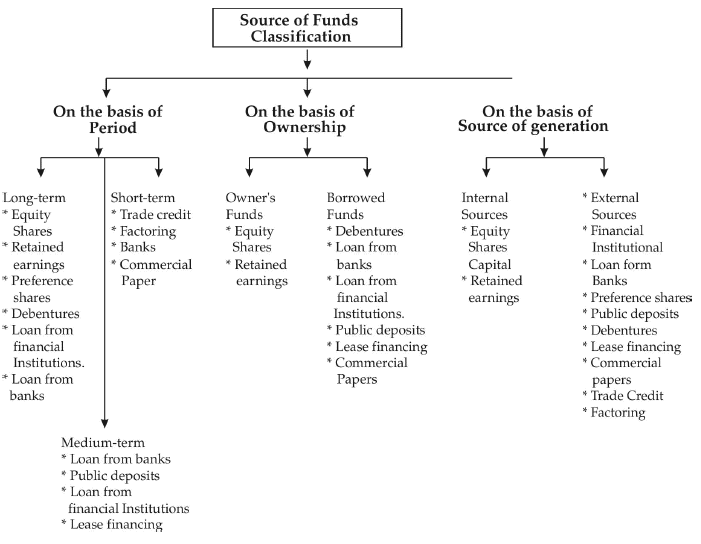
CLASSIFICATION OF SOURCE OF FUNDS :
METHODS OF RAISING FINANCE :-
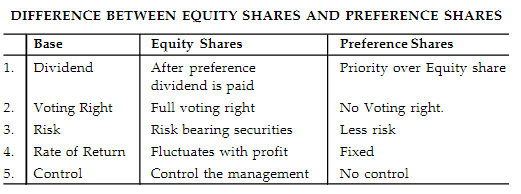
Issue of Share : The capital obtained by issue of shares is known as share capital. The capital of a company is divide into small units called share. If a company issue 10,000 shares of Rs. 10/- each then the share capital of company is 1,00,000. The person holding the share is known as shareholder. There are two types of share (I) Equity share (II) preference share.
a) Equity Share : Equity shares represent the ownership of a company. They have right to vote and right to participate in the management because they are the owner of the company.
ADVANTAGES / MERITS :-
1.Permanent Capital : Equity share capital is important source of finance for a long term.
2. No charge on assets : For raising funds by issue of equity shares a company does not need to mortgage its assets.
3. Higher returns : Equity share holder get higher returns in the years of high profits.
4. Control : They have right to vote and right to participate in the management.
5. No burden on company : Payment of equity dividend is not compulsory
LIMITATIONS / DEMERITS :-
1. Risk : Equity shareholder bear higher risk because payment of equity dividend is not compulsory.
2. Higer Cost : Cost of equity shares is greater than the cost of preference share.
3. Delays : Issue of Equity shares is time consuming. Issue depends on Share Market Conditions : Equity Shareholders are the primary risk bearer therefore the demand of equity shares are in the boom time.
B. Preference Share : - Preference shares are safe in investment. They receive dividend at a fixed rate. Preference shareholder are like creditors. They have no voting right.
Types of preference shares :-
1. Cumulative preference shares.
2. Non cumulative preference shares.
3. Participating preference shares.
4. Non participating preference shares.
5. Convertible preference shares.
6. Non Convertible preference shares.
MERITS OF PREFERENCE SHARES :-
1. Investment is safe : Preference shareholders investment is safe. They have preferential right to claim dividend and capital.
2 .No Charge on assets : The company does not need to mortgage its assets for issue of preference shares.
3. Control : It does not affect the control of equity share holders because they have no voting right.
4. Fixed dividend : They get fixed dividend so they are useful for those investor who want fixed rate of return.
LIMITATIONS / DEMERITS :
1.Costly sources of funds : Rate of preference dividend is greater than rate of interest on debenture, for a company it is costly source of funds than Debentures.
2. No tax saving : Preference dividend is not deductible from profit for income tax. Therefore there is no tax saving.
3. Burden on the company : In the year of losses dividend has to be paid.
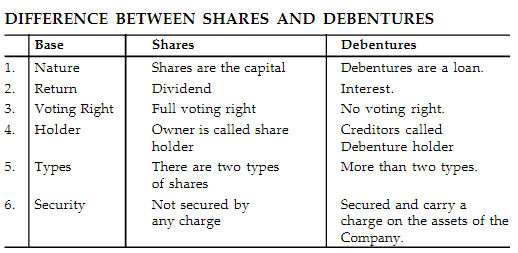
Debentures : Debentures are the important debt sources of finance for raising long term finance. They found fixed rate of interest on Debentures. Interest is paid after every six months or one year. They are like creditors of a company.
Type of Debentures :-
1.Secured Debentures
2. Unsecured Debentures
3. Convertible Debentures.
4. Non Convertible Debentures.
5. Redeemable Debentures.
6. Registered Debentures.
MERITS OF DEBENTURES :
1.Investment is Safe : Debentures are prefered by those investor who do not want to take risk and are interested in fixed income.
2 .Control : Debenture holder do not have voting right.
3. Less Costly : Debentures are less costly as compared to cost of preference shares.
4. Tax Saving : Interest on Debentures is a tax deductable expense. Therefore, there is a tax saving.
LIMITATION OF DEBENTURES :-
1. Fixed Obligation : There is a greater risk when there is no earning because interest on debentures has to be paid if the company suffers losses
2. Charge on assets : The company has to mortgage its assets to issue Debentures.
3. Reduction in Credibility : With the new issue of debentures the company's capability to further borrow funds reduces.
Retained Earning :- A portion of company s net profit after tax and dividend. Which is not distributed but are retained for reinvestment purpose is called retained earning. This is also called sources of self-financing.
MERITS
1.No costs : No costs in the form of interest, dividend, advertisement and prospects.
2. No charges on assets : The company does not have to mortgage its assets.
3. Growth and expansion : Growth and expansion of business is possible by reinvesting the retained profits.
4. Goodwill : The market price of the company share will increase.
DEMERITS
1.Uncertain Source : It is uncertain source of fund because it is available only when profits are high.
2.Dissatisfaction among shareholder : Retained profits cause dissatisfaction among the shareholder because they get low dividend.
PUBLIC DEPOSITS :
The deposits that are raised by company direct from the public are known as public deposits. The rate of interest offered on public deposits are higher than the rate of interest on bank deposits. This is regulated by the R.B.I. and can not exceed 25% of share capital and reserves.
MERITS :-
1.No charge on assets : The company doesnot have to mortgage its assets.
2.Tax Saving : Interest paid on public deposits is tax deductable, hence there is tax saving.
3. Simple procedure : The procedure for obtaining public deposits is simpler than share and Debenture.
4. Control : They do not have voting right therefore the control of the company is not diluted.
LIMITATIONS :-
1. For Short Term Finance : The maturity period is short. The company can not depend on them for long term.
2. Limited fund : The quantum of public deposit is limited because of legal restrictions 25% of share capital and free reserves.
3. Not Suitable for New Company : New company generally find difficulty to raise funds through public deposits.
COMMERCIAL BANKS :
Commercial Banks give loan and advances to business in the form of cash credit, overdraft loans and discounting of Bill. Rate of interest on loan is fixed.
MERITS
1.Timely financial assistance : Commercial Bank provide timely financial assistance to business.
2. Secrecy : Secrecy is maintained about loan taken from a Commercial Banks.
3. Easier source of funds : This is the easier source of funds as there in no need to issue prospectus for raising funds.
LIMITATIONS / DEMERITS
1.Short or Medium term finance : Funds are not available for a long time.
2.Charge on assets : Required source security of assets before a loan is sanctioned.
FINANCIAL INSTITUTION :
The state and central government have eastablised many financial institutions to provide finance to companies. They are called development Bank. These are IFCI, ICICI, IDBI and LIC, UTI.
MERITS :
1. Longterm Finance : Financial Institution provide long term finance which is not provided by Commercial Bank.
2. Managerial Advice : They provide financial, managerial and technical advice to business firm.
3. Easy installments : Loan can be made in easy installments. It does not prove to be much of a burden on business.
LIMITATIONS / DEMERITS :-
1.More time Consuming : The procedure for granting loan is time consuming due to rigid criteria and many formalities.
2.Restrictions : Financial Institution place restrictions on the company's autonomy of management.
INTERNATIONAL SOURCE OF BUSINESS FINANCE :
1. Commercial Bank : Commercial Bank all over the world provide foreign currency loan for business. Standard chartered is a major source of foreign currency loan to the Indian industry.
2. International Agencies and development Bank : Many number of international agencies and development Bank e.g. IFC, ADB provide long term loan.
3. INTERNATIONAL CAPITAL MARKET :
GDR : When the local currency shares of a company are delivered to the depository bank, which issues depository receipt against shares, these receipt denominated in US doller are caller GDR s.
I. Feature of GDR :-
1. GDR can be listed and traded on a stock exchange of any foreign country other than America.
2. It is negotiable instrument.
3. A holder of GDR can convert it into the shares.
4. Holder get dividends.
5. Holder does not have voting rights.
6. Many Indian companies such as Reliance, Wipro and ICICI have issue GDR.
II. ADR : The depository receipt issued by a company in USA are known as ADR s
Feature of ADR :-
1. It can be issued only to American Citizens.
2. It can be listed and traded is American stock exchange.
3. Indian companies such as Infosys, Reliance issued ADR
III. FCCB s : - The FCCB s are issued in a foreign currency and carry a fixed interest rate. These are listed and traded in foreign stock exchange and similar to the debenture.
Indian Depository Receipts (IDRs)
IDRs are like GDR or ADR except that the issuer is a foreign company raising funds from Indian Market. IDRs are rupee dominated. They can be listed on any Indian stock Exchange.
Issue Procedure of IDRs

1. Firstly, a Foreign Co. hands over the shares to OCB (it requires approval from Finance Ministry to act as a custodian)
2. The OCB request ID to issue shares in the form of IDR.
3. The ID converts the issue which are in foreign currency into IDR and into indian rupee.
4. Lastly, the ID issues them to intending investors.
Features of IDRs
1. IDRs are issued by any foreign company
2. The IDRs can be listed on any Indian stock exchange.
3. A single IDR can represent more than one share, such as one IDR = 10 shares.
4. The holders of IDR have no right to vote in the company.
5. The IDRs are in rupee denomination.
Advantages of IDR
1.It provides an additional investment opportunity to Indian Investors for overseas investment.
2. It satisfies the capital need of foreign companies. It provides listing facility to foreign companies to list on Indian Equity Market.
3. It reduces the risk of Indian Investors who want to take their money abroad.
Inter-Corporate Deposits (ICD)
Inter-Corporate Deposits are unsecured short term deposits made by one company with another company. These deposits are essentially brokered deposited, which led the involvement of brokers. The rate of interest on their deposits is higher than that of banks and other markets. The biggest advantage of ICDs is that the transaction is free from legal hassles.
Type of ICDs
1.Three Months Deposits - These deposits are most populer type of ICDs. These deposits are generally considered by borrowers to solve problems of short term capital adequacy. The annual rate of interest for these deposits is around 12%.
2.Six months Deposits - It is usually made first class borrowers. The annual rate of interest for these deposits is around 15%
3.Call deposits - This deposit can be withdrawn by the lender on a day's notice. The annual rate of interest on call deposits is around 10%
Features of ICDs
1. These transactions takes place between two companies.
2. There are short term deposits.
3. These are unsecured deposits.
4. These transactions are generally completed through brokers.
5. These deposits have no organised market.
6. These deposits have no legal formalities.
7. These are risky deposits from the point of view of lenders.
QUESTIONS :
1. What is meant by business finance.
Ans: Business finance means the funds or money required by a business to carry out its activities. It includes money needed to buy fixed assets, meet day-to-day expenses (working capital), upgrade technology, diversify operations and finance growth and expansion.
2. Define a share.
Ans: A share is a small unit of ownership in a company. When a company issues shares, each share represents a portion of the company's capital; a person who holds a share is called a shareholder.
3. Why is equity share capital called risk capital?
Ans: Equity share capital is called risk capital because equity shareholders bear the residual risk of the business. Dividends on equity are not guaranteed and are paid only after interest and preference dividends. In case of liquidation, equity shareholders are paid last after creditors and preference shareholders.
4. Preference share are not suitable to which kind of Investor.
Ans: Preference shares are not suitable for investors who want control (voting rights) or are seeking substantial capital appreciation. Preference shareholders receive fixed dividends and generally have no voting rights, so those seeking active control or large growth in value prefer equity shares instead.
5. Write the name of two Indian Company which issue GDR.
Ans: Two Indian companies that have issued GDRs are Reliance and Wipro (ICICI is another example).
6. Why are retained profit called self financing.
Ans: Retained profits are called self-financing because the company uses its own undistributed earnings to finance investment and expansion. These funds come internally, avoid external borrowing, and do not involve interest or issuing new securities.
7. What is the full form of ADR.
Ans: ADR stands for American Depository Receipt.
8. What is the difference between share and debenture.
Ans:
- Nature: A share represents ownership in a company; a debenture is a debt instrument (loan) given to the company.
- Return: Shareholders receive dividends (variable), while debenture holders receive fixed interest.
- Voting rights: Shareholders (equity) usually have voting rights; debenture holders do not.
- Claim on assets: Debenture holders are creditors and have priority over shareholders in repayment; shareholders have residual claim.
- Tax treatment: Interest on debentures is tax-deductible for the company; dividends paid on shares are not.
9. What do you understand by GDR.
Ans: A Global Depository Receipt (GDR) is a negotiable instrument issued by a depository bank representing shares of a domestic company and denominated in a foreign currency (commonly US dollars). GDRs allow a domestic company to raise funds and list on foreign stock exchanges; holders receive dividends but usually do not have voting rights in the issuing company.
10. Explain the right of equity share holder.
Ans: Rights of an equity shareholder include:
- Right to vote at general meetings and influence management decisions.
- Right to dividend when declared by the company (variable and not guaranteed).
- Right to inspect accounts and receive statutory information (annual report, notices).
- Right to transfer shares subject to company rules and law.
- Right to share in surplus assets on winding up after meeting obligations to creditors and preference shareholders.
- Right of pre-emption (in many cases) to subscribe to new issues to maintain proportionate holdings.
11. Explain the main merits and demerits of debenture.
Ans:
- Merits:
- Debentures are preferred by risk-averse investors because they provide a fixed income.
- They do not dilute control as debenture holders have no voting rights.
- Interest on debentures is generally cheaper than dividend cost and is tax-deductible for the company.
- Debentures can be secured, increasing investor confidence.
- Demerits:
- Debentures create a fixed obligation to pay interest even in years of low profit, increasing financial risk.
- Secured debentures may require a charge on assets, restricting company freedom to use those assets.
- Issuing large amounts of debentures can reduce borrowing capacity and affect future creditworthiness.
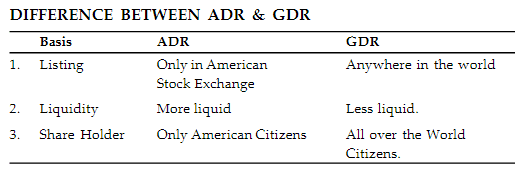
12. What is the difference between ADR and GDR s.
Ans:
- Issuer market: ADR (American Depository Receipt) is issued for the US market and mainly for American investors; GDR (Global Depository Receipt) is issued for international markets other than (or including) the US and can be subscribed by investors in several countries.
- Listing: ADRs are listed on American stock exchanges; GDRs can be listed on multiple foreign exchanges (often in Europe or elsewhere).
- Investor scope: ADRs are generally limited to US investors; GDRs target a broader international investor base.
- Examples: Infosys and Reliance have issued ADRs; Reliance, Wipro and ICICI have issued GDRs.
13. Public Deposits as a source of finance is better than raising funds. Comments.
Ans: Public deposits have both advantages and limitations:
- Advantages: They are easier and quicker to obtain than issuing shares or debentures, usually require no charge on assets, and interest paid is tax-deductible for the company.
- Limitations: They are suitable only for short-term needs and are legally limited (e.g. cannot exceed 25% of share capital and free reserves). New companies may find it difficult to attract public deposits, and the total quantum available is limited.
14. What are the feature of equity share. What are the advantage of issuing equity share to raise term finance debenture.
Ans:
- Features of equity shares: Represent ownership, provide voting rights, give residual claim on profits and assets, have no fixed maturity (permanent capital), are transferable, and dividend is variable.
- Advantages of issuing equity shares (for raising term finance) compared with debentures:
- No fixed interest obligation-reduces pressure on cash flows in lean years.
- Does not create a charge on assets, preserving borrowing capacity.
- Strengthens the company's capital base and creditworthiness for future borrowing.
- Dividend is payable only from profits, offering flexibility.
15. Write Short Notes on :
(a) IDR
Ans: Indian Depository Receipt (IDR) is a rupee-denominated instrument issued by a foreign company to raise funds from Indian investors. An IDR represents underlying equity of the foreign issuer, can be listed on Indian stock exchanges, and typically carries no voting rights for the holder. IDRs provide Indian investors an opportunity to invest in foreign companies without dealing in foreign currency.
(b) ICD
Ans: Inter-Corporate Deposit (ICD) is a short-term, unsecured deposit made by one company with another. ICDs are usually brokered, carry higher interest rates than bank deposits, have short maturities (e.g. three or six months) and involve fewer legal formalities. They are useful for meeting short-term finance needs but are considered riskier for lenders due to lack of security and absence of a formal organised market.
FAQs on Short Notes & Important Questions - Sources of Business Finance
| 1. What are the sources of business finance? |  |
| 2. What is the importance of business finance? | |
| 3. What is the difference between equity shares and preference shares? | |
| 4. What is the role of banks in providing business finance? | |
| 5. What are the advantages of public deposits as a source of business finance? | |