NCERT Solutions - Patol Babu, Film Star

TEXTBOOK QUESTIONS (SOLVED)
3. Answer the following questions briefly.
(a) What was the news that Nishikanto Ghosh gave Patol Babu?
Ans. Nishikanto Ghosh told Patol Babu that his brother-in-law, Naresh Dutt, was connected with the film industry and was looking for someone like Patol Babu to play a role in a film.
(b) How did Patol Babu react? Why ? [C.B.S.E. 2012 (T-2)]
Ans. Patol Babu had long nurtured a passion for acting and theatre, so he was deeply thrilled at the prospect of appearing in a film after 52 years of longing. The offer seemed like the fulfilment of a lifelong dream.
(c) Why had Patol Babu lost his first job in Calcutta?
Ans. Although he was doing well and was in his boss's good books, Patol Babu lost his nine-year job because his office carried out sudden retrenchment as a result of the war.
(d) How does Patol Babu reconcile to the dialogue given to him? [C.B.S.E. 2012 (T-2)]
Ans. At first he was dejected to learn that his only line was the single exclamation, "Oh!" He was about to give up, but the director explained that he was the only actor with a speaking part that day. Encouraged by this and remembering his mentor's advice, he accepted the role and prepared to perform the line well.
(e) Who was Prakashi? How do his words help Patol Babu in enacting his role? [C.B.S.E. 2012 (T-2)]
Or
What was the advice of Patol Babu's mentor, Gagon Pakrashi?
Ans. Mr Prakashi (referred to in the text as Gagon Pakrashi) was Patol Babu's mentor. He advised that every word spoken on stage is important - "each word is like a fruit on a tree" - and should be given full justice. This advice helped Patol Babu overcome his disappointment and to practise the single word "Oh!" in many different ways, treating even a tiny part with seriousness and care.
(f) How do we know that Patol Babu was a meticulous man?
Ans. Patol Babu practised every detail of his tiny role carefully. He practised the different ways to say "Oh!", worked out how his features would be twisted by pain after a collision, practised how he would fling his arms, how he would crouch and then resume his walk. He even asked the director for a rehearsal so that his timing and movement would be right, although the director declined.
(g) Why did Mr. Mullick turn down Patol Babu's request for a rehearsal?
Ans. Mr Mullick, the director, was very busy and preoccupied. He had little patience for rehearsals for what he considered an insignificant role. More importantly, the scene had to be shot in bright sunlight and clouds were approaching, so he had to take the shot quickly and declined the rehearsal request.
(h) What were the special touches that Patol Babu gave to his role to make it more authentic?
Ans. Patol Babu suggested that he should be reading a newspaper when he collided with the lead actor; this would make the action look natural. The director also had a small, butterfly-shaped moustache added to his face to make the character look more authentic.
4. Discuss the following questions in detail and write the answer in your notebooks :
(a) ''I hope the part calls for some dialogue.'' Who says this? Why does he/she ask this question?
Ans. Patol Babu asks Naresh Dutt, the director, whether the part calls for dialogue because he hopes for a speaking role rather than a silent walk-on. He wants an opportunity to speak on the screen after many years of longing.
(b) 'Were these people pulling his legs? Was the whole thing a gigantic hoax? A meek, harmless man like him and they had to drag him into the middle of the city to make a laughing stock out of him. How could anyone be so cruel?" Why does Patol Babu have these thoughts?
Ans. Patol Babu had travelled to Faraday House full of hope after being told he had a speaking part. When he discovered that his only line was the single syllable "Oh!", he felt humiliated and thought he had been made a fool of. He feared that he had been dragged into the city only to be mocked, and this made him angry, disappointed and ready to go home.
(c) Patol Babu is an amateur actor for whom walk-on part in a movie turns into an ultimate challenge. Discuss.
Ans. Patol Babu possessed an artistic temperament and a meticulous nature. Although his part required only the single word "Oh!", he remembered his mentor's advice: "However small a part you're offered, never consider it beneath your dignity to accept it ... make the most of your opportunity." Motivated by this, he set out to give a remarkable performance.
He practised saying "Oh!" with different inflections and rehearsed the physical action of the collision - how his face would show pain, how he would fling his arms and crouch, and how he would resume walking. Although the director refused a rehearsal, he was allowed to walk with a newspaper during the shot and to have a small moustache added. His careful preparation paid off: the director exclaimed, "Jolly good! Why, you're quite an actor," and the lead actor, Chanchal Kumar, said, "My God! You timed it so well that I nearly passed out."
Patol Babu's long-held aspirations were reawakened at the age of fifty-two. He demonstrated that a true artist cares about perfection and giving full justice to a part, no matter how small.
(d) Do you agree with the statement that Patol Babu is a practical man who comes to terms with whatever life has to offer?
Ans. Patol Babu is not merely practical in the common sense. He has an artist's mind and is emotionally driven. When he first realised his part was only one syllable he wanted to quit, but his mentor's counsel urged him to stay and perform with dignity. He completed the job with great care and then walked away without accepting the money. This shows that his actions were guided by pride in his craft and by principles, rather than by practical considerations of money alone.
(e) Why does Patol Babu walk away before he can be paid for his role? What does this reveal about his character?
Ans. Patol Babu is very pleased with his performance and feels he has honoured his mentor, Gagon Pakrashi. He believes that the film people cannot appreciate the hard work he invested for that single shot. To him, fifteen or twenty rupees would be an inadequate recompense for such dedicated effort. Walking away without taking the money shows his dignity, pride in workmanship, and the view that art cannot be measured merely in monetary terms.
(f) Do you think making a movie is an easy job? Discuss with reference to the story?
Ans. Making a film is far from easy. It involves finding and hiring locations, casting suitable actors, transporting heavy equipment and managing crowds. Shooting requires attention to minute details - for example, adding a small moustache to a character or ensuring precise timing in a walk-on. The director and crew must work under pressure; on that day Mr Mullick refused a rehearsal because the scene had to be shot in bright daylight before clouds gathered. The account shows that film work is tiring, time-sensitive and demands careful coordination.
5. Use the words given below to tell about Patol Babu's character.
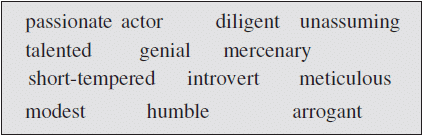
(a) That an offer to act in a film - - - - - - - - -beyond wild dreams
Ans. - unassuming, modest
(b) Indeed - - - - - - - - - - him.
Ans. - talented / passionate actor.
(c) I was with Hudson - - - - - - - - - - single day.
Ans. -diligent / meticulous
(d) It didn't matter - - - - - - - - - - so many people.
Ans. - modest / humble
(e) Patol Babu - - - - - - - - - - glass window.
Ans. - meticulous / diligent
(f) It is true - - - - - - - - - - dedication ?
Ans. - passionate actor / humble
FAQs on NCERT Solutions - Patol Babu, Film Star
| 1. What is the story of the chapter "Patol Babu, Film Star"? |  |
| 2. What was Patol Babu's role in the movie? | |
| 3. Why did Patol Babu refuse to take the money offered by the film production team? | |
| 4. How did Patol Babu's past experience help him during the film shoot? | |
| 5. What is the theme of the chapter "Patol Babu, Film Star"? | |





