Summary - Ozymandias

Paraphrase
1 - 8 lines - (I met a traveller .................... that fed)
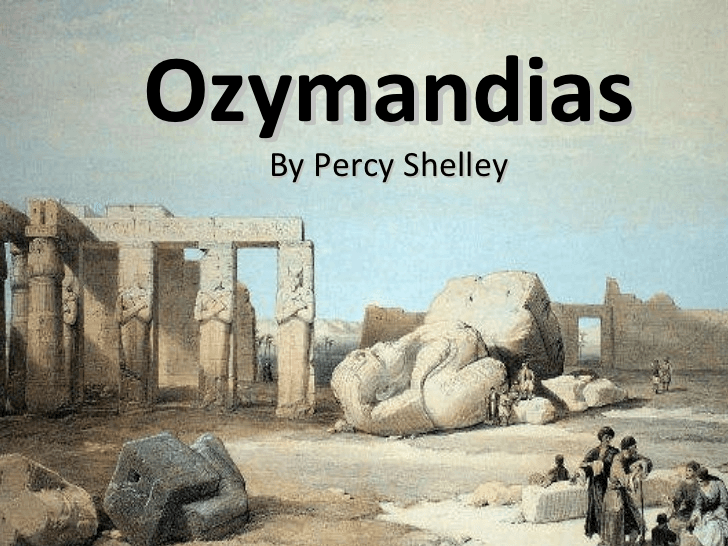
The speaker recalls meeting a traveller from an ancient land who described the ruins of a once-great statue. The traveller said that only two vast stone legs remain standing, with no torso between them; nearby lies a shattered stone head, half buried in sand. The face is badly damaged, yet the sculptor's skill is still evident in the expression - a harsh, contemptuous look of a ruler who sneered at those beneath him. This expression shows that the sculptor truly understood the ruler's character and passions. The description suggests that the ruler treated his subjects harshly, yet there is also an implication that he provided for them in some way, for the inscription suggests he cared about the legacy of his power.
9 - 14 lines - (My name ......................... far away)
On the statue's pedestal is an inscription that reads, "My name is Ozymandias, King of Kings; look on my Works, ye Mighty, and despair!" These proud words claim the ruler's greatness and invite others to acknowledge his achievements. Yet all around the ruined statue there is nothing left of those works - only the lone and level sands stretching away into the distance. The emptiness and the ruined monument together show the contrast between the ruler's boastful claim to immortality and the reality of time's power to reduce human pride and achievements to nothing.
About the Poem and the Poet
Ozymandias is a sonnet written by the English Romantic poet Percy Bysshe Shelley. Shelley composed the poem in 1817 and it was first published in 1818. The poem explores themes of pride, the transience of power, human vanity, and the ravages of time. Around the same time, the poet Horace Smith wrote a sonnet on the same subject; both poems respond to the 19th-century interest in ancient Egypt and the discovery and exhibition of its monuments.
Themes
- The transience of human power: Great empires and rulers appear mighty but ultimately decline and vanish.
- Irony of monument and memory: Ozymandias's proud inscription stands in stark contrast to the ruined statue and the empty desert.
- Art versus power: The sculptor's work outlasts the ruler's power and serves as the truthful record of character, whereas political authority is ephemeral.
- Human vanity and hubris: Boasts about eternal greatness are exposed by the passage of time.
Literary Devices and Features
- Irony: The boast "King of Kings" is undercut by the ruined statue and deserted scene.
- Imagery: Strong visual images - "two vast and trunkless legs of stone," "shattered visage," and "lone and level sands" - create the poem's powerful effect.
- Alliteration and consonance: Sounds such as the repeated s in "stands, stone, sunk, sand" give texture and musicality.
- Metonymy: The statue stands for the ruler's power and the empire's achievements.
- Contrast: Between the sculptor's realistic art and the ruler's hollow claims; between human ambition and natural decay.
Important Words and Meanings
- Sneer: A contemptuous or scornful look or smile.
- Visage: The face or appearance of a person.
- Pedestal: The base on which a statue stands, often carrying an inscription.
- Colossal: Very large in size; immense.
- Antique: Old or ancient; of a former period.
- Sand(s) as symbol: The desert sands symbolise time, emptiness, and oblivion.
FAQs on Summary - Ozymandias
| 1. What is the poem "Ozymandias" about? |  |
| 2. What is the theme of "Ozymandias"? | |
| 3. Who is the speaker in "Ozymandias"? | |
| 4. What is the significance of the phrase "king of kings" in "Ozymandias"? | |
| 5. What is the tone of "Ozymandias"? | |





