Summary - The Solitary Reaper


Summary
The Solitary Reaper is a lyric poem by William Wordsworth which celebrates the simple beauty of a peasant girl's song and the deep, lasting effect that music and nature can have on a sensitive mind. The poem describes a chance encounter: the poet comes upon a young girl working alone in a field, reaping and singing, and he is so moved by the song that it becomes an unforgettable experience which he carries with him long after he has left the scene.
Context and Form
The poem belongs to Wordsworth's preoccupation with nature and ordinary rural life, and with the idea that profound feeling and poetic experience are found in everyday scenes. It is a lyric poem written in simple language so that readers can easily follow the poet's emotional response. The poem is arranged in four stanzas of equal length.
Detailed Summary
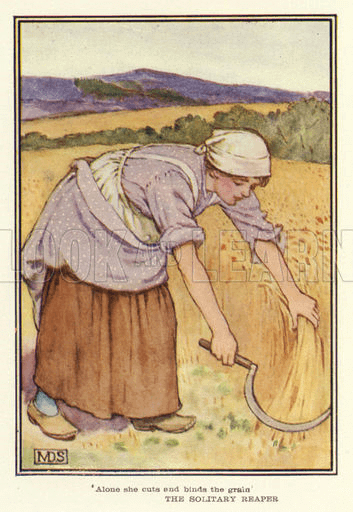
As the poet walks through the highland country he sees a solitary peasant girl in a field of ripening grain. She is reaping-cutting the crop with her sickle-and at the same time singing a song. The sight of the girl, set alone against the landscape, immediately draws the poet's attention because her voice is full and melodious and it seems to fill the whole valley.
The poet compares the maiden's song with two well-known examples of delightful bird-song. He feels that her singing is even more moving than the nightingale's song, which traditionally comforts wearied travellers, and even more thrilling than the melodious call of the cuckoo, which is associated with joy and the arrival of spring and summer. The poet uses these comparisons to show how powerful and persuasive the maiden's voice appears to him, and to suggest that its beauty is universal in appeal.
The poet cannot understand the words of the song because it is sung in a dialect unfamiliar to him; nevertheless, from the tone and the music he guesses its emotional character. The tune strikes him as sad and plaintive and he imagines that it may be about sorrowful memories, losses or old battles, or it may speak of ordinary joys and sorrows of daily life. The precise subject of the song remains unknown, but its emotional effect is clear to the poet.
The singing, the poet feels, seems to have no end while he listens; the girl bends over her work and sings on, absorbed in her labour and song. The poet is so captivated that he stands motionless, held by the power of the melody. When he eventually climbs the hill the actual sound dies away, yet the impression remains. The tune continues to live in the poet's memory and imagination as a fresh, evocative recollection that he will always treasure. The poem therefore foregrounds the idea that art and music are universal languages capable of touching the human heart beyond the limits of words or dialect.
Stanza-wise Paraphrase
Stanza 1: The poet sees a solitary highland girl reaping grain and singing. Her single figure and singing catch his eye as he crosses a field.
Stanza 2: He compares her song with the nightingale's and the cuckoo's, suggesting that her voice is as beautiful, consoling and stirring as these famous bird-songs.
Stanza 3: The poet cannot understand the language or the literal meaning of the song, but from its tone he senses sadness; he speculates that the song may be about ancient sorrow, lost love, or common domestic joys and sorrows.
Stanza 4: The song holds him still as he listens; when he moves away up the hill the sound fades, yet it remains alive in his memory, vivid and unforgettable.
Themes and Tone
The dominant theme is the power of music and the way natural beauty and simple human activity generate deep emotion. The poem also emphasises the universal quality of art: a song need not be understood word for word to be deeply affecting. Another important theme is the dignity and beauty of ordinary rural life; the solitary reaper, though a simple peasant, becomes an emblem of natural grace and expressive power. The tone of the poem is contemplative, awed and slightly melancholy-awareness of beauty mixed with an ache of loss, since the poet cannot fully grasp the words and must leave the scene.
Poetic Devices and Language
The poem uses vivid imagery to create the scene-the sight of the lone worker, the sounds of her song carried over the valley-and several similes to compare her singing with the nightingale and the cuckoo. Wordsworth's diction is plain and direct, which suits his interest in common people and natural speech. The poem also employs repetition and contrast (the solitude of the girl against the wide landscape) to emphasize the central experience, and uses hyperbole at moments to communicate the poet's heightened emotional response.
Importance for Students
For learners, the poem is valuable because it demonstrates how a simple, everyday scene can be transformed into a profound poetic moment through careful attention and feeling. It provides a clear example of Romantic interest in nature, the emotion of the individual observer, and the dignity of common life. The poem's language is accessible, making it suitable for close reading, paraphrase practice and analysis of poetic devices.
Conclusion
The Solitary Reaper celebrates the universal power of music and the lasting effect of a single moving experience. Wordsworth shows that the ordinary can become extraordinary when perceived with sensitivity: the solitary girl's song, mysterious in language but full of feeling, leaves an unforgettable impression on the poet's mind. The poem invites readers to recognise beauty in simple moments and to appreciate how art can communicate beyond words.
FAQs on Summary - The Solitary Reaper
| 1. What is the theme of "The Solitary Reaper"? |  |
| 2. What is the rhyme scheme of "The Solitary Reaper"? | |
| 3. Who is the speaker in "The Solitary Reaper"? | |
| 4. What is the significance of the title "The Solitary Reaper"? | |
| 5. What is the central idea of "The Solitary Reaper"? | |





