NCERT Solutions - Emerging Modes of Business

Short Answer Question
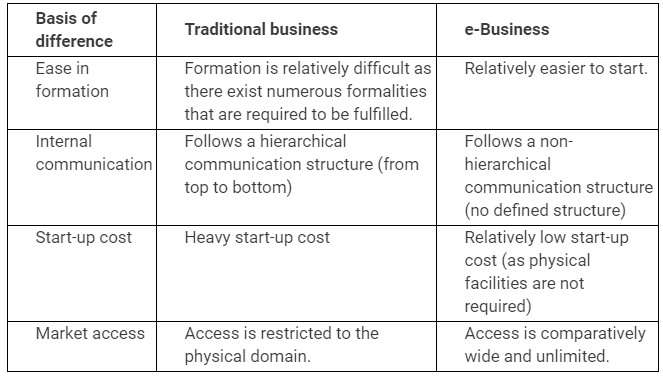
Q1. State any three differences between e-business and traditional business.
Ans:
Q2. Describe briefly any two applications of e-business.
Ans: The following are two important applications of e-business.
(a) e-procurement: This refers to the purchase of goods and services through online platforms. It includes mechanisms such as reverse auctions, where sellers bid to supply a buyer, and digital marketplaces that bring together multiple buyers and sellers. E-procurement speeds up sourcing, increases competition among suppliers and often helps firms obtain inputs at lower cost and with greater transparency.
(b) e-delivery: This involves the electronic delivery of digital products such as software, games, music or films directly to the customer's device. Payment for such deliveries is usually made online. E-delivery reduces distribution time and cost and allows instant access to purchased content.
Q3. Describe briefly the data storage and transmission risks in e-business.
Ans:
(a) Data storage risk: Data kept on computer systems can face several threats during business operations. If sensitive data falls into the wrong hands it may be misused. Also, malicious software such as viruses can corrupt or destroy stored data. Regular backups, access controls and antivirus measures are important to reduce these risks.
(b) Transaction risk: Online transactions are vulnerable to a number of problems which can disrupt trade or cause loss. The common transaction risks are listed below.
- Default on order taking or giving: This occurs when either the seller denies receiving an order placed by the buyer, or the buyer denies placing an order. Such disputes may arise from system errors, poor record-keeping or fraud.
- Default on delivery: This covers cases where the wrong goods are delivered to the right address, the right goods are delivered to the wrong address, or goods are not delivered at all. Clear delivery procedures and tracking help reduce such risks.
- Default on payment: This happens when the seller does not receive payment despite the buyer claiming to have paid, or when electronic payment fails. Secure payment gateways, transaction logs and payment confirmation mechanisms are used to manage this risk.
Long Answer Questions
Q1. Why are e-business and outsourcing referred to as the emerging modes of business? Discuss the factors responsible for the growing importance of these trends.
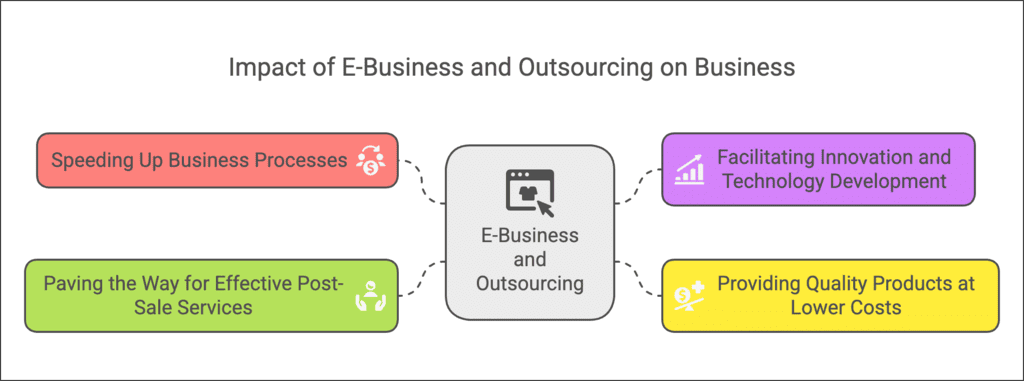
Ans: Rapid globalisation and continuous product and process innovations have brought significant changes in how business is conducted. E-business and outsourcing are two such emerging modes. E-business means conducting business online using computer networks; it allows buyers and sellers to trade any time, reducing time, cost and effort. Outsourcing means contracting out non-core activities to external firms so a company can concentrate on its core functions such as research, product design and strategy. The main factors that explain the growing importance of these trends are:
- They speed up business processes: Consumers expect faster service and 24×7 availability. E-business and outsourcing enable transactions and support services to operate round the clock, meeting customer expectations.
- They promote innovation and technology development: By outsourcing routine tasks and using online platforms, firms free up resources to invest in innovation, research and better technology.
- They help supply quality products at lower cost: Efficient online sales channels and specialised outsourced services can reduce production and distribution costs, enabling firms to offer better quality or customised products at competitive prices.
- They enable effective post-sale services: E-business platforms and outsourced support centres provide quick customer service, warranties, returns and technical support more efficiently than many traditional systems.
Q2. Elaborate the steps involved in on-line trading.
Ans: Online trading lets customers buy from anywhere using a website or app. The main steps involved are listed below.
- Registration: A buyer first finds a reliable shopping website and opens an account by providing details such as name, delivery address, a unique user name and a secret password. The account helps the website identify the buyer and maintain order history.
- Placing an order: After registering, the buyer browses product listings, reads reviews, compares options and selects items to add to a virtual cart. Once satisfied, the buyer proceeds to place the order and moves to the payment stage.
- Payment mechanism: The buyer selects a payment method. Common modes are:
(i) Cash on delivery (CoD): Payment is made in cash when the goods are delivered.
(ii) Cheque: The buyer pays by cheque; goods are dispatched after the cheque is realised.
(iii) Net banking: The buyer transfers funds electronically from their bank account to the seller's account via the Internet.
(iv) Credit or debit card: Payment is made online using card details; this is linked to the buyer's bank account.
(v) Digital cash or e-cash: This is electronic currency stored in the buyer's device or account and used for online purchases. E-cash has no physical form and speeds up small value transactions.
Q3. Evaluate the need for outsourcing and discuss its limitations.
Ans: Outsourcing means assigning non-core business functions to specialised external firms while the contracting company focuses on its main activities.
Advantages of outsourcing:
The key benefits are as follows.
- Focus on core activities: Outsourcing routine or support tasks allows a firm to concentrate on strategic and value-adding work, such as product development and marketing.
- Specialisation: Outsourced firms often have specialised skills and experience, which can improve the quality and efficiency of the outsourced tasks.
- Cost savings: Outsourcing can reduce costs, especially for back-office operations, by exploiting economies of scale and lower labour costs at the service provider.
Limitations of outsourcing:
The main drawbacks are as follows.
- Confidentiality: Sharing sensitive information and technology with external providers risks leakage to competitors. Robust contracts and confidentiality agreements are necessary but may not remove all risk.
- Quality concerns: Once a contract is fixed, some providers may cut corners to save costs, resulting in poorer quality of services or inputs and harming the contracting firm's reputation.
- Resentment in home country: Outsourcing to low-cost foreign locations can lead to unemployment and social resentment in the home country, which may cause political or consumer backlash against the outsourcing firm.
Q4. Discuss the salient aspects of B2C commerce.
Ans: The important features of business-to-consumer (B2C) e-commerce are as follows.
- Wide coverage: B2C e-commerce connects businesses directly to a vast number of consumers across the globe, effectively reducing the importance of geographical boundaries.
- Effective promotion: Online platforms allow more creative and interactive promotion using multimedia, animations and social media. Sellers can advertise on their websites and on networks such as Facebook and Twitter to reach target customers.
- Low promotional costs and quick post-sale services: Digital promotion often costs less than traditional advertising. B2C firms can also provide fast post-sale support through call centres and online help, improving customer satisfaction.
- Consumer-friendly payment methods: B2C platforms offer multiple payment options-debit/credit cards, cash on delivery, EMIs and net banking-making purchases convenient and accessible.
- Easy access: Customers can browse and buy products 24×7 and contact support at any time, which is more convenient than conventional retail hours.
- Customised goods: E-commerce enables firms to offer personalised or customised products to meet individual customer preferences, which increases customer value.
Q5. Discuss the limitations of the electronic mode of doing business. Are these limitations severe enough to restrict its scope? Give reasons for your answer
Ans: The electronic mode of business has certain limitations, described below, but these are not so severe as to restrict its overall growth.
- Lack of personal touch: E-commerce does not allow direct physical examination of goods at the point of sale. For items like clothing, footwear or jewellery, many buyers still prefer face-to-face inspection. Improved return policies, detailed product images and virtual try-on tools are helping reduce this limitation.
- Lack of security: Online transactions face risks such as leakage of card details, anonymous sellers, hacking, phishing and virus attacks. Stronger security measures, encryption and trusted payment gateways are gradually reducing these risks.
- Technical drawbacks: Online trading requires basic computer and Internet skills, which can exclude less tech-savvy users and contribute to a digital divide. Server failures and website glitches may also frustrate customers. However, websites are becoming more user-friendly and reliable with better technology and customer support.
Despite these limitations, the scope of e-business is expanding because:
- Websites are becoming more interactive and consumer-friendly, which reduces the problem of impersonal transactions.
- Improvements in information technology have sped up communications and allowed customers to ask questions and resolve doubts before buying.
- Government and NGO efforts to extend Internet access to rural areas are widening the customer base and reducing hesitation to use online services.
FAQs on NCERT Solutions - Emerging Modes of Business
| 1. What are the emerging modes of business? |  |
| 2. How does e-commerce impact traditional businesses? | |
| 3. What is the sharing economy and how does it work? | |
| 4. How do subscription-based services work? | |
| 5. What are the benefits of digital payment systems? | |