NCERT Solutions - Formation of a Company

Short Answer Questions
Q1: Name the stages in the formation of a company.
Ans: The formation of a company involves four main stages. First is promotion, where promoters conceive the business idea and conduct feasibility studies. Second is incorporation, which includes completing legal formalities and registering the company, giving it a separate legal identity. Third is subscription of capital, where funds are raised through shares or debentures. Finally, commencement of business takes place after fulfilling statutory requirements and obtaining necessary approvals, allowing the company to begin its operations.
Q2: List the documents required for the incorporation of a company.
Ans: Several documents are required for incorporation. These include the Memorandum of Association, defining objectives and scope, and the Articles of Association, containing internal rules. Consent of proposed directors and agreements for key managerial personnel are also needed. Approval of the company name from the Registrar must be obtained. Additionally, statutory declarations of compliance, details of the registered office, and proof of payment of fees are submitted to ensure all legal formalities are properly completed.
Q3: What is a prospectus? Is it necessary for every company to file a prospectus?
Ans: A prospectus is a formal document issued by a company inviting the general public to subscribe to or purchase its shares or debentures. It describes the company's business, financial position, objectives, management and the terms of the offer. When a company intends to raise capital from the public (for example, through an initial public offering), it must file and publish a prospectus so that potential investors have the necessary information to make an informed decision. However, a private company is prohibited from making a public invitation and, therefore, is not required to file a prospectus. Only companies seeking funds from the general public must issue and file a prospectus.
Q4: Briefly explain the term 'Return of Allotment'.
Ans: Return of allotment is a statutory statement filed with the Registrar of Companies after shares have been allotted. It contains the names and addresses of allottees, the number of shares allotted to each, the amount called and paid, and the total paid-up capital. The purpose is to provide an official record of who holds the company's shares immediately after allotment. This return must be submitted within the time prescribed by law so that the register of members and public records are up to date.
Q5: At which stage in the formation of a company does it interact with SEBI?
Ans: A company interacts with the Securities and Exchange Board of India (SEBI) at the stage of subscription of capital, specifically when it proposes to raise funds from the public by issuing shares or debentures. SEBI regulates public issues and prescribes disclosures and procedures to safeguard investors' interests. Therefore, before making a public issue or listing securities on stock exchanges, the company must comply with SEBI's rules and obtain any necessary approvals or clearances.
Long Answer Questions
Q1: What is meant by the term 'promotion'? Discuss the legal position of promoters with respect to a company promoted by them.
Ans: Promotion is the initial phase in forming a company. It begins when an individual or a group conceives a business idea and takes steps to convert it into a working enterprise by planning, arranging resources and carrying out necessary pre-incorporation activities. The people who perform these tasks are called promoters. They may identify business opportunities, conduct feasibility studies, secure finance, select the company's name and prepare foundational documents.
The legal position and liabilities of promoters are as follows:
- They are not agents or trustees of the company prior to incorporation because the company does not legally exist until registration. Any contract entered into before incorporation is, in principle, the promoter's personal responsibility unless adopted by the company after incorporation.
- They must disclose any personal interest in transactions entered on behalf of the proposed company. Promoters must not make secret profits; undisclosed personal gains from pre-incorporation deals can be set aside or recovered by the company.
- They are legally liable for any false or misleading statements in the prospectus. If investors suffer loss due to untrue statements, promoters (along with directors and others) can be held responsible under statutory provisions.
- Claims for payment of promotion expenses depend on agreement and subsequent company action. Generally, promoters cannot unilaterally demand reimbursement unless the company, after incorporation, ratifies and accepts those expenses or agrees to indemnify them.
- The company may, as a matter of choice, compensate promoters for their services by allotting shares or making payments, but such arrangements should be disclosed and approved in accordance with law and company procedures.
Q2: Explain the steps taken by promoters in the promotion of a company.
Ans: The promoters perform a series of organised steps to bring a company into existence. These are:
(i) Conceiving a business idea:
A promoter identifies a potential business opportunity and considers whether it can be converted into a viable enterprise.
(ii) Checking the feasibility of the idea:
Promoters carry out detailed studies to test feasibility in three main areas:
(a) Technical feasibility:
Whether the required technology, raw materials and processes are available to implement the project.
(b) Financial feasibility:
An estimate of cost, capital requirements and likely sources of finance to judge whether the project is affordable.
(c) Economic feasibility:
Whether the project is likely to be profitable and sustainable in the market context.
(iii) Selecting the company's name:
Promoters propose names and apply to the Registrar of Companies, usually offering several options in order of preference, so that an acceptable name may be approved.
(iv) Selecting members to sign the memorandum of association (MoA):
Promoters arrange for the minimum number of subscribers required by law to sign the MoA; these subscribers often become the company's first directors or members.
(v) Appointing professionals:
They engage solicitors, accountants, bankers, brokers and underwriters to prepare legal documents, arrange finance, and manage the issue of shares where required.
(vi) Preparing all necessary documents:
Promoters ensure the Memorandum and Articles of Association, consent of directors, declarations and other statutory forms are completed and submitted to the Registrar for incorporation.
Q3: What is 'Memorandum of Association'? Briefly explain its clauses.
Ans: A Memorandum of Association (MoA) is the fundamental document that defines the scope and powers of a company. It sets out the company's objects, capital structure and relationship with the outside world. The MoA must be signed by the required minimum number of subscribers and is publicly available. Its principal clauses are:
(a) The name clause: States the approved name of the company by which it will be known.
(b) Registered-office clause: Specifies the state in which the company's registered office will be situated; the exact address is to be given within the prescribed time after incorporation.
(c) Objects clause: Defines the main business activities the company may lawfully undertake. It is usually divided into:
(i) The main objects: Essential activities for which the company is formed; acts beyond these are generally not permitted.
(ii) Other objects: Additional activities which the company may undertake with proper authority; changes here may need special approvals.
(d) Liability clause: Specifies whether members' liability is limited and, if so, the extent of unpaid liability on their shares.
(e) Capital clause: States the authorised share capital and its division into shares of fixed amounts.
(f) Association clause: Contains the statement of the subscribers declaring their intention to form the company and to take up specified shares.
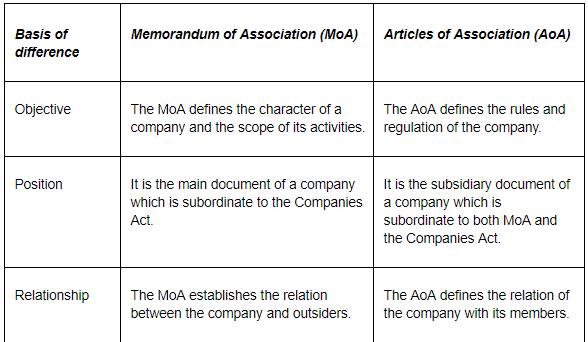
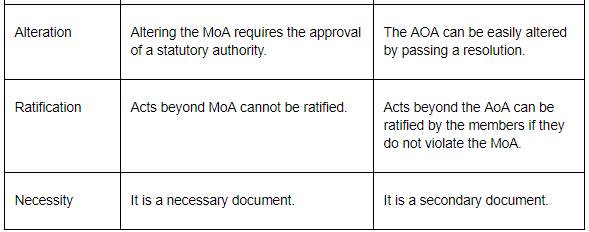
Q4: Distinguish between 'Memorandum of Association' and 'Articles of Association.'
Ans:
Q5: What is the meaning of Certificate of Incorporation?
Ans: The certificate of incorporation is the official document issued by the Registrar of Companies that confirms the legal registration of a company. It specifies the date on which the company comes into existence as a separate legal entity. The certificate is conclusive evidence that the company has been validly incorporated according to law. Once issued, the company may, subject to any statutory conditions, commence its business and exercise the powers conferred by its memorandum and articles.
Q6: Discuss the stages of formation of a company.
Ans: The following are stages of formation of a company:
- Promotion of the company: The promoters conceive the idea, carry out feasibility studies and take initial steps to set up the company.
- Incorporation of the company as a separate legal entity: After submitting the required documents and fees, the Registrar issues the certificate of incorporation and the company becomes a legal person.
- Subscription of capital in the form of shares and debentures: The company raises funds by allotting shares or issuing debentures; if funds are raised from the public, prescribed procedures and disclosures must be followed.
- Commencement of business after completion of formalities: Once statutory requirements are met and necessary clearances obtained, the company starts its commercial operations.
FAQs on NCERT Solutions - Formation of a Company
| 1. What are the main steps involved in company formation under CBSE Class 11 Business Studies? |  |
| 2. What's the difference between memorandum of association and articles of association in company formation? | |
| 3. Why do companies need separate incorporation documents and why can't they just operate as partnerships? | |
| 4. What documents do I need to prepare before applying for company registration with the Registrar of Companies? | |
| 5. How does the certificate of incorporation differ from the certificate for commencement of business? | |