NCERT Solutions - International Business

Short Answer Questions
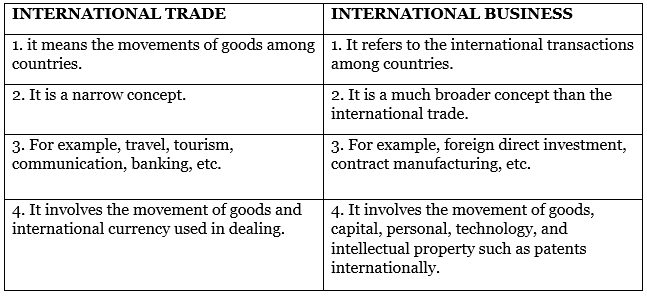
Q1: Differentiate between international trade and international business.Ans: The difference between international trade and international business are:
- International trade refers specifically to the export and import of goods across national borders. It covers the physical movement of merchandise and related documentation.
- International business is a broader concept. It includes international trade as well as cross-border services (such as banking, insurance, tourism), foreign direct investment, licensing, franchising, joint ventures, contract manufacturing and transfer of technology and personnel.
- While international trade mainly involves transactions in goods, international business involves transactions in goods, services, capital and technology, and may include long-term business presence abroad.
Q2: Discuss any three advantages of international business.
Ans: International business refers to transactions among countries such as foreign direct investment and contract manufacturing. It is broader than international trade because it involves movement of goods, capital, personnel, technology and intellectual property. The three main advantages of international business are:
- Earns foreign exchange. International business helps a country to earn foreign exchange, which can be used to pay for imports of technology, capital goods and other essential items.
- Better use of resources and price stability. It enables optimal use of natural and human resources by allowing countries to specialise in products they can produce efficiently. This helps reduce wastage and tends to stabilise prices by balancing supply and demand internationally.
- Enables large-scale production and economies of scale. Access to international markets allows firms to expand output, achieve internal economies of scale and lower the cost of production, which can improve competitiveness.
Q3: What is the major reason underlying trade between nations?
Ans: The major reason underlying trade between nations is the theory of comparative cost advantage. Key points are:
- Not all countries can produce every good efficiently because of differences in resource endowments and productivity.
- Some resources are abundant in one country and scarce in another, so countries specialise in producing goods that use their abundant resources and trade for other goods.
- Factors of production-land, labour, capital and entrepreneurship-vary among countries. For example, a labour-abundant country like India tends to specialise in labour-intensive goods and trade these for capital-intensive goods from countries like the USA.
- Each country gains by trading goods that it can produce most efficiently for goods that others produce comparatively better, leading to mutual benefit from trade.
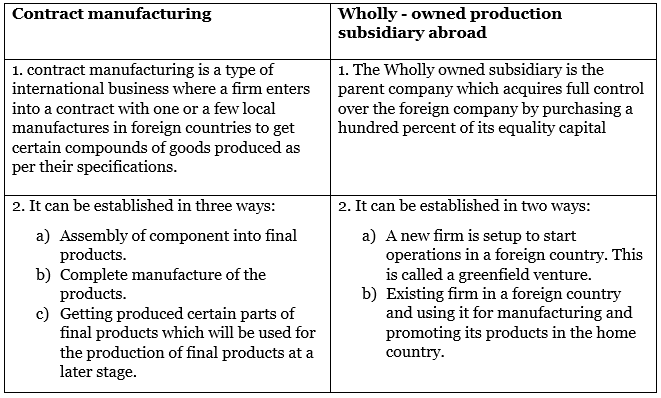
Q4: Differentiate between contract manufacturing and setting up wholly owned production subsidiary abroad.
Ans: The difference between contract manufacturing and setting up wholly- owned production subsidiary abroad are:
- Contract manufacturing is an arrangement in which a firm contracts a foreign manufacturer to produce goods on its behalf. The contracting firm retains control over designs and marketing, while avoiding large capital investment abroad.
- Wholly owned subsidiary involves establishing and owning a production unit in the foreign country with 100% equity. The parent firm bears full investment, control and risk.
- Contract manufacturing requires less capital, involves lower risk and is faster to implement; a wholly owned subsidiary requires substantial investment, greater control and involves higher political and business risk.
Q5: Why is it necessary for an export firm to go in for pre-shipment inspection?
Ans: It is important for an export firm to obtain pre-shipment inspection for the following reasons:
- To ensure product quality and conformity to buyer specifications by having the goods checked by a competent agency authorised by the government.
- Under the Export Quality Control and Inspection Act of 1963, certain goods must be inspected before shipment; exporters must obtain an inspection certificate when their goods fall under the notified categories.
- An inspection certificate helps build buyer confidence, facilitates customs clearance at the destination and may be required by banks for payment or finance.
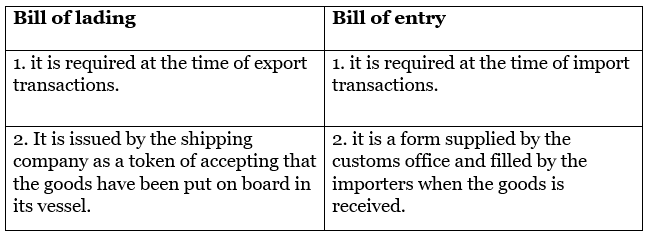
Q6: What is bill of lading? How does it differ from bill of entry?
Ans: A bill of lading is a document issued by a shipping company that serves as a receipt for goods shipped on board a vessel and as a contract to carry the goods to the agreed port of destination. It also acts as a document of title to the goods. It differs from a bill of entry in the following ways:
- A bill of lading is issued by the carrier to the exporter or shipper; a bill of entry is submitted by the importer (or his agent) to customs for clearance of imported goods.
- The bill of lading relates to carriage of goods and transfer of title; the bill of entry is a customs declaration giving details of the imported goods for assessment and payment of customs duty.
- A bill of lading is used to claim the goods at destination and to negotiate payment; a bill of entry is used to obtain customs clearance on arrival and to determine import duties.
Q7: What is a letter of credit? Why does an exporter need this document?
Ans: A letter of credit (L/C) is a guarantee issued by the importer's bank promising to pay the exporter's bank for the export documents presented, provided the terms and conditions of the L/C are met. An exporter needs this document because:
- It reduces the payment risk by ensuring that payment will be made by a reputable bank if documentary conditions are complied with.
- It provides greater certainty and security compared to open account sales, especially when dealing with unfamiliar foreign buyers or countries with uncertain payment systems.
- Banks handling L/Cs can also help exporters obtain pre-shipment or post-shipment finance based on the security of the L/C.
Q8: Discuss the process involved in securing payment for exports.
Ans: The process involved in securing payment for exports are:
- The exporter informs the importer about shipment of the goods and prepares the shipping documents.
- Documents such as the bill of lading, commercial invoice and packing list are required by the importer to claim title to the goods and to obtain customs clearance at the destination.
- The exporter forwards these documents to his bank with instructions to deliver them to the importer only after the importer accepts and pays the bill of exchange (documents against acceptance or payment) or as per the agreed terms.
- The exporter's bank forwards the documents to the importer's bank, which presents them to the importer against payment or acceptance as instructed.
- If payment is received, the exporter's bank credits the exporter's account. Alternatively, the exporter may obtain immediate payment from his bank by discounting the export bills or by signing a letter of indemnity where applicable.
- After payment, the exporter obtains a bank certificate of payment stating that the required documents were presented and that payment has been received in accordance with exchange control regulations.
Long Answer Questions
Q1: "International business is more than international trade". Comment.Ans: Yes. International business is broader than international trade for the following reasons:
- Wider scope. International trade mainly covers export and import of goods. International business includes trade plus cross-border services, foreign investment, licensing, franchising, contract manufacturing and overseas production.
- Services and other flows. International business covers services such as banking, insurance, tourism and logistics, along with movements of capital, technology and people.
- Multiple entry modes. While international trade involves selling goods across borders, international business uses various modes-licensing, franchising, joint ventures, strategic alliances and wholly-owned subsidiaries-to operate in foreign markets.
- Long-term presence. International business often involves establishing a sustained presence abroad (investment, subsidiaries, supply chains) rather than only one-off cross-border shipments.
Q2: What benefits do firms derive by entering into international business?
Ans: Firms gain several benefits by entering international business, including:
- Market expansion. Firms can sell where domestic demand is limited, avoiding saturation and increasing overall sales.
- Higher profits. By accessing markets with higher prices or greater demand, firms may earn higher margins than in the domestic market.
- Growth and competitiveness. International presence helps firms grow faster and build capabilities to face intense domestic competition.
- Strategic advantages. Firms can access new technologies, skilled labour, raw materials and managerial practices, and form strategic alliances to strengthen their global position.
Q3: In what ways is exporting a better way of entering international markets than setting up wholly owned subsidiaries abroad.
Ans: Exporting is often preferred to establishing wholly owned subsidiaries for these reasons:
- Simplicity and speed. Exporting is easier to start and manage compared with setting up a full production unit overseas.
- Lower investment. Exporting requires far less capital and fixed investment than a wholly owned subsidiary, making it suitable for small and medium enterprises.
- Lower risk. Exporting exposes the firm to less political, economic and operational risk in the foreign country since it does not involve owning assets there.
- Flexibility. Exporters can test markets with limited commitment and scale up later if conditions are favourable, whereas wholly owned subsidiaries involve long-term commitment.
Q4: Rekha Garments has received an order to export 2000 men's trousers to Swift Imports Ltd., located in Australia. Discuss the procedure that Rekha Garments would need to go through for executing the export order.
Ans: Rekha will have to take the following steps to execute the export order:
- Check the importer's creditworthiness and request a suitable mode of payment, preferably a letter of credit from Swift Imports Ltd.'s bank.
- Obtain necessary registrations such as an Import-Export Code (IEC) from the regional licensing authority and any other licences required to export garments.
- Arrange pre-shipment finance from a bank, if needed, to purchase raw materials and finance production.
- Manufacture and pack the trousers according to the buyer's specifications and contract terms.
- Obtain pre-shipment inspection and a certificate of inspection from the authorised export inspection agency if the product falls under the notified categories.
- Secure excise or other domestic clearances, if applicable, by submitting invoices and required documents to the Excise Commissioner or relevant authority.
- Get a certificate of origin if required; this can help the importer obtain tariff concessions under trade agreements.
- Book shipping space with a carrier or freight forwarder, providing complete details of the consignment, shipping date and port of shipment.
- Ensure correct packing and labelling, and arrange marine insurance to cover transit risks.
- Obtain customs clearance for export formalities and present the goods for shipment; the ship's officer issues a mate's receipt on loading.
- Receive a bill of lading from the shipping company after freight is booked; this document confirms carriage and acts as title.
- Prepare and send the required export documents (bill of lading, invoice, packing list, inspection certificate, certificate of origin, insurance certificate, etc.) to the exporter's bank with instructions for presentation to the importer's bank as per the letter of credit or agreed terms.
- Upon presentation and acceptance, receive payment through banking channels; finally obtain a bank certificate of payment confirming that payment was received and all exchange control formalities were complied with.
Q5: Your firm is planning to import textile machinery from Canada. Describe the procedure involved in importing.
Ans: Steps for importing textile machinery from Canada are:
- Obtain an Import-Export Code (IEC) by applying to the regional authority; this code is required for import formalities.
- Secure a Registration-cum-Membership Certificate (RCMC) from the relevant trade promotion body if required for the sector.
- Open negotiation with the foreign supplier and arrange the method of payment, commonly a letter of credit issued by the importer's bank specifying required documents.
- When the exporter ships the machinery, the ship's captain records the consignment in the import general manifest and the dock authorities note arrival details.
- The importer is notified of arrival and prepares a bill of entry (a customs declaration) containing full details of the imported goods and submits it to customs for clearance.
- Customs examines the bill of entry and, if necessary, inspects the machinery. The appraiser verifies value and classification, and the importer pays any applicable customs duty and taxes to obtain clearance.
Q6: What is IMF? Discuss its various objectives and functions.
Ans: The International Monetary Fund (IMF) was established in 1945 with headquarters in Washington, D.C. Its primary purpose is to promote international monetary cooperation and maintain stability in the international monetary system.
Objectives:
- To promote international monetary cooperation among member countries.
- To facilitate balanced growth of international trade and thereby promote employment and income.
- To promote exchange rate stability and orderly exchange arrangements among members.
- To facilitate the balanced correction of international payment imbalances.
Functions:
- Provide short-term and temporary financial assistance to member countries facing balance of payments problems.
- Surveillance of members' economic and exchange-rate policies, offering policy advice to promote stability.
- Offer technical assistance and training in areas such as fiscal policy, monetary policy and statistics.
- Act as a forum for consultation on international monetary problems and coordinate policies among members.
- Manage international reserves and special drawing rights (SDRs) as part of the international reserve system.
Q7: Write a detailed note on features, structure, objectives and functioning of WTO.
Ans: The World Trade Organization (WTO), established in 1995 as the successor to the General Agreement on Tariffs and Trade (GATT), is based in Geneva, Switzerland. It provides a global framework for trade rules among member countries and covers trade in goods, services and aspects of intellectual property.
Objectives:
- To provide a stable, predictable and transparent multilateral trading system.
- To facilitate efficient use of world resources and sustainable development through the reduction of trade barriers.
- To improve living standards, create employment opportunities and raise real income worldwide by expanding trade.
- To reduce tariffs and other barriers to trade and ensure non-discriminatory treatment among members.
Features and Structure:
- Membership is open to all countries willing to accept WTO rules; decisions are taken by member governments.
- Key bodies include the Ministerial Conference (the top decision-making body), the General Council (which acts on behalf of the Ministerial Conference between meetings) and specialised councils for goods, services and intellectual property.
- The WTO has a permanent Secretariat based in Geneva to provide administrative and technical support.
Functions:
- Administering WTO agreements and providing a forum for trade negotiations to lower trade barriers.
- Acting as a dispute settlement body to resolve trade disputes among members through agreed procedures.
- Monitoring national trade policies and ensuring members adhere to WTO rules and commitments.
- Offering technical assistance and training for developing countries to help them benefit from the multilateral trading system.
- Cooperating with other international institutions such as the IMF and the World Bank to enhance global economic stability and development.
FAQs on NCERT Solutions - International Business
| 1. What exactly is international business and how does it differ from domestic trade? |  |
| 2. Why do companies choose to enter international markets instead of staying domestic? | |
| 3. What are the main barriers to entry in international business that companies face? | |
| 4. How do exchange rates and currency fluctuations affect international business operations? | |
| 5. What role do trade agreements and organisations like WTO play in international business? | |