NCERT Solutions - Discovering Tut: The Saga Continues


Quick Recap
Written by A.R. Williams, this chapter is about the last heir of the powerful Pharaoh Dynasty, Tutankhamun, who died when he was a teenager after ruling for nine years. He died in a mysterious way, this chapter throws light over all the possible mysteries - the curse, where his tomb lies, his life and ultimately death. Egyptians believe that there is life after death and that is the reason why the Pharaohs were buried with wealth and everyday use items.
Q: Notice these expressions in the text. Infer their meaning from the context.
Forensic reconstruction
Scudded across
Casket grey
Resurrection
Funerary treasures
Circumvented
Computed tomography
Eerie detail
Ans:
- Forensic reconstruction- It refers to the process of creating a face on the skull and seeing how the owner of the skull looked like. Here, it refers to the construction of the bust of King Tut based on the data received from CT scan.
- Scudded across- It refers to moving quickly. The phrase is used with reference to the
movement of the 'dark-bellied clouds'. - Casket grey- The words point out to the covering of the stars by the dark-bellied clouds, the way jewels are kept in a casket (a jewel box).
- Resurrection- It refers to a new beginning for something which is old and long forgotten. Here, it refers to the new life after death.
- Funerary treasures- The valuable things with which the king was buried were no less than treasures, as most of the items were made of pure gold. They are, thus, referred to as 'funerary treasures'.
- Circumvented- The thieves would easily bypass the guards with artfulness and rip the mummy apart to remove the gold.
- Computed tomography- Also known as CT scan, it provides an X-ray image of the body in cross-section. It is used for diagnostic purposes.
- Eerie detail- Uncanny description of the resulting image of the head of Tut visible through the CT scan.
Understanding the Text
Q1: Give reasons for the following.
(i) King Tut's body has been subjected to repeated scrutiny.
Ans: King Tut's body has been subjected to repeated scrutiny for the riches it was buried with. There has also been a lot of speculation about the manner of his death and the time of his death.
(ii) Howard Carter's investigation was resented.
Ans: Howard Carter's investigation was resented because he used unscientific methods to cut the body away from the wooden base. He also focused more on the discovery of gold than on the fascinating details of Tut's life and the mysteries of his death.
(iii) Carter had to chisel away the solidified resins to raise the king's remains.
Ans: Carter found that the ritual resin that was used as a polish has hardened. The result was that the mummy was cemented to the bottom of the solid gold coffin. Neither the strongest force could move the mummy nor the burning sun could loosen the remains of the king.
(iv) Tut's body was buried along with gilded treasures.
Ans: The ancient royals of Egypt were fabulously wealthy. They believed in afterlife. They also believed that they could take their wealth with them. So gilded treasures were buried with them.
(v) The boy king changed his name from Tutankhaten to Tutankhamun.
Ans: Tutankhamun, the boy-king, changed his name from Tutankhaten to Tutankhamun in order to restore everything that his father had destroyed.
Q2: (i) List the deeds that led Ray Johnson to describe Akhenaten as "wacky".
Ans: According to Ray Johnson, Akhenten was wacky because:
- He promoted the worship of Aten instead of Amun.
- He moved the religious capital from Thebes to the new city of Akhetaten.
- He smashed Amun's images.
- He closed Amun's temples.
- He changed his name to Akhenaten, or servant of Aten.
(ii) What were the results of the CT scan?
Ans: The results of the CT scan were highly promising. Around 1700 digital X-ray cross-sectional images were produced. A grey-colored head appeared on the screen, and the neck vertebrae were clearly visible. The images of the hand, ribcage, and skull were equally distinct, indicating that nothing was seriously wrong with Tut's body.
(iii) List the advances in technology that have improved forensic analysis.
Ans: The advancement of medical technology has reshaped the future of archaeology in forensic investigations by focusing more on the physical characteristics of ancient remains than on the treasures buried with them. With the invention of the CT scanner and X-ray, diagnostic imaging became possible, allowing archaeologists to create a three-dimensional virtual reconstruction of ancient bodies and reveal the preserved internal structures that have endured for thousands of years.
(iii) Explain the statement, "King Tut is one of the first mummies to be scanned - in death, as in life ..."
Ans: It is believed that King Tut was the first pharaoh whose mummified remains were scanned, nearly 3,300 years after his death. He was a prominent figure during his lifetime. Although quite young, he displayed wisdom and practicality, taking bold decisions and restoring the long-lost traditions and rituals that his father had abolished. He ruled for nine years before his sudden and unexplained death.
Talking about the Text
Q1: Scientific intervention is necessary to unearth buried mysteries.
Ans: For
If you think history has any relevance in our life, we must get at the truth. There are so many mysteries which remain unsolved. For example, we know very little about the Indus civilisation. The seals remain un-deciphered. This needs scientific investigation. Without scientific intervention they will remain in the dark.
Against
No doubt we need to know the past. History has relevance in our life. But sometimes we take it too far. King Tut's mummy has been repeatedly investigated. Inspite of spending millions of dollars, nothing new has been revealed. We must utilise our resources to help the living rather than investigating the dead.
Q2: Advanced technology gives us conclusive evidence of past events.
Ans: For
Today, technology is so advanced that we can reconstruct the past. For instance, we understand how Pompeii was destroyed and have managed to recreate the entire city, providing insights into how the people lived.
Against
It is an overstatement to claim that advanced technology offers us conclusive evidence of past events. Take the example of King Tut. Although his remains have been subjected to C.T. scans, these can only provide limited information about his death. If he was murdered, the scans cannot reveal who did it or why. They may suggest how he died, but they do not provide definitive answers.
Q3: Traditions, rituals and funerary practices must be respected.
Ans:
For
People who buried their dead with rituals and funerary practices did so with reverence for their dead. They wanted to lie in peace, undisturbed. We must respect their sentiments.
Against
People in ancient times had some beliefs and funerary rituals. By investigating into them we can know much about them. It adds to our knowledge about the progress of human civilisation in different parts of the world.
Thinking about Language
Read the following piece of information from The Encyclopedia of Language by David Crystal.
"Egyptian is now extinct: its history dates from before the 3rd millennium BC, preserved in many hieroglyphic inscriptions and papyrus manuscripts. Around the 2nd century AD, it developed into a language known as Coptic. Coptic may still have been used as late as the early 19th century and is still used as a religious language by Monophysite Christians in Egypt."
Q1: What do you think are the reasons for the extinction of languages?
Ans: A language becomes extinct when its use is restricted to specific classes or categories of people. Secondly, the harshness of rules and lack of flexibility in usage also contribute to the extinction of languages.
Q2: Do you think it is important to preserve languages?
Ans: Yes, it is important to preserve languages as they are responsible for the development of the culture of the community. It helps in the preservation of one's heritage and traditions. Language preservation ensures contact with one's history and literature.
Q3: In what ways do you think we could help prevent the extinction of languages and dialects?
Ans: To prevent the extinction of languages and dialects, we can take several important steps. First, it is crucial to pass on the vocabulary and dialects of a language to the next generation. This can be achieved by teaching these languages in colleges and universities, encouraging students to specialise in them. Additionally, teaching children to use their mother tongue fosters a strong connection to their cultural roots. Lastly, respecting and valuing one's language is essential for ensuring its survival for future generations.
Working with Words
Q1: Given below are some interesting combinations of words. Explain why they have been used together.
(i) ghostly dust devils
(ii) desert sky
(iii) stunning artefacts
(iv) funerary treasures
(v) scientific detachment
(vi) dark-bellied clouds
(vii) casket grey
(viii) eternal brilliance
(ix) ritual resins
(x) virtual body
Ans:
(i) ghostly dust devils- it points out to the devilish or frightful movement of the dusty winds. It reflects the anger of the winds for disturbing the king from his resting place.
(ii) desert sky- it refers to the dusty sky of the desert. The barren sky spread over the vast desert region portrays a sad and dry picture.
(iii) stunning artefacts- items found in the tomb were extremely beautiful. Usage of both words together explains the 'eternal brilliance' of the objects.
(iv) funerary treasures- reference is to the fact that the king was buried with numerous things
which were no less than treasures, as most of the items were made of pure gold.
(v) scientific detachment- it refers to an unemotional or objective attitude towards scientific study.
(vi) dark-bellied clouds- it refers to the dark clouds containing rain.
(vii) casket grey- the words point out to the stars being covered by the 'dark-bellied clouds', the way jewels are kept in a casket (a jewel box).
(viii) eternal brilliance- eternal refers to something that is timeless. Thus, eternal brilliance refers to the timeless lustre and shine of the jewels and valuables of the king.
(ix) ritual resins- resins are used as a customary duty in the process of burying a body.
(x) virtual body- a body created through electronic images or CT scan. It resembles a real
body and provides a very clear view.
Q2: Here are some commonly used medical terms. Find out their meanings.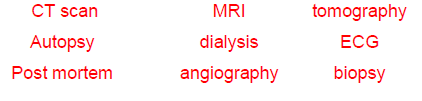 Ans:
Ans:
- CT scan - It refers to Computed Tomography. It provides an X-ray image of a body in cross-section. It is used for diagnostic purposes.
- MRI- MRI is the short form of magnetic resonance imaging. It is a diagnostic tool. Tomography- It refers to taking pictures of various sections of a human body in a three-dimensional view.
- Autopsy- It refers to the post-mortem examination.
- Dialysis- It is the process of filtration of the bloodstream usually during kidney failure.
- ECG - The electrocardiogram is a diagnostic tool that measures and records the electrical activity of the heart in exquisite detail.
- Post mortem- It refers to the medical examination and dissection of a dead body to determine the cause of death
- Angiography- Angiography is the examination of the blood vessels using x-rays and injection of a radiopaque substance.
- Biopsy- The removal and examination of a sample of tissue from a living body for diagnostic purposes is known as biopsy.
Things to do
I. The constellation Orion is associated with the legend of Osiris, the god of the afterlife.
Find out the astronomic descriptions and legends associated with the following:
- Ursa Major (Saptarishi Mandala)
- Polaris (Dhruva tara)
- Pegasus (Winged horse) (iv) Sirius (Dog star)
- Gemini (Mithuna)
Ans:
- Ursa Major (Saptarishi mandala). This bright constellation can be observed all year long as it never sinks below the horizon. It is also known as 'Greater Bear' as it represents the back and tail of the bear. According to Sanskrit mythology, this group of seven sages (sapta rishi) also moves around the constant star 'Dhruva Tara' known as Polaris.
- Polaris (Dhruva tara). This star remains constant and always points to the North. The direction of Ursa Major keeps changing with the passage of the night, but Polaris remains unchanged. It is associated with the legend of Dhruva, the six year old boy who was blessed by Lord Vishnu with a permanent and constant abode in the universe.
- Pegasus (Winged horse). This is associated with Greek mythology as the winged horse, sprung from Medusa's blood. It carries lightning bolts for Zeus. Pegasus' constellation may be seen when stars are out.
- Sirius (Dog star). This is associated with the legend of Orion. It is called 'Dog Star' as it represents Orion's large hunting dog. The first glimpse of Sirius at dawn announced the rising of the Nile in ancient Egypt.
- Gemini (Mithuna). A combination of two Nakshatras-Aardhara and Punarvasu and having contradictory qualities.
II. Some of the leaves and flowers mentioned in the passage for adorning the dead are willow, olive, celery, lotus, cornflower. Which of these are common in our country?
Ans: Willow, olive, lotus and cornflower are common in our country.
III. Name some leaves and flowers that are used as adornments in our country.
Ans: Roses, Lotus, myrtles, marigolds, champa and chameli flowers and the leaves of mango, peepal, banana and basil are used as adornments in our country.
FAQs on NCERT Solutions - Discovering Tut: The Saga Continues
| 1. What is the main theme of "Discovering Tut: The Saga Continues"? |  |
| 2. How does the author depict the character of King Tutankhamun in the article? | |
| 3. What role does archaeology play in the understanding of King Tutankhamun's life? | |
| 4. What are some significant artifacts mentioned in the article that were found in King Tutankhamun's tomb? | |
| 5. How has the discovery of King Tutankhamun's tomb influenced modern perceptions of ancient Egypt? | |