Short Answer Questions (with Solutions) - Forms of Market and Price Determination

Very short answer questions
1. Define perfect competition.
Ans:- Perfect competition is a market with large number of buyers and sellers , selling homogeneous product at same price.
2. Define monopoly.
Ans: Monopoly is a market situation dominated by a single seller who has full control over the price.
3. Define monopolistic competition.
Ans:- It refers to a market situation in which many buyers and sellers selling differentiated product and have partial control over the price.
4. Under which market form firm is a price maker?
Ans:- Monopoly
5. What are selling cost?
Ans:- Cost incurred by a firm for the promotion of sale is known as selling cost. (Advertisement cost)
6. What is oligopoly?
Ans:- Oligopoly is defined as a market structure in which there are few large sellers who sell either homogenous or differentiated goods.
7. In which market form is there product differentiation?
Ans:- Monopolistic competition market and oligopoly market
8. What is product differentiation?
Ans: It means close substitutes offered by different producers to show their output differs from other output available in the market. Differentiation can be in colour, size packing, brand name etc to attract buyers.
9. What do you mean by patent rights?
Ans:- Patent rights is an exclusive right or license granted to a company to produce a particular output under a specific technology.
10. What is price discrimination?
Ans: - It refers to charging of different prices from different consumers for different units of the same product.
11. What is the shape of marginal revenue curve under monopoly?
Ans:- Under monopoly market MR curve is downwards sloping curve form left to right and it lies below the AR curve.
12. What do you mean by abnormal profits?
Ans:- It is a situation for the firm when TR > TC.
13. Why AR is equal to MR under perfect competition?
Ans:- AR is equal to MR under perfect competition because price is constant.
14. What are advertisement costs?
Ans:- Advertisement cost are the expenditure incurred by a firm for the promotion of its sales such as publicity through TV , Radio , Newspaper , Magazine etc.
15. What is short period?
Ans:- Short period refers to that much time period when quantity of output can be changed only by changing the quantity of variable input and fixed factors remaining same.
16. Define long period.
Ans:- Long period refers to that much time period available to a firm in which it can increase its outputs by changing its fixed and variable inputs.
17. What is meant by normal profit?
Ans:- Normal profit is the minimum amount of profit which is required to keep an entrepreneur in production in the long run.
18. What is break-even price?
ANs:- In a perfectly competitive market, break- even price is the price at which a firm earn normal profit (Price=AC). In the long run, Break- even price is that price where P=AR=MC
Short Answer Questions: (3 / 4 Marks)
Q1. Explain any four characteristics of perfect competition market.
Ans:-
i) Large number of buyers and sellers : The number of buyers and sellers are so large in this market that no firm can influence the price.
ii) Homogeneous products: Products are uniform in nature. The products are perfect substitute of each other. No seller can charge a higher price for the product. Otherwise he will lose his customers.
iii) Perfect knowledge: Buyers as well as sellers have complete knowledge about the product.
iv) Free entry and exit of firm: Under perfect competition any firm can enter or exit in the market at any time. This ensures that the firms are neither earning abnormal profits nor incurring abnormal losses.
Q2. Explain briefly why a firm under perfect competition is a price taker not a price maker?
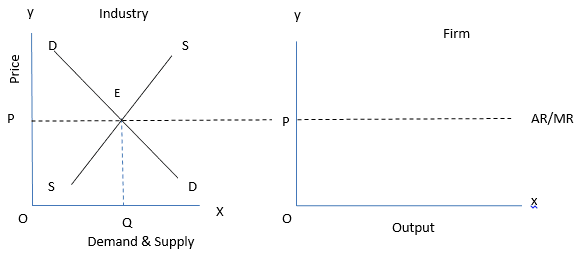
Ans:- A firm under perfect competition is a price taker not a price maker because the price is determined by the market forces of demand of supply. This price is known as equilibrium price. All the firms in the industry have to sell their outputs at this equilibrium price. The reason is that, number of firms under perfect competition is so large. So no firm can influence the price by its supply. All firms produce homogeneous product.
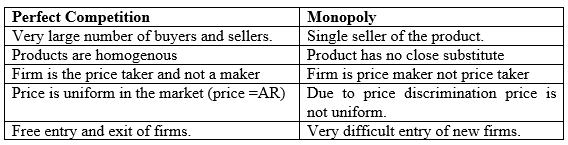
Q3. Distinguish between monopoly and perfect competition.
Ans.
Q4. Which features of monopolistic competition are monopolistic in nature?ii) Control over price
Ans:-
- Product differentiation
- Control over price
- Downward sloping demand curve
Q5. What are the reasons which give emergence to the monopoly market?
Ans:-
- Patent Rights: Patent rights are the authority given by the government to a particular firm to produce a particular product for a specific time period.
- Formation of Cartel: Cartel refers to a collective decision taken by a group of firms to avoid outside competition and securing monopoly right.
- Government licensing: Government provides the license to a particular firm to produce a particular commodity exclusively.
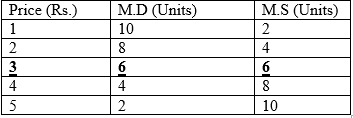
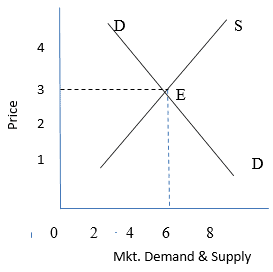
Q6. Explain the process of price determination under perfect competition with the help of schedule and a diagram.
Ans. Equilibrium price is that price which is determined by market forces of demand and supply. At this price both demand and supply are equal to each other. Diagrammatically it is determined at the point where demand curve and supply curve intersect each other. At this point price is known as equilibrium price and quantity is known as equilibrium quantity.
Q7. When will equilibrium price not change even if demand and supply increase?
Ans:- When proportionate increase in demand is just equal to proportionate increase in supply. Equilibrium price will not change. It can be shown in the following diagrams.
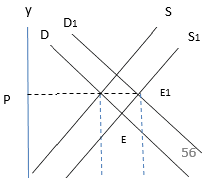
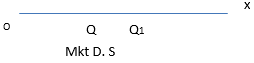
In the above diagram increase in demand is just equal to increase in supply. Demand curve shift from D to D1 and supply curve shift from S to S1 which intersect at point E. Thus equilibrium price remain unchanged at OP though equilibrium quantity increased from OQ to OQ1.
Q8. How does increase in price of substitute goods in consumption affect the equilibrium price of a good? Explain with a diagram.
Ans:- An increase in price of substitute goods (coke) will cause increase in demand for its related goods (Pepsi) . The demand curve for Pepsi will shift to the right side. The supply curve of Pepsi remains the same. It will lead to an increase in equilibrium price of Pepsi and increase in quantity also.
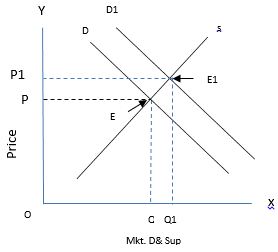
Result: Price increases from OP to OP1.Quantity demand increases from OQ to OQ1
Q9. How does the equilibrium price of a normal commodity change when income of its buyers falls? Explain the chain effects.
Ans.
- When income falls demand falls
- Supply remaining unchanged .There is excess supply at a given price
- This leads to competition among sellers to reduce the price.
- As a result demand starts rising and supply starts falling.
- These changes continue till a new equilibrium price is established where demand equal supply.
- Equilibrium price falls.
Q10. Show with the help of diagram the effect on equilibrium price and quantity when supply is perfectly inelastic and demand increases and decreases?
Ans:-
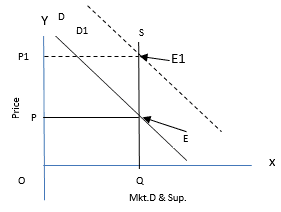
When supply is perfectly inelastic and demand increases. Demand curve shift to towards right. The new demand curve D1 intersects the supply curve at point E1.
Result : Price increases from OP to OP1 and quantity demand remains unchanged.
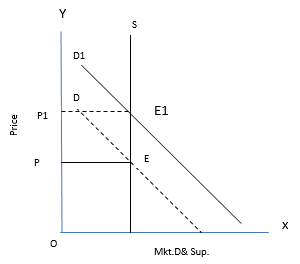
In the above diagram demand curve shift left wards from D to D1 Price falls from OP to OP1 , but quantity remains same.
FAQs on Short Answer Questions (with Solutions) - Forms of Market and Price Determination
| 1. How do I identify whether a market is perfectly competitive or monopolistic in exam questions? |  |
| 2. What's the difference between price determination in perfect competition versus monopoly? | |
| 3. Why do firms in monopolistic competition have downward-sloping demand curves unlike perfectly competitive firms? | |
| 4. How do I work out equilibrium price and quantity in oligopoly market structures for A Level exams? | |
| 5. What common mistakes do students make when comparing price determination across different market forms? | |