Commerce Exam  >  Commerce Notes  >  Economics Class 12  >  Government Budget and the Economy Chapter Notes - Economics Class 12 - Commerce

Government Budget and the Economy Chapter Notes - Economics Class 12 - Commerce

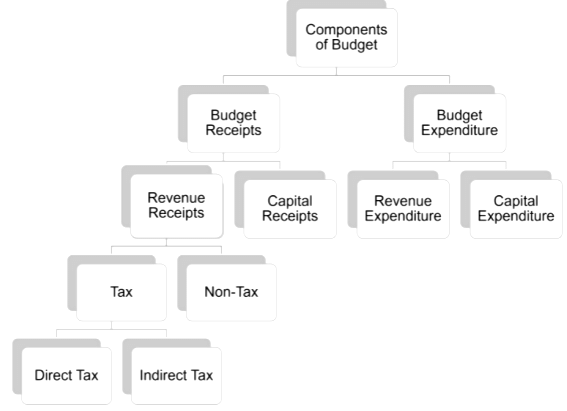
Government Budget: Meaning and Components

The Indian Constitution (Article 112) requires the Government of India to present an Annual Financial Statement before Parliament. This statement contains the estimated receipts and expenditures for each financial year (1 April - 31 March) and forms the core of the government budget.

Although the budget covers a single financial year, its effects extend beyond that year. To track government finances, two separate accounts are maintained:

  • Revenue Account (Revenue Budget): Records income and expenditure relating to the current financial year.
  • Capital Account (Capital Budget): Records transactions that create or extinguish assets and liabilities of the government.

Understanding these accounts helps in appreciating the objectives and impact of the budget on the economy.

Government Budget: Meaning and Components

MULTIPLE CHOICE QUESTION
Try yourself: What does the Revenue Account in the government budget record?
A

Government assets

B

Income and expenditure for the current financial year

C

Future financial plans

D

Government liabilities

Objectives of the Government Budget

The government intervenes in the economy mainly to enhance public welfare. The budget performs three central functions:

Allocation Function of the Government Budget

The allocation function concerns the provision of goods and services that private markets either do not supply or supply inefficiently.

  • Public goods (e.g., national defence, roads, government administration) are provided because private markets fail to supply them efficiently.
  • Private goods (e.g., clothes, cars, food) are rivalrous and excludable; private markets normally supply them.
  • Public goods are non-rivalrous (one person's consumption does not reduce another's) and non-excludable (people cannot be easily excluded from using them), which causes the free-rider problem. To overcome this, the government raises funds through taxation and provides these goods.
  • Public goods may be publicly provided (funded via the budget and produced either by government or private producers) or publicly produced (produced directly by the government).

Redistribution Function of the Government Budget

The budget transfers purchasing power from some groups to others to achieve a fairer distribution of income and welfare.

  • National income is shared between private income (earnings of households and firms) and public income (revenue collected by the government).
  • Households receive personal income, and their spending capacity after taxes and transfers is personal disposable income.
  • The government redistributes income using taxes (which reduce disposable income, especially for richer groups) and transfers (subsidies, pensions, welfare payments that increase income of poorer groups).

Through these measures the government seeks a more equitable income distribution.

Stabilization Function of the Government Budget

The budget is a tool for stabilising the economy-controlling demand, employment and price stability.

  • In periods of low aggregate demand and rising unemployment, the government can increase spending or reduce taxes to boost demand and employment.
  • In periods of excess demand and rising inflation, the government can reduce spending or increase taxes to dampen demand.

This stabilization function helps prevent extreme fluctuations in output, employment and prices.

Stabilization Function of the Government Budget

Classification of Receipts

Government receipts are classified into Revenue Receipts and Capital Receipts, depending on whether they create liabilities or reduce financial assets.

1. Revenue Receipts

Revenue receipts do not create future liabilities for the government and are non-redeemable. They are of two types: tax revenue and non-tax revenue.

Tax Revenue

Tax revenue is raised through direct taxes and indirect taxes:

  • Direct taxes: Levied on the income or wealth of individuals and firms, e.g., income tax and corporation tax.
  • Indirect taxes: Levied on goods and services and collected through market transactions. Examples include:
    • Excise duty: Tax on goods produced within the country.
    • Customs duty: Tax on imports and exports.
    • Service tax: Was levied on services earlier; it has now been subsumed under Goods and Services Tax (GST).

Certain direct taxes that were small revenue sources-such as wealth tax, gift tax and estate duty-have been abolished over time.

The government often uses progressive taxation (higher rates for higher incomes) to achieve redistribution. Indirect taxes are usually structured so that:

  • Necessities are exempt or taxed at low rates.
  • Comforts and semi-luxuries are taxed moderately.
  • Luxuries, tobacco and petroleum products are taxed heavily.

Non-Tax Revenue

Non-tax revenue includes:

  • Interest receipts on loans given by the government.
  • Dividends and profits from government investments in public enterprises.
  • Fees and service charges for government services.
  • Grants-in-aid from foreign governments or international organisations.
Non-Tax Revenue

2. Capital Receipts

Capital receipts either create liabilities or reduce financial assets of the government. They fall into:

Debt-Creating Receipts

  • Loans and borrowings: Funds borrowed from external agencies (foreign governments, multilateral agencies) or internal sources (sale of government bonds and securities). These create obligations that must be repaid with interest.

Non-Debt Creating Receipts

  • Disinvestment: Sale of government shares in public sector undertakings (PSUs), which reduces government financial assets without creating liabilities.

Capital receipts help meet the government's financing needs but affect future fiscal stability because of repayment obligations or loss of income-generating assets.

Sources of Capital Receipts

  • Borrowings: Funds raised from the public, Reserve Bank of India, and other lenders; these create liabilities since they must be repaid.
  • Recovery of loans: Repayment of loans previously given by the government (reduces government's financial assets).
  • Other receipts: Receipts from disinvestment and small savings collections.
Non-Debt Creating Receipts

Classification of Expenditure

Government expenditure is classified into Revenue Expenditure and Capital Expenditure, depending on whether the spending creates assets or liabilities.

1. Revenue Expenditure

Revenue expenditure does not create physical or financial assets. It supports the routine functioning of the government and includes:

  • Expenditure on the normal functioning of government departments and services.
  • Interest payments on loans taken by the government.
  • Grants given to state governments and other entities (even when used for asset creation).

Plan and Non-Plan Expenditure (Earlier Classification)

Earlier, budget documents classified expenditure into Plan and Non-Plan items linked to Five-Year Plans. This included:

  • Plan revenue expenditure: Expenditure related to five-year plans and assistance to state plans.
  • Non-plan revenue expenditure: Day-to-day spending on general, economic and social services-chief components being interest payments, defence expenditure, subsidies and salaries/pensions.

Since 2017 this plan/non-plan distinction was discontinued; the classification now used is revenue and capital expenditure.

2. Capital Expenditure

Capital expenditure creates assets or reduces liabilities. It includes:

  • Acquisition of assets: Land, buildings, machinery and equipment.
  • Investment in shares of public sector undertakings (PSUs).
  • Loans and advances to states, union territories and other entities.

Earlier plan/non-plan distinction for capital expenditure

  • Plan capital expenditure: Related to development projects under Five-Year Plans.
  • Non-plan capital expenditure: Capital spending on social, economic and general services.

MULTIPLE CHOICE QUESTION
Try yourself: What is a characteristic of public goods?
A

They are rivalrous.

B

They are excludable.

C

They are non-rivalrous.

D

They are always free.

Role of the Budget in National Policy

The government budget is an instrument of economic policy. Since Independence, budgets have been linked with national economic planning and are used to shape fiscal policy and development strategies.

Fiscal Responsibility and Budget Management Act, 2003 (FRBMA)

To promote fiscal discipline and transparency, the government is required to present three policy statements along with the budget as per FRBMA, 2003:

  1. Medium-term Fiscal Policy Statement: Sets three-year targets for fiscal indicators and examines sustainability of revenue expenditure.
  2. Fiscal Policy Strategy Statement: States fiscal priorities, current fiscal policies and any deviations from earlier policies.
  3. Macroeconomic Framework Statement: Analyses projected growth, fiscal balance and external economic conditions.

These statements improve accountability and help maintain fiscal stability.

Balanced, Surplus and Deficit Budget

The budget outcome depends on the relationship between government receipts and expenditure.

  • Balanced Budget: Government revenue equals government expenditure. If expenditure rises, taxes must be raised to maintain balance.
  • Surplus Budget: Revenue exceeds expenditure; surplus funds can be used for future needs or to reduce debt.
  • Deficit Budget: Expenditure exceeds revenue; common when governments borrow to finance infrastructure, welfare and development programmes.

Measures of Government Deficit

Different measures capture different aspects of the budget gap.

1. Revenue Deficit

Revenue Deficit = Revenue Expenditure - Revenue Receipts

A revenue deficit occurs when routine government expenditure (salaries, subsidies, interest etc.) exceeds revenue receipts (tax and non-tax revenues). It indicates that the government is borrowing to meet day-to-day expenses, which is undesirable for long-term growth.

2. Fiscal Deficit

Fiscal Deficit = Total Expenditure - (Revenue Receipts + Non-Debt Capital Receipts)

The fiscal deficit shows the total amount the government needs to borrow in a year to meet its expenditure net of revenue and non-debt capital receipts.

If a large part of the fiscal deficit arises from revenue deficit, it means borrowing is being used for consumption rather than investment.

3. Primary Deficit

Primary Deficit = Fiscal Deficit - Interest Payments

Primary deficit shows the fiscal gap excluding interest payments on past borrowings. A positive primary deficit implies current non-interest spending exceeds the government's current receipts.

These measures help assess the financial health of the economy and guide fiscal policy choices.

3. Primary Deficit

MULTIPLE CHOICE QUESTION
Try yourself: What is a balanced budget?
A

When income exceeds spending.

B

When spending exceeds income.

C

When income matches spending.

D

When there is a surplus of funds.

Fiscal Policy: Government's Role in Economic Stability

John Maynard Keynes, in The General Theory of Employment, Interest and Money, emphasised the importance of fiscal policy-the use of government spending and taxation-to stabilise output and employment.

How the Government Affects the Economy

  1. Government Spending (G): Directly increases aggregate demand; higher G raises production and employment.
  2. Taxes (T) and Transfers (TR):
    • Taxes reduce households' disposable income, thereby lowering consumption.
    • Transfers (pensions, unemployment benefits, subsidies) increase disposable income and boost consumption.

Consumption depends on income and the marginal propensity to consume (MPC). A common behavioural specification is that consumption (C) depends on disposable income (Y - T) and MPC (c):

How the Government Affects the Economy

where Y denotes national income and c denotes the marginal propensity to consume (MPC).

Aggregate demand (AD) then becomes:

How the Government Affects the Economy

where I denotes investment and G government spending.

Impact of Government Expenditure on Income

  • If G > T, the government runs a deficit budget (spending exceeds revenue).
  • If G < T, the budget is in surplus.
  • An increase in G (with T unchanged) shifts aggregate demand upward and raises equilibrium income.

An increase in government spending generates additional income through the multiplier effect. The total change in income (ΔY) resulting from a change in government spending is given by the government spending multiplier:

Impact of Government Expenditure on Income

Thus, a rise in G causes a more than proportional rise in total income because consumption rises as income increases.

Changes in Taxes

A reduction in taxes increases households' disposable income (Y - T), raising consumption and aggregate demand.

Tax Multiplier

The tax multiplier measures the effect of a change in taxes on national income and equals:

Changes in Taxes

where c is the MPC. Since a tax cut raises income and spending, the tax multiplier is negative (a reduction in taxes raises income).

Changes in Taxes

Comparing Government Spending and Tax Multipliers

  • Government spending multiplierdirectly increases aggregate demand and therefore has a larger immediate impact on income:
    Comparing Government Spending and Tax Multipliers
  • Tax multiplieraffects income indirectly via disposable income and consumption:
    Comparing Government Spending and Tax Multipliers

Because taxes influence spending indirectly, the tax multiplier is smaller in absolute value than the government spending multiplier.

Example

If MPC = 0.8:

  • Government spending multiplier =
    Example
  • So, an increase in government spending by ₹100 leads to an income increase of ₹500.
  • Tax multiplier =
    Example
  • So, a tax cut of ₹100 increases income by ₹400.
  • Government spending has a larger effect on national income than equivalent tax cuts.
  • Both instruments stimulate economic activity, but direct spending is generally more powerful in raising aggregate demand.

Balanced Budget Multiplier

The tax multiplier is always one less in absolute value than the government spending multiplier. Therefore, if the government increases spending and taxes by the same amount, the net effect on income equals the change in government spending. This is known as the balanced budget multiplier:

Balanced Budget Multiplier

For example, if the government spends ₹100 more and raises taxes by ₹100, national income rises by exactly ₹100.

Why the Balanced Budget Multiplier Equals 1

  • An increase in government spending raises income directly and also raises consumption via the multiplier.
  • An equivalent tax increase reduces consumption, offsetting part of the spending effect.
  • When the increase in G equals the increase in T, the net effect on income equals the level of increase in G.

Proportional Taxes and the Multiplier

When taxes are proportional to income (T = tY), a part of any rise in income is automatically taken as tax. This reduces the effective MPC and therefore reduces the multiplier.

Proportional Taxes and the Multiplier

As (1 - t) < 1, the resulting multiplier is smaller than under a lump-sum tax system:

Proportional Taxes and the Multiplier
Proportional taxes make the AD schedule flatterProportional taxes make the AD schedule flatter
Example

If MPC = 0.8 and the tax rate t = 0.25:

  • Effective MPC = 0.8 × (1 - 0.25) = 0.6.
  • Government spending multiplier = 1 / (1 - 0.6) = 2.5.
  • If G increases by ₹100, income increases by ₹250 (instead of ₹500 under lump-sum taxes).

This demonstrates that proportional taxes reduce the overall impact of government spending on income.

The document Government Budget and the Economy Chapter Notes - Economics Class 12 - Commerce is a part of the Commerce Course Economics Class 12.
All you need of Commerce at this link: Commerce
61 videos|350 docs|44 tests

FAQs on Government Budget and the Economy Chapter Notes - Economics Class 12 - Commerce

1. What is a government budget and why is it important for the economy?
Ans. A government budget is a financial plan that outlines the government's expected revenues and expenditures over a specific period, usually a year. It is important for the economy because it helps allocate resources to various sectors, influences economic growth, controls inflation, and ensures the provision of public services.
2. What are the main components of a government budget?
Ans. The main components of a government budget include revenues (such as taxes and grants), expenditures (including public services, infrastructure, and welfare programs), and the budget balance (the difference between revenues and expenditures, which can be a surplus, deficit, or balanced budget).
3. How does a government budget impact public services?
Ans. A government budget directly impacts public services by determining how much funding is allocated to various sectors such as education, healthcare, and infrastructure. A well-planned budget ensures that essential services are adequately funded, while budget cuts can lead to a reduction in service quality or availability.
4. What is a budget deficit and what are its consequences?
Ans. A budget deficit occurs when a government's expenditures exceed its revenues. The consequences can include increased national debt, higher interest rates, reduced public investment, and potential future tax increases. Long-term deficits can lead to economic instability and reduced investor confidence.
5. How do government budgets influence economic policies?
Ans. Government budgets influence economic policies by determining fiscal policy direction, including taxation and spending levels. A budget can promote economic growth through investments in infrastructure and education or aim to control inflation by reducing spending. The budget reflects the government's priorities and economic strategy.
Related Searches
Previous Year Questions with Solutions, Semester Notes, pdf , study material, practice quizzes, mock tests for examination, Important questions, Summary, Extra Questions, MCQs, video lectures, ppt, shortcuts and tricks, past year papers, Government Budget and the Economy Chapter Notes - Economics Class 12 - Commerce, Exam, Objective type Questions, Government Budget and the Economy Chapter Notes - Economics Class 12 - Commerce, Sample Paper, Viva Questions, Government Budget and the Economy Chapter Notes - Economics Class 12 - Commerce, Free;