Long Answer Questions - Government Budget and the Economy

06 MARK QUESATIONS AND ANSWERS
Q1. How is tax revenue different from administrative revenue?
Ans: Tax Revenue:-
- It Is The Main Source Of Revenue For The Government.
- It Arises From Taxes Levied By The Government On Individuals And Firms.
- Taxes Are Of Two Types: Direct And Indirect.
- Direct Taxes Are Levied Directly On Income Or Wealth Of Persons. Examples: Income Tax, Corporate Tax, Wealth Tax. Incidence And Impact Fall On The Same Person.
- Indirect Taxes Are Levied On Production Or Sale Of Goods And Services. Examples: Sales Tax, Excise Duty. The Tax Is Paid By One Person But The Burden Can Be Passed To Another.
Administrative Revenue:-
- It Arises From Fees And Charges That The Government Collects For Its Administrative Functions.
- It Includes Items Such As:
a. Fees (For Services Provided By Government Departments)
b. Licence Fees
c. Fines And Penalties
d. Forfeitures Of Surety By Courts
e. Escheat - The Claim Of The Government On Property Of A Person Who Dies Without Legal Heirs.
Q2. What is a balanced government budget? Explain the multiplier effect of a balanced budget.
Ans:
- Balanced Budget: - A Budget Is Said To Be Balanced When Estimated Government Revenue Equals Estimated Government Expenditure. In Other Words, There Is No Planned Deficit Or Surplus.
- Multiplier Effect Of A Balanced Budget:-
a. When An Increase In Government Expenditure (ΔG) Is Financed By An Equal Increase In Lump-Sum Taxes (ΔT = ΔG), The Combined Effect On National Income (ΔY) Can Be Shown Using The Spending And Tax Multipliers.
b. Let MPC Be The Marginal Propensity To Consume. The Government Spending Multiplier (k) = 1 / (1 - MPC). The Tax Multiplier = -MPC / (1 - MPC).
c. The Net Effect Of An Equal Increase In Government Spending And Taxes Is: k + (Tax Multiplier) = 1 / (1 - MPC) - MPC / (1 - MPC) = 1.
d. Therefore, The Balanced Budget Multiplier Is Unity (1). This Means That If Government Spending Rises By Rs. X And Taxes Rise By The Same Amount To Finance That Spending, National Income Will Rise By Approximately Rs. X.
e. Implication: A Balanced Budget Can Have An Expansionary Effect On Output Even Though Taxes Increase, Provided Taxes Are Lump-Sum And There Are No Offsetting Effects (Such As Large Interest Rate Rises Or External Leakages). It Is Often Suggested As A Policy To Reduce Underemployment And Move Towards Full Employment.
NUMERICALS
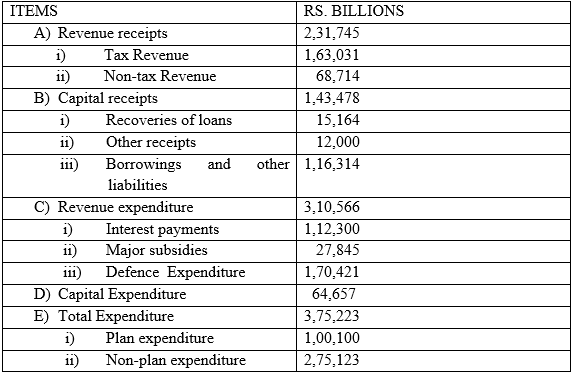
Q1. The following figures are based on budget estimates of Government of India for the year 2001 - 2002.
Calculate
i) Fiscal Deficit
ii) Revenue Deficit and
iii) Primary deficit.
Ans:
i) Fiscal Deficit = Total Expenditure - Revenue Receipts - Non-debt Capital Receipts.
Total Expenditure = 3,75,223
Revenue Receipts = 2,31,745
Other Non-debt Receipts (as given) = 15,164 and 12,000
So, Fiscal Deficit = 3,75,223 - 2,31,745 - 15,164 - 12,000 = Rs. 1,16,314.
ii) Revenue Deficit = Revenue Expenditure - Revenue Receipts.
Revenue Expenditure = 3,10,566
Revenue Receipts = 2,31,745
Therefore, Revenue Deficit = 3,10,566 - 2,31,745 = Rs. 78,821.
iii) Primary Deficit = Fiscal Deficit - Interest Payments.
Fiscal Deficit = 1,16,314
Interest Payments = 1,12,300
Therefore, Primary Deficit = 1,16,314 - 1,12,300 = Rs. 4,014.
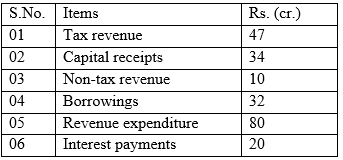
Q2. From the following data about a government budget find
a) Revenue Deficit
b) Fiscal Deficit and
c) Primary Deficit.
Ans:
a) Revenue Deficit = Revenue Expenditure - (Tax Revenue + Non-tax Revenue).
Given: Revenue Expenditure = 80
Tax Revenue = 47
Non-tax Revenue = 10
Revenue Deficit = 80 - (47 + 10) = 80 - 57 = 23 (cr.).
b) Fiscal Deficit = Total Borrowings (As Shown In The Data).
Given Borrowings = 32 (cr.).
c) Primary Deficit = Fiscal Deficit - Interest Payments.
Fiscal Deficit = 32 (cr.)
Interest Payments = 20 (cr.)
Primary Deficit = 32 - 20 = 12 (cr.).
HIGHER ORDER THINKING SKILLS (HOTS)
What are the three levels at which the budget impacts the economy?
Ans: The Budget Affects The Economy At Three Broad Levels:
Aggregate Fiscal Discipline:- This Refers To Controlling Overall Government Expenditure In Relation To Available Revenues. Strong Fiscal Discipline Helps Maintain Macro-Economic Stability, Keeps Deficits And Debt Within Sustainable Limits, And Reduces The Risk Of High Inflation Or Interest Rates.
Allocation Of Resources:- The Budget Determines How Resources Are Distributed Across Sectors And Programmes. Through Expenditure Priorities And Tax Policy, The Government Can Support Social Priorities (Such As Health, Education), Encourage Investment In Infrastructure, Or Provide Incentives For Key Industries.
Effective And Efficient Provision Of Programmes:- This Concerns How Well Government Spending Translates Into Desired Outcomes. Effectiveness Measures Whether Programmes Achieve Their Goals (For Example, Improved Literacy Or Health). Efficiency Measures Whether Public Funds Are Used Economically To Produce Those Outcomes. Good Budget Design Emphasises Both Targeting And Performance Monitoring.
FAQs on Long Answer Questions - Government Budget and the Economy
| 1. What is a government budget and how does it impact the economy? |  |
| 2. How does the government generate revenue for its budget? | |
| 3. What are the main components of a government budget? | |
| 4. How does the government budget impact different sectors of the economy? | |
| 5. What are the possible consequences of an unbalanced government budget? | |