NCERT Solutions - Principles of Management

Very Short Answer Type Questions
Q1: What makes principles of management flexible?Ans: Management principles are not rigid rules; they are general guidelines that managers adapt to suit different situations. They allow managers to select and apply the most appropriate principle or combination of principles according to the circumstances, organisational needs and the nature of the task. Each principle acts as a management tool that can be modified in practice to obtain the best results.
Q2: State the main objective of time study.
Ans: The main objective of a time study is to establish the standard time required to perform a specified job. This standard time helps management in planning the number of workers needed, scheduling work, and fixing fair wages and incentive schemes based on measured performance.
Q3: Name the principle that is an extension of the 'harmony, not discord'.
Ans: Co-operation, not Individualism is the principle that extends the idea of 'Harmony, not Discord'.
Q4: State any two causes of fatigue that may create hindrance in the employee's performance.
Ans:
- Long working hours and inadequate rest periods.
- Poor or uncordial relationships with supervisors or colleagues.
Q5: SanakLal and Gagan started their career in Wales Limited (a printing press) after going through a rigorous recruitment process. Since they had no prior work experience, the firm decided to give them one year to prove themselves. Name the principle of management followed by Wales Limited.
Ans: The firm followed the principle of Stability of Personnel, which emphasises giving employees sufficient time and opportunity to settle into their roles and demonstrate their capabilities.
Q6: Which technique is used by Taylor for distinguishing efficient and inefficient workers?
Ans: Taylor used the Differential Piece Wage System, which rewards workers with higher piece rates if they perform above a set standard and pays lower rates to those who do not, thereby distinguishing efficient from inefficient workers.
Short Answer Type Questions
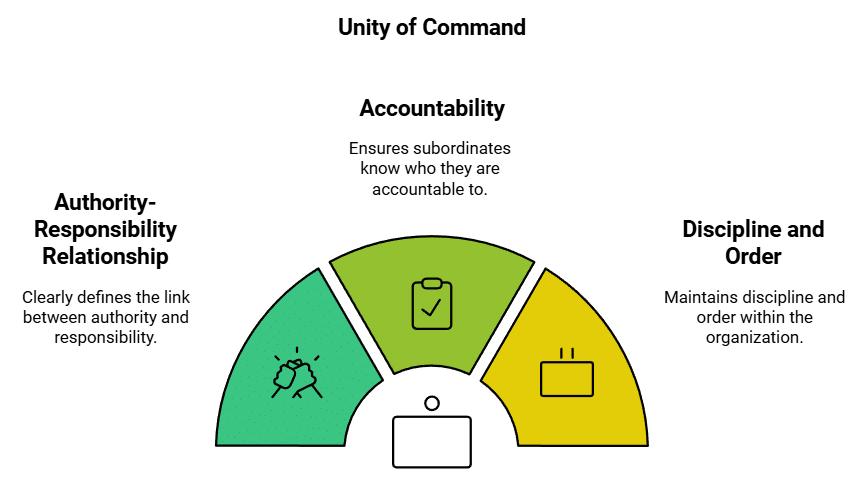
Q1: How is the Principle of 'Unity of Command' useful to management? Explain briefly.Ans: The principle of Unity of Command means each subordinate should receive orders from, and be accountable to, only one superior. Its usefulness to management includes:
- Clearly defined authority-responsibility relationships, avoiding confusion about who is accountable.
- Improved discipline, since instructions come from a single source.
- Reduced conflict and overlapping instructions, which helps in smoother execution of work.
Q2: Define scientific management. State any three of its principles.
Ans: Scientific Management is the systematic study of work methods to improve productivity by identifying and applying the best way to perform tasks. It aims at selecting the right person for the job, training them, and ensuring work is done in the most efficient manner. Three principles of scientific management are:
- Science, Not Rule of Thumb: Replace arbitrary methods by scientifically tested procedures to identify the best method of doing a job.
- Harmony, Not Discord: Labour and management should work in cooperation rather than in conflict; a change of attitude on both sides (a mental revolution) is necessary to create mutual trust.
- Co-operation, Not Individualism: Management and workers should co-operate to increase productivity, with management accepting good worker suggestions and workers avoiding actions that harm organisational goals.
Q3: If an organisation does not provide the right place for physical and human resources in an organisation, which principle is violated? What are the consequences of it?
Ans: The principle of Order is violated. Consequences include:
- Wasted time locating materials and people.
- Delays in decision-making and production schedules.
- Increased energy wastage leading to inefficiency.
- Hindrance to smooth business operations and reduced productivity.
Q4: Explain any four points regarding significance of principles of management.
Ans: Significance of principles of management:
- Provide Managers with Useful Insights: Principles improve managers' understanding of situations and help them act more effectively, for example, delegation frees time for strategic tasks.
- Scientific Decision Making: Principles encourage logical, evidence-based decisions rather than guesswork.
- Optimum Utilisation of Resources and Effective Administration: Following principles helps in saving time and effort, leading to better productivity and lower costs.
- Management Training, Education and Research: Principles form the foundation for management education and training and guide further research in managerial best practice.
Q5: Explain the principle of 'Scalar Chain' and gang plank.
Ans: The Scalar Chain is the formal line of authority running from the highest to the lowest levels in an organisation. It specifies the path for communication and responsibility, ensuring clarity in authority relationships.
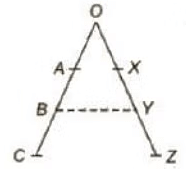
In the diagram, O heads two teams where A and X are at the same level, B and Y are at the same level, and C and Z are at the same level. Communication normally follows the chain A → B → C and X → Y → Z. Direct communication between C and Z would have to follow the full chain and may be slow in an emergency. To overcome this, Fayol suggested the Gang-Plank, which permits direct communication between employees at the same level (for example, C and Z) when speed is required, while still maintaining overall unity of command.
Q6: A production manager at top level in a reputed corporate, Mr. Rathore holds the responsibility for ordering raw material for the firm. While deciding on the supplier for the financial year 2017-18, he gave the order to his cousin at a higher price per unit instead of the firm's usual supplier who was willing to lower the rates for the order. Which principle of management was violated by Mr. Rathore? What are the positive impacts of following the above identified principle?
Ans: Mr Rathore violated the principle of Subordination of Individual Interest to General Interest. This principle requires that individual interests must not prevail over the organisation's goals.
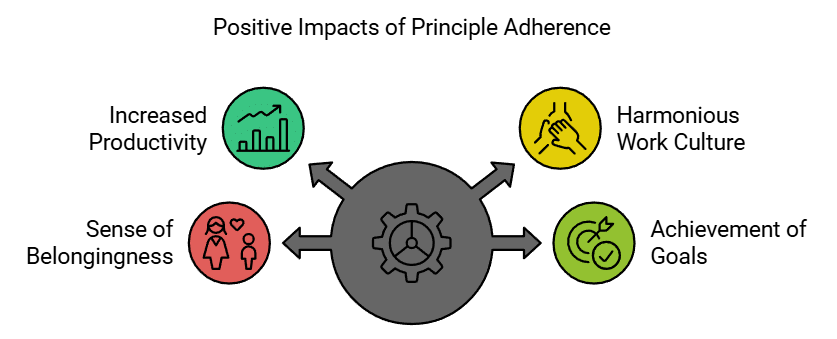
Positive impacts of following this principle include:
- Increased Productivity: Decisions aligned with organisational goals improve overall performance.
- Harmonious Work Culture: Prioritising common goals reduces conflicts and promotes teamwork.
- Sense of Belonging: Employees feel valued when the organisation acts fairly, increasing commitment.
- Achievement of Organisational Goals: Coherent actions across the organisation help achieve objectives efficiently.
Long Answer Type/ Essay Type Questions
Q1: Explain the Principles of Scientific management given by Taylor.Ans: The principles of Scientific Management given by Taylor are:
- Science, Not Rule of Thumb: Replace traditional, arbitrary methods by scientific study to identify the best way of doing each task and standardise it across the organisation.
- Harmony, Not Discord: Labour and management should cooperate through mutual respect and understanding rather than remain in adversarial positions; this change in attitude is called the mental revolution.
- Co-operation, Not Individualism: Management and workers must work together rather than compete; management should accept good suggestions from workers and workers should avoid actions that harm organisational interests.
- Development of Each Person to His/Her Greatest Efficiency and Prosperity: Select, train and develop workers scientifically so that their abilities match job requirements; provide training to raise skills, leading to higher efficiency and mutual prosperity.
Q2: Explain the following Principles of management given by Fayol with examples:
(a) Unity of direction
(b) Equity
(c) Espirit de corps
(d) Order
(e) Centralisation and decentralisation
(f) Initiative
Ans: Fayol's general principles of management explained briefly are:
(a) Unity of Direction: All units working on the same objective should be under one plan and one head. For example, marketing activities for a product (advertising, sales promotion and distribution) should be coordinated under one manager so efforts are aligned.
(b) Equity: Managers should be fair and kind in their dealings to gain loyalty and devotion. Decisions should be merit-based without discrimination on the basis of gender, caste, religion or language.
(c) Espirit de Corps: Management must build team spirit and unity among workers. Good teamwork improves coordination and performance; leaders should give credit to the team rather than taking personal credit.
(d) Order: There should be a place for everything and everyone. Materials, tools and people should be arranged so that no time is wasted in locating them and operations proceed smoothly.
(e) Centralisation and Decentralisation: Centralisation is the concentration of authority at top levels; decentralisation is the spreading of authority to lower levels. Fayol recommended a suitable mix: routine decisions may be decentralised while critical decisions remain centralised.
(f) Initiative: Employees should be encouraged to propose and carry out plans. Encouraging initiative promotes innovation and cost/time savings; organisations may reward useful suggestions.
Q3: Explain the technique of 'Functional Foremanship' and the concept of 'Mental Revolution' as enunciated by Taylor.
Ans:
Functional Foremanship: Functional foremanship is based on specialisation of supervision. Taylor argued that one foreman could not be expert in all aspects of work, so he proposed eight foremen divided between planning and production to guide workers. The eight foremen are:
Under Planning In-charge:
- Route Clerk - Specifies the sequence of operations.
- Instruction Card Clerk - Gives detailed instructions to workers.
- Time and Cost Clerk - Keeps time and cost records.
- Disciplinarian - Ensures discipline among workers.
Under Production In-charge:
- Speed Boss - Ensures work is done on time.
- Gang Boss - Assigns workers and machines for the job.
- Repair Boss - Maintains machines and tools.
- Inspector - Checks quality of output.
Mental Revolution: This concept calls for a complete change in attitude by both management and workers. Management should share gains from increased productivity with workers, and workers should co-operate to increase productivity. This mutual change of mind fosters trust, reduces conflict and benefits both parties through higher efficiency and prosperity.
Q4: Discuss the following techniques of Scientific Work Study:
(a) Time Study
(b) Motion Study
(c) Fatigue Study
(d) Method Study
(e) Simplification and standardisation of work
Ans: Techniques of scientific work study include:
(a) Time Study: Determines the standard time to perform a well-defined job by taking multiple observations. Objectives include fixing the number of workers required, designing incentive schemes and estimating labour cost. For example, if standard time for a task is 20 minutes, a worker can do three pieces in an hour.
(b) Motion Study: Analyses the body movements involved in a job to identify productive, incidental and unproductive motions. By eliminating unproductive motions and reducing incidental ones, efficiency increases.
(c) Fatigue Study: Establishes appropriate rest intervals to reduce physical and mental fatigue and maintain consistent performance. For example, scheduled breaks during long shifts help workers to recover and sustain output quality.
(d) Method Study: Seeks the best method of doing a job by examining all steps from procurement to delivery. Its objective is to minimise cost and time while maximising customer satisfaction.
(e) Simplification and Standardisation of Work: Standardisation sets fixed types, sizes and quality levels for products and processes to ensure interchangeability and consistent performance. Simplification reduces unnecessary variety of products or parts, resulting in lower costs, better equipment utilisation and higher turnover.
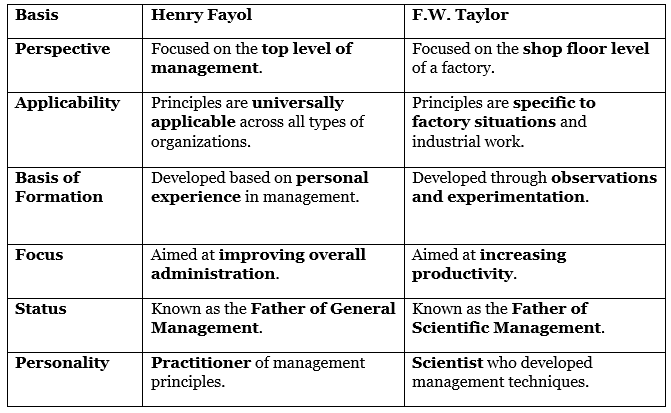
Q5: Discuss the differences between the contributions of Taylor and Fayol.
Ans:
Q6: Discuss the relevance of Taylor and Fayol's contribution to the contemporary business environment.
Ans: The contributions of Taylor and Fayol remain relevant today:
- Taylor's scientific management provides methods for improving shop-floor productivity through work study, standardisation and incentive systems. Modern manufacturing and service processes still use these ideas to increase efficiency.
- Fayol's general principles guide overall managerial practice across levels - planning, organising, commanding, coordinating and controlling. They help improve coordination, clarify authority and encourage effective organisational structure.
- Together, their ideas support both operational efficiency and managerial effectiveness in contemporary organisations, including large corporations and small firms.
Q7: 'Bhasin' Limited was engaged in the business of food processing and selling its products under a popular brand. Lately the business was expanding due to good quality and reasonable prices. Also with more people working the market for processed food was increasing. New players were also coming to cash in on the new trend. In order to keep its market share in the short run the company directed its existing workforce to work overtime. But this resulted in many problems. Due to increased pressure of work the efficiency of the workers declined. Sometimes the subordinates had to work for more than one superior resulting in declining efficiency. The divisions that were previously working on one product were also made to work on two or more products.
This resulted in a lot of overlapping and wastage. The workers were becoming in-disciplined. The spirit of teamwork, which had characterized the company, previously was beginning to wane. Workers were feeling cheated and initiative was declining. The quality of the products was beginning to decline and market share was on the verge of decrease.
Actually the company had implemented changes without creating the required infrastructure.
Q.1. Identify the principle of management (out of 14 given by Henry Fayol) that were being violated by the company.
Ans: The company violated the following principles:
- Division of Work
- Unity of Command
- Unity of Direction
- Discipline
- Subordination of Individual Interest to General Interest
- Order
- Initiative
- Remuneration
Q.2. Explain these principles in brief.
Ans:
- Division of Work: Work should be divided according to specialisation. In the case, employees were given multiple unrelated tasks which reduced efficiency. Proper division increases skill and output.
- Unity of Command: Each subordinate must report to only one superior. When workers report to more than one boss, they receive conflicting instructions and their accountability suffers.
- Unity of Direction: Activities with the same objective should follow one plan under one head. Assigning the same unit to different products without a single plan caused overlap and confusion.
- Discipline: Rules and agreements must be respected. Overwork and lack of clear policies led to indiscipline and falling morale in the company.
- Subordination of Individual Interest to General Interest: Individual or short-term managerial decisions must not override the organisation's broader interest. Prioritising short-term market share over employees' well-being harmed long-term performance.
- Order: People and materials must be in their proper places. Lack of order produced delays, wastage and inefficiency.
- Initiative: Workers should be allowed to propose improvements. By not seeking employee input, management missed opportunities to improve processes and morale.
- Remuneration: Workers should receive fair pay for their effort. Excessive overtime without proper compensation made workers feel cheated and demotivated.
Q.3. What steps should the company management take in relation to the above principles to restore the company to its past glory? Answer Following steps should be taken by the company to retain its past glory:
Ans:
- Divide work into specialised tasks and assign roles according to employees' skills.
- Ensure each employee reports to only one superior to restore unity of command.
- Align units and functions under clear plans and heads to restore unity of direction.
- Reinstate formal rules and fair policies to maintain discipline.
- Provide fair remuneration and incentives for extra effort.
- Follow a clear hierarchical communication pattern and improve coordination.
- Encourage suggestions and feedback from employees and act on feasible ideas.
- Invest in measures to rebuild employee morale and a sense of belonging.
The management of company Bhasin now realised its folly. To rectify the situation, it appointed a management consultant 'M consultants' to recommend a restructuring plan to bring the company back on the rails. 'M consultants' undertook a study of the production process at the plant of the company Bhasin and recommended the following changes:
- Introduce scientific management of production to improve shop-floor efficiency.
- Implement production planning, including routing, scheduling, dispatching and feedback.
- Separate planning from operations by introducing Functional Foremanship.
- Conduct work study to optimise use of resources.
- Standardise activities to increase efficiency and accountability.
- Introduce a differential piece-rate system or other fair incentive schemes to motivate workers.
- Implement the above changes alongside the corrective organisational steps recommended earlier.
FAQs on NCERT Solutions - Principles of Management
| 1. What are the 14 principles of management by Henri Fayol and why do they matter for Class 12 exams? |  |
| 2. How do Taylor's scientific management principles differ from Fayol's administrative management approach? | |
| 3. What's the difference between authority and responsibility in management, and which one is more important? | |
| 4. Can you explain what "unity of command" means and give an example of when it breaks down? | |
| 5. Why is esprit de corps considered a crucial management principle for team performance? | |