NCERT Solutions - Business Environment

Very Short Answer Question
Q1. What is meant by business environment?
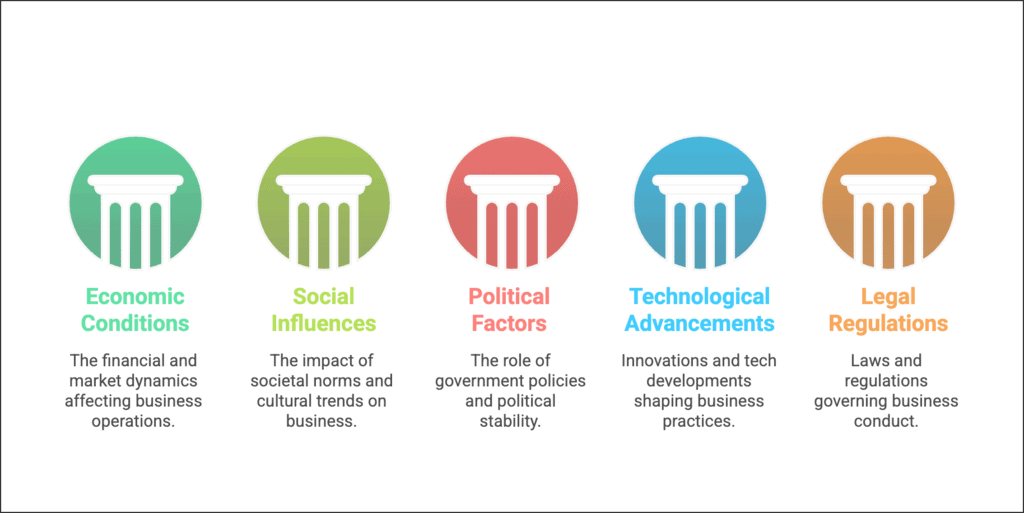
Ans: Business environment refers to the sum of all individuals, institutions and forces outside a business that can affect its performance. It includes various factors such as:
- Economic conditions
- Social influences
- Political factors
- Technological advancements
- Legal regulations
Q2. How does understanding of the business environment help in improving the performance of a business?
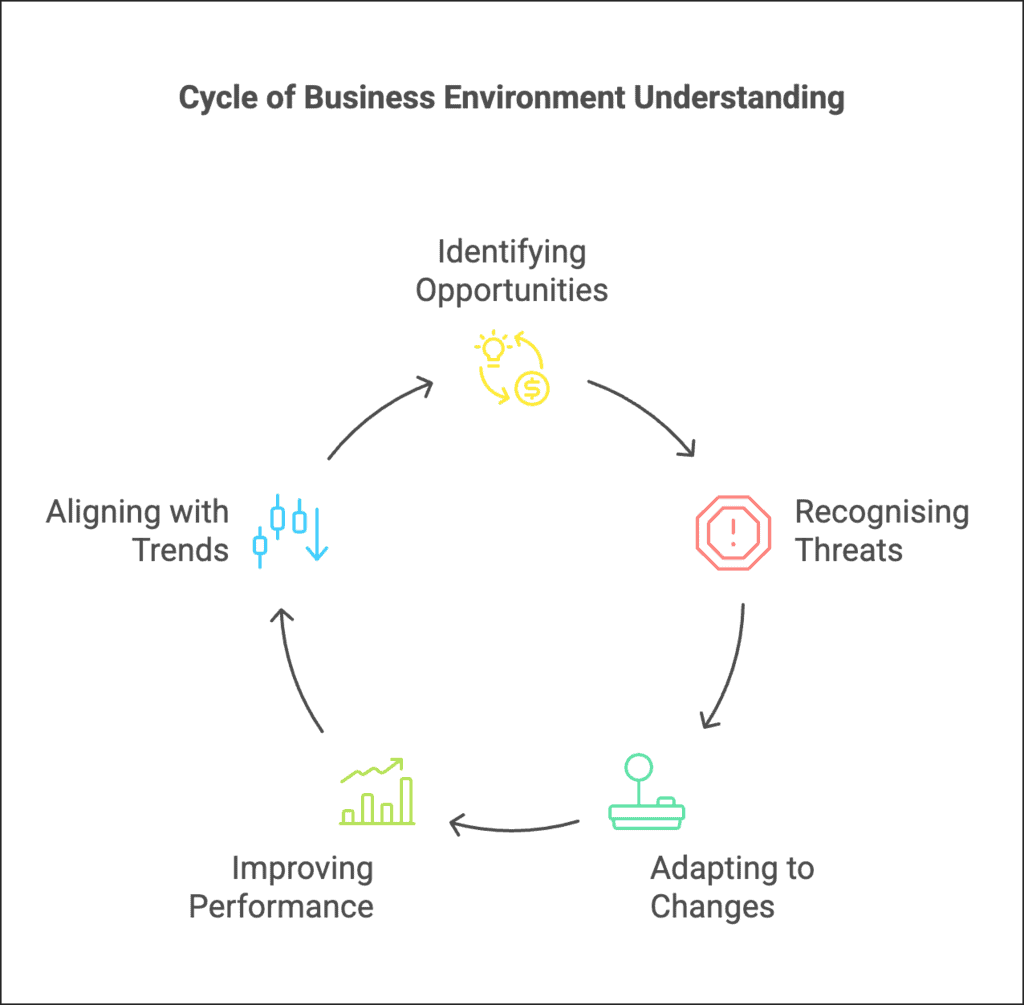
Ans: Understanding the business environment helps a firm in several ways:
- Identifying opportunities: it enables firms to spot new markets, products or technologies that can be exploited for growth.
- Recognising threats: early detection of risks (for example, new competitors or regulatory changes) allows timely corrective action.
- Adapting to change: understanding external trends helps firms adjust their strategies and operations quickly.
- assisting in planning and policy formulation so that the company plans remain realistic and feasible.
- enhancing overall performance and long-term sustainability by aligning internal strengths with external conditions.
Q3. Give an example to show that a business firm operates within numerous interrelated factors constituting the business environment. (Hint: example highlighting the interrelatedness of dimensions of business environment).
Ans: A useful example is the growing consumer interest in health and fitness, which has increased demand for fat-free cooking oils and organic foods.
This change is affected by several interconnected dimensions of the business environment:
- Social trends: rising health awareness among consumers increases demand for healthier products.
- Technological advances: improved processing and preservation methods make healthier products feasible at scale.
- Economic factors: higher disposable incomes allow consumers to choose healthier (often more expensive) options.
Q4. Krishna Furnishers Mart started its operations in the year 1954 and emerged as the market leader in the industry because of their original designs and efficiency in operations. They had a steady demand for their products but over the years, they found their market share declining because of new entrants in the field. The firm decided to review their operations and decided that in order to meet the competition, they need to study and analyze the market trends and then design and develop their products accordingly. List any two impacts of changes in business environment on Krishna Furnishers Mart's operations. (Hint: increase in competition and Market orientation).
Ans:
- Increase in competition: new entrants reduced Krishna Furnishers Mart's market share and forced the firm to rethink pricing, quality and distribution strategies.
- Market orientation: the firm now needs to study changing customer preferences and redesign products and marketing efforts to meet current demand.
Q5. Name any two specific forces of business environment affecting business.
Ans: Specific forces of the business environment that affect firms include:
- Customers: their preferences and buying behaviour directly influence product design, pricing and promotion.
- Competitors: competitors' strategies, product offerings and pricing decisions shape a firm's market share and tactical responses.
Short Answer Type Questions
Q1. Why it is important for business enterprises to understand their environment? Explain.
Ans: Understanding the business environment is important because it helps enterprises to:
- Identify opportunities: firms can spot new markets, technologies or partnerships to grow their business.
- Recognise threats: awareness of external risks (such as new competitors or legal changes) allows firms to take preventive measures.
- Adapt to changes: firms can adjust production, marketing and investment plans in response to technological, economic or social shifts.
- Improve decision-making: environmental knowledge leads to better planning and policy formulation.
- Align with trends: staying informed about consumer preferences and industry trends helps maintain relevance and competitiveness.
Q2. Explain the following terms: (a) Liberalisation (b) Privatization (c) Globalisation
Ans: Liberalisation: the removal or relaxation of government restrictions on business activity. Key aspects include:
- Deregulation of industries
- Lowering of trade barriers
- Encouraging private investment
- Promoting competition and growth
Privatisation: the transfer of ownership, management or control of public sector enterprises to private entities. The main objectives are:
- Improving efficiency
- Boosting profitability
Globalisation: the process by which economies become integrated with the rest of the world. It involves:
- Increased trade
- Foreign investment
- Technological advancements
- Free movement of goods, services, and information across borders
Q3. National Digital Library of India (NDL India) is a pilot project initiated by the HRD ministry. It works towards developing a framework of virtual repository of learning resources with a singlewindow search facility. It provides support to all academic levels including researchers, lifelong learners and differentlyabled learners free of cost. State the dimensions of business environment highlighted above.
Ans: The project highlights the following dimensions of the business environment:
- Technological environment: Creation of a virtual repository and a single-window search facility demonstrates technological progress and digital infrastructure.
- Social environment: Emphasis on lifelong learning and accessibility for differently-abled learners shows social objectives of inclusion and education.
- Political environment: As a government initiative by the Ministry of HRD, it reflects the role of public policy and political support in promoting educational resources.
Q4. State the impact of demonetization on interest rates, private wealth and real estate.
Ans: Impact of demonetization on interest rates, private wealth, and real estate:
- Interest rates: A large inflow of deposits into banks raised their liquidity, which tended to put downward pressure on interest rates.
- Private wealth: Unaccounted cash holdings fell as people were forced to deposit old notes and face greater scrutiny, reducing hidden or illicit wealth.
- Real estate: The market cooled, especially for transactions reliant on cash, and speculative demand declined, leading to reduced prices or slower growth in some segments.
Long Answer Question
Q1. How would you characterize business environment? Explain with examples, the difference between general and specific environment.
Ans: Features of business environment
- Totality of external forces: the business environment is the aggregate of all external factors that influence a firm.
- Specific and general forces: some forces affect a particular firm directly while others affect all firms in an economy.
- Interrelatedness: different elements of the environment influence one another; for example, rising life expectancy (social) increases demand for healthcare products, which spurs technological and market responses.
- Dynamic nature: the environment keeps changing because of new technologies, changing consumer tastes, and the entry of competitors.
- Uncertainty: future changes are often unpredictable, making forecasting and planning difficult.
- Complexity: many interlinked factors operate simultaneously, so managers often analyse parts of the environment separately.
- Relativity: the environment varies across countries and regions; political and legal conditions in one country may differ markedly from another.
Importance of business environment
- Identifying opportunities and gaining a competitive edge.
- Recognising threats and early warning signals.
- Coping with rapid changes.
- Assisting in planning and policy formulation.
- Enhancing overall performance.
Difference between specific and general environment
- Specific forces: these influence particular firms directly; examples include customers, suppliers, competitors and creditors.
- General forces: these affect all firms in an economy indirectly; examples include social trends, political conditions, economic policies and technological developments.
Q2. How would you argue that the success of a business enterprise is significantly influenced by its environment?
Ans: importance of business environment
- Identifying opportunities: firms that scan the environment can discover new markets or technologies early and gain first-mover advantage. for example, Maruti Udyog identified the need for affordable small cars and capitalised on that market.
- Identifying threats: knowledge of the environment helps firms detect competitive threats or regulatory changes and respond promptly by improving products or strategies.
- Tapping useful resources: understanding sources of finance, raw materials and labour helps firms secure the inputs needed for production.
- Coping with rapid changes: environmental awareness enables managers to adapt plans in response to technological change or shifting customer tastes.
- Assisting in planning and policy formulation: sound environmental analysis leads to better decisions about long-term direction and investments.
- Improving performance: continuous monitoring of the external environment helps firms remain competitive and sustain growth over time.
Q3. Explain, with examples, the various dimensions of business environment.
Ans: Economic environment: this comprises factors such as government economic policy, interest rates, taxation and monetary policy. for example, when banks reduce interest rates on long-term loans, demand for automobiles and housing often rises as borrowing becomes cheaper.
- this can stimulate investment and consumption in sectors like automobiles and construction.
Social environment: social forces include customs, values, demographic trends and societal expectations. important elements are:
(a) life expectancy
(b) shifts in the presence of women in the workforce
(c) consumption habits
Example: as more women join the workforce, demand rises for ready-to-eat meals, formal wear and electronic household gadgets.
Technological environment: scientific and technological developments create new methods of production and delivery. for example, online railway ticket booking has made travel planning more convenient and efficient for consumers.
Political environment: political stability and the attitude of the government towards business affect enterprise operations. elements include the constitution, government policies and political ideology. for example, the new economic policy of 1991 opened the economy and attracted foreign firms, though initial bureaucratic hurdles remained.
Legal environment: laws and regulations determine acceptable business conduct. firms must comply with legislation and administrative orders. for example, advertising restrictions on alcoholic beverages affect how firms promote such products.
Q4. The government of India announced Demonetization of ₹ 500 and ₹ 1,000 currency notes with effect from the midnight of November 8, 2016: As a result, the existing ₹ 500 and ₹ 1,000 currency notes ceased to be legal tender from that date. New currency notes of the denomination of ₹ 500 and ₹ 2,000 were issued by Reserve Bank of India after the announcement.
This step resulted in a substantial increase in the awareness about and use of Point of Sale machines, ewallets, digital cash and other modes of cashless transactions. Also, increased transparency in monetary transactions and disclosure led to a rise in government revenue in the form of tax collection.
(a) Enumerate the dimensions of business environment highlighted above.
(b) State the features of Demonetization.
Ans: (a) Dimensions of business environment highlighted:
Political dimension:
- The government decision to demonetise high-value notes in November 2016 shows the impact of political and policy actions on economic activity.
- Such policy moves can change business practices and consumer behaviour rapidly.
Legal dimension:
- The declaration that existing ₹ 500 and ₹ 1,000 notes ceased to be legal tender is an example of a legal change that directly affects transactions.
- Businesses had to comply immediately with new legal and transactional requirements.
Technological dimension:
- The policy accelerated the adoption of digital payment methods such as point-of-sale machines, e-wallets and other cashless options.
- Technology thus played a key role in enabling the shift towards a less cash-dependent economy.
Features of demonetisation:
- Reducing unaccounted money: holders of unaccounted cash had to deposit money in banks, exposing hidden wealth to scrutiny and taxation.
- Discouraging tax evasion: the move aimed to bring more transactions into the formal financial system and reduce illicit dealings.
- Channelising savings into banks: demonetisation increased bank deposits, thereby formalising a larger share of money in the financial system.
- Promoting cashless transactions: it encouraged the use of digital payments, point-of-sale devices and mobile wallets, accelerating financial digitisation.
Q5. What economic changes were initiated by the Government under the Industrial Policy, 1991? What impact have these changes made on business and industry?
Ans: Economic changes initiated by the government under the Industrial Policy, 1991:
- The number of industries requiring compulsory licensing was reduced to a few essential areas.
- The role of the public sector was limited to industries considered strategically important.
- Disinvestment of several public sector enterprises was undertaken.
- Foreign direct investment (FDI) was encouraged and allowed in many sectors.
- Automatic permission was given for certain technology agreements with foreign firms.
- The Foreign Investment Promotion Board (FIPB) was set up to facilitate foreign investment.
The Indian corporate sector faced several challenges due to these policy changes. Some important ones are:
- Increased competition: The entry of new domestic and foreign players intensified market competition.
- More demanding customers: Better-informed consumers expect higher quality and more choices.
- Rapid technological change: Smaller firms may struggle to keep up with costly technological upgrades.
- Need for continuous change: Firms must continuously update operations, products and management practices to survive.
- Requirement for skilled human resources: Competitive markets demand better-trained and more competent personnel.
- Shift to market orientation: Firms needed to study customer needs carefully and produce according to market demand rather than follow a purely production-oriented approach.
- Reduced budgetary support for public sector: Many public enterprises had to become self-reliant and improve efficiency to survive without heavy government backing.
Q6. What are the essential features of: (a) Liberalisation, (b) Privatization and (c) Globalisation?
Ans: The essential features of Liberalisation:
- Abolishing licensing requirements in most industries.
- No restrictions on the expansion or contraction of businesses.
- Free movement of goods and services.
- Freedom to set prices for goods and services.
- Reduction in tax rates.
- Simplified procedures for imports and exports.
- Facilitated attraction of foreign capital and technology.
Essential features of Privatisation:
- Redefinition of the role of the public sector.
- Policy of planned disinvestments in the public sector.
- Referring sick enterprises to the Board of Industrial and Financial Reconstruction.
Essential features of Globalisation:
- Import liberalisation.
- Promotion of exports.
- Reforms in foreign exchange policies.
FAQs on NCERT Solutions - Business Environment
| 1. What is the significance of the business environment in decision-making? |  |
| 2. How do economic factors affect business operations? | |
| 3. What role does government policy play in the business environment? | |
| 4. How can businesses adapt to changes in the technological environment? | |
| 5. What are the components of the business environment? | |