NCERT Solutions - Organising

Very Short Answer Type Questions
Q1: Identify the network of social relationships which arises spontaneously due to interaction at work.Ans: Informal organisation
Q2: What does the term 'Span of management' refer to?
Ans: Span of management refers to the number of subordinates that can be effectively managed by a superior.
Q3: State any two circumstances under which the functional structure will prove to be an appropriate choice.
Ans:
- When the organisation is large and requires a high degree of specialisation.
- When the focus is on increasing managerial and operational efficiency.
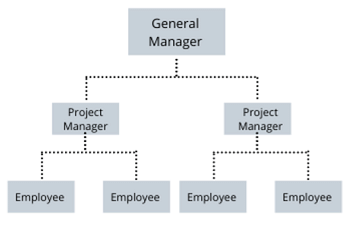
Q4: Draw a diagram depicting a functional structure.
Ans:
Q5: company has its registered office in Delhi, manufacturing unit at Gurgaon and marketing and sales department at Faridabad. The company manufactures the consumer products. Which type of organisational structure should it adopt to achieve its target?
Ans: The company should adopt a divisional structure because it operates in different geographical locations and handles diverse activities; a divisional structure allows each region or product group to be managed independently and responsively.
Short Answer Type Questions
Q1: What are the steps in the process of organising?Ans: Organising involves the following steps, which are taken in sequence.
- Identification and Division of Work: The process begins by identifying the total work to be done and dividing it into smaller, manageable tasks.
- Departmentalisation: After work is divided, similar or related jobs are grouped together to form departments or units.
- Assignment of Duties: Jobs are assigned to individuals according to their ability, experience and suitability.
- Establishing Reporting Relationships: Each individual must know to whom they report and who reports to them; clear reporting lines promote coordination among departments.
Q2: Discuss the elements of delegation.
Ans: The elements of delegation are as follows:
- Authority: Authority is the right to give orders and make decisions within the limits of a position. It flows downward along the chain of command and is constrained by laws and organisational rules.
- Responsibility: Responsibility is the obligation of a person to perform the tasks assigned to them. It arises from the superior-subordinate relationship and normally flows upwards as subordinates are accountable for their duties.
- Accountability: Accountability means being answerable for the final outcome. Once authority and responsibility are accepted, the person cannot deny accountability. Accountability cannot be delegated and ultimately flows upwards.
Q3: How does informal organisation support the formal organisation?
Ans: The informal organisation provides several benefits that support the formal structure, important among them being:
- Quick Feedback: Informal channels allow information to spread faster and provide rapid feedback because they do not need to follow prescribed formal lines of communication.
- Fulfilment of Social Needs: Informal groups help employees satisfy social needs by providing companionship and a sense of belonging, which increases job satisfaction and morale.
- Support for Organisational Objectives: Informal networks can compensate for deficiencies in the formal organisation-for example, they may reveal employees' reactions to new policies or highlight practical problems that need managerial attention.
Q4: Can a large sized organisation be totally centralised of decentralised? Give your opinion.
Ans: No large organisation can be totally centralised or totally decentralised. Complete centralisation would place all decision making at the apex, eliminating the need for a management hierarchy. Complete decentralisation would push all decisions to the lowest level, removing the need for higher management. Both extremes are unrealistic.
As organisations grow in size and complexity, there is a natural tendency to move towards decentralisation because employees closer to operations often have better information for day-to-day decisions. Therefore, organisations usually strike a balance between centralised control and decentralised authority to combine the benefits of both approaches.
Q5: Decentralisation is extending delegation to the lowest level. Comment.
Ans: Decentralisation refers to the systematic distribution of authority throughout all levels of the organisation. It places decision-making powers nearer to the points of action. Delegation is the process by which a superior assigns authority and responsibility to subordinates; decentralisation is the outcome when delegation becomes widespread and reaches the lowest levels. For example, if a director delegates production target responsibility to a production head, who in turn delegates hiring authority to a manager, and the manager delegates selection to supervisors, the cumulative effect is decentralisation.
Q6: Neha runs a factory wherein she manufactures shoes. The business has been doing well and she intends to expand by diversifying into leather bags as well as western formal wear thereby making her company a complete provider of corporate wear. This will enable her to market her business unit as the one stop for working women. Which type of structure would you recommend for her expanded organisation and why?
Ans: Neha should adopt a divisional structure because:
- She is diversifying into distinct product lines (shoes, leather bags, western formal wear), and a divisional structure organises resources around each product line.
- It will allow her to measure the profit margins and performance of each product line separately, aiding better strategic decisions on future diversification.
- It facilitates further expansion by adding new divisions without disrupting existing operations, providing flexibility and clearer accountability.
Q7: The production manager asked the foreman to achieve a target production of 200 units per day, but he doesn't give him the authority to requisition tools and materials from the stores department. Can the production manager blame the foreman if he is not able to achieve the desired target? Give reasons.
Ans: No. The production manager cannot hold the foreman fully responsible because the foreman was not given the necessary authority to carry out the work.
- The principle of authority-responsibility requires a balance between authority and responsibility.
- If a subordinate is given responsibility without corresponding authority, they cannot be expected to perform effectively; conversely, excess authority without responsibility may lead to misuse.
Long Answer Type Questions
Q1: Why delegation is considered essential for effective organising?Ans: Delegation is essential for effective organising because it enables smooth operations and efficient management. The main benefits are:
- Reduces Managerial Workload: Delegation allows managers to transfer routine tasks to subordinates, freeing them to focus on strategic and critical responsibilities.
- Facilitates Specialisation: Assigning specific tasks to individuals with relevant skills promotes specialisation and improves efficiency.
- Improves Decision-Making: When employees are empowered to decide within their authority, decisions are taken faster and closer to the point of action.
- Encourages Initiative and Innovation: Responsibility and authority motivate employees to take initiative and contribute creative solutions.
- Develops Future Leaders: Delegation provides on-the-job training and prepares subordinates for higher responsibilities.
- Enhances Motivation and Morale: Trusting employees with authority increases their commitment and sense of ownership.
- Ensures Better Coordination: Clear assignment of duties and authority reduces overlaps and conflicts between departments.
- Improves Organisational Efficiency: Optimal use of human resources aligns individual efforts with organisational goals and increases productivity.
Q2: What is a divisional structure? Discuss its advantages and limitations.
Ans: A divisional structure consists of separate business units or divisions, each responsible for its own performance and headed by a divisional manager. Divisions are often formed on the basis of products, services, customers or geographic areas.
Merits:
- Skill Development: Product specialisation helps divisional heads develop broad managerial skills, preparing them for higher positions.
- Accountability: Revenues and costs for each division can be identified, making divisional heads accountable for profit and performance; this aids performance measurement.
- Quick Decision Making: Each division functions with autonomy, which promotes initiative and speeds up decision making.
- Facilitates Expansion: New product lines or divisions can be added without disrupting existing units, allowing growth with minimal upheaval.
Demerits:
- Conflicts: Divisions may compete for resources, leading to conflicts over fund allocation and priorities.
- Higher Cost: Replication of functions across divisions (e.g., separate marketing or HR teams) increases overall expenditure.
- Risk of Local Optimisation: Divisional managers may focus on divisional interests at the expense of overall organisational objectives, leading to a loss of coherence.
Q3: Decentralisation is an optional policy. Explain why an organisation would choose to be decentralised.
Ans: Organisations opt for decentralisation for several reasons:
- Develops Initiative Among Subordinates: Allowing lower levels to make decisions encourages use of judgement and builds confidence in managers at those levels.
- Develops Managerial Talent for the Future: Experience gained through independent assignments helps subordinates grow into future leaders.
- Quick Decision Making: Decisions taken near the point of action are faster because they do not require multiple levels of approval.
- Relief to Top Management: Delegating routine decisions frees senior management to concentrate on policy and strategic matters.
- Facilitates Growth: Autonomy at lower levels allows departments and divisions to operate more flexibly and competitively, aiding expansion.
- Better Control: Decentralisation enables performance to be evaluated at each level, making it easier to hold specific units accountable for their results.
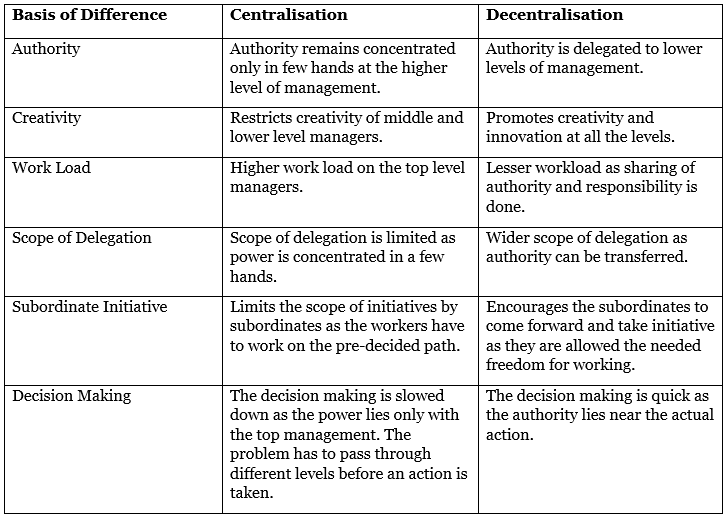
Q4: Distinguish between centralisation and decentralisation.
Ans: Following are the differential factors between centralisation and decentralisation.
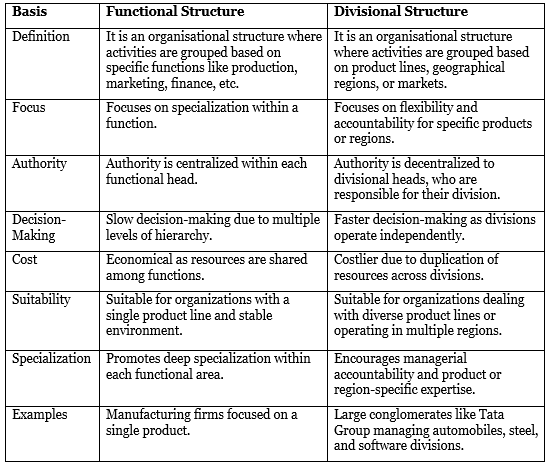
Q5: How is a functional structure different from a divisional structure?
Ans: Differences Between Functional Structure and Divisional Structure:
Q6: A company, which manufactures a popular brand of toys, has been enjoying good market reputation. It has a functional organisational structure with separate departments for Production, Marketing, Finance, Human Resources and Research and Development. Lately to use its brand name and also to cash on to new business opportunities it is thinking to diversify into manufacture of new range of electronic toys for which a new market is emerging.
Which organisation structure should be adopted in this situation?
Give concrete reasons with regard to benefits the company will derive from the steps it should take.
Ans: In this situation, the company should shift from a functional structure to a divisional structure because it is adding a new product line. The benefits and reasons are:
- The performance of each unit can be assessed separately, making accountability clear.
- New product lines can be added easily without disturbing existing operations.
- Decision making becomes faster within each division, which is important for responding to market changes.
- A divisional structure keeps communication lines short with customers and improves the responsiveness of service and product development.
Q7: A company manufacturing sewing machines set up in 1945 by the British promoters follows formal organisation culture in totality. It is facing lot of problems in delays in decision making. As the result it is not able to adapt to changing business environment. The work force is also not motivated since they cannot vent their grievances except through formal channels, which involve red tape. Employee turnover is high. Its market share is also declining due to changed circumstances and business environment. You are to advise the company with regard to change it should bring about in its organisation structure to overcome the problems faced by it. Give reasons in terms of benefits it will derive from the changes suggested by you.
Ans: The following changes are suggested to overcome the limitations of a strictly formal organisation:
- Encourage informal interaction: Management should promote social events and informal get-togethers so that employees can interact freely. This improves morale, reduces alienation and helps build trust.
- Decentralise decision making: Move routine operational decisions to lower levels so that responses are faster and top management can focus on strategy.
- Diversify related business activities: Entering related areas such as textile machinery parts (for example, embroidery or sequencing units) can open new revenue streams and reduce dependence on a single product line.
These changes will reduce delays, increase employee motivation, improve retention, and make the company more adaptable to market changes.
Q8: A company X limited manufacturing cosmetics, which has enjoyed a preeminent position in business, has grown in size. Its business was very good till 1991. But after that, new liberalised environment has seen entry of many MNC's in the sector. With the result the market share of X limited has declined. The company had followed a very centralised business model with Directors and divisional heads making even minor decisions. Before 1991 this business model had served the company very well as consumers had no choice. But now the company is under pressure to reform.
What organisation structure changes should the company bring about in order to retain its market share?
How will the changes suggested by you help the firm? Keep in mind that the sector in which the company is FMCG.
Ans: The company should move towards decentralisation for the following reasons:
- Decentralisation will allow lower levels to take routine and minor decisions, enabling faster response to market trends in the FMCG sector.
- It will give senior managers more time to focus on strategic planning and competitive strategies rather than day-to-day operations.
- Local managers and divisional heads will be better placed to understand regional consumer preferences and can adapt marketing and product decisions accordingly.
These changes will help the firm by improving speed of decision making, increasing market responsiveness, empowering managers to act on local opportunities, and allowing top management to concentrate on long-term strategy to regain market share.
FAQs on NCERT Solutions - Organising
| 1. What is the importance of organizing in an organization? |  |
| 2. How does organizing contribute to the success of an organization? | |
| 3. What are the key elements of organizing in an organization? | |
| 4. How can an organization ensure effective coordination through organizing? | |
| 5. What are the challenges faced in the process of organizing? | |