NCERT Solutions - Staffing

Very Short Answer Type Questions
Q1: What is meant by staffing?
Ans: Staffing is the managerial function of filling and keeping filled the positions in an organisation. It includes identifying manpower needs, recruiting and selecting suitable candidates, placing them in appropriate jobs, and providing training and development to retain and utilise human resources effectively to achieve organisational objectives.
Q2: State the two important sources of recruitment.
Ans: The two important sources of recruitment are:
- Internal sources: Includes transfers, promotions and employee referrals. These make use of existing employees who are already familiar with the organisation's work culture and systems.
- External sources: Includes advertisements, employment exchanges, campus recruitment, recruitment agencies and web-based portals. These bring fresh skills and a wider pool of candidates.
Q3: The workers of a factory are unable to work on new machines and always demand for help of the supervisor. The Supervisor is overburdened with their frequent calls. Suggest the remedy.
Ans: The remedy is training. Organise short, focused on-the-job training sessions and demonstrations for workers on the new machines so they learn to operate them independently; this will reduce routine calls to the supervisor and improve productivity.
Q4: The quality of production is not as per standards. On investigation, it was observed that most of the workers were not fully aware of the proper operation of the machinery. What could be the way to improve the quality of production to meet the standards?
Ans: Training is the solution. Provide systematic training on correct machine operation, quality checks and standard procedures so workers understand quality requirements and reduce defects.
Q5: The workers of a factory remain idle because of a lack of knowledge of hi-tech machines. Frequent visits of engineers are made, which causes high overhead charges. How can this problem be removed?
Ans: The problem can be resolved through vestibule training, where workers are trained in a simulated workshop using the same machines and conditions they will face on the shop floor. This reduces dependence on engineers, cuts overhead visits and speeds up production readiness.
Short Answer Type Questions
Q1: What is meant by recruitment? How is it different from selection?
Ans: Recruitment refers to the process of finding and encouraging potential candidates to apply for jobs in an organisation. It aims to create a pool of suitably qualified applicants. Selection is the subsequent process of identifying and choosing the best candidate from that pool to fill a specific job. Key differences include:
- Objective: Recruitment is positive (attract candidates); selection is eliminative (choose the best).
- Result: Recruitment creates a candidate pool; selection results in appointment of a candidate.
- Scope: Recruitment is broader and external; selection is specific and more detailed.
Q2: An organisation provides security services. It requires such candidates who are reliable and don't leak out the secrets of their clients. What steps should be incorporated in selection process?
Ans: For hiring reliable security personnel include the following steps:
- Thorough reference checks: Contact previous employers to verify conduct, reliability and integrity.
- Background and police verification: Ensure there is no criminal record and confirm identity details.
- Personality and integrity tests: Use interviews and psychometric tools to assess trustworthiness and temperament.
- Contractual confidentiality clauses and probation: Include strict confidentiality terms in the employment contract and apply a probation period to observe behaviour on the job.
Q3: A company is manufacturing paper plates and bowls. It produces 1,00,000 plates and bowls each day. Due to local festival, it got an urgent order of extra 50,000 plates and bowls. Explain the method of recruitment that the company should adopt in the given circumstances to meet the order.
Ans: To meet the urgent demand the company should use a mix of internal and short-term external recruitment:
- Internal option - overtime: Ask existing employees to work overtime; this is quick and keeps quality consistent.
- External option - temporary hires: Recruit temporary workers through labour contractors or local advertisements, and use employee referrals for speed and reliability.
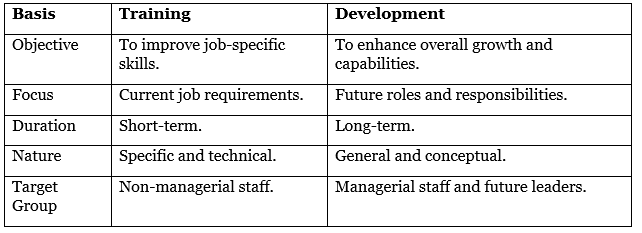
Q4: Distinguish between training and development.
Ans: The Difference between training and development is given below:
Q5: Why are internal sources of recruitment considered to be more economical?
Ans: Internal sources of recruitment are economical because:
- Lower cost: The organisation avoids expenses on advertising, agency fees and detailed external search.
- Time-saving: Existing employees already know the organisation's procedures and need less orientation, so vacancies are filled faster.
Q6: 'No organisation can be successful unless it fills and keeps the various positions filled with the right kind of people for the right job.' Elucidate.
Ans: The success of an organisation depends on hiring and retaining the right people for the following reasons:
- Efficiency: Employees with the right skills perform tasks more effectively and reduce wastage.
- Goal achievement: Competent staff contribute directly to meeting organisational objectives and targets.
- Adaptability: The right workforce adapts better to changes in technology and market conditions.
- Reduced costs: Proper staffing lowers turnover, training and supervision costs, improving long-term stability.
Thus, staffing is critical for organisational success because it ensures a suitable match between jobs and employees.
Long Answer Type Questions
Q1: 'Human resource management includes many specialised activities and duties.' Explain.
Ans: Human resource management is the function concerned with acquiring, developing and maintaining the workforce of an organisation. This includes several specialised activities such as:
- Identifying personnel needs: Forecasting how many and which types of employees are required.
- Recruitment: Attracting suitable candidates through internal and external sources.
- Job analysis: Defining job roles, duties and specifications to create clear job descriptions.
- Training and development: Enhancing employees' skills for current tasks and future responsibilities.
- Performance appraisal: Assessing performance to guide promotions, increments and training needs.
- Managing labour relations: Maintaining harmonious relations between management and employees, including union dealings where applicable.
- Handling grievances: Addressing employee complaints and resolving disputes fairly.
- Employee welfare: Implementing benefits and welfare measures to ensure employee well-being.
- Legal compliance: Ensuring HR practices comply with labour laws and protecting the organisation legally.
Q2: Explain the procedure for the selection of employees.
Ans: Employee selection follows a sequence of steps designed to identify the best candidate. The usual procedure is:
- Preliminary screening: Shortlist candidates by checking applications and CVs to remove clearly unsuitable applicants.
- Selection tests: Use written, practical or psychometric tests to measure abilities relevant to the job (technical skills, aptitude, personality).
- Employment interview: Conduct structured interviews to assess fit, communication, attitude and problem-solving skills.
- Reference and background checks: Verify past employment, qualifications and character through referees and records.
- Selection decision: Choose the candidate who best meets job requirements and organisational fit.
- Medical examination: Confirm physical and mental fitness for the role where necessary.
- Job offer and contract: Issue an appointment letter and employment contract specifying duties, salary and joining date.
Q3: What are the advantages of training to the individual and to the organisation?
Ans: Training provides benefits to both the organisation and the individual.
Benefits to the organisation:
- Training reduces wastage of time and materials by improving workers' competence.
- It enhances employee productivity and the quality of output.
- Training equips employees to handle emergencies and new technologies.
- It increases worker motivation and reduces absenteeism and turnover.
- Helps the organisation adapt to changing environments and competition.
Benefits to the employee:
- Better career opportunities due to improved skills and knowledge.
- Potential for higher earnings because of improved performance and promotability.
- Trained workers can operate machines more efficiently and safely.
- Training increases job satisfaction and motivation.
Q4: Kaul Consultants have launched www.naukaripao.com exclusively for senior management professionals. The portal lists out senior level jobs and ensures that the job is genuine through rigorous screening process.
(a) State the source of recruitment highlighted in the case above.
(b) State four benefits of the above-identified source of recruitment.
Answers:
(a) State the source of recruitment highlighted in the case above.
Ans: The source of recruitment is Web-based recruitment (e-recruitment).
(b) State four benefits of the above-identified source of recruitment.
Ans:
- Provides access to a wide pool of candidates, including passive and active job seekers across regions.
- More cost-effective than many traditional methods as advertising and processing costs are lower.
- Enables faster hiring through streamlined application processing, screening tools and automated shortlisting.
- Allows targeted recruitment for senior or specialised roles by screening for experience, certifications and references before shortlisting.
Q5: A company, Xylo Limited, is setting up a new plant in India for manufacturing auto components. India is a highly competitive and cost effective production base in this sector. Many reputed car manufacturers source their auto components from here. Xylo limited is planning to capture about 40% of the market share in India and also export to the tune of at least ₹50 crores in about 2 years of its planned operations. To achieve these targets it requires a highly trained and motivated work force. You have been retained by the company to advise it in this matter. While giving answers, keep in mind the sector the company is operating. Questions:
(a) Outline the process of staffing the company should follow.
(b) Which sources of recruitment should the company rely upon? Give reasons for your recommendation.
(c) Outline the process of selection the company should follow with reasons.
Answers:
(a) Outline the process of staffing the company should follow.
Ans:
- Estimating manpower requirements: Carry out workforce planning to determine numbers and skill sets needed for production, quality, maintenance, R&D and export operations.
- Recruitment: Use appropriate internal and external channels to attract technicians, engineers and managers as per demand.
- Selection: Implement rigorous selection to ensure technical competence and reliability (tests, practical assessments and interviews).
- Placement and orientation: Place employees in suitable roles and provide induction on safety, quality standards and company processes.
- Training and development: Provide continuous technical training, apprenticeships and skill-up programmes focused on automotive standards and export requirements.
- Retention and motivation: Offer competitive pay, performance incentives and career paths to retain skilled personnel.
(b) Which sources of recruitment should the company rely upon? Give reasons.
Ans:
- External sources: Campus recruitment (for engineers and fresh technical talent), specialised job portals and industry placements to bring in updated technical knowledge and fresh ideas required for modern manufacturing.
- Local skilled labour and contractors: For rapid scaling of shop-floor capacity during ramp-up phases recruit through local vocational institutes and trusted labour contractors.
- Internal sources: Promote experienced employees into supervisory and quality roles to preserve organisational knowledge and morale.
Reasons: A mix ensures technical expertise, quick availability of skilled operatives, continuity from experienced staff and alignment with quality and export standards.
(c) Outline the process of selection the company should follow with reasons.
Ans:
- Preliminary screening: Shortlist applications to focus on candidates with necessary qualifications and experience - saves time and resources.
- Written and practical tests: Assess technical knowledge and hands-on skills relevant to auto components manufacturing to ensure competence.
- Interviews and skill demonstrations: Use structured interviews and live demonstrations on equipment or simulators to judge problem solving, quality focus and tool handling.
- Reference checks and background verification: Confirm prior work standards and reliability, crucial for quality and on-time delivery commitments.
- Medical examination and probation: Ensure fitness for the job and use a probation period to evaluate performance on the shop floor.
Q6: A major insurance company handled all recruiting, screening and training processes for data entry/customer service representatives. Their competitor was attracting most of the qualified, potential employees in their market. Recruiting was made even more difficult by the strong economy and the 'jobseeker's market.' This resulted in the client having to choose from candidates who had the 'soft' skills needed for the job, but lacked the proper 'hard' skills and training.
Questions:
(a) As an HR manager what problems do you see in the company?
(b) How do you think it can be resolved and what would be its impact on the company?
Answers:
(a) As an HR manager, what problems do you see in the company?
Ans:
- Overemphasis on soft skills while neglecting essential hard skills required for the job, leading to a skills gap.
- Losing qualified candidates to competitors due to weaker employer branding, compensation or hiring processes.
(b) How do you think it can be resolved, and what would be its impact on the company?
Ans:
- Resolution: Introduce focused hard-skills training (typing, data tools, domain knowledge) during onboarding; partner with training providers for certification courses; use assessment centres to evaluate technical skills before hiring. Improve employer branding and offer competitive pay and benefits to attract qualified candidates.
- Impact: Higher employee competency, improved service quality, reduced training cycles and turnover, and a stronger ability to compete for talent in a tight labour market.
Q7: Ms. Jayshree recently completed her Post Graduate Diploma in Human Resource Management. A few months from now a large steel manufacturing company appointed her as its human resource manager. As of now, the company employs 800 persons and has an expansion plan in hand which may require another 200 persons for various types of additional requirements. Ms. Jayshree has been given complete charge of the company's Human Resource Department.
Questions:
(a) Point out, what functions is she supposed to perform?
(b) What problems do you foresee in her job?
(c) What steps is she going to take to perform her job efficiently?
(d) How significant is her role in the organisation?
Answers:
(a) Point out, what functions is she supposed to perform?
Ans:
- Workforce planning - forecasting manpower needs for current operations and expansion.
- Recruitment and selection - attracting and appointing suitable candidates for technical and non-technical roles.
- Employee training and development - designing training for safety, operations and managerial skills.
- Performance appraisal and compensation management - setting appraisal systems and fair pay structures.
- Industrial relations and grievance handling - maintaining harmony and addressing employee issues.
(b) What problems do you foresee in her job?
Ans:
- Managing a large and diverse workforce with varying skill levels and expectations.
- Meeting the staffing demands of the expansion within time and budget constraints.
- Handling potential resistance to change and ensuring compliance with labour laws and safety standards.
(c) What steps is she going to take to perform her job efficiently?
Ans:
- Develop a robust recruitment and training plan aligned to expansion needs, including timelines and budgets.
- Implement HR information systems (HRIS) to streamline hiring, attendance and payroll processes.
- Introduce continuous skill development and safety training for shop-floor employees.
- Set up clear performance metrics, appraisal systems and communication channels to address grievances quickly.
(d) How significant is her role in the organisation?
Ans:
Her role is crucial. As HR manager she ensures that the company has the right talent to meet expansion goals, maintains employee morale, ensures compliance with labour and safety norms, and contributes to higher productivity and reduced turnover - all of which directly affect the company's success.
FAQs on NCERT Solutions - Staffing
| 1. What is the importance of staffing in an organization? |  |
| 2. What are the main steps involved in the staffing process? | |
| 3. How does recruitment differ from selection in the staffing process? | |
| 4. What are the challenges faced in staffing today? | |
| 5. How does effective staffing impact overall organizational performance? | |