NCERT Solutions - Open Economy Macroeconomics

Q1: Differentiate between balance of trade and current account balance.
Ans: Balance of trade and current account balance are related but distinct concepts:
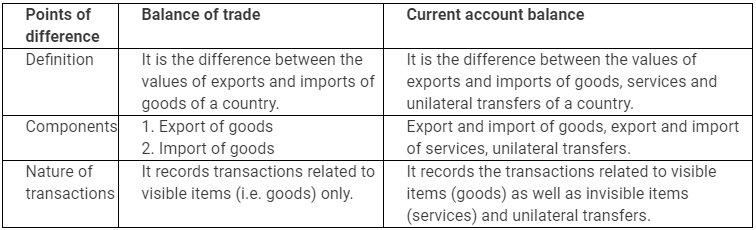
In short, BOT is a component of the current account. Policy implications differ: a goods trade deficit might be offset by surpluses in services or income receipts, whereas a persistent current account deficit signals that a country is a net borrower from the rest of the world.
Q2: What are official reserve transactions? Explain their importance in the balance of payments.
Ans: The transactions carried by the monetary authority of a country that change its stock of official reserves are called official reserve transactions (ORT). These transactions typically involve the central bank buying or selling foreign assets - foreign currency, reserve claims, or gold - in the foreign exchange market.
Key features and workings:
- During a BoP deficit, the central bank sells foreign currency reserves (or borrows abroad) to pay for excess imports or other outflows. This reduces official reserves and appears as a debit in reserve transactions.
- During a BoP surplus, the central bank buys foreign assets, increasing reserves; this shows up as a credit in reserve transactions.
Importance in the balance of payments:
- ORT provide an immediate buffer to finance deficits and stabilise the exchange rate when other BoP items are unfavourable.
- They allow governments to smooth short-term volatility and implement exchange rate policy (e.g. defend a peg or moderate excessive appreciation/depreciation).
- Changes in official reserves signal the overall BoP position: rising reserves imply an overall surplus and falling reserves imply an overall deficit.
Q3: Distinguish between the nominal exchange rate and the real exchange rate. If you were to decide whether to buy domestic goods or foreign goods, which rate would be more relevant? Explain.
Ans: Nominal exchange rate is the price of one currency expressed in terms of another. It indicates the number of units of domestic currency required to purchase one unit of foreign currency. For example, if the rupee-dollar rate is Rs 45 = $1, it costs 45 rupees to buy one dollar.
Real exchange rate measures the relative price of foreign goods in terms of domestic goods. It adjusts the nominal rate for price level differences between countries and is therefore a measure of competitiveness.
Real exchange rate

where Pf is the foreign price level, P is the domestic price level and e is the nominal exchange rate (domestic currency price of one unit of foreign currency).
Example: a watch costs $40 in the US and e = Rs 50/$, so the rupee price of the watch is ePf = 50 × 40 = Rs 2,000. If the Indian price of the same watch is Rs 2,000, the real exchange rate is 1 and goods cost the same across countries after adjustment for exchange rates and prices.
If you must choose between domestic and foreign goods, the real exchange rate is more relevant because it captures both the nominal exchange rate and relative price (inflation) differences across countries. It indicates whether foreign goods are cheap or expensive once prices are taken into account, and hence shows the incentive to import or buy domestically.
Q4: Suppose it takes 1.25 yen to buy a rupee, and the price level in Japan is 3, and the price level in India is 1.2. Calculate the real exchange rate between India and Japan (the price of Japanese goods in terms of Indian goods). (Hint: First find out the nominal exchange rate as the price of yen in rupees.)
Ans: Price level in Japan (foreign), Pf = 3
Price level in India (domestic), P = 1.2
Given: 1 rupee = 1.25 yen. Therefore, the nominal price of 1 yen in rupees is:
Price of 1 yen = 1 / 1.25 = 0.8 rupee
Now compute the real exchange rate (price of Japanese goods in terms of Indian goods):


Numerically: real exchange rate = e × Pf / P = 0.8 × 3 / 1.2 = 2
Therefore, one unit of Japanese goods costs the equivalent of 2 units of Indian goods at the given prices and exchange rate; the real exchange rate is 2.
Q5: Explain the automatic mechanism by which BoP equilibrium was achieved under the gold standard.
Ans: Under the gold standard each currency was defined in terms of a fixed quantity of gold. International payments were settled in gold, and the monetary base of countries depended directly on their gold holdings. The automatic adjustment mechanism - often called the price-specie flow mechanism - worked as follows:
- If a country had a BoP deficit, gold outflows occurred to pay for net imports. This reduced the domestic money supply.
- A smaller money supply led, over time, to lower domestic prices and costs. Cheaper domestic goods increased exports and reduced imports.
- The adjustment in trade flows corrected the BoP deficit as gold outflows slowed and eventually reversed.
Similarly, a BoP surplus brought gold inflows, raised the money supply, pushed up prices and thus reduced the surplus. This mechanism made the BoP self-correcting under the classical gold standard, without active exchange rate policy by authorities.
Q6: How is the exchange rate determined under a flexible exchange rate regime?
Ans: Under a flexible (or floating) exchange rate regime the exchange rate is determined by market forces of demand and supply for foreign currency. Equilibrium occurs where the quantity of foreign exchange demanded equals the quantity supplied.
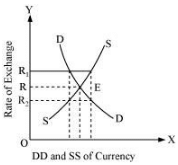
In the figure, the horizontal axis measures quantity of foreign currency and the vertical axis the exchange rate (price of foreign currency). The downward sloping demand curve (DD) shows that as the exchange rate falls (foreign currency becomes cheaper in domestic terms), demand for foreign currency rises. The upward sloping supply curve shows that a higher exchange rate induces greater supply of foreign currency. The intersection E determines the market exchange rate.
If the rate rises above equilibrium there is excess supply which pushes it back down; if it falls below equilibrium there is excess demand which pushes it up. In practice, shifts in demand and supply arise from trade flows, capital movements and expectations, which then change the equilibrium exchange rate.
Q7: Differentiate between devaluation and depreciation.
Ans:

Effects of both are similar in terms of competitiveness: domestic goods become relatively cheaper to foreigners, boosting exports, and imports become more expensive for domestic consumers. The important difference is whether the change is policy-driven (devaluation) or market-driven (depreciation).
Q8: Would the central bank need to intervene in a managed floating system? Explain why.
Ans: Yes. A managed float lies between pure fixed and pure floating systems: exchange rates are primarily market-determined, but the central bank intervenes occasionally to smooth excessive volatility or to achieve macroeconomic objectives.
Reasons for intervention:
- to prevent disruptive and disorderly market movements or speculative attacks;
- to maintain competitiveness and control inflationary pressures transmitted through exchange rate changes;
- to ensure that exchange rate moves are consistent with broader macroeconomic goals.
Intervention can be sterilised or unsterilised, depending on whether the central bank offsets domestic monetary effects of its foreign exchange operations.
Q9: Are the concepts of demand for domestic goods and domestic demand for goods the same?
Ans: No. In an open economy, these two concepts differ:
- Demand for domestic goods: total demand for goods produced within the domestic economy, irrespective of who buys them. It includes both domestic purchases and foreign demand (exports).
- Domestic demand for goods: demand within the domestic market for goods, whether those goods are produced domestically or imported. It is the market demand faced by suppliers in the home country.
Thus, demand for domestic goods emphasises the origin of supply, while domestic demand emphasises the location of demand.
Q10: What is the marginal propensity to import when M = 60 + 0.06Y? What is the relationship between the marginal propensity to import and the aggregate demand function?
Ans: Marginal propensity to import (m) is the fraction of an additional unit of income spent on imports.
Given M = 60 + 0.06Y, the marginal propensity to import is m = 0.06.
Relationship with aggregate demand: a higher m implies a larger leak from the circular flow of income because a greater share of any increase in income is spent on imports rather than on domestic goods. As a result, the autonomous expenditure multiplier falls and the impact of a change in autonomous demand on national income is reduced. In other words, induced imports weaken the transmission of domestic spending into domestic income and output.
Q11: Why is the open economy autonomous expenditure multiplier smaller than the closed economy one?
Ans: In a closed economy the multiplier is governed only by the marginal propensity to consume (c). With autonomous expenditure A1 = C + I + G, equilibrium income satisfies:
Y (1 - c) = A1
so closed-economy multiplier = 1 / (1 - c).
In an open economy, part of any increase in income is spent on imports (m), which are leakages from the domestic spending stream. The equilibrium condition becomes:
Thus the open-economy multiplier = 1 / (1 - c + m). Because the denominator (1 - c + m) is larger than (1 - c) when m > 0, the multiplier in an open economy is smaller than in a closed economy. Intuitively, some of the additional spending leaks abroad as imports, so less of it circulates domestically to generate further rounds of income.
Q12: Calculate the open economy multiplier with proportional taxes, T = tY, instead of lump-sum taxes as assumed in the text.
Ans:
With proportional taxes, disposable income is (1 - t)Y and consumption is C + c(1 - t)Y. The equilibrium condition is:
Y = C + c(1 - t)Y + I + G + X - M - mY
Rearranging:
Y [1 - c(1 - t) + m] = C + I + G + X - M = A
Therefore, open economy multiplier with proportional taxes is
Multiplier = 1 / [1 - c(1 - t) + m]
This shows that proportional taxation reduces the marginal propensity to consume out of income (because of (1 - t)), further affecting the multiplier; induced imports (m) again reduce the multiplier.
Q13: Suppose C = 40 + 0.8Y D. T = 50, I = 60, G = 40, X = 90, M = 50 + 0.05Y
(a) Find equilibrium income
(b) Find the net export balance at equilibrium income
(c) What happens to equilibrium income and the net export balance when the government purchases increase from 40 to 50?
Ans: Given: C = 40 + 0.8YD, T = 50, so YD = Y - 50. Therefore
C = 40 + 0.8(Y - 50) = 40 + 0.8Y - 40 = 0.8Y
Aggregate demand: Y = C + I + G + X - M = 0.8Y + 60 + 40 + 90 - (50 + 0.05Y)
Simplify constants: 60 + 40 + 90 - 50 = 140. Combine Y terms:
Y = 0.8Y - 0.05Y + 140 = 0.75Y + 140
So 0.25Y = 140 ⇒ Y = 560.
(b) Net exports at equilibrium: NX = X - M = 90 - (50 + 0.05Y) = 40 - 0.05×560 = 40 - 28 = 12.
(c) If G rises from 40 to 50, repeat the calculation: constants become 60 + 50 + 90 - 50 = 150. The Y equation is Y = 0.75Y + 150 ⇒ 0.25Y = 150 ⇒ Y = 600.
Thus, equilibrium income increases by 40.
Net exports at the new equilibrium: NX = 90 - (50 + 0.05×600) = 40 - 30 = 10. So NX falls from 12 to 10. The change in Y (40) from a 10 increase in G reflects a multiplier of 4, consistent with 1 / (1 - c + m) = 1 / (1 - 0.8 + 0.05) = 4.
Q14: In the above example, if exports change to X = 100, find the change in equilibrium income and the net export balance.
Ans:
Starting from the original baseline (with G = 40), increasing X from 90 to 100 raises autonomous demand by 10. The multiplier (as above) is 4, so equilibrium income rises by 10 × 4 = 40. Thus income increases from 560 to 600.
Net exports at the new equilibrium: NX = X - M = 100 - (50 + 0.05×600) = 50 - 30 = 20. So NX increases from 12 to 20, a rise of 8.
Q15: Suppose the exchange rate between the Rupee and the dollar was Rs. 30=1$ in the year 2010. Suppose the prices have doubled in India over 20 years while they have remained fixed in USA. What, according to the purchasing power parity theory will be the exchange rate between dollar and rupee in the year 2030.
Ans:
If prices in India double while US prices remain unchanged, goods that cost Rs 30 in 2010 would cost Rs 60 in 2030, while the US price remains $1. Under purchasing power parity (PPP), exchange rates adjust so that identical goods cost the same in both countries when priced in a common currency. Therefore Rs 60 should equal $1, implying an exchange rate of Rs 60 = $1 in 2030. In other words, the rupee depreciates by a factor of two relative to the dollar.
Q16: If inflation is higher in country A than in Country B, and the exchange rate between the two countries is fixed, what is likely to happen to the trade balance between the two countries?
Ans: With higher inflation in country A and a fixed exchange rate, country A's goods become relatively more expensive compared with country B's goods. As a result:
- Country A's exports to B will tend to fall (they become less competitive), and imports from B to A will tend to rise.
- Hence country A will tend to run a trade deficit, while country B will tend to run a trade surplus, all else equal.
If the fixed rate is maintained, the adjustment must occur through real variables (trade flows, incomes) or depletion/accumulation of reserves, rather than through exchange rate movements.
Q17: Should a current account deficit be a cause for alarm? Explain.
Ans:
A current account deficit is not automatically a reason for alarm; its significance depends on context. Consider the following points:
- Cause and composition: If the deficit finances productive investment (infrastructure, industry) that raises future exports and growth, it may be sustainable. If it finances consumption or short-term liabilities, it is more worrying.
- Financing and capital flows: A deficit funded by stable capital flows (foreign direct investment) is less risky than one funded by short-term portfolio flows that can reverse quickly.
- External debt and reserves: High levels of foreign debt and low reserves make a deficit more vulnerable to external shocks. Debt servicing obligations matter.
In short, a current account deficit warrants careful analysis of its causes, financing sources and sustainability rather than an automatic alarm.
Q18: Suppose C = 100 + 0.75Y D, I = 500, G = 750, taxes are 20 per cent of income, X = 150, M = 100 + 0.2Y. Calculate equilibrium income, the budget deficit or surplus and the trade deficit or surplus.
Ans:
Given: C = 100 + 0.75YD, taxes = 0.2Y so YD = (1 - 0.2)Y = 0.8Y. Thus
Aggregate demand: Y = C + I + G + X - M = 100 + 0.6Y + 500 + 750 + 150 - (100 + 0.2Y)
Simplify constants: 100 + 500 + 750 + 150 - 100 = 1,400. Combine Y terms: 0.6Y - 0.2Y = 0.4Y. So
Therefore equilibrium income is approximately Y = 2,333.33.
Government receipts (taxes) = 0.2Y = 0.2 × 2,333.33 = 466.67. Government expenditure G = 750, so the budget position is a deficit of 750 - 466.67 = 283.33.
Trade balance (net exports): NX = X - M = 150 - (100 + 0.2Y) = 50 - 0.2×2,333.33 = 50 - 466.67 = -416.67. Thus there is a trade deficit of approximately 416.67.
Q19: Discuss some of the exchange rate arrangements that countries have entered into to bring about stability in their external accounts.
Ans: To combine the extremes of fixed and flexible exchange rate regimes, countries use intermediate arrangements that offer some stability while allowing adjustments. Common arrangements include:
- Wider bands: a peg with allowed fluctuations within a specified band (for example, ±10%). The exchange rate is mostly fixed but can move within the band to accommodate moderate pressures.
- Crawling peg: the currency is adjusted periodically in small steps (a pre-announced rate of depreciation or appreciation) to accommodate differential inflation or other trends while avoiding large discrete changes.
- Managed floating: the exchange rate is largely market-driven but authorities intervene occasionally to smooth volatility or to achieve macroeconomic objectives. There is no fixed band, but interventions are discretionary.
Other variants include pegging to a currency basket, currency boards, or full monetary unions. The choice depends on a country's trade patterns, capital mobility, and policy priorities.
Old NCERT Question
Q1: Explain why G - T = (Sg - I) - (X - M).
Ans: In an open economy, national income identity is
Y = C + I + G + X - M = C + I + G + NX
Rearrange to obtain savings on the left: Y - C - G = I + NX.
The left side, Y - C - G, represents national savings S, which can be split into private savings SP = Y - C - T and government savings Sg = T - G. Thus:
Rearrange for NX: NX = SP + Sg - I. Substituting SP = Y - C - T and Sg = T - G gives:
NX = (Y - C - T) + (T - G) - I = Y - C - G - I
Rewriting, G - T = (SP - I) - NX.
Note: there is a misprint in the question: the correct expression uses SP (private savings), not Sg. The corrected relation is
G - T = (SP - I) - NX
Interpretation: a government budget deficit (G-T> 0) must be financed either by private savings in excess of investment (SP - I > 0) or by running a trade surplus (NX > 0) - rearranged, it shows how fiscal positions, private savings and external balances are interconnected.
FAQs on NCERT Solutions - Open Economy Macroeconomics
| 1. What are the main components of open economy macroeconomics? |  |
| 2. How does a country's exchange rate impact its economy in an open economy setting? | |
| 3. What are the implications of trade deficits in open economy macroeconomics? | |
| 4. How do capital flows affect open economy macroeconomics? | |
| 5. How does government policy influence open economy macroeconomics? | |





