NCERT Solutions - Rural Development

Q1: What do you mean by rural development? Bring out the key issues in rural development.
Ans: Rural areas support the bulk of India's population and, at the same time, are often the epicentre of poverty, hunger and starvation. To accelerate national growth and raise living standards, rural development must be given priority. Rural development refers to actions and initiatives taken for the social and economic advancement of rural or backward areas. The key issues in rural development are as follows:
- Human Capital Formation- Rural areas often lack quality human capital. Rural development programmes should therefore focus on education, vocational and technical training, health care and other measures that build human resources.
- Development of Productive Resources- Productive resources create employment opportunities. Agriculture, the main occupation in rural areas, frequently suffers from low productivity, inadequate infrastructure and disguised unemployment. Rural development must promote alternative occupations and improve productivity in agriculture to raise incomes.
- Development of Rural Infrastructure- Infrastructure is crucial at the micro level. It supports production activities and enables economic growth and social development. Rural infrastructure includes banks and credit societies, electricity, transport, irrigation, markets and facilities for agricultural research and extension.
- Land Reforms- Land reforms combined with technical improvements allow the use of modern methods, increase productivity and enable efficient land use. Well-designed land reforms support larger-scale and more productive agriculture.
- Lessening Poverty- Poverty is a primary cause of rural underdevelopment and gives rise to unemployment, poor human capital, inequality and other problems. A key step to reduce poverty is to create income-earning assets for rural households. Such assets generate income, raise living standards and make rural people more self-reliant.
Q2: Discuss the importance of credit in rural development.
Ans: Finance and credit are essential for rural development. Rural incomes and savings are often low, so farmers find it difficult to invest in their farms. Formal banks in rural areas tend to lend to larger landholders, leaving small and marginal farmers dependent on moneylenders. Access to institutional credit is therefore crucial for agricultural growth and rural development. The importance of credit in rural development can be seen from the following points:
- Credit helps farmers to commercialise their farming. Commercial farming requires funds for inputs and investments that small subsistence farmers usually cannot provide from their own savings.
- Given the long period between sowing and harvest, credit meets the initial needs for inputs such as seeds, fertilisers and hired labour.
- Credit helps break the vicious circle of poverty by providing funds for both productive and household needs, enabling farmers to invest and improve livelihoods.
- Agriculture is vulnerable to weather and crop failure. Timely farm credit and crop insurance protect farmers from shocks and reduce their dependence on informal lenders.
Q3: Explain the role of micro-credit in meeting the credit requirements of the poor.
Ans:
- Micro-credit refers to small loans and related financial services provided to the poor, often through Self Help Groups (SHGs) and non-governmental organisations.
- The SHG movement plays a crucial role by encouraging saving habits among rural households and building collective strength.
- Individual savings of group members are pooled to meet the financial needs of needy members, reducing reliance on moneylenders.
- SHGs are linked to banks so that groups can access formal credit; this linkage improves access for poor borrowers.
- SHGs allow economically weak individuals to gain bargaining power and mutual support as part of a group.
- Financing through SHGs reduces transaction costs for both lenders and borrowers and simplifies documentation and legal formalities.
- The National Bank for Agricultural and Rural Development (NABARD) has supported micro-credit by providing concessional finance and by promoting SHG-bank linkages.
- Presently, around 6 crore women in 54 lakh SHGs are operating across rural areas, and SHG programmes are popular among small and marginal farmers because of their informal and accessible credit delivery mechanism.
Q4: Explain the steps taken by the government in developing rural markets.
Ans: The Indian government has taken several measures to develop rural markets. The main steps include:
- Regulated Markets: Regulated markets are supervised by a Market Committee comprising farmers, government representatives and traders. These committees improve transparency by ensuring correct scales and weights and by monitoring transactions so that farmers and consumers receive fair prices.
- Infrastructure Development: The government has provided cold storage, warehouses and other facilities to allow farmers to store produce and sell when prices are favourable. Railways and other transport agencies provide subsidised transport for agricultural produce to help farmers reach urban markets.
- Co-operative Agricultural Marketing Societies: Co-operative societies enable collective marketing, which strengthens farmers' bargaining power and helps them obtain fairer prices.
- MSP Policy: The Minimum Support Price (MSP) guarantees a minimum legislated price for certain crops. MSP protects farmers from sharp price falls and provides an assured floor price, reducing price risk in agriculture.
Q5: Why is agricultural diversification essential for sustainable livelihoods?
Ans: Agricultural diversification means varying crop production and shifting some agricultural labour to allied activities (such as livestock, poultry and fisheries) and to non-farm occupations. Diversification is essential for sustainable livelihoods for several reasons:
- Much of Indian farming depends on the monsoon, which makes income from crops risky. Diversification provides alternative sources of income and reduces dependence on rainfall.
- Due to limited irrigation, agricultural employment is often seasonal. Diversification into allied and non-farm activities provides year-round employment and income, especially during the Rabi season.
- Agriculture is overcrowded and cannot generate sufficient additional jobs. Non-farm activities in rural areas open new employment avenues and absorb surplus labour.
- Non-farm sectors have dynamic linkages with farming, for example, through agro-processing and services. These linkages support broader economic growth in rural areas.
Q6: Critically evaluate the role of the rural banking system in the process of rural development in India.
Ans: Following the nationalisation of commercial banks in 1969, the concept of social banking emerged to extend institutional credit at reasonable interest rates. NABARD has also advanced rural credit and supported rural institutions. Institutional credit has helped free many farmers from moneylenders and mahajans. However, rural banking exhibits several deficiencies:
- Institutional loans are often linked to security or collateral, excluding many small and marginal farmers from credit access.
- Commercial banks have not always encouraged thrift or regular saving habits among farmers.
- Leniency in loan recovery and weak enforcement of repayment norms has increased default rates, reducing the financial viability of rural branches.
- Limited outreach, inadequate branch penetration and procedural hurdles continue to restrict credit availability for the poorest farmers.
In summary, rural banking has played a vital and positive role in extending formal finance, but persistent problems in reach, collateral requirements and loan recovery limit its full effectiveness in promoting rural development.
Q7: What do you mean by agricultural marketing?
Ans: Agricultural marketing covers all activities from harvesting to the final sale of products by farmers. These activities include:
- Gathering the product after harvesting.
- Processing the product.
- Grading the product according to quality norms.
- Packaging the product.
- Storing the product for future sale.
- Selling the product at an attractive price.
Thus, agricultural marketing is not limited to bringing produce to market; it also includes all measures that help farmers obtain the maximum possible price for their produce.
Q8: Mention some obstacles that hinder the mechanism of agricultural marketing.
Ans: Agricultural marketing faces several obstacles that reduce farmers' real returns. Key problems are:
- Defective weighing techniques and misappropriation of accounts at markets reduce the farmgate price received by farmers.
- Farmers are often ill-informed about market prices and conditions. Being unaware, they may sell produce at lower prices.
- Insufficient storage facilities force farmers to sell immediately after harvest, often at unfavourable prices, and increase vulnerability to pests and weather.
- Lack of access to formal agricultural credit pushes farmers towards moneylenders and mahajans, increasing their costs and risks.
Q9: What are the alternative channels available for agricultural marketing? Give some examples.
Ans: The exploitation of small and marginal farmers by middlemen created the need for alternative marketing channels that allow direct sales and better prices. Examples of alternative channels include:
- Farmer markets such as Apni Mandi (in Punjab, Haryana and Rajasthan), Hadaspar Mandi (Pune), Rythu Bazaars (Andhra Pradesh) and Uzhavar Sandies (Tamil Nadu), where farmers sell directly to consumers.
- Direct contracts between farmers and national or international companies, wherein companies provide advance payments and procure produce at pre-determined rates.
These alternative channels raise farmers' incomes and reduce price risk for small and marginal producers.
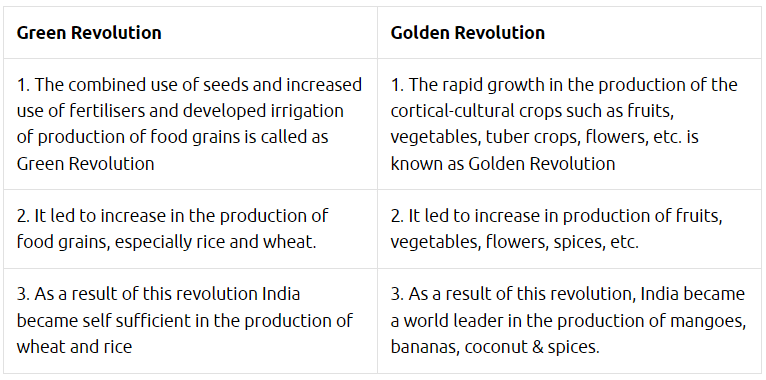
Q10: Distinguish between 'Green Revolution' and 'Golden Revolution'
Ans:
Q11: Do you think the various measures taken by the government to improve agricultural marketing are sufficient? Discuss.
Ans: The government has initiated several measures to improve agricultural marketing, including regulated markets, infrastructure development (cold storage, warehouses), dissemination of market information through radio and television agriculture programmes, and the Minimum Support Price policy. Despite these efforts, the marketing system remains only partly successful because of several persistent problems:
- Defective weighing practices and misappropriation of accounts still occur in some markets.
- Many farmers lack timely information about market prices and demand, forcing them to accept low prices.
- Insufficient storage and processing facilities compel farmers to sell immediately after harvest at low prices and increase post-harvest losses.
- Limited institutional finance availability makes farmers dependent on informal lenders.
- Poor transportation infrastructure prevents farmers from accessing distant, higher-paying markets.
- A large number of intermediaries separates farmers from consumers; intermediaries often capture a major share of the final price, leaving farmers with a small portion of the produce's value.
Thus, while government measures have helped, more investment in infrastructure, market information systems, storage, transport and direct marketing channels is needed to make the system fully effective.
Q12: Explain the role of non-farm employment in promoting rural diversification.
Ans: Non-farm employment is important for raising incomes and creating sustainable livelihoods beyond agriculture. Its role in rural diversification includes:
- Reducing risk by providing income sources independent of monsoon variability.
- Providing employment opportunities in the agricultural off-season (e.g. Rabi season) where irrigation is limited.
- Absorbing surplus labour from overcrowded agriculture and thereby reducing disguised unemployment.
- Creating dynamic linkages with agriculture through sectors such as agro-processing, handicrafts and services, which help rural growth.
- Offering year-round employment in contrast to seasonal farm work, which helps reduce rural poverty.
- Supplying inputs and processed goods to large industries (for example, agro-processing and food industries), which strengthens rural-urban economic linkages and reduces regional disparities.
Q13: Bring out the importance of animal husbandry, fisheries and horticulture as a source of diversification.
Ans: Importance of Animal Husbandry
- Animal husbandry (livestock farming) is a major non-farm employment activity in India. Poultry, cattle, goats and sheep are important components. Many rural families combine livestock with crop farming to increase income. Livestock farming is especially important in semi-arid and arid regions where irrigation is limited and crop farming is less feasible.
- Capital investment in livestock is generally lower than for some forms of crop farming, and livestock activities provide employment for rural women. Approximately 70 million small and marginal farmers are engaged in livestock farming, which has increased production of milk, eggs, meat, wool and other by-products and improved nutritional intake.
Importance of Fisheries
- Fisheries provide livelihoods in coastal and inland regions such as Kerala, Maharashtra, Gujarat and Tamil Nadu. Fishing communities depend on inland water bodies (rivers, lakes, ponds) and marine resources (seas and oceans).
- Government efforts and investment have increased production, but the sector still faces low per capita earnings, limited labour mobility, illiteracy and indebtedness. Despite significant employment, fisheries contribute a small share (about 1.4%) to India's GDP.
Importance of Horticulture
- Horticulture (fruits, vegetables, medicinal and aromatic plants, flowers) is emerging as an important rural livelihood. India is a leading producer of many fruits and vegetables (mangoes, bananas, coconuts, cashew nuts, etc.). Horticultural production has raised incomes of families engaged in this sector.
- Horticulture reduces vulnerability for small and marginal farmers, provides employment opportunities for women and generates significant rural employment (around 19% of the labour force). With proper investment and infrastructure, horticulture can be promoted further as an environmentally friendly source of rural income.
Q14: 'Information technology plays a very significant role in achieving sustainable development and food security' - comment.
Ans:
- Information technology (IT) plays a significant role in sustainable development and food security by enabling the collection, storage and analysis of data on weather, soils, crop performance and market conditions. This information supports policy decisions and corrective measures. For example, weather forecasts allow early warning of adverse conditions and help plan mitigation to reduce food insecurity.
- IT helps disseminate information on improved technologies, soil and crop management, quality of inputs and modern techniques through Kisan Call Centres and agricultural websites. IT also identifies experts and extension services related to food security and sustainable development.
- Moreover, IT generates rural employment by creating information kiosks (PCs with internet and scanners) in villages. Overall, IT improves farmers' access to knowledge, markets and services and plays a vital role in achieving food security and sustainable development.
Q15: What is organic farming and how does it promote sustainable development?
Ans: Organic farming is a system that sustains and enhances ecological balance by relying primarily on organic inputs and natural processes. Unlike conventional farming, which uses synthetic fertilisers and toxic pesticides that harm ecosystems, organic farming produces food without synthetic chemicals, maintains soil fertility and supports biodiversity. By producing non-toxic food and conserving natural resources, organic farming promotes eco-friendly and sustainable development.
Q16: Identify the benefits and limitations of organic farming.
Ans: Organic farming has several advantages over conventional farming, together with some limitations:
- Discards Use of Chemicals: Organic farming avoids synthetic chemicals, preventing groundwater contamination and related health hazards; it is more environment-friendly.
- Sustains Soil Fertility: By avoiding chemical fertilisers and using organic manures and crop rotations, organic farming helps maintain long-term soil fertility.
- Healthier Food: Organically grown crops are free from synthetic residues and are perceived to have higher nutritional value; demand for organic produce is growing even at higher prices.
- Inexpensive Technology for Small Farmers: Organic techniques can be less capital-intensive, benefiting small and marginal farmers who form a large part of the agricultural population.
- Generates Income from Exports: There is international demand for organic produce, which can provide higher export earnings for producers.
Limitations of Organic Farming:
Despite these benefits, organic farming faces the following limitations:
- Yields under organic farming are generally lower than those under high-input conventional farming, which may reduce overall productivity.
- Adoption depends on farmer awareness and willingness; lower short-term yields discourage some farmers from converting to organic methods.
- Inadequate infrastructure, certification costs and marketing channels are major constraints for organic producers.
- Lower yields can make organic farming less financially viable for small and marginal landholders without appropriate support and transitional arrangements.
Q17: Enlist some problems faced by farmers during the initial years of organic farming.
Ans: During the initial years of conversion to organic farming, farmers commonly face several problems:
- Yields often fall below those of conventional farming in the short term, making large-scale production difficult.
- Lower yield per hectare reduces short-term profitability, making the transition financially challenging for small and marginal farmers.
- Organic products may be more perishable and have a shorter shelf life, increasing post-harvest losses if storage and cold chains are inadequate.
- Off-season production choices are limited under organic systems, reducing income flexibility.
- Despite these constraints, labour-intensive organic techniques can be advantageous in India, where labour is abundant, and India has developed comparative strengths in some organic products.
Q18: "Jan-Dhan-Yojna helps in the rural development." Do you agree with this statement? Explain.
Ans: The expansion and promotion of the rural banking sector gained new momentum with the Pradhan Mantri Jan-Dhan Yojana (PMJDY). Under this scheme, all adults are encouraged to open bank accounts. Account holders can get accidental insurance cover (about ₹1-2 lakh), a small overdraft facility (typically up to ₹10,000), and they receive government wages and social security payments (such as MNREGA wages and old-age pensions) directly into their accounts. There is no requirement to maintain a minimum balance. Over 40 crore people have opened bank accounts under this scheme, which has promoted saving habits and enabled efficient allocation of financial resources in rural areas. Banks have been able to mobilise substantial funds-over ₹1,40,000 crore-through these accounts, thereby supporting financial inclusion and rural development.
FAQs on NCERT Solutions - Rural Development
| 1. What are the key objectives of rural development? |  |
| 2. How does rural development help in bridging the urban-rural divide? | |
| 3. What are some of the challenges faced in implementing rural development programs? | |
| 4. How can community participation contribute to the success of rural development projects? | |
| 5. What role do government policies play in promoting rural development? | |