NCERT Solutions - Employment: Growth, Informalisation and Other Issues

Q1: Who is a worker?
Ans:
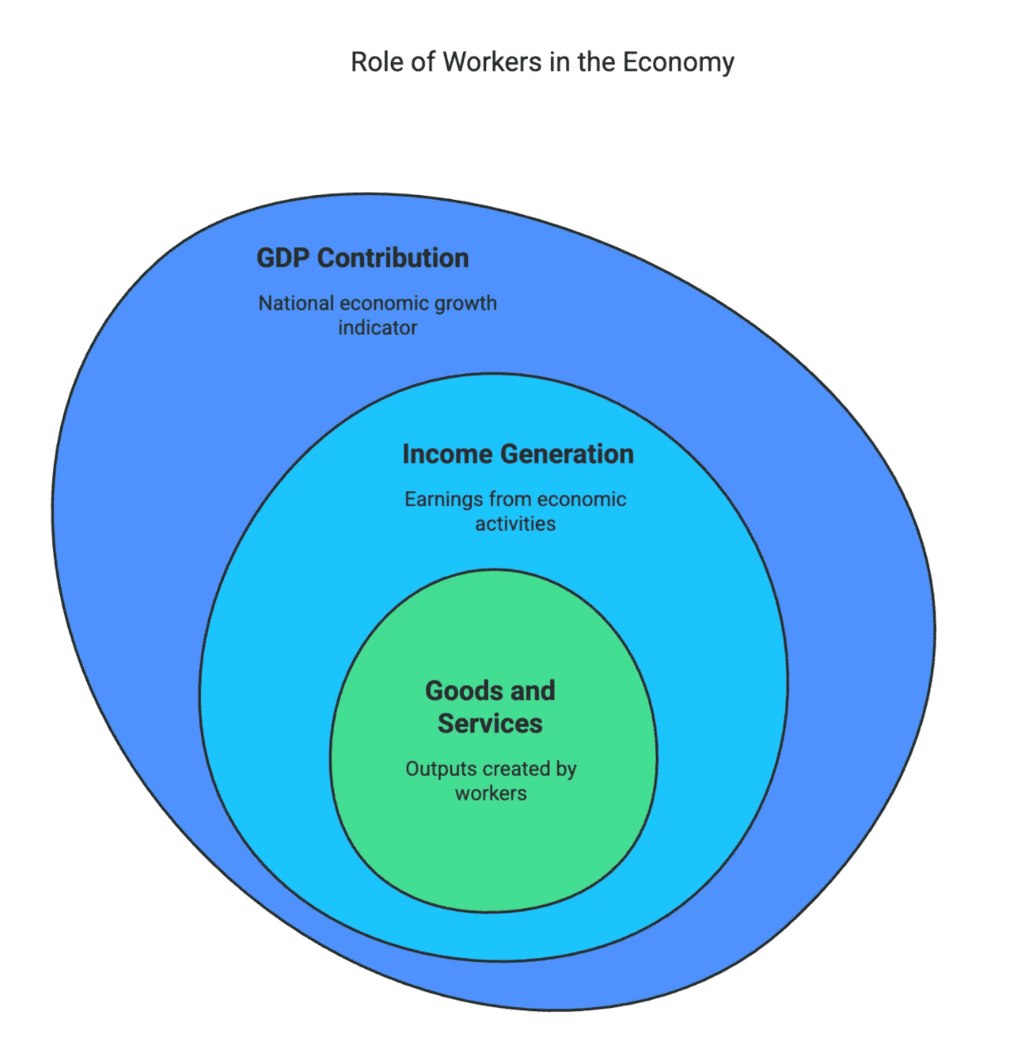
- A worker is someone who engages in activities to earn a living by contributing to the production of goods or the provision of services.
- In economic terms, a worker is an individual who takes part in lawful production or service activities that generate income for themselves and add to the country's GDP during a specified period.
- For example, a farmer growing crops, a teacher teaching students, and a factory worker manufacturing products are all considered workers because their activities produce goods or provide services that have economic value.
Q2: Define the worker-population ratio.
Ans: The worker-population ratio is the proportion of a country's population that is actively engaged in producing goods and providing services. It is calculated by dividing the total workforce by the total population and multiplying the result by 100 to express it as a percentage. This ratio indicates how much of the population is contributing to economic production.

Q3: Are the following workers - a beggar, a thief, a smuggler, a gambler? Why?
Ans: No. A beggar, a thief, a smuggler or a gambler are not considered workers in the economic sense. A worker is expected to engage in lawful production or service activities that add value to the economy and contribute to national income. Begging, theft, smuggling and gambling are either illegal or non-productive activities and do not legitimately contribute to the country's GDP. Therefore, these persons are not treated as workers.
Q4: Find the odd man out
(i) owner of a saloon
(ii) a cobbler
(iii) a cashier in Mother Dairy
(iv) a tuition master
(v) transport operator
(vi) construction worker
Ans: The tuition master and the owner of a saloon are the odd ones out. This is because the tuition master and the saloon owner are self-employed and run their own enterprises, whereas the cobbler (in the sense of a hired cobbler), the cashier in Mother Dairy, the transport operator (as a hired driver or worker) and the construction worker are typically hired employees who render services to others in exchange for wages or salaries.
Q5: The newly emerging jobs are found mostly in the ____________sector
(service/manufacturing).
Ans: The newly emerging jobs are found mostly in the service sector.
The service sector is taking a lead over the manufacturing sector as a source of employment. It includes trade, commerce, banking, insurance, health and other services. These services are developing at a faster pace than manufacturing and other allied production activities, largely because of the globalisation of the economy and rising demand for varied services.
Q6: An establishment with four hired workers is known as __________ (formal/informal) sector establishment.
Ans: An establishment with four hired workers is known as an informal sector establishment.
An informal sector establishment is part of the unorganised sector of the economy. It includes enterprises that hire less than 10 workers (except certain farming and self-employment activities). Such establishments typically lack formal contracts and social security for employees; hence an establishment with four hired workers is classified as informal.
Q7: Raj is going to school. When he is not in school, you will find him working on his farm. Can you consider him as a worker? Why?
Ans: Yes. Raj can be considered a worker because he contributes labour to agricultural production when he works on the farm. His work adds to total farm output and thereby contributes to the country's GDP. Being a student does not prevent him from being counted as a worker for the time he is engaged in productive economic activity.
Q8: Compared to urban women, more rural women are found working. Why?
Ans:
- Rural women account for a larger share of the workforce because agricultural and allied work often have lower formal education and skill requirements, allowing many rural women to participate.
- Economic necessity and rural poverty push many rural women into paid and unpaid work to support family incomes.
- Urban families often have higher incomes and different social norms, so fewer urban women enter paid work despite improving female literacy.
- Decisions within families, availability of local work and social constraints also influence women's participation; these factors tend to result in higher female labour participation in rural areas than in urban areas.
Q9: Meena is a housewife. Besides taking care of household chores, she works in the cloth shop which is owned and operated by her husband. Can she be considered as a worker? Why?
Ans: Yes. Meena's work in her husband's cloth shop is productive economic activity because it contributes to the shop's operations and output. Even if she is not formally paid, her labour adds value to the business and supports family income; therefore, she qualifies as a worker in economic terms.
Q10: Find the odd man out (i) a rickshaw puller who works under a rickshaw owner (ii) a mason (iii) a mechanic shop worker (iv) a shoeshine boy.
Ans: The shoeshine boy is the odd man out. The rickshaw puller (when working for an owner), the mason and the mechanic shop worker are typically hired workers who render services to employers and receive wages. The shoeshine boy is usually self-employed and carries out his occupation independently, making him different from the others.
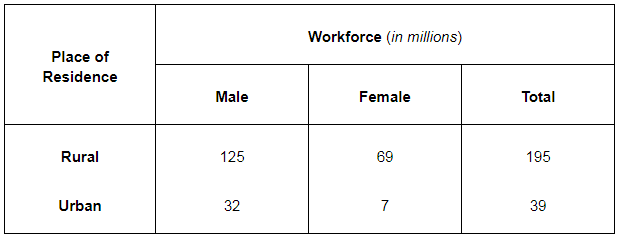
Q11: The following table shows the distribution of the workforce in India for the year 1972-73. Analyse it and give reasons for the nature of workforce distribution. You will notice that the data is pertaining to the situation in India 30 years ago!
Ans:
(i) In 1972-73, India's total workforce was 234 million. A very large share-about 83% (195 million)-was from rural areas, while only 17% (39 million) was urban. This distribution reflects the economy's heavy dependence on agriculture and rural occupations at that time.
(ii) The rural workforce included a higher proportion of women (36% of the rural workforce) than the urban workforce (18% female). Overall, male participation was higher in both areas, largely because many economic opportunities requiring formal skills, education or regular salaried jobs were concentrated in urban areas and were more accessible to men.
(iii) The dominance of low-productivity agriculture in rural areas meant low earnings and widespread poverty. Many rural workers were engaged in self-employment or casual work in agriculture, leading to underemployment and disguised unemployment.
In summary, the workforce distribution of 1972-73 shows an economy in which agriculture employed the majority, female participation was relatively low especially in urban areas, and limited industrial and service employment in urban centres kept rural dependence on farming very high.
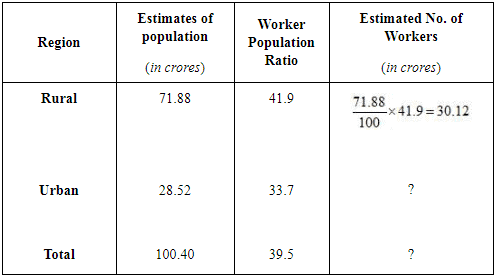
Q12: The following table shows the population and worker population ratio for India in 1999-2000. Can you estimate the workforce (urban and total) for India?
Ans:
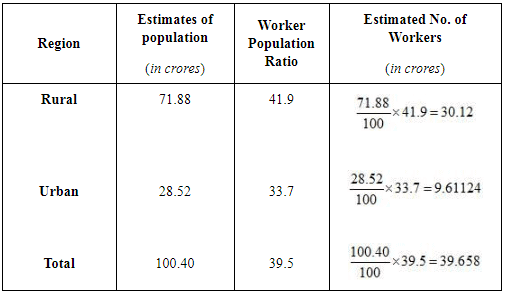

Note: The estimated urban and total workforce figures have been calculated using the population totals and the worker-population ratios shown in the given table. The detailed working and tabulated results are provided in the images above.
Q13: Why are regular salaried employees more in urban areas than in rural areas?
Ans: Regular salaried employees are more numerous in urban areas because:
- Urban areas have better access to education and vocational training, enabling people to acquire the skills required for permanent, salaried jobs.
- Most large firms, government offices and organised enterprises are located in towns and cities where infrastructure-such as banks, transport and communications-is better.
- These organised employers offer long-term contracts, social security and fixed wages, which are features associated with regular salaried employment that are less common in rural settings.
Q14: Why are less women found in regular salaried employment?
Ans:
- Many women work in informal, family or casual jobs that lack formal contracts; such work is not classified as regular salaried employment.
- Women often face lower access to education, skill training and professional networks that lead to stable salaried jobs.
- Social constraints, care responsibilities and limited bargaining power also push many women into unpaid family work, self-employment or casual labour rather than regular salaried positions.
Q15: Analyse the recent trends in the sectoral distribution of the workforce in India.
Ans:
- The workforce is distributed across three main sectors: Primary (agriculture, forestry, fishing), Secondary (manufacturing, construction) and Tertiary (services).
- Even recently, a large share of India's workforce remains in the primary sector; for example, about 57.3% were employed in primary activities in the data cited.
- The secondary sector employs a smaller share (about 17.6%), while the tertiary sector employs around 25.1% and is growing rapidly.
- Urban workers are concentrated in secondary and tertiary activities, while rural workers remain largely dependent on primary activities.
- The services sector is expanding fast and becoming an increasing source of employment and GDP; however, the pace of shift from agriculture to industry and services has been gradual.
- Women remain more present in the primary sector compared to secondary and tertiary sectors.
Q16: Compared to the 1970s, there has hardly been any change in the distribution of workforce across various industries. Comment.
Ans:
- India has remained an agrarian economy with a large portion of the population depending on agriculture for livelihood. This has made the shift away from agriculture slow.
- Between 1972-73 and 1999-00 the share of the workforce in the primary sector fell from about 74% to 60%, while the secondary and tertiary sectors increased modestly. These changes are not large enough given the scale of the labour force.
- Many workers have shifted into casual wage employment rather than into stable industrial or service jobs, causing greater casualisation of the workforce.
- Overall, although some structural change has occurred, industry and services have not grown fast enough to absorb the surplus labour from agriculture and generate sufficient employment gains.
Q17: Do you think that in the last 50 years, employment generated in the country is commensurate with the growth of GDP in India? How?
Ans:
- Though GDP has risen substantially over recent decades, employment growth has not kept pace - a phenomenon referred to as jobless growth.
- Rising use of technology and capital-intensive production methods in industry and services has increased output without a proportional increase in jobs.
- As a result, a large number of workers remain in low-productivity agriculture or in informal, low-paid work, leading to persistent underemployment and disguised unemployment.
- Multinational companies and high-growth service sectors often create jobs that require higher skills, so the overall employment generation remains limited for low-skilled labour.
Q18: Is it necessary to generate employment in the formal sector rather than in the informal sector? Why?
Ans:
- The formal sector (organised sector) provides jobs that are generally protected by labour laws and include social security benefits such as provident fund, pension and gratuity. This improves job security and worker welfare.
- Informal sector jobs typically lack social protection, stable contracts and bargaining power, making workers vulnerable to shocks and exploitation.
- Generating more formal sector employment helps reduce poverty, inequality and economic vulnerability by offering steady incomes and legal protections.
- Thus, expanding formal employment is important for inclusive economic development, although the informal sector will continue to play a role in providing immediate livelihoods.
Q19: Victor is able to get work only for two hours in a day. Rest of the day, he is looking for work. Is he unemployed? Why? What kind of jobs could persons like Victor be doing?
Ans:
Victor is underemployed rather than fully employed. He does work for two hours daily but spends the remainder of the day seeking additional work, which shows that he wants and is available for more work than he currently obtains. According to National Sample Survey practice, a person employed for less than 28 hours a week is often classified as underemployed. People in Victor's situation typically take on part-time or casual jobs such as delivering newspapers, casual restaurant work, delivery or courier tasks, day-labour at construction sites, or other short-duration informal tasks that offer only a few hours of work each day.
Q20: You are residing in a village. If you are asked to advise the village panchayat, what kinds of activities would you suggest for the improvement of your village which would also generate employment.
Ans: The following suggestions can help generate employment opportunities in a village:
- Increase Production: Promote agricultural improvements and encourage small-scale and cottage industries (e.g., handicrafts, food processing) to create local jobs and support rural industry.
- Increase Productivity: Provide training in modern farming methods and appropriate technology so workers can produce more with the same inputs, leading to higher incomes and more investment in labour-intensive activities.
- Control Population Growth: Raise awareness about family planning and provide related services so that population growth does not outstrip employment opportunities.
- Create Non-agricultural Employment: Develop off-season activities such as pottery, tailoring, carpentry, and village-level services to reduce seasonal unemployment and disguised unemployment.
- Easy Credit and Finance: Establish rural financial institutions or cooperatives to provide affordable credit for small entrepreneurs and farmers to start or expand income-generating activities.
- Education and Health Facilities: Improve schools, adult education (including night schools), vocational training, sanitation and healthcare to raise human capital and employability in the long term.
Q21: Who is a casual wage labourer?
Ans: Casual wage labourers are workers who are not employed throughout the year and typically work only for a few months. They are not hired on a regular basis, do not receive social security benefits (such as provident fund or gratuity), and are generally engaged in unskilled or low-skilled tasks. An example is a worker employed at a construction site on a day-to-day basis.
Q22: How will you know whether a worker is working in the informal sector?
Ans: The following features help to identify a worker in the informal sector:
- The worker is employed in an enterprise that is not part of the organised public sector and typically hires 10 or fewer workers.
- The worker may be self-employed or work in small family enterprises, and many workers in the informal sector are not formally hired employees.
- Workers in the informal sector generally do not receive social security benefits such as provident fund, pension or gratuity.
- Their economic interests are not well protected by labour laws (except limited protections like the Minimum Wages Act in some cases), leaving them exposed to market uncertainties and with low bargaining power.
FAQs on NCERT Solutions - Employment: Growth, Informalisation and Other Issues
| 1. What are the main factors contributing to employment growth in India? |  |
| 2. How does informalization of employment affect workers in India? | |
| 3. What are the implications of informal employment on economic growth? | |
| 4. What measures can be taken to formalize informal employment in India? | |
| 5. How does the COVID-19 pandemic impact employment in the informal sector? | |