NCERT Solutions - Sociology and Society

Q1: Why is the study of the origin and growth of sociology important?
Ans:
- Every subject has a history that helps explain its nature. Tracing the origin and growth of sociology clarifies why it studies social phenomena in a distinct, systematic way and how its core concerns emerged.
- Sociology developed during major social transformations such as the rise of modern science, industrialisation, urbanisation and new political ideas about rights and citizenship. These historical changes shaped the questions sociologists ask and the methods they use.
- Early thinkers compared society to living organisms and described stages of social development from simple to complex. These classical perspectives help us understand why contemporary sociology focuses on social structures, institutions and their functions.
- Studying the discipline's growth shows how personal choices - for example, decisions about education or occupation - are linked to larger social forces such as the economy, family patterns and gender norms.
- In the Indian context, colonial rule and its consequences prompted sociologists to examine power, inequality and cultural diversity. This history explains why Indian sociology pays special attention to context and diversity.
- Knowledge of the discipline's development also explains its methods: why sociology values empirical evidence, systematic enquiry and critical questioning rather than mere opinion or tradition.
- Overall, learning the origin and growth of sociology strengthens the subject by making its concepts, methods and applications clearer and more reliable for studying and addressing real social problems.
Q2: Discuss the different aspects of the term 'society'. How is it different from your common sense understanding?
Ans: The different aspects of the term 'society' have been explained by early sociologists like Auguste Comte, Karl Marx, and Herbert Spencer.
- These thinkers classified societies into two broad categories:
- Pre-modern societies: For example, hunter-gatherer groups, pastoral and agrarian communities, and other non-industrial forms of social organisation.
- Modern societies: For example, industrialised and urban societies where production, division of labour and formal institutions are more complex.
- Sociology studies society using systematic rules and principles that depend on clear concepts, reliable data and appropriate methods, rather than on casual observation.
- By contrast, common sense views of society are often naturalistic or individualistic, treating social arrangements as simply "the way things are" or as the result of individual choices alone.
- Common-sense knowledge usually does not question its own assumptions or investigate underlying causes; it accepts familiar explanations without testing them.
- Sociology takes a systematic and critical approach rooted in scientific investigation: it asks how social structures, institutions and historical processes shape behaviour and outcomes.
Thus, the common-sense meaning of 'society' tends to be limited or partial, while the sociological understanding is broader, analytical and evidence-based.
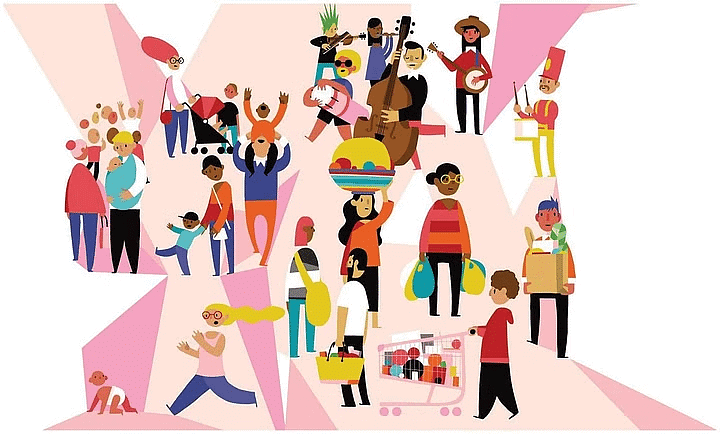 Sociology and Society
Q3: Discuss how there is greater give and take among disciplines today.
Ans: The increased give and take among disciplines today can be seen in the following ways:
- Sociology examines social behaviour, institutions, policies and programmes, all of which are shaped by historical, political and economic factors; this naturally leads sociology to engage with other social sciences.
- Political Science focuses on the state and political processes. Political circumstances and policies affect social life and the economy. The overlap appears in political sociology, which studies political behaviour, gender and politics, organisational decision-making, and electoral support.
- Economics analyses production, distribution and consumption. Economic decisions are influenced by social norms and institutions, so economic sociology studies how economic behaviour is embedded in social relations, values and interests.
- History has traditionally studied past events, but modern historians increasingly use sociological concepts to understand social institutions, gender relations and everyday life in the past; this creates a shared method in social history.
- Psychology studies individual behaviour and mental processes. Because the individual is shaped by social contexts, social psychology investigates how social situations, groups and institutions influence attitudes and actions.
- Anthropology studies social and cultural life, especially in simpler or non-industrial societies. Cultural and social anthropology remain closely allied to sociology in studying values, customs and social organisation; anthropology is often called the sister discipline of sociology.
In short, economy, polity and society are deeply interrelated. As social problems become more complex, disciplines borrow concepts and methods from one another so that sociologists, economists and political scientists can study overlapping issues in a more integrated manner.
Q4: Identify any personal problem that you or your friends or relatives are facing. Attempt a sociological understanding.
Ans: (Any answer supported with argument or explanation would solve the purpose. One sample answer has been provided to you)
One personal problem that a friend of mine is facing is unemployment. He has been searching for a job for over six months without success. His situation can be analysed sociologically to understand the broader social forces and structures contributing to his unemployment.
- First, unemployment is linked to the economic structure of society. Changes such as automation, outsourcing and economic slowdowns reduce the number of available jobs in some sectors, creating intense competition for positions.
- Second, the education system may not always match the needs of the changing labour market. If qualifications and curricula emphasise traditional subjects rather than current skill demands, graduates may not be readily employable.
- The gap between the skills taught and those demanded by employers is therefore a key factor. Vocational training, internships and skill-based courses often improve employability but may be unevenly available.
- Social stratification also plays a role. Social class, caste, gender and ethnicity affect access to resources and networks. My friend's lower-middle-class background limits access to influential contacts and financial support that could help in a job search.
- Social networks and social capital strongly influence employment prospects. People with stronger networks find jobs through referrals; those lacking such ties may face longer unemployment.
- Finally, individual agency and choices matter: job-search strategies, geographical mobility, willingness to retrain, and the ability to accept different kinds of work affect outcomes. However, individual efforts operate within structural constraints.
In conclusion, my friend's unemployment is not only an individual problem but the result of interacting social factors - economic change, education-labour market mismatch, social inequalities and limited networks. A sociological understanding suggests policy responses such as better alignment of education with market needs, expanded skill training, active labour-market programmes and measures to reduce structural inequality.
FAQs on NCERT Solutions - Sociology and Society
| 1. What is the importance of studying sociology in understanding society? |  |
| 2. How does sociology contribute to addressing social issues and inequalities? | |
| 3. What are some key sociological theories that help explain social phenomena? | |
| 4. How does sociology differ from other social sciences like psychology and anthropology? | |
| 5. Can sociology be used to inform public policy and decision-making? | |