NCERT Solutions - Methods of Enquiry in Psychology

Q1: What are the goals of scientific enquiry?
Ans: The goals of scientific enquiry are as follows:
- Description: To observe and record behaviour or phenomena accurately and systematically so that they can be clearly understood and communicated.
- Prediction: To identify relationships between behaviours or events so that one can forecast when they are likely to occur, often with an expected margin of error.
- Explanation: To discover the causes or determinants of behaviour and to specify the conditions under which a behaviour occurs or does not occur.
- Control: To use explanations to influence behaviour by changing antecedent conditions so that a behaviour can be produced, reduced or enhanced as required.
- Application: To apply findings to solve real-life problems and bring about positive changes in education, health, industry and other social settings.
Q2: Describe the various steps involved in conducting a scientific enquiry.
Ans: The various steps involved in conducting a scientific enquiry can be described as follows:
- Conceptualisation of problem: Narrow down and define the specific problem clearly. This involves reviewing earlier research, using personal observations and experience, and then stating a tentative explanation or hypothesis.
- Data collection: Prepare a detailed plan or blueprint for the study. This includes identifying the participants, choosing the research method (for example, experiment, survey or observation), selecting the tools or instruments, and outlining the exact procedure for collecting data.
- Drawing conclusions: Analyse the collected data using suitable statistical techniques and present results clearly (for example, in graphs or charts). Use these results to test the hypothesis and draw reasoned conclusions.
- Revising research conclusions: Confirm the hypothesis on the basis of data or, if required, modify it and conduct further testing. Other researchers may replicate or extend the study, making enquiry a continuous and self-correcting process.
Q3: Explain the nature of psychological data.
Ans: The nature of psychological data can be explained through the following points:
- Psychological data are not independent entities: Behaviour is influenced by physical and social context, the people present and the time at which it occurs. For example, a person may act differently when alone than in a group.
- Quality and nature of data are affected by method of collection: Answers given in an interview may differ from what is observed directly, because people may respond differently when questioned than when they act.
- Data are facts that need interpretation: Raw data do not carry meaning by themselves; researchers give them context and interpretation to arrive at conclusions.
Q4: How do experimental and control groups differ? Explain with the help of an example.
Ans: Experimental groups differ from control groups in that the independent variable is manipulated in experimental groups but is absent or held constant in the control group. For example, in a study by Latane and Darley participants were sent to three types of rooms.
Room 1, in which the participant was alone, formed the control group. Rooms 2 and 3, in which other persons were present with the participant, formed the experimental groups.
The independent variable in this study was the presence or absence of other people in the room. All other conditions were kept the same across groups. Since the presence of other persons was manipulated only in the experimental groups, the control group allowed the researchers to see what happened when that factor was absent.
Q5: A researcher is studying the relationship between speed of cycling and the presence of people. Formulate a relevant hypothesis and identify the independent and dependent variables.
Ans: Relationship between the speed of cycling and the presence of people
- Hypothesis: As the speed of cycling increases, people nearby tend to move away more quickly.
- Field experiment: Two marketplaces are chosen. A boy is asked to ride a bicycle through each market at different speeds while observers record how people respond.
- Market 1: When the boy rides at a high speed, observers note that people move away quickly to avoid being hit.
- Market 2: When the boy rides at a normal or slow speed, observers note that people move away more slowly and give way as usual.
- Conclusion: Higher cycling speed is associated with faster movement of bystanders; lower speed is associated with slower movement of bystanders.
- Revision of research conclusion: The observed pattern supports the hypothesis. Further replications would increase confidence in the result.
- Independent variable: Speed of the bicycle.
- Dependent variable: Movement (speed/direction) of people near the cyclist.
Q6: Discuss the strengths and weaknesses of experimental method as a method of enquiry.
Ans: The strengths and weaknesses of experimental method as a method of enquiry are:
Strengths
- It provides relatively convincing evidence of a cause-effect relationship between variables because the researcher manipulates the independent variable.
- Extraneous variables can be controlled, especially in laboratory settings, which helps isolate the effect of the independent variable.
- Sequence effects can be reduced by using counter-balancing techniques when the same participants experience different conditions.
- Random assignment to groups helps prevent systematic differences between groups and supports valid conclusions.
Weaknesses
- Highly controlled laboratory conditions may not reflect real-world situations, so findings may lack ecological validity.
- Results from laboratory experiments may not generalise to everyday life; field experiments are sometimes needed for real situations.
- Not all problems can be studied experimentally because some variables cannot be ethically or practically manipulated.
- It is difficult to identify and control all relevant variables, particularly in field settings, which can complicate interpretation of results.
Q7: Dr. Krishnan is going to observe and record children's play behaviour at a nursery school without attempting to influence or control the behaviour. Which method of research is involved? Explain the process and discuss its merits and demerits.
Ans: Dr. Krishnan will use the non-participant observation method to observe and record children's play behaviour without influencing it. She will sit quietly at a distance in the play area and watch how children interact with one another and with teachers. The children will not know they are being observed. Later, she will record her notes, organise the observations, analyse patterns and compare them with her initial expectations or hypotheses.
Merits of non-participant observation method
The researcher observes behaviour as it naturally occurs, which helps to capture genuine actions and interactions rather than responses influenced by the researcher.
Demerits of non-participant observation method
This method is time consuming and labour intensive. Observations are vulnerable to the observer's bias because personal values and interpretations can affect what is noticed and how it is recorded. Ethical concerns such as permission and privacy must also be considered.
Q8: Give two examples of the situations where survey method can be used. What are the limitations of this method?
Ans:
The two examples where a survey method can be used are as follows:
- To find out people's attitudes towards a polio eradication programme.
- To collect information about the characteristics of members of a particular population, such as age, education and occupation.
The limitations of survey method are as follows:
- People may provide inaccurate information because of memory lapses or because they prefer not to reveal their true opinions.
- Respondents sometimes give answers they believe the researcher wants to hear (social desirability bias).
- Low response rates or poorly worded questions can reduce the usefulness of survey data.
Q9: Differentiate between an interview and a questionnaire.
Ans: The difference between an interview and a questionnaire are:
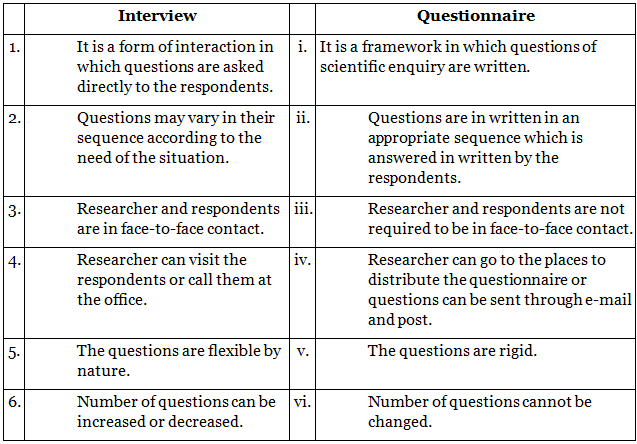
- Mode of administration: An interview is conducted orally (face-to-face or by telephone); a questionnaire is completed in writing by the respondent.
- Flexibility: Interviews allow for probing and clarification of answers; questionnaires are more rigid and use standardised questions.
- Time and cost: Interviews usually take more time and are costlier; questionnaires can be cheaper and quicker for large samples.
- Interviewer effect: Interviews may be influenced by the interviewer; questionnaires reduce interviewer bias but may suffer from misinterpretation by respondents.
- Data uniformity: Questionnaires provide more standardised data that are easier to score; interviews can yield richer qualitative details.
Q10: Explain the characteristics of a standardised test.
Ans: The characteristics of a standardised test are as follows:
- Validity: The test measures what it claims to measure. A valid test produces scores that reflect the intended trait or ability.
- Reliability: The test yields consistent results over time or across equivalent forms. Test-retest shows temporal stability; split-half shows internal consistency.
- Norms: The test is standardised on a representative sample to provide norms or average scores. Norms allow an individual's score to be interpreted relative to the group.
Q11: Describe the limitations of psychological enquiry.
Ans: The limitations of psychological enquiry are as follows:
- Lack of true zero point: Psychological measurements are often relative; scores do not represent an absolute zero point in the way some physical measures do.
- Relative nature of psychological tools: Tests and measures must be adapted to the context and population; a test developed for urban children may not be suitable for tribal children without modification.
- Subjective interpretation of qualitative data: Qualitative findings depend on the researcher's interpretation, which can vary between observers.
Q12: What are the ethical guidelines that a psychologist needs to follow while conducting a psychological enquiry?
Ans: The following are the ethical guidelines that a psychologist needs to follow while conducting a psychological enquiry:
- Voluntary Participation: Participation should be entirely voluntary; individuals must have the choice to take part or to decline.
- Informed Consent: Participants should be informed about the nature, purpose and possible impact of the study before it begins so they can decide whether to take part.
- Debriefing: After participation, researchers should explain the study fully, answer questions and ensure participants leave in the same mental and physical state as before the study.
- Sharing the Results: Researchers should share findings with participants when appropriate; participants' reactions can provide useful feedback and respect their involvement.
- Confidentiality of Data Source: Information given by participants must be kept confidential and not disclosed to others without permission.
Hence, researchers must ensure these ethical principles are followed to respect participants' rights, protect their welfare and maintain public trust in research.
FAQs on NCERT Solutions - Methods of Enquiry in Psychology
| 1. What is the importance of methods of inquiry in psychology? |  |
| 2. What are the different methods of inquiry used in psychology? | |
| 3. How do psychologists ensure the validity and reliability of their research findings? | |
| 4. How do psychologists determine causation in their research? | |
| 5. How do qualitative research methods contribute to the field of psychology? | |