NCERT Solutions - Human Development

Q1: What is development? How is it different from growth and maturation?
Ans: Development is the pattern of progressive, orderly and predictable changes that originate at conception and continue to take place throughout an individual's life. It involves changes in physical, cognitive and socio-emotional capacities and the way these are organised over time. It is different from growth and maturation by the following features:
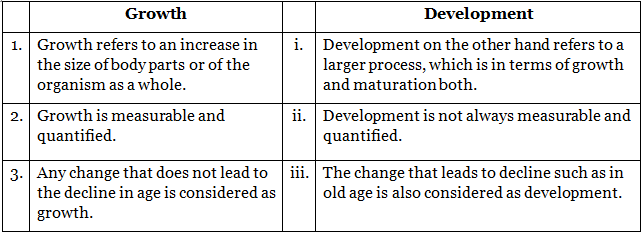
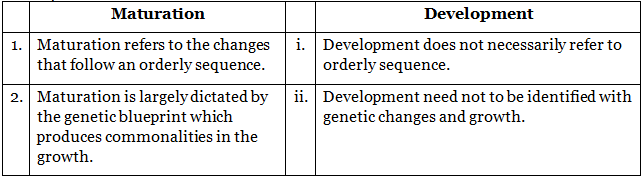
Q2: Describe the main features of life-span perspective on development.
Ans: The main features of life-span perspective on development are as follows:
- Development is a lifelong process that takes place across all age groups starting from conception to old age. It includes both gains (for example, new skills) and losses (for example, decline in some capacities) and these interact dynamically.
- The biological, cognitive, and socio-emotional processes of human development are interwoven; changes in one domain influence the others throughout the life span.
- Development is multi-directional as some dimensions or components of a given domain may increase while others show a decrease (for example, vocabulary may increase while certain memory functions decline in later life).
- Development is highly plastic since psychological capacities can be modified by experience, although the degree of plasticity varies among individuals and across ages.
- Development is influenced by historical conditions; major social events and historical periods shape the opportunities and constraints people experience.
- Multiple disciplines-such as psychology, anthropology, sociology and the neurosciences-contribute to our understanding of development, reflecting its complex nature.
- Development is context-dependent: responses and actions of individuals are related to inherited traits, physical environment, and social, historical and cultural contexts, which differ across persons.
Q3: What are developmental tasks? Explain by giving examples.
Ans: Developmental tasks are the skills, activities or responsibilities that are expected to be achieved during particular age periods to promote healthy development. They guide what is commonly seen as appropriate progress at each stage of life. Examples include:
- Infancy: Developing basic motor skills (for example, sitting, crawling, walking) and forming early attachment relationships.
- Toddlerhood: Gaining a sense of autonomy (for example, basic self-care like feeding oneself, saying "no" to assert independence).
- Middle childhood: Learning to cooperate with peers, developing school readiness and basic academic skills.
- Adolescence: Accepting bodily changes, forming peer relationships, developing a sense of identity and preparing for vocational decisions.
- Early adulthood: Establishing a career and intimate relationships, and achieving financial independence.
Q4: 'Environment of the child has a major role in the development of the child'. Support your answer with examples.
Ans: The environment of the child has a major role in development because it provides the physical, social and cultural conditions in which skills and personality develop. Environmental factors interact with genetic predispositions to shape outcomes.
- Physical and material environment: Adequate nutrition, health care and safe living conditions support healthy physical and cognitive development. For example, a child who receives good nutrition and stimulation at home learns faster and is healthier than one deprived of these.
- Educational environment: Access to schooling and quality teaching helps develop confidence, language and thinking skills. For example, a child sent to school is more likely to develop self-reliance and social skills than a child denied education.
- Family and emotional environment: A stable, responsive family helps children regulate emotions and learn social behaviour. For example, a child with a calm, supportive family learns to manage anger, while a chaotic home may reinforce aggressive responses.
- Socio-economic and cultural environment: Family income, parental education and cultural practices influence opportunities and aspirations. For example, children exposed to diverse experiences early in life tend to be more confident and adaptable.
Q5: How do socio-cultural factors influence development?
Ans: Following are the socio-cultural influences on the development of an individual:
- Socio-cultural factors provide the social context in which development takes place; norms, values and expectations shape behaviour and goals.
- Children learn social roles, attitudes and habits from family, peers and community, so their personality and behaviour reflect these cultural patterns.
- Cultural background influences interaction styles and social identity, affecting how individuals relate to others and to institutions (for example, schooling, work).
- Variation in experiences across social and cultural groups leads to differences in opportunities, skills and aspirations among individuals.
- Specific factors such as home conditions, quality of schooling and peer interaction directly affect learning, social competence and emotional adjustment.
- For example, children growing up in an unsupportive family find it harder to learn decision-making and self-control, whereas children exposed to supportive, stimulating environments develop confidence and problem-solving skills.
Q6: Discuss the cognitive changes taking place in a developing child.
Ans: Cognitive development refers to changes in thinking, reasoning, and understanding. According to Jean Piaget, it occurs in stages:
- 0-2 years: Sensorimotor stage. Infants explore the world by coordinating sensory experiences with physical actions. They develop object permanence - the understanding that objects continue to exist even when out of sight.
- 2-7 years: Preoperational thinking. Children begin to use mental symbols to represent objects and events. They engage in symbolic play and language development, but thinking is often egocentric (difficulty seeing another's viewpoint) and they may show animistic thought (attributing life to inanimate objects).
- 4-7 years: Intuitive thought emerges within the preoperational stage. Children ask many questions and try to understand causes, though their reasoning is based more on intuition than on logical principles.
- 7-11 years: Concrete operational thought. Children develop logical thinking about concrete events. They can classify objects into sets, understand conservation (that quantity remains the same despite changes in shape), and perform reversible mental operations.
- 11-15 years: Formal operational thought. Adolescents develop abstract and hypothetical reasoning. They can think about possibilities, use systematic problem-solving, and reflect on their own thinking. This stage may also bring a form of adolescent egocentrism (see next question).
Q7: Attachment bonds formed in childhood years have long-term effects. Explain taking examples from dailylife.
Ans: Attachment bonds formed in childhood have long-term effects because early relationships shape patterns of trust, emotion regulation and interpersonal behaviour that continue into later life.
- When children experience sensitive, responsive caregiving, they tend to develop secure attachment: they trust carers, feel safe to explore and later form healthy relationships as adults. For example, a child confident of parental support may discuss important choices such as career or marriage openly with parents.
- By contrast, children who experience inconsistent or unresponsive care may develop insecure attachment, leading to difficulties in trusting others, problems with communication and increased risk of behavioural problems. For example, lack of emotional support in childhood is often linked with poor peer relationships or juvenile delinquency.
- Everyday effects include how adults form close relationships, handle stress, and seek help; secure early attachment is associated with better social adjustment and emotional well-being, while poor early attachment can contribute to anxiety, withdrawal or aggression.
Q8: What is adolescence? Explain the concept of egocentrism.
Ans: Adolescence is commonly defined as the stage of life that begins at the onset of puberty, when sexual maturity or the ability to reproduce is attained. It is a transitional period between childhood and adulthood marked by rapid biological, cognitive and social changes. It typically starts at approximately 11 to 12 years of age and continues until about 18 to 20 years of age.
The concept of egocentrism deals with strong self-focus. It is a viewpoint centred on the self that makes it hard to appreciate other people's perspectives. In adolescence, egocentrism often has two elements:
- Imaginary audience - The belief that others are as preoccupied with the adolescent as they are with themselves. This leads to heightened self-consciousness; for example, a teenager may feel everyone notices a small blemish or a choice of clothing.
- Personal fable - A sense of uniqueness and invulnerability; adolescents may feel their experiences are special and that others cannot understand them, which can lead to risk-taking (for example, believing "That won't happen to me").
Q9: What are the factors influencing the formation of identity during adolescence? Support your answer with examples.
Ans: The factors influencing the formation of identity during adolescence are as follows:
- Cultural background: Cultural values and practices shape beliefs, roles and expectations. For example, adolescents in different cultures may prioritise family duties or individual achievement according to cultural norms.
- Family and societal values: The attitudes and values modelled at home and in the community guide adolescents' choices and sense of right and wrong. For example, teenagers raised in a consumer-oriented society may place more emphasis on material success than those raised in communities that value spiritual or communal goals.
- Ethnic background: Identification with an ethnic group provides a sense of belonging and influences customs, language and social expectations. For example, rites of passage or community roles may differ across ethnic groups and shape identity.
- Socio-economic status: Access to resources and opportunities affects career aspirations, leisure activities and peer groups. For example, access to education and technology can broaden vocational choices and social identity.
- Vocational commitment: Choices about study streams and career paths become part of identity as adolescents decide whether to pursue science, commerce or other routes and begin to form professional goals.
Q10: What are the challenges faced by individuals on entry to adulthood?
Ans: The challenges faced by individuals on entry to adulthood include several personal and social adjustments. Key areas are:
(i) Career and work
- Entering the workforce brings new responsibilities and expectations. Young adults must adapt to job demands, prove competence and cope with pressures from employers and themselves.
- They may face uncertainty about career choice, need to acquire new skills and balance work with other life commitments.
(ii) Marriage
- Entering a marital relationship requires adjustment to shared decision-making, understanding a partner's likes and dislikes, and negotiating roles in household work.
- When both partners work, there are additional challenges of sharing domestic responsibilities and maintaining communication.
(iii) Parenthood
- Becoming a parent is a major transition that brings responsibility and stress. It requires learning parenting skills, managing time and meeting children's needs.
- The experience depends on factors such as number of children, social support, and the quality of the couple's relationship. Single parents face added pressures in meeting both economic and caregiving responsibilities.
FAQs on NCERT Solutions - Human Development
| 1. What are the stages of human development according to the article? |  |
| 2. How does human development differ from person to person? | |
| 3. What are some factors that can impact human development? | |
| 4. How does human development affect society as a whole? | |
| 5. How can individuals promote their own human development? | |





