Solved Examples: Ratio & Proportion | Quantitative for GMAT PDF Download
What is Ratio and Proportion?
A comparison of two quantities by division is called a ratio and the equality of two ratios is called proportion. A ratio can be written in different forms like x : y or x/y and is commonly read as, x is to y.
On the other hand, proportion is an equation that says that two ratios are equivalent. A proportion is written as x : y : : z : w, and is read as x is to y as z is to w. Here, x/y = z/w where w & y are not equal to 0.
Solved Examples
Example 1: The annual budget for a road construction project is $25,200 budgeted equally over 12 months. If by the end of the third month the actual expenses have been $7,420, how much has the construction project gone over budget?
(a) $2150
(b) $3340
(c) $1120
(d) $980
(e) $1640
Ans: (c)
The monthly budget is found by:
which for 3 months is a budget of:
2,100 x 3=6,300
To find out how much they are over budget the budgeted amount is subtracted from the actual expenses.
7,420 − 6,300=1,120
Example 2: The Duchy of Grand Fenwick uses an unusual currency system. It takes 24 tiny fenwicks to make a big fenwick.
At current exchange rates, 1 big fenwick can be exchanged for $3.26 American currency. For how much in Grand Fenwick currency can an American tourist exchange $300 (rounded to the nearest tiny fenwick)?
(a) 92 big fenwicks and 1 tiny fenwick
(b) 40 big fenwicks and 18 tiny fenwicks
(c) 108 big fenwicks and 16 tiny fenwicks
(d) 296 big fenwicks and 16 tiny fenwicks
(e) None of the above
Ans: (a)
$3.26 can be exchanged for 1 big fenwick, or, equivalently, 24 tiny fenwicks. We can set up a proportion statement, where F is the number of tiny fenwicks for which $300 can be exchanged:
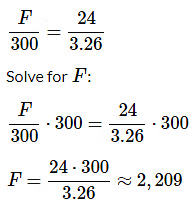
The answer is 2,209 tiny fenwicks, which can be counted up with division:
2,209÷24=92 R 1
or 92 big fenwicks and 1 tiny fenwick.
Example 3: The ratio 3 to 1/2 is equal to the ratio:
(a) 1 to 6
(b) 3 to 2
(c) 2 to 3
(d) 6 to 1
(e) 5 to 1
Ans: (d)
The ratio 3 to 1/2 is the same as 
which equals a ratio of 6 to 1.
Also, if you double both sides of the ratio, you get 6 to 1.
Example 4: The ratio 4 to 1/4 is equal to which of the following ratios?
(a) 8 to 1
(b) 12 to 1
(c) 16 to 1
(d) 16 to 3
(e) 6 to 1
Ans: (c)
The ratio 4 to 1/4 is equal to  which is
16 can be written as the ratio 16 to 1.
Example 5: On a map, one and a half inches represents sixty actual miles. In terms of N, what distance in actual miles is represented by N inches on the map?
(a) 45N mi
(b)40/N mi
(c) 40N mi
(d) 90/N mi
(e) 90 N mi
Ans: (b)
Let x be the number of actual miles. Then the proportion statement to be set up, with each ratio being number of actual miles to number of map inches, is:
Simplify the left expression and solve for x
Example 6: The Kingdom of Zenda uses an unusual currency system. It takes 16 kronkheits to make a grotnik and 12 grotniks to make a gazoo.
At current, $1 can be exchanged for 8 grotniks and 8 kronkheits. For how much American currency can a visitor from Zenda exchange a 100-gazoo bill, to the nearest cent?
(a) $ 141.18
(b) $ 85.00
(c) $ 11.76
(d) $ 70.83
(e) None of the above
Ans: (a)
$1 can be exchanged for 8 grotniks and 8 kronkheits, or, equivalently, 8.5 grotniks (8 kronkheits is one-half of a grotnik). 100 gazoos is equal to 100 x 12=1,200 grotniks. Therefore, if D is the number of dollars that can be exchanged for the 100-gazoo bill, we can set up the proportion:

Solve for D:
That is, the 100-gazoo bill can be exchanged for $141.18.
Example7: A box contains red and blue marbles. The probablity of picking a red is 1/3. There are 30 blue marbles. How many total marbles are there?
(a) 45
(b) 50
(c) 40
(d) 60
(e) 90
Ans: (a)
if 1/3 are red, then 2/3 are blue, and the number of blue marbles can be written as

Plug in the number of blue marbles, 30, and solve for the total marbles.

Example 8: In a certain classroom all of the students are either sophomores or juniors. The number of boys and girls in the classroom are equal. Of the girls 3/7 are sophomores, and there are 24 junior boys. If the number of junior boys in the classroom are in the same proportion to the total amount of boys as the number of sophomore girls are to the total number of girls, how many students are in the classroom?
(a) 96
(b) 72
(c) 56
(d) 168
(e) 112
Ans: (e)
This question seems convoluted but is actually more simple than it seems. We are told that the number of girls and boys in the classroom are equal and that 3/7 of the girls are sophomores. We are then told that 24 of the boys are juniors, and that they represent a proportion of total boys equal to the proportion of sophomore girls to total girls. This means that: where x is the total number of boys.
If we know that the number of boys and girls in the class are equal, then the total number of students in the class = 112.
Example 9: Nishita has necklaces, bracelets, and rings in a ratio of 7:5:4. If she has 64 jewelry items total, how many bracelets does she have?
(a) 16
(b) 20
(c) 5
(d) 28
(e) 32
Ans: (b)
7x+5x+4x=64
16x=64
x=4
bracelets: 5x=5(4)=20
Example 10: Five different pizza places offer five different specials. Assuming that all of these pizzas are of the same thickness and that all are of the same quality, which of the following is the best buy?
(a) A round pizza 10 inches in diameter for $5.99
(b) A round pizza 12 inches in diameter for $8.99
(c) A 12 inch by 8 inch rectangular pizza for $9.99
(d) A 9 inch by 9 inch square pizza for $6.99
(e) A 10 inch by 10 inch square pizza for $7.99
Ans: (a)
Since all of the pizzas are of the same thickness and quality, to determine the best bargain, calculate the price per square inch of each. The least amount will mark the best bargain.
Edit this later
A round pizza 10 inches in diameter for $5.99:
The area of the pizza in square inches is 
The cost per square inch: 5.99÷25π=0.076 or 7.6 cents
A round pizza 12 inches in diameter for $8.99
The area of the pizza in square inches is A=πr2=π⋅62=36π
The cost per square inch: 8.99÷36π=0.079 or 7.9 cents
A 9 inch by 9 inch square pizza for $6.99
The area of the pizza in square inches is 9⋅9=81
The cost per square inch: 6.99÷81=0.086 or 8.6 cents
A 10 inch by 10 inch square pizza for $7.99
The area of the pizza in square inches is 10⋅10=100
The cost per square inch: 7.99÷100=0.080 or 8.0 cents
A 12 inch by 8 inch rectangular pizza for $9.99:
The area of the pizza in square inches is 12⋅8=96
The cost per square inch: 9.99÷96=0.104 or 10.4 cents
The round pizza 10 inches in diameter for $5.99 is the best buy.
Example 11: If the ratio of the ages of two friends A and B is 3 : 5 and that of B and C is 3 : 5 and the sum of the ages of all 3 friends is 147, how old is B?
(a) 15 years
(b) 75 years
(c) 49 years
(d) 45 years
(e) 27 years
Ans: (d)
Ratio of ages of two friends A and B = 3 : 5
Ratio of ages of two friends B and C = 3 : 5
Sum of the ages of A, B and C = A + B + C = 147 ... (i)
Step 1: Express the ratios such that value of B is the same in both ratios
How to equate the value of B in both the ratios?
Rewrite the two ratios such that the value of B in both ratios is the LCM of the values of B in the two ratios.
Multiply the first ratio by 3 → A : B = 9 : 15
Multiply the second ratio by 5 → B : C = 15 : 25
Step 2: Compute A : B : C
Now that the value of B is the same in the two ratios, A : B : C = 9 : 15 : 25
Step 3: Compute Age of B
So, if A is 9x years old, B will be 15x and C will be 25x old. Sum of their ages is 147.
So, 9x + 15x + 25x = 147
49x = 147 or x = 3
B's age = 15x = 15 × 3 = 45
Age of B = 45 years
Choice D is the correct answer
Example 12: A box contains x red balls, thrice as many green balls and, half as many blue balls as there are red balls. If the box contains no other balls, which of the following could be the number of balls in the box?
(a) 22
(b) 44
(c) 54
(d) 33
(e) 24
Ans: (c)
Number of red balls = x
Number of green balls → thrice as many as the number of red balls = 3x
Number of blue balls → half as many as the number of red balls = x2
Total number of balls = x + 3x + x/2 = 9x/2x29x2
Total number of balls and number of red balls are both integers ∴ 9x/2 and x are integers.
If 9x/2 is an integer, x has to be an even number. Four out of the five answer options are even. We need additional deduction to arrive at the answer.
For any even value of x, 9x/2 will be a multiple of 9.
So, the total number of balls has to be a multiple of 9.
The only multiple of 9 in the answer options is 54.
Number of balls in the box = 54
Example 13: If a, b, and c are numbers such that (a + b) : (b + c) : (c + a) is 15 : 11 : 12, then
 (a) Quantity A is greater
(b) Quantity B is greater
(c) The two quantities are equal
(d) Cannot be determined
Ans: (d)
Given Data
(a + b) : (b + c) : (c + a) = 15 : 11 : 12
To compare a and c, it is sufficient if we compare the first two components of this ratio.
(a + b) : (c + b) = 15 : 11
Since b is a constant present in both the components, we can find the greater of the two terms, a and c, by equating the above ratio.
However, the caveat is that the ratio a + b : c + b is 15 : 11. Either both a and c are positive or are negative.
Case 1: Both a and c are positive
Let the value of (a + b) be 15x, and (c + b) be 11x.
If x is positive it is evident that 15x > 11x.
∴ (a + b) > (c + b)
Based on Case 1, we can deduce that a > c.
Case 2: Both a and c are negative
Let the value of (a + b) be 15x, and (c + b) be 11x.
If x is negative it is evident that 15x < 11x.
∴ (a + b) < (c + b)
Based on Case 2, we can deduce that a < c.
Because both possibilities exist, we are not able to deduce which of the two quantities a or c is greater based on the information given in the question. The key to getting the answer right is to remember that 15: 11 need not always result in the two quantities being positive.
Choice D is the correct answer
|
115 videos|106 docs|113 tests
|
FAQs on Solved Examples: Ratio & Proportion - Quantitative for GMAT
| 1. What is the difference between ratio and proportion? |  |
| 2. How do you simplify ratios? | |
| 3. How can ratios be used in real life? | |
| 4. What is the rule for solving proportions? | |
| 5. Can ratios and proportions be used in geometry? | |

|
4.8K Views |

|
4.70/5 Rating |

|
Dec 18, 2024 Last updated |

|
Explore Courses for GMAT exam
|

|
MCQs
,Objective type Questions
,Viva Questions
,mock tests for examination
,Exam
,Free
,Sample Paper
,ppt
,Important questions
,Previous Year Questions with Solutions
,study material
,Summary
,Solved Examples: Ratio & Proportion | Quantitative for GMAT
,past year papers
,Solved Examples: Ratio & Proportion | Quantitative for GMAT
,video lectures
,practice quizzes
,Semester Notes
,Solved Examples: Ratio & Proportion | Quantitative for GMAT
,Extra Questions
,shortcuts and tricks
;


Solved Examples: Ratio & Proportion Free PDF Download
Importance of Solved Examples: Ratio & Proportion
Solved Examples: Ratio & Proportion Notes
Solved Examples: Ratio & Proportion GMAT Questions
Study Solved Examples: Ratio & Proportion on the App
|
© EduRev
|
Education Revolution
|


Follow Us
|


