NCERT Solutions - Motivation and Emotion

Q1: Explain the concept of motivation.
Ans: The concept of motivation explains the causes of behaviour. The term is derived from the Latin word movere, meaning to move. Motivation refers to the internal processes that initiate, sustain and direct activity towards goals. Motives are the reasons behind actions - for example, earning money is a motive for going to work, and obtaining a degree is the motive for attending college. Motivation helps to predict behaviour because it provides an explanation of why people select particular actions and how strongly they pursue them. Thus, motivation is one of the key determinants of behaviour and guides choices, effort and persistence in achieving goals.
Q2: What are the biological bases of hunger and thirst needs?
Ans:
- The biological bases of hunger and thirst are indicated by events both inside and outside the body that create drives and stimulate behaviour.
- Organisms have physiological needs that produce a drive; this drive motivates actions aimed at achieving particular goals and reducing the internal state of need.
- The stimuli for hunger include stomach contractions, a fall in blood glucose concentration, and nerve signals from the liver to the brain. External cues such as the aroma, taste and appearance of food also trigger eating by making the organism aware of food availability.
- Thirst arises from a loss of body water that creates dehydration of cells and tissues and a drying sensation in the mouth. Osmoreceptors in the hypothalamus detect changes in blood concentration and generate nerve impulses that signal thirst and prompt drinking when the body's water balance is disturbed.
Q3: How do the needs for achievement, affiliation, and power influence the behaviour of adolescents? Explain with examples.
Ans: The needs for achievement, affiliation and power shape adolescents' motives and therefore influence their choice of activities and social behaviour.
- The need for affiliation is aroused when individuals seek closeness, support or acceptance. For example, adolescents experiencing peer pressure try to make friends, join groups or follow trends to gain popularity and a sense of belonging.
- The need for achievement motivates individuals to tackle challenging tasks and to seek feedback on performance. For example, adolescents who want good marks work hard, set study goals and ask teachers for feedback so they can improve and feel successful.
- The need for power involves the desire to influence or control others. An adolescent aiming to be class captain or a club leader is motivated to gain authority, organise activities and guide peers, so as to exercise influence within the school.
Q4: What is the basic idea behind Maslow's hierarchy of needs? Explain with suitable examples.
Ans: Maslow's hierarchy of needs presents human needs arranged in an order of priority, from the most basic to the most advanced. The model suggests that lower-level needs must be reasonably satisfied before higher-level needs become strong motivators. The hierarchy is often shown as a pyramid with fundamental needs at the base and self-actualisation at the top.
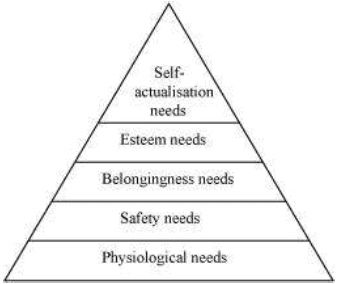
- Physiological needs: These form the base of the pyramid and include essentials such as food, water, shelter and sleep. For example, a person who is hungry is primarily motivated to obtain food before attending to other concerns.
- Safety needs: Once physiological needs are met, the desire for physical and psychological security emerges. Examples are a safe home, steady employment and a predictable environment.
- Belongingness and love needs: This level involves the desire to form social bonds and feel accepted. Being part of a family, friendship groups or school clubs meets the need for belonging and affection.
- Esteem needs: After social needs are satisfied, individuals seek respect, recognition and a sense of competence. Holding a responsible post in school, gaining awards or receiving praise contributes to self-esteem.
- Self-actualisation: At the top is the need to realise one's full potential. This appears when a person pursues personal growth, creativity or new learning-such as returning to study mid-career to learn a new skill.
Q5: How does culture influence the expression of emotions?
Ans: Culture shapes how people express emotions by providing rules and norms for acceptable gestures, facial expressions and social behaviour. While some facial expressions are recognised across cultures, many non-verbal behaviours differ. For example, Latin Americans and Southern Europeans tend to make direct eye contact during interaction, whereas many Asians prefer a more peripheral gaze. Gestures and movements used to convey feelings vary: a handclap in China may signal worry or disappointment, while laughter can be used to express anger in some contexts. Silence is also culturally shaped; in India, silence can be used to convey deep emotion, whereas in some Western cultures it may be read as embarrassment. These cultural display rules influence both the intensity and the form of emotional expression.
Q6: Why is it important to manage negative emotions? Suggest ways to manage negative emotions.
Ans: Managing negative emotions is important because they can block clear thinking, reduce decision-making ability and harm psychological and physical health. For example, excessive anxiety can make it hard to concentrate or perform routine tasks, and prolonged negative feelings may lead to withdrawal from social and work activities. Effective emotion management supports better social functioning, clearer judgment and overall well-being.
The ways to manage negative emotions are:
(i) Enhance self-awareness and creativity - recognise feelings early and use creative outlets (writing, art, music) to express them.
(ii) Appraise the situation objectively - try to view events without bias, separating facts from interpretations.
(iii) Self-monitor by evaluating achievements and experiences regularly to build perspective and reduce negative rumination.
(iv) Engage in self-modelling - recall and model your best performances to boost confidence and cope with setbacks.
(v) Use perceptual reorganisation and cognitive restructuring - change unhelpful thought patterns by looking for alternative, balanced interpretations.
(vi) Develop and nurture good relationships and empathy - supportive social ties ease distress and offer practical help.
(vii) Participate in community service - helping others can reduce focus on personal problems and increase positive feelings.
Old NCERT Solutions
Q1: Does physiological arousal precede or follow an emotional experience? Explain.
Ans: Physiological arousal typically accompanies or follows the subjective experience of emotion. Emotional situations trigger neurophysiological changes - such as increased heart rate, sweating or trembling - which accompany the feeling of fear or anxiety. For example, a student who faces an examination without preparation first feels anxious about the consequences, and this emotional state is followed by physical signs such as nervousness and sweating.
Q2: Is it important to consciously interpret and label emotions in order to explain them? Discuss giving suitable examples.
Ans: Yes, it is important to interpret and label emotions because emotional expressions and their meanings vary across cultures and contexts. Some emotions are common to many cultures, but the number of recognised emotional states and the ways they are expressed differ. Display rules shape how intensely and in what form feelings are shown. For instance, the Tahitian language has many distinct labels for anger used in different situations, and studies show that North Americans and Japanese differ in how many facial expressions they use for particular emotions. While basic emotions such as love, anger, grief and wonder occur widely, other emotions like surprise, contempt or shame vary in prominence across societies and individuals. Conscious labelling helps in understanding these differences and in communicating feelings accurately.
FAQs on NCERT Solutions - Motivation and Emotion
| 1. What's the difference between motivation and emotion in psychology? |  |
| 2. How do intrinsic and extrinsic motivation affect student performance in CBSE exams? | |
| 3. What are the main theories of motivation I need to know for my humanities exam? | |
| 4. Why do emotions sometimes stop me from studying even when I'm motivated? | |
| 5. What role does the autonomic nervous system play in emotional responses during exams? | |