Revision Notes - Human Memory


Introduction
Memory is an essential part of daily life. At times it helps us remember information quickly and accurately, while at other times it seems to fail us - for example, when we forget a name, struggle to recall what we studied, or suddenly remember something learnt years ago. Memory enables recognition of people, decision-making, problem-solving, and social connection.
Psychologists have long studied how memory works - how information is encoded, stored, forgotten and retrieved. One of the earliest systematic investigators of memory was Hermann Ebbinghaus, a German psychologist. His laboratory studies produced the forgetting curve, showing that forgetting is rapid at first and then slows down. Subsequent researchers have expanded and corrected early ideas to give the multi-faceted view of memory used in psychology today.
Nature of Memory
Memory refers to keeping and recalling information over time for use in different mental tasks. Depending on the task, retention may be brief (for example, holding an unfamiliar phone number until you dial it) or long-term (for example, the methods of arithmetic learnt at school).

Memory is often described as a process that involves three connected but distinct stages:
- Encoding: The initial recording of information so that it can be represented in the nervous system. Encoding requires attention and often involves finding or creating meaning for the information.
- Storage: The retention of encoded information over time so that it can be accessed later.
- Retrieval: The process of bringing stored information back into conscious awareness so it can be used for thinking, solving problems, or making decisions.
Try yourself: What is the first stage of human memory?
Information-processing Approach: The Stage Model
- Earlier View of Memory: In the beginning, psychologists believed that memory was simply a storage system - like a large container that holds everything we learn and experience, ready to be used whenever needed.
- New View Inspired by Computers: With the invention of computers, scientists began to understand memory differently. They noticed that, like computers, human beings also process information - not just store it. Both humans and computers can take in information, store it, manipulate it, and use it when required.
- Computer and Human Memory Comparison:
- A computer has temporary memory (RAM) and permanent memory (hard disk).
- It processes information using commands and shows results as output.
- Similarly, humans also take in information, store it for short or long periods, and use it depending on the task.
- Example: When solving a maths problem, you recall and use stored knowledge about operations like addition, subtraction, or division to find the answer.
- The Stage Model of Memory: This computer-like understanding of memory led psychologists Atkinson and Shiffrin (1968) to propose the Stage Model of Memory. It explains memory as a system that processes information step by step - through different stages - before it is stored or retrieved.
Memory Systems: Sensory, Short-term and Long-term
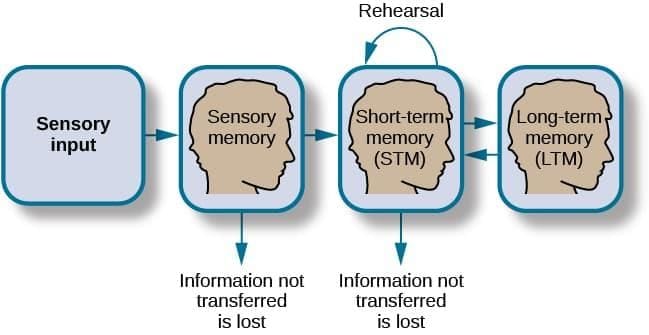
The Stage Model identifies three main memory systems: sensory memory, short-term memory, and long-term memory. These systems interact through encoding, storage and retrieval processes.
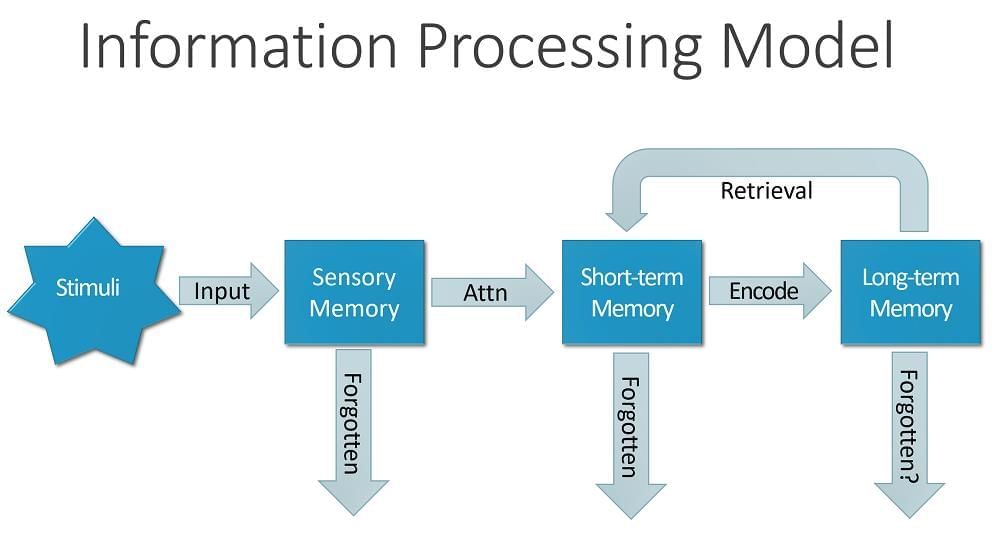
Sensory Memory
- Incoming information first enters sensory memory (sensory registers).
- It can hold a large amount of sensory detail but only for a very short time (usually less than one second).
- Sensory memory captures precise, momentary impressions from vision, hearing, touch and other senses; unattended sensory information fades quickly.
Short-term Memory (STM)
- When we attend to certain sensory information, it moves into short-term memory, which retains a limited amount of information for a short duration (about 30 seconds or less unless rehearsed).
- Atkinson and Shiffrin and early studies emphasised that STM often encodes information acoustically (by sound), so similar sounding items are easily confused.
Long-term Memory (LTM)
- Meaning and capacity: Long-term memory stores information that has been encoded from short-term memory. It has a very large capacity and can retain information for long periods - from events of the previous day to memories from childhood.
- Nature of storage: Information in LTM is often organised and stored semantically (by meaning). Once properly consolidated in LTM it is typically not erased, though retrieval may fail.
- Forgetting: Failure to recall items is often due to retrieval failure rather than the complete loss of the memory trace.
- Control Processes:
1. Selective Attention: Only information we focus on enters short-term memory; unattended information quickly fades away.
2. Maintenance Rehearsal: Repeating information helps keep it in short-term memory temporarily (e.g., repeating a phone number).
3. Chunking: Grouping information into meaningful units expands short-term memory capacity.
Example: 194719492004 can be remembered as 1947, 1949, and 2004 by linking them to historical events.
4. Elaborative Rehearsal: Connecting new information to what we already know helps transfer it to long-term memory.
Example: Understanding "humanity" by linking it to ideas like "compassion" or "kindness." - Encoding in STM and LTM: Early accounts suggested STM uses acoustic encoding and LTM uses semantic encoding. Later research showed both types of encoding can occur in either store.
- Case study - KF (Shallice & Warrington, 1970): The patient KF had impaired short-term memory but preserved long-term memory, showing that information can sometimes reach LTM without a fully functioning STM. This challenged strict sequential versions of the stage model.
- Revised view: Some researchers argue memory functions as a more continuous process rather than strictly separate stores, motivating newer, more complex models.
Working Memory
The modern view treats short-term memory as an active system for holding and manipulating information during complex cognitive tasks. Alan Baddeley proposed a widely accepted model in which short-term memory is a working memory - a mental workbench used for thinking, planning and problem solving.
Main components (Baddeley):
- Phonological loop: Holds verbal and acoustic information for a few seconds unless rehearsed.
- Visuo-spatial sketchpad: Stores visual and spatial information temporarily (images, locations, shapes).
- Central executive: An attentional control system that coordinates the phonological loop and visuo-spatial sketchpad, directs attention, and links working memory to long-term memory.
- Function: Working memory supports the temporary holding and processing of information needed for reasoning, comprehension, and mental tasks.
Levels of Processing
In 1972 Craik and Lockhart proposed the levels of processing view. Instead of separate stores, they argued that the depth at which information is processed determines how well it is remembered: shallow (surface) processing produces fragile memory; deep (meaningful) processing produces durable memory.
Processing can occur at multiple levels:
- Shallow processing: Analysis of physical or structural features (for example, noticing the shape of letters or the font colour of the word \"cat\").
- Intermediate processing: Phonetic processing that focuses on the sounds associated with the word (for example, recognising the three sounds or syllables in \"cat\").
- Deep processing: Semantic processing that analyses the meaning (for example, thinking of a cat as a furry, four-legged mammal, linking it with personal experiences or attributes).
Memory Retention
- Shallow and intermediate processing lead to fragile memories that decay quickly.
- Deep, semantic processing results in memories that are better retained and more resistant to forgetting.
Implications for Learning
- Focus on meaning: Understanding ideas rather than rote repetition improves long-term retention.
- Elaborate the material: Relate new information to existing knowledge, personal experiences and examples to encourage elaborative rehearsal and deeper encoding.
Types of Long-Term Memory
Declarative (explicit) memory:Memory for facts, names, dates and events that can be consciously described. It divides into:
1. Episodic memory: Personal life events and experiences with contextual details (time, place, associated emotions) - for example, remembering a birthday celebration or an anniversary.
2. Semantic memory: General knowledge and facts independent of the context in which they were learned - for example, knowing that 7 × 8 = 56 or that India gained independence on 15 August 1947.
Procedural (implicit, non-declarative) memory: Memory for skills and actions (how to ride a bicycle, play an instrument, or type). These memories are often difficult to verbalise but enable fluent performance.
Try yourself: What is procedural memory?
Long-term Memory Classification
Researchers describe other kinds of long-term memories that highlight the variety of human memory.
- Flashbulb memories: Vivid, detailed memories for surprising or highly emotional events. They feel like mental photographs and often include strong contextual details (where you were, what you were doing). Emotion tends to deepen processing and strengthen retrieval cues.
- Autobiographical memory: Personal memories about one's own life. These memories are not uniform across the lifespan: very few memories from the first 4-5 years (childhood amnesia), a peak of recollection for events in early adulthood (often around the 20s), and varying retention of later versus earlier life periods in old age.
- Implicit memory: Memories outside conscious awareness that still influence behaviour (for example, a skilled typist types without consciously thinking of key positions). Implicit memory can remain intact in some brain-injured patients who cannot consciously recall the same material.
Methods of Memory Measurement
No single method measures all forms of memory. Psychologists use different experimental tasks depending on the memory type being studied.
- Free recall and recognition (for episodic/factual memory): In free recall, participants study a list and later attempt to recall items in any order; the number of items recalled indicates memory strength. In recognition tasks, participants judge whether items are old (previously seen) or new; higher correct recognition indicates stronger memory.
- Sentence verification task (for semantic memory): Participants decide whether statements are true or false; faster and more accurate responses indicate stronger semantic retention.
- Priming (for implicit memory): Participants are exposed to stimuli (for example, a list of words) and later complete word fragments or tasks influenced by prior exposure. Faster completion of fragments that were previously seen indicates implicit memory effects even when participants do not consciously remember the earlier exposure.
Nature and Causes of Forgetting
Forgetting occurs when information stored in LTM cannot be brought to conscious awareness. Reasons include:
- Insufficient initial learning - the material was not encoded strongly enough.
- Incorrect or incomplete encoding.
- Loss or degradation of the stored information trace.
Key Theories of Forgetting
Ebbinghaus's Experiments and the Forgetting Curve
- Hermann Ebbinghaus used lists of nonsense syllables (for example, NOK, SEP) to study memory experimentally and measured how quickly material was forgotten over time by relearning the same lists.
- Forgetting curve: Ebbinghaus found rapid forgetting shortly after learning (especially within the first hour and the first nine hours), followed by a slower decline thereafter. This basic pattern of rapid initial loss and slower long-term decline remains influential.

Trace Decay (Disuse Theory)
- This view suggests that memories are physical traces in the brain and that these traces decay with time if not used.
- Criticism: Some experimental results (for example, better retention when a person sleeps soon after learning) challenge a simple time-based decay account and show that other factors affect forgetting.
Interference Theory
- Interference occurs when different pieces of information compete, making retrieval of the target information difficult.
- Proactive interference: Earlier learning interferes with later learning (for example, previously learned language patterns making it harder to learn a new language).
- Retroactive interference: New learning interferes with recall of earlier material (for example, learning new vocabulary makes recall of older vocabulary more difficult).
Experimental Designs for Retroactive and Proactive Interference

Repressed Memories
- Traumatic Experiences:
- Some people go through events that are deeply painful or emotionally distressing.
- These experiences can cause strong emotional hurt and may affect memory.
- Freud's Explanation - Repression:
- According to Sigmund Freud, painful or threatening memories are often pushed into the unconscious mind.
- This process is called repression, where such memories are blocked from conscious awareness to protect the person from emotional pain.
- Psychological Amnesia:
- In some cases, trauma can lead to memory loss (amnesia).
- The person becomes unable to recall certain events because their mind avoids facing the painful reality.
- This can lead to generalized amnesia, where large parts of one's memory are lost.
- Fugue State:
- In severe cases, a person may enter a fugue state, a condition where they forget their identity and may even take on a new name, address, or personality.
- The two identities are separate - one is unaware of the other's existence.
- Forgetting Under Stress:
- Forgetfulness can also occur due to stress or high anxiety, even without trauma.
- For example, students who study hard for exams may become so nervous during the test that they temporarily forget everything they learned.
Retrieval Failure
- Researchers such as Tulving emphasise that forgetting often results from inadequate or inappropriate retrieval cues rather than permanent loss of the memory.
- Retrieval cues are hints that help access stored information; providing effective cues can greatly improve recall.
- Example: If a list of words comes from different categories, giving the category names at test acts as a retrieval cue and improves recall.
Enhancing Memory
Several techniques improve memory. These include mnemonic devices, organisational strategies, study methods that promote deep processing, and lifestyle factors that support learning.

Image-based Mnemonics
Image-based mnemonics create vivid mental pictures linking the material to be remembered with memorable images. Two common methods are the Keyword Method and the Method of Loci.
1. Keyword Method
- Useful for learning vocabulary in a foreign language.
- Choose an English word (the keyword) that sounds like the foreign word, then form a mental image linking the keyword and the meaning of the foreign word.
- Example: Spanish pato (duck) - use English word pot as keyword and imagine a duck sitting in a pot of water. The unusual image helps recall the foreign word.
2. Method of Loci
- Helps remember ordered lists by placing items as visual images in familiar locations (for example, rooms of your house).
- Example: For a shopping list (bread, eggs, tomatoes, soap), imagine bread and eggs in the kitchen, tomatoes on the table, and soap in the bathroom. Mentally walking through these locations in order recalls the entire list.
Organisation-based Mnemonics
Organising information into meaningful structures makes recall easier.
(a) Chunking
- Group small pieces of information into larger, meaningful units or chunks to expand the effective capacity of short-term memory.
- Example: A long number such as 194719492004 is easier to remember when grouped as 1947, 1949, 2004 by linking each chunk to historical years.
(b) First-Letter Technique
- Form a word, phrase or sentence from the first letters of the items you want to remember.
- Example: The colours of the rainbow are remembered as VIBGYOR (Violet, Indigo, Blue, Green, Yellow, Orange, Red).
Memory Improvement Strategies
Psychologists recommend a broad approach to improving memory rather than relying on a single trick.
(a) Engage in deep processing
- Focus on meaning rather than surface features: ask questions, connect new information to prior knowledge, and understand relationships among ideas.
- This kind of elaboration helps transfer information into long-term memory more effectively.
(b) Minimise interference
- Interference occurs when similar materials conflict; avoid studying highly similar topics back-to-back (for example, two languages or two closely related subjects).
- Switch between unrelated subjects or take short breaks to reduce interference and improve learning retention.
(c) Provide retrieval cues
- Identify likely retrieval cues (keywords, headings, visuals, examples) while studying and link them to main ideas.
- Well-chosen cues make it easier to recall large amounts of material under test conditions.
PQRST Method for Studying (Thomas & Robinson)
The PQRST technique is a structured study method to improve comprehension and memory:
- P - Preview: Skim the chapter or material to get a general idea of the content.
- Q - Question: Ask questions about what you will learn; turn headings into questions.
- R - Read: Read carefully to find answers to the questions you formulated.
- S - Self-recitation: Summarise and explain the material to yourself in your own words.
- T - Test: Check your understanding by testing yourself on the material.
Final Note
- There is no single method that instantly improves memory for every task.
- Effective memory depends on multiple factors, including good physical and mental health, interest and motivation, prior familiarity with the topic, and appropriate strategy selection.
- Combining several techniques (elaboration, organisation, mnemonics, effective scheduling and retrieval practice) and practising them consistently gives the best results for long-term memory improvement.
FAQs on Revision Notes - Human Memory
| 1. What is the difference between short-term memory and long-term memory in CBSE Psychology? |  |
| 2. Why do I forget things I just studied-is it a memory problem or normal? | |
| 3. How does chunking help improve memory capacity and retention? | |
| 4. What are the three stages of memory processing, and how do they work together? | |
| 5. What's the role of rehearsal in moving information from working memory to long-term memory? | |