NCERT Solutions - Federalism

Q1: From the list of following events which ones would you identify with the functioning of federalism? Why?
- The Centre on Tuesday announced Sixth Schedule status to GNLF-led Darjeeling Gorkha Hill Council, which would ensure greater autonomy to the governing body in the Hill district of West Bengal. A tripartite Memorandum of Settlement was signed in New Delhi between the Centre, West Bengal government and the Subhas Ghising-led Gorkha National Liberation Front (GNLF) after two days of hectic deliberations.
- Government for action plan for rain-hit States: Centre has asked the rain-ravaged States to submit detailed plans for reconstruction to enable it to respond to their demands for extra relief expeditiously.
- New Commissioner for Delhi: The Capital is getting a new municipal commissioner. Confirming this, present MCD Commissioner Rakesh Mehta said he has received his transfer orders and that he is likely to be replaced by IAS officer Ashok Kumar, who is serving as the Chief Secretary in Arunachal Pradesh. Mehta, a 1975 batch IAS officer, has been heading the MCD for about three-and-a-half years.
- CU Status for Manipur University: Rajya Sabha on Wednesday passed a Bill to convert the Manipur University into a Central University with the Human Resource Development Minister promising such institutions in the North Eastern States of Arunachal Pradesh, Tripura and Sikkim as well.
- Funds released: The Centre has released Rs. 553 lakh to Arunachal Pradesh under its rural water supply scheme. The first instalment was of Rs. 466.81 lakh.
- We'll teach the Biharis how to live in Mumbai: Around 100 Shiv Sainiks stormed J. J. Hospital, disrupted daily operations, raised slogans and threatened to take matters into their own hands if no action was taken against non-Maharashtrian students.
- Demand for dismissal of Government: The Congress Legislature Party (CLP) in a representation submitted to State Governor recently, has demanded dismissal of the ruling Democratic Alliance of Nagaland (DAN) government for its alleged financial mismanagement and embezzlement of public money.
- NDA government asks naxalites to surrender arms: Amid a walkout by opposition RJD and its allies Congress and CPI (M), the Bihar government today appealed to the naxalites to shun the path of violence and reaffirmed its pledge to root out unemployment to usher in a new era of development in Bihar.
Ans:
- Yes. The agreement between the Centre, the West Bengal government and the GNLF shows federal functioning because it is a tripartite arrangement recognising local autonomy. Such arrangements decentralise decision-making and allow a regional body to administer local affairs, which is a key feature of federalism.
- Yes. The Centre asking States for reconstruction plans after rains reflects cooperative federalism. Disaster relief and reconstruction primarily fall on States, while the Centre provides financial and technical assistance on request. This interaction-States planning and Centre responding-is a federal practice.
- No. The appointment or transfer of a municipal commissioner is an administrative matter within the state's or local government's domain and does not by itself illustrate federal sharing of powers between Centre and State. It is an internal administrative action rather than an instance of federal negotiation or power-sharing.
- No. Converting a State university into a Central University is an act of central legislation and administrative decision. It illustrates centralisation of a particular sector (higher education) rather than an instance of shared federal functioning between Centre and State.
- Yes. Release of funds by the Centre to a State under a rural water supply scheme is an example of fiscal federalism. The Centre's financial support for state-level development programmes is a routine mechanism through which federal relations operate.
- No. Storming a hospital and raising regionalist slogans is an act of political or social agitation, not a functioning of federal institutions. Such behaviour undermines the spirit of cooperative federalism and the rights of citizens, but it is not an example of formal Centre-State working.
- No. A political demand for dismissal of a State government is a partisan political exercise. While constitutional procedures exist for removing a government, mere demands do not reflect federal mechanisms; if used improperly, such demands can threaten federal autonomy.
- Yes. When a State government appeals to local armed groups (naxalites) to renounce violence or takes measures to address internal insurgency, it is exercising its state responsibility for law and order. Tackling such problems often requires cooperation with the Centre, so this is part of federal functioning, especially in security and development coordination.
Q2: Think which of the following statements would be correct. State why.
- Federalism enhances the possibility of people from different regions to interact without the fear of one's culture being imposed upon them by others.
- Federal system will hinder easier economic transaction between two different regions that have distinct types of resources.
- A federal system will ensure that the powers of those at the centre will remain limited.
Ans:
- Federalism enhances interaction: This statement is correct. Federal arrangements allow regions to retain cultural, linguistic or local institutions while remaining part of a larger political unit. This protection of regional autonomy reduces the fear of cultural imposition and encourages people from different regions to interact and cooperate.
- Federal system hinders trade: This statement is incorrect. A well-designed federal system does not obstruct economic transactions. Constitutions usually guarantee free movement of goods, services and capital across regions and provide mechanisms (courts, inter-state councils) to resolve trade disputes. Federalism can even promote trade by allowing states to specialise according to their resources.
- Central powers are limited: This statement is partially correct. Federal systems are intended to divide and limit powers so that the central authority cannot dominate all functions. However, in practice some federal systems (including India) provide the Centre with significant powers-for example, residuary powers, emergency provisions and financial controls-which can make the Centre comparatively stronger.

Q3: Based on the first few articles of Belgian constitution - given below - explain how federalism is visualised in that country. Try and write a similar Article for the Constitution of India.
Title I: On Federal Belgium, its components and its territory.
Article 1 : Belgium is a Federal State made up of communities and regions.
Article 2 : Belgium is made up of three communities: The French Community, the Flemish Community and the German Community.
Article 3 : Belgium is made up of three regions: The Walloon region, the Flemish region and the Brussels region.
Article 4 : Belgium has four linguistic regions: The French-speaking region, the Dutch-speaking region, the bilingual region of Brussels Capital and the German-speaking region. Each «commune» (county borough) of the Kingdom is part of one of these linguistic regions.
Article 5 : The Walloon region is made up of the following provinces: The Walloon Brabant, Hainault, Liege, Luxemburg and Namur. The Flemish region is made up of the following provinces: Antwerp, the Flemish Brabant, West Flanders, East Flanders and Limburg.
Ans: The federal structure of Belgium is built on two complementary principles: communities and regions. Communities represent cultural and linguistic groups (responsible for matters such as culture and education), while regions are territorial units responsible for economic affairs and local administration. The constitution explicitly recognises linguistic regions and allocates competences accordingly, so cultural identity and territorial governance are both protected.
Title I: On Federal India, its components and its territory.
Article 1: India is a Federal Republic composed of States and Union Territories, each enjoying constitutionally defined powers.
Article 2: India recognises its linguistic, cultural and religious plurality and provides protection and promotion of regional languages and cultures by law.
Article 3: The territory of India shall consist of States and Union Territories as provided by law; the reorganisation of States shall be carried out by Parliament following consultative procedures.
Article 4: Powers and responsibilities between the Union and the States shall be demarcated by law into Union subjects, State subjects and Concurrent subjects, with clear procedures for cooperation where competences overlap.
Article 5: The judiciary shall be independent and empowered to interpret the Constitution and adjudicate disputes between the Union and States, and among States.
These Articles aim to mirror the Belgian idea that constitutional text should recognise both territorial units and cultural/linguistic identities while providing clear lines of responsibility and mechanisms for resolving conflicts.
Q4: Imagine that you were to rewrite the provisions regarding federalism. Write an essay of not more than 300 words making your suggestions about:
(a) division of powers among the centre and the States,
(b) distribution of financial resources,
(c) methods of resolving inter-State disputes and
(d) appointment of Governors
Ans:
Federalism should balance unity with regional autonomy. My suggestions are:
- (a) Division of powers: Clearly list subjects for the Union, States and the Concurrent sphere so overlaps are minimised. Union subjects should cover defence, foreign affairs, currency and inter-state infrastructure. State subjects should include police, public order, health, agriculture and local government. Concurrent subjects can include education and environmental protection, with a requirement that Centre legislation on concurrent matters be limited to national interest and subject to judicial review.
- (b) Distribution of financial resources: Strengthen state finances by increasing their share in central tax devolution recommended by an independent Finance Commission at regular intervals. Ensure a mix of untied revenue transfers and conditional grants for national priorities. Allow states greater freedom to mobilise their own resources while maintaining macroeconomic stability through transparent borrowing norms.
- (c) Methods of resolving inter-State disputes: Institutionalise a strengthened Inter-State Council with a standing secretariat and mediation powers. Make river and resource tribunals statutory, time-bound and binding. Keep the Supreme Court as the final arbiter but encourage alternative dispute resolution and arbitration to settle technical disputes quickly.
- (d) Appointment of Governors: Make the appointment process consultative: require the Centre to consult the Chief Minister and Leader of Opposition of the State. Fix a non-arbitrary tenure and restrict discretionary powers (such as dissolving assemblies) to clear constitutional situations. Provide safeguards against partisan misuse by requiring written reasons for major decisions and subjecting them to judicial review.
These measures would reduce friction, clarify responsibilities and strengthen cooperative federalism while protecting the constitutional autonomy of States.
Q5: Which of the following should be the basis for formation of a State? Why?
(a) Common Language
(b) Common economic interests
(c) Common religion
(d) Administrative convenience
Ans: (d)
Explanation: Administrative convenience is the most appropriate basis for forming a State because it focuses on effective governance, delivery of public services and ease of administration. States formed on administrative criteria can be managed more efficiently, enabling better planning and resource allocation. Forming States on language or religion risks segregation and communal divisions; basing them solely on economic interests may ignore cultural and administrative realities and create governance challenges.
Q6: Majority of people from the States of north India-Rajasthan, Madhya Pradesh, Uttar Pradesh, Bihar - speak Hindi. If all these States are combined to form one State, would it be in tune with the idea of federalism? Give arguments.
Ans: Federalism is a system that allows for two levels of government: one at the national level and another at the regional level. If the Hindi-speaking states of Rajasthan, Uttar Pradesh, Madhya Pradesh, and Bihar were merged into a single state, it could challenge the principles of federalism. Here are the main arguments:
- Such a merger would reduce the number of regional governments and centralise authority in a very large unit, weakening decentralised governance which is central to federalism.
- Large states can become administratively unwieldy; local needs and minority interests within the larger unit might be neglected.
- Regional diversity exists even within Hindi-speaking areas-social, economic and cultural differences mean local issues need local solutions.
- Representation would be affected: smaller regions might lose political voice within the larger entity, leading to tensions and demands for new sub-units.
Therefore, merging these states into one would not be in tune with federalism's aim to accommodate diversity through multiple levels of government and to bring governance closer to people.
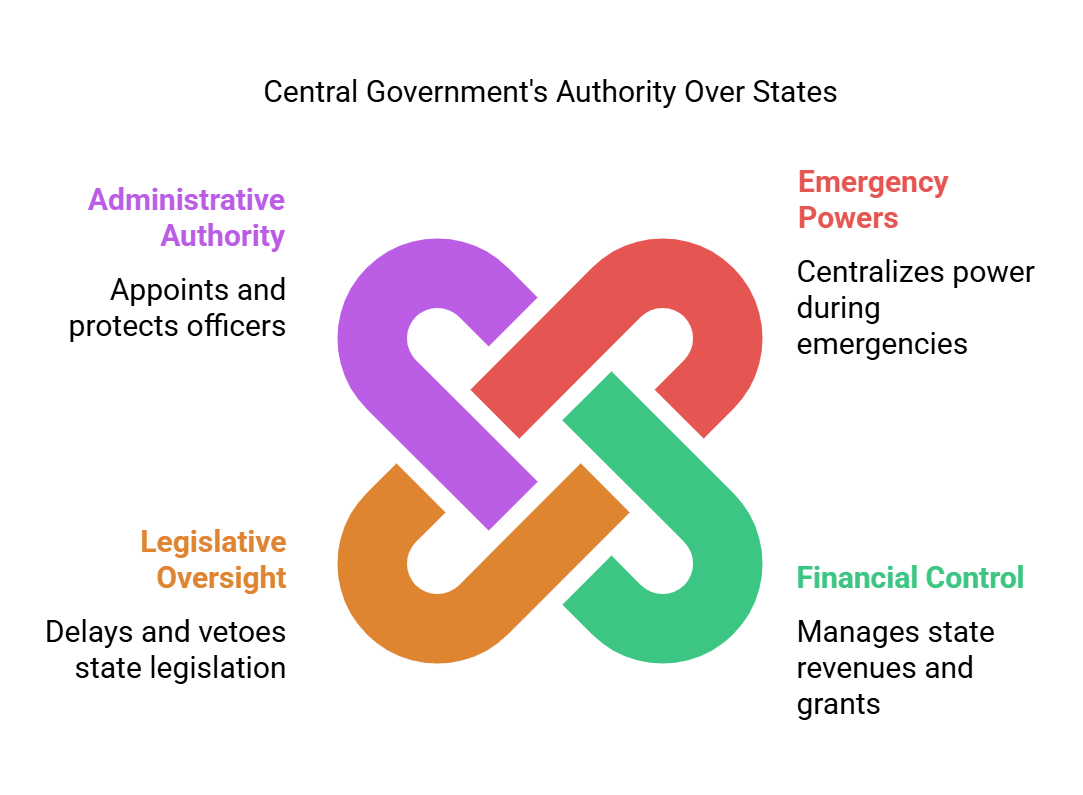
Q7: List four features of the Indian Constitution that give greater power to the central government than the State government.
Ans: The Indian Constitution contains several features that grant greater power to the central government compared to state governments. Here are four key features:
- Emergency Provisions: During national, financial or constitutional emergencies, powers shift to the Centre and state governments become subordinate, greatly increasing central authority.
- Financial Dominance: The Centre controls major taxation powers and devolution of resources; states depend on central transfers and grants, creating fiscal asymmetry.
- Residuary Powers: Powers not mentioned specifically in the lists are vested in the Centre, giving it the final say on unforeseen subjects.
- Administrative Control: The All-India Services and central influence over key appointments (including Governors) give the Centre significant leverage over state administration.
Q8: Why are many States unhappy about the role of the Governor?
Ans: Many states are unhappy about the role of the Governor for several reasons:
- The Governor is appointed by the central government and is not elected by the people of the State; this raises concerns about impartiality.
- Governors have discretionary powers (for example, reserving bills for the President or recommending President's Rule) that can be used in ways perceived as partisan.
- There have been instances where Governors are accused of interfering in routine state administration or favouring the ruling party at the Centre, especially when state and central governments are from rival parties.
- The Governor's role in inviting parties to form governments in hung assemblies and in advising the Centre can influence political outcomes and cause tensions with elected state governments.
Q9: President's rule can be imposed in a State if the government is not being run according to the provisions of the Constitution. State whether any of the following conditions are a fit case for imposition of President's rule in the State. Give reasons.
- Two members of the State legislative assembly belonging to the main opposition party have been killed by criminals and the opposition is demanding dismissal of the State government.
- Kidnapping of young children for ransom is on rise. The number of crimes against women are increasing.
- No political party has secured majority in the recent elections of the State Legislative Assembly. It is feared that some MLAs from the other parties may be lured to support a political party in return for money.
- Different political parties are ruling in the State and at the centre and they are bitter opponents of each other.
- More than 2000 people have been killed in the communal riots.
- In the water dispute between the two States, one State government refused to follow the decision of the Supreme Court.
Ans:
- No. The killing of two opposition members, while a serious law-and-order matter requiring investigation and action, does not by itself amount to a breakdown of constitutional machinery that warrants President's Rule. The proper response is police action and prosecution, not removal of the elected government.
- No. A rise in kidnapping and crimes against women is a grave law-and-order problem, but unless the state administration has completely failed to enforce the law and constitutional processes have broken down, it is not by itself sufficient ground for President's Rule. The Governor should report the situation and, if needed, Centre assistance can be provided.
- No. A hung assembly is a political situation. President's Rule cannot be imposed merely on suspicion of defections or corruption. Constitutional practice requires the largest party or coalition be given a chance to prove majority on the floor of the House; dismissal without such a test would violate democratic norms.
- No. Political rivalry between the State and Centre is not a ground for President's Rule. Differences of party in power are normal in federal systems and do not prove a breakdown of constitutional machinery.
- Yes. Widespread communal violence causing mass loss of life and the collapse of public order may amount to failure of the state to carry out its constitutional duties. If the administration is unable to restore order and protect citizens, President's Rule can be a constitutional option.
- Yes. A State's refusal to comply with a binding order of the Supreme Court or to obey constitutional obligations may indicate a breakdown of constitutional government. Such defiance can be a ground for central intervention subject to constitutional procedure and judicial review.
Q10: What are the demands raised by States in their quest for greater autonomy?
Ans: There are four demands raised by States in their quest for greater autonomy that are as follows:
- Separation of Powers: Some States seek clearer and greater powers over subjects now controlled or influenced by the Centre, so that decision-making on local matters rests with elected state institutions.
- Financial Autonomy: States demand a larger share of central revenues, more freedom to raise their own taxes and fewer conditional grants so they can plan and implement policies independently.
- Administrative Autonomy: States want greater control over personnel and administration within their territory, including more say in appointments and transfers of officials working in the state.
- Cultural and Linguistic Rights: States ask for protection of their languages, cultures and local laws, and resist policies perceived as imposing a single national culture or language.
Q11: Should some states be governed by special provisions? Does this create resentment among other States? Does this help in forging greater unity among the regions of the country?
Ans: It is often appropriate for some States or regions to be governed by special constitutional provisions when they have distinct historical, cultural, social or administrative circumstances that require protection or special treatment. Examples include regions with tribal populations, difficult terrain, strategic sensitivity or unique customs that need legal safeguards.
Special provisions can help preserve local identities and provide stability by recognising differences and offering tailored administrative arrangements. However, they can also create resentment among other States if the rationale or benefits are unclear, or if they are perceived as unfair privileges. To avoid resentment, special provisions should be transparent, time-bound where possible, and justified on objective grounds.
When well designed and fairly applied, special provisions can strengthen national unity by accommodating diversity and reducing separatist pressures. Conversely, poor implementation or opaque special treatment can foster a sense of bias and weaken trust between regions. Thus, special provisions can both help and hinder unity depending on their purpose, justification and administration.
FAQs on NCERT Solutions - Federalism
| 1. What is federalism and how does it function in India? |  |
| 2. What are the key features of federalism? | |
| 3. How does the division of powers work in Indian federalism? | |
| 4. What challenges does federalism face in India? | |
| 5. How does federalism promote unity in diversity in India? | |





