NCERT Solutions - Freedom

Q1: What is meant by freedom? Is there a relationship between freedom for the individual and freedom for the nation?
Ans: Freedom is the ability of a person to act, speak and think without undue external restraint, provided these actions do not harm others and are necessary for the person's development. There is a close relationship between individual freedom and national freedom because:
- If a nation is politically and socially free, its citizens have space to develop their creativity and capabilities.
- National development depends on the cooperation, creativity and skills of individuals; these can be used fully only when external constraints are removed.
- A free society minimises arbitrary restrictions, enabling members to realise their potentials with the least possible social constraints.
- No society can have zero constraints; what matters is whether constraints are justified and consistent with individual rights.
- Social constraints should be open to discussion and review through public debate so that they remain justified and do not become instruments of oppression.
Q2: What is the difference between the negative and positive conception of liberty?
Ans:
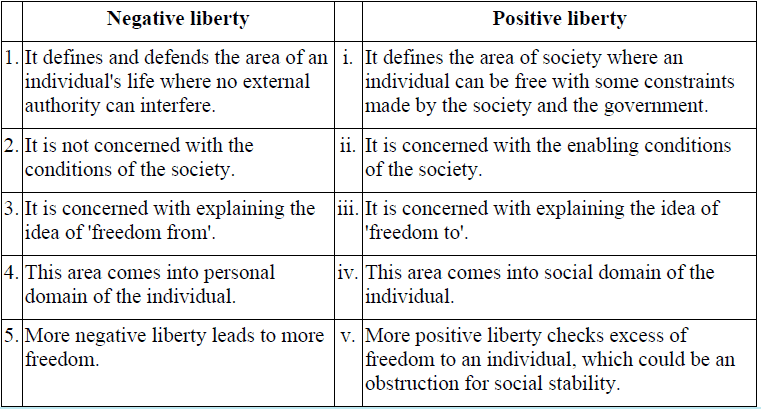
Q3: What is meant by social constraints? Are constraints of any kind necessary for enjoying freedom?
Ans: Social constraints are rules, norms or laws imposed by a society to regulate behaviour. They may be formal (laws, regulations) or informal (customs, social expectations).
- Different groups sometimes demand bans on films, books or other forms of expression when they believe these offend public morality or order.
- Banning can be a quick way to meet such demands, but repeated or excessive bans harm long-term social development by encouraging avoidance rather than discussion.
- If people accept restrictions voluntarily to pursue their goals, their freedom is not necessarily curtailed; voluntary limits can be part of choice.
- Constraints become unacceptable when they are imposed by coercion or without justification; therefore constraints should be open to public debate and justification.
Q4: What is the role of the state in upholding freedom of its citizens?
Ans:
- The state protects freedom by guaranteeing basic rights and by enforcing laws that prevent arbitrary actions against individuals.
- The state may impose reasonable restrictions to prevent harm to others and to maintain public order; these are justified when they protect citizens' equal freedoms.
- The state promotes positive liberty by providing services and opportunities (for example, education and public health) so citizens can make meaningful choices.
- The state defines and checks actions that affect others, ensuring that individual conduct does not undermine social stability and the rights of other people.
Q5: What is meant by freedom of expression? What in your view would be a reasonable restriction on this freedom? Give examples.
Ans:
- Freedom of expression is the right to express one's opinions and ideas through speech, writing, art and other media without undue interference.
- It is a part of the basic area of non-interference (negative liberty), and in India it is recognised as a fundamental right subject to reasonable restrictions.
- Society may tolerate some inconvenience caused by free expression in order to protect the larger right; it must not, however, suppress expression simply because it disagrees with the view expressed.
- A reasonable restriction is one that protects other important values while allowing free discussion to continue. Examples of such restrictions include limits to protect privacy, public order, decency and to prevent defamation or incitement to violence.
Specific examples:
- Restrictions to protect privacy: People may be prevented from publishing intimate details of others' private lives without consent (for example, when a former employee is contractually bound not to disclose confidential family matters).
- Film censorship: A film certification body may require cuts or refuse screening of material likely to cause serious disturbance to public order or offend widely held standards of decency.
- Restrictions against incitement or hate speech: Speech that directly incites violence or hatred against a community can be legitimately restricted to protect public peace and the rights of others.
FAQs on NCERT Solutions - Freedom
| 1. What exactly does freedom mean in the context of Indian Polity and the Constitution? |  |
| 2. How does the NCERT explain the difference between political freedom and personal freedom? | |
| 3. What are the main restrictions on freedom mentioned in the Indian Constitution, and why do they exist? | |
| 4. Why is freedom of expression considered fundamental in Indian democracy according to NCERT solutions? | |
| 5. How do civil liberties and freedom rights work together to protect Indian citizens? | |





