NCERT Solutions - Secularism

Q1: Which of the following do you feel are compatible with the idea of secularism? Give reasons.
(a) Absence of domination of one religious group by another.
(b) Recognition of a state religion.
(c) Equal state support to all religions.
(d) Mandatory prayers in schools.
(e) Allowing separate educational institutions for any minority community.
(f) Appointment of temple management bodies by the government.
(g) Intervention of state to ensure entry of Dalits in temples.
Ans:
(a) This idea is compatible because:
- Equality prevents one religious community from dominating another, which protects the rights and freedoms of minorities.
- Minority communities retain the freedom to practise their beliefs, follow their worship, and to preach without interference or fear of domination.
(b) It is not compatible because recognising a state religion gives formal preference to one faith and tends to place other religions at a structural disadvantage. A declared state religion is inconsistent with the impartial role expected of a secular state.
(c) The idea of equal treatment of religions by the state is compatible with secularism in principle. However, equal and identical support to every religion in all its rituals and festivals is not always feasible because:
- Different religions have different numbers and types of festivals and rituals; identical state involvement in each is impractical.
- The forms of worship and institutional requirements differ across religions, so uniform material support may not be meaningful.
- Therefore, while the state should be impartial and treat religions equally before the law, the precise form of state support must respect neutrality and the autonomy of religious communities.
(d) It is not compatible because mandatory prayers in schools violate the freedom of conscience and religious liberty of students, teachers and staff. Secularism requires that the state, including its institutions, should not compel religious observance.
(e) It is compatible. Allowing separate educational institutions for minority communities is consistent with protecting cultural and educational rights. Such protection helps minorities preserve their identity and is recognised as a legitimate right in the Indian constitutional framework.
(f) It is generally not compatible for the state to directly manage religious institutions, because this amounts to government interference in purely religious affairs. At the same time, the state may regulate institutions when there are issues of public order, corruption, or violations of law; but direct appointment of temple management bodies as a routine practice undermines religious autonomy.
(g) It is compatible because:
- State intervention to secure access for marginalised groups (for example, Dalits) removes discriminatory barriers and protects equal civil and social rights.
- Secularism is concerned not only with inter-religious equality but also with preventing domination and discrimination within religions.
- The state's corrective action in such cases promotes freedom of worship and equality for all citizens.
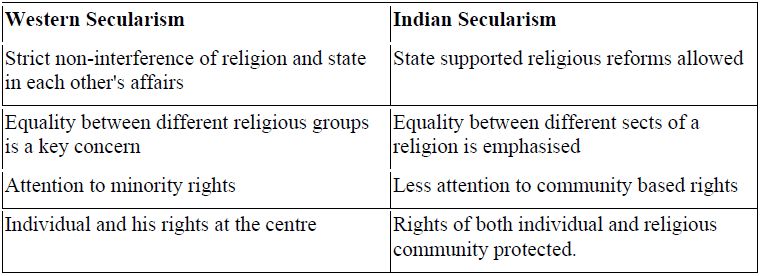
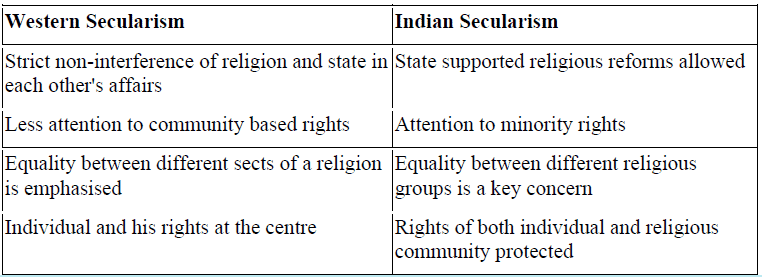
Q2: Some of the key characteristics of western and Indian model of secularism have got mixed up. Separate them and make a new table.
Ans:
Q3: What do you understand by secularism? Can it be equated with religious tolerance?
Ans:
- Secularism is a doctrine that opposes any form of domination by one religious group over another and protects freedom of conscience and equal citizenship; it does not oppose religion itself.
- Secularism cannot be equated simply with religious tolerance. Religious tolerance means accepting or allowing the existence of different religious beliefs, which may still coexist with unequal power relations among communities.
- Religious tolerance is one component of secularism, but secularism goes further by seeking active equality, state impartiality, and protection against both inter-religious and intra-religious discrimination.
Q4: Do you agree with the following statements? Give reasons for supporting or opposing any of them.
(a) Secularism does not allow us to have a religious identity.
(b) Secularism is against inequality within a religious group or between different religious groups.
(c) Secularism has a western-Christian origin. It is not suitable for India.
Ans:
(a) This statement is opposed because secularism protects the freedom of religion and the right to have a religious identity. Secularism secures the space for individuals and communities to follow and preserve their faith while ensuring equal citizenship.
(b) This statement is supported because secularism opposes inequalities that arise from religious hierarchies and discrimination. It:
- Seeks equality of citizens irrespective of their religion.
- Allows religious institutions to exist but resists practices within religions that deny civil or social rights to groups or individuals.
- Promotes equal opportunities in public life, employment and access to public goods for people of all religions.
(c) This statement is opposed because secularism is not exclusively of Western origin nor is it unsuitable for India. Reasons include:
- India adopted a model of secularism appropriate to its plural social reality; the Indian approach emphasises state impartiality, accommodation and protection of minority rights rather than strict separation alone.
- Historical examples from India show rulers and traditions that practised tolerance and plural accommodation long before modern Western secular theories.
- The Indian Constitution recognises religious freedom while allowing the state to intervene when necessary to protect social justice and equality.
Q5: Indian secularism focuses on more than the religion-state separation. Explain.
Ans:
- Indian secularism goes beyond simple separation of religion and state; it emphasises harmony among religions and the protection of citizens' social and civil rights.
- The state permits the practice and propagation of all religions and strives to treat them impartially, while also taking steps to remove social disadvantages rooted in religious or communal practices.
- Indian secularism allows the state to intervene in religious practices when such practices violate constitutional rights, public order, or social justice-thus combining neutrality with positive measures to ensure equality.
- In short, the Indian model balances non-interference in purely religious matters with corrective action wherever religious practices impinge on equality, liberty or social welfare.
Q6: Explain the concept of principled distance.
Ans:
- Principled distance is the idea that the state should not adopt a fixed stance of either strict separation or complete entanglement with religion. Instead, it should adopt a flexible, principled approach in its dealings with religious communities.
- Under this concept, the state gives equal respect to all religions but may intervene selectively to protect constitutional rights, promote social justice, or prevent discrimination and domination.
- The state therefore keeps a measured distance from religious institutions generally, but it can draw closer when justice, equality or public interest requires intervention, and step back when autonomy is appropriate. This balance aims to preserve both religious freedom and equal citizenship.
FAQs on NCERT Solutions - Secularism
| 1. What is secularism according to NCERT Solutions? |  |
| 2. How does secularism promote religious freedom? | |
| 3. Why is secularism important in a diverse society? | |
| 4. How does secularism contribute to the idea of citizenship? | |
| 5. What are the challenges faced by secularism in today's world? | |





