NCERT Solutions: Industries

Exercises
Q1: Answer the following questions.
(i) What is meant by the term 'industry'?
Ans: The term industry refers to a type of economic activity that focuses on:
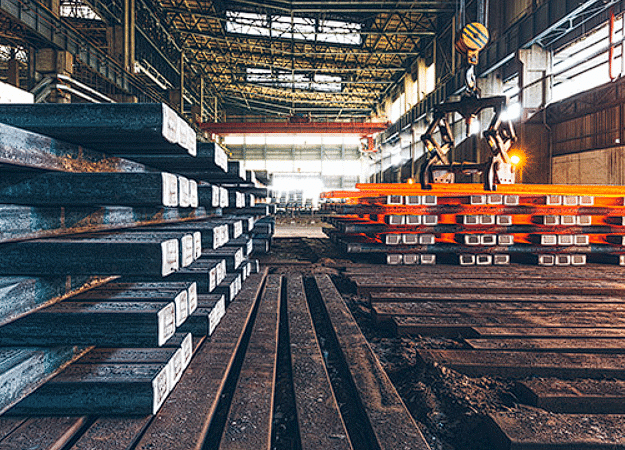
- Production of goods - For example, the iron and steel industry.
- Extraction of minerals - Such as the coal mining industry.
- Provision of services - Like the tourism industry.
Thus, Industries play a crucial role in the economy by transforming raw materials into valuable products and services.
 Iron & Steel Industry
(ii) What are the main factors which influence the location of an industry?
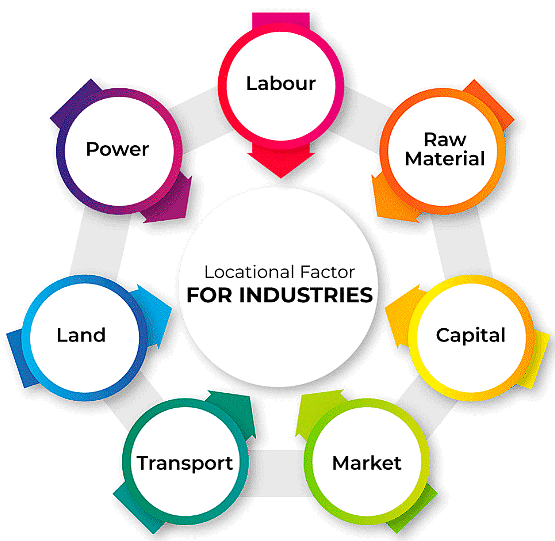
Ans: Setting up an industry can significantly boost the development of a location. The main factors influencing the location of industries include:
- Availability of raw materials and land
- Access to water and labour
- Reliable sources of power and transport
- Proximity to markets
- Access to sufficient capital
Additionally, governments may provide incentives such as:
- Subsidised power
- Lower transport costs
- Improved infrastructure
These measures aim to encourage industries to establish themselves in economically backward areas.
(iii) Which industry is often referred to as the backbone of modern industry and why?
Ans: The iron and steel industry is often referred to as the backbone of the modern industry because almost everything is either made from iron or steel or has been made using tools and machinery of these metals.
Examples like -ships, trains, vehicles; all are made largely of steel. Materials of our day-to-day use starting safety pin to our building in which we live, are made from steel. Without the use of iron no industry can run.
Q2: Distinguish between the following
(i) Agro-based and mineral-based industry
Ans:
Agro-based industry | Mineral-based industry |
Uses plant and animal products as raw materials | Uses mineral ores as raw materials |
Source of employment for people in rural areas | Source of employment for people in rural as well as urban areas |
Examples: Dairy industry, cotton textile industry | Examples: Iron and steel industry, heavy machinery industry |
(ii) Public-sector and joint-sector industry
Ans:
Public-sector industry | Joint-sector industry |
Owned and operated by the government | Jointly owned and operated by the government and individuals or a group of individuals |
Example: Hindustan Aeronautics Limited, Steel Authority of India Limited | Example: Maruti Udyog Limited |
Q3: Give two examples of the following in the space provided.
(i) Raw materials: ____________ and _____________
(ii) End product: ____________ and _____________
(iii) Tertiary activities: ____________ and _____________
(iv) Agro-based industries: ____________ and _____________
(v) Cottage industries: ____________ and _____________
(vi) Co-operatives: ____________ and _____________
Ans:
(i) Raw materials: cotton and steel
(ii) End product: shirt and safety pin
(iii) Tertiary activities: banking and transport
(iv) Agro-based industries: dairy industry and cotton textile industry
(v) Cottage industries: pottery industry and basket-weaving industry
(vi) Co-operatives: Anand Milk Union Limited and Sudha Dairy
Deleted Questions from NCERT
Q.1. (iv) Why cotton textile industry rapidly expanded in Mumbai?
Ans: The cotton textile industry is one of the oldest industries in the world. In India, Mumbai was the first place which saw the establishment of a successful mechanized textile mill in 1854. Mumbai saw the rapid expansion of the cotton textile industry after this because of the following reasons:-
(i) Favourable climatic conditions such as warm and moist climate
(ii) Nearness of a port which facilitated import of machinery
(iii) Availability of raw material and skilled labour.
(v) What are the similarities between information technology industry in Bangalore and California?
Ans: Similarities between the information technology industries in Bangalore and California include:
- Presence of high-quality educational institutions and advanced scientific centres.
- Pleasant climate and a clean environment.
- A skilled and well-trained workforce.
- Access to diverse markets.
- Well-developed and well-connected infrastructure.
Q 2. Tick the correct answer.
(i) Silicon Valley is located in
(a) Bangalore
(b) California
(c) Ahmedabad
Ans: (b) California
(ii) Which one of the following industries is known as sunrise industry?
(a) Iron and steel industry
(b) Cotton textile
(c) Information technology
Ans: (c) Information technology
(iii) Which one of the following is a natural fibre?
(a) Nylon
(b) Jute
(c) Acrylic
Ans: (b) Jute
FAQs on NCERT Solutions: Industries
| 1. What are the different types of industries and how do they differ from each other? |  |
| 2. Why is the location of industries so important in India? | |
| 3. How do small-scale industries differ from large-scale industries in terms of production and employment? | |
| 4. What is the role of cottage industries in rural economies, and why are they important for CBSE Class 8 SST? | |
| 5. What are the major industrial sectors in India, and which ones are growing the fastest? | |