NCERT Solutions - The Best Christmas Present in the World


Comprehension Check (Page 10)
Q1. What did the author find in a junk shop?
Ans:
- The author found a nineteenth-century roll-top desk in the junk shop. It was made of oak and was in very poor condition.
- The roll-top was broken into several pieces, one leg had been clumsily mended and there were scorch marks down one side. The author bought the desk with the intention of restoring it.
Q2. What did he find in a secret drawer? Who do you think had put it in there?
Ans:
- The author found a small black tin box hidden in a secret drawer. A piece of paper was sellotaped to its lid which read, 'Jim's last letter, received January 25, 1915. To be buried with me when the time comes.'
- It is most likely that the box had been placed there by Mrs Jim Macpherson (Connie), Jim's wife, because her name and address were written on the envelope kept inside the box.

Comprehension Check (Page 14)
Q1. Who had written the letter, to whom, and when?
Ans: Captain Jim Macpherson of the British army, who was serving in the war, wrote the letter to his wife, Connie, on 26 December 1914.
Q2. Why was the letter written--what was the wonderful thing that had happened?
Ans:
- Jim wrote the letter to tell his wife about a remarkable event that took place on Christmas Day: the British and German soldiers had met in no man's land and celebrated together.
- It was a wonderful event because, despite being at war, the soldiers put down their weapons and shared food and songs, showing a moment of peace and common humanity.
Q3. What jobs did Hans Wolf and Jim Macpherson have when they were not soldiers?
Ans: Hans Wolf was a cellist who played in an orchestra. Jim Macpherson was a schoolteacher from Dorset.
Q4. Had Hans Wolf even been to Dorset? Why did he say he knew it?
Ans: No, Hans Wolf had never actually been to Dorset. He said he knew about England because he had learned about it at school and from reading English books.
Q5. Do you think Jim Macpherson came back from the war? How do you know this?
Ans:
- It is unlikely that Jim Macpherson returned from the war. The note on the tin box called the letter his "last letter", which suggests that he did not come back.
- The cheerful account of the Christmas meeting and the later reference to the letter being the last message imply that Connie may not have received any further news from Jim.
Comprehension Check (Page 15)
Q1. Why did the author go to Bridport?
Ans: The author went to Bridport because that was the address given for Mrs Macpherson. He wanted to return Jim's letter and the tin box to her.
Q2. How old was Mrs. Macpherson now? Where was she?
Ans: Mrs Macpherson was one hundred and one years old. She was being looked after in a nursing home called Burlington House.
Comprehension Check (Page 16)
Q1. Who did Connie Macpherson think her visitor was?
Ans: Connie Macpherson believed that her visitor was her husband, Jim.
Q2. Which sentence in the text shows that the visitor did not try to hide his identity?
Ans: The sentence that shows he did not try to hide his identity is, "I explained about the desk, about how I had found it, but I don't think she was listening." This shows he spoke openly about why he had come.
Working with Text
Q1. For how long do you think Connie had kept Jim's letter? Give reasons for your answer.
Ans: Connie had kept Jim's letter for many years. She read it often, every day, so that she could feel Jim close to her. This regular reading shows how precious the letter was to her over a long time.
Q2. Why do you think the desk had been sold, and when?
Ans: The desk was probably sold after the house where Connie lived was damaged by fire. When the house was burnt and Connie moved to a nursing home, neighbours or family likely cleared the damaged items and the desk was sold as part of that process.
Q3. Why do Jim and Hans think that games or sports are good ways of resolving conflicts? Do you agree?
Ans: Jim and Hans believed that games are a good way to settle differences because matches do not cause death or lasting harm; no children become orphans and no wives become widows. Games allow rivalry without violence. I agree with this view because sport offers fair competition and helps build respect between people, while war causes loss and destruction.
Q4. Do you think the soldiers of the two armies are like each other, or different from each other? Find evidence from the story to support your answer.
Ans:
- The soldiers of the two armies were very much alike. They celebrated Christmas together, shared food and drink, smoked, laughed and talked as people do in peacetime.
- They spoke about books and places, cheered and stamped their feet while watching the match, and sang carols together at night.
- Both groups agreed that war brought only death and destruction and that each man hoped to return to his family alive.
- All these details show that the soldiers had similar hopes, interests and feelings.
Q5. Mention the various ways in which the British and the German soldiers become friends and find things in common at Christmas.
Ans:
- The British and the German soldiers celebrated together: they shared food, drink and cigarettes, and joined in conversation and laughter.
- They talked about books and familiar names like Bathsheba, Gabriel Oak and Sergeant Troy, and discussed places such as Dorset.
- They played a game of football, cheering and clapping together, and they exchanged carols at night.
- Through these shared activities and conversations they discovered much in common and became friends for that time.
Q6. What is Connie's Christmas present? Why is it "the best Christmas present in the world"?
Ans:
- Connie's Christmas present was the visitor who came to give her Jim's letter and the tin box. She mistook the visitor for her husband and believed Jim had come home for Christmas.
- For Connie this was the best present in the world because she had long hoped and read Jim's letter every day to feel he was near. The visitor's arrival made her believe that Jim had returned as he had promised, which brought her immense happiness.
Q7. Do you think the title of this story is suitable for it? Can you think of any other title(s)?
Ans:
- Yes, the title is suitable. The spirit of Christmas - peace, generosity and human warmth - is central to the narrative. The events on Christmas Day and the visit to Connie both underline this theme.
- Other possible titles could be: "A Christmas Truce", "Jim's Last Letter" or "The Visitor at Burlington House".
Working With Language
Q1.
(i) Read the passage below and underline the verbs in the past tense.
A man got on the train and sat down. The compartment was empty except for one lady. She took her gloves off. A few hours later the police arrested the man. They held him for 24 hours and then freed him.
(ii) Fill in the blanks using the correct form of the verbs in brackets.
My little sister is very naughty. When she __________ (come) back from school yesterday, she had _________ (tear) her dress. We ________ (ask) her how it had_________ (happen). She _______________ (say) she ____________ (have, quarrel) with a boy. She __________ __________ (have, beat) him in a race and he_______________ (have, try) to push her. She _________________________ (have, tell) the teacher and so he ____________________________ (have, chase) her, and she ________________________ (have, fall) down and ___(have, tear) her
dress.
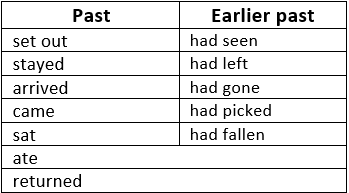
(iii) Underline the verbs and arrange them in two columns, Past and Earlier past.
(a) My friends set out to see the caves in the next town, but I stayed at home, because I had seen them already.
(b) When they arrived at the station, their train had left. They came back home, but by that time I had gone out to see a movie!
(c) So they sat outside and ate the lunch I had packed for them.
(d) By the time I returned, they had fallen asleep!
Ans: (i) A man got on the train and sat down. The compartment was empty except for one lady. She took her gloves off. A few hours later the police arrested the man. They held him for 24 hours and then freed him.
(ii) My little sister is very naughty. When she came (come) back from school yesterday, she had torn (tear) her dress. We asked (ask) her how it had happened (happen). She said (say) she had quarrelled (have, quarrel) with a boy. She had beaten (have, beat) him in a race and he had tried (have, try) to push her. She had told (have, tell) the teacher and so he had chased (have, chase) her, and she had fallen (have, fall) down and had torn (have, tear) her dress.
(iii) (a) My friends set out to see the caves in the next town, but I stayed at home because I had seen them already.
(b) When they arrived at the station, their train had left. They came back home, but by that time I had gone out to see a movie!
(c) So they sat outside and ate the lunch I had packed for them.
(d) By the time I returned, they had fallen asleep!
Q3. Find these phrasal verbs in the story.
burn out; light up; look on; run out; keep out;
Write down the sentences in which they occur, consult a dictionary and write down the meaning that you think matches the meaning of the phrasal verb in the sentence.
Ans:
(i) burn out
House number 12 turned out to be nothing but a burned-out shell, the roof gaping, the windows boarded-up.
Meaning: badly damaged or destroyed by fire.
(ii) light up
That was the moment her eyes lit up with recognition and her face became suffused with a sudden glow of happiness.
Meaning: to show sudden happiness or excitement on the face.
(iii) look on
Hans Wolf and I looked on and cheered, clapping our hands and stamping our feet, to keep out the cold as much as anything.
Meaning: to watch an event happening without taking part.
(iv) run out
The time came, and all too soon, when the game was finished, the schnapps and the rum and the sausage had long since run out, and we knew it was all over.
Meaning: to be used up or finished; no more left.
(v) keep out
Hans Wolf and I looked on and cheered, clapping our hands and stamping our feet, to keep out the cold as much as anything.
Meaning: to prevent something (here, the cold) from affecting you.
Q4. The table below contains a list of nouns and some adjectives. Use as many adjectives as you can to describe each noun. You might come up with some funny descriptions!

Ans:


FAQs on NCERT Solutions - The Best Christmas Present in the World
| 1. What is the story "The Best Christmas Present in the World" about? |  |
| 2. Who wrote "The Best Christmas Present in the World"? | |
| 3. What is the significance of the Christmas Truce during World War I? | |
| 4. What is the main theme of "The Best Christmas Present in the World"? | |
| 5. What is the historical context of "The Best Christmas Present in the World"? | |