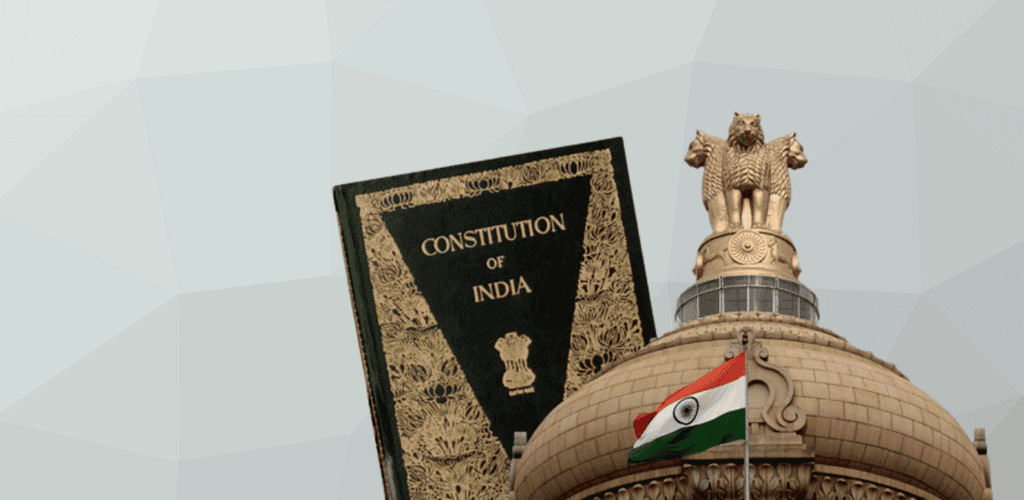
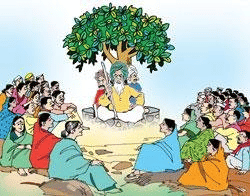
Constitutional norms provide the foundation for laws, governance and justice in a polity. The Constitution specifies the rules, institutions and procedures through which the state acts. These rules are given effect through laws enacted by authorities created under the Constitution and through interpretation by the judiciary. The Supreme Court, as the highest court, is the final interpreter of constitutional provisions. Constitutional arrangements also aim to promote social justice and equality by structuring power and creating mechanisms - such as the Panchayati Raj system - for decentralised governance and local participation.
Constitutional Norms and Social Justice: Interpretation to Aid Social Justice
There is a distinction between law and justice. Law refers to rules backed by the coercive power of the state; its authority rests on enforceability.
Justice refers to fairness and moral rightness. The legitimacy of law is strengthened when law promotes fairness and social justice.
The Constitution is the supreme legal document that constitutes the principal authorities of the state and lays down the procedures for making and implementing laws.
All other laws derive their validity from the Constitution and are implemented by constitutional authorities created under it.
A hierarchy of courts interprets laws and resolves disputes. The Supreme Court is the ultimate interpreter of the Constitution and has the power to strike down laws that are inconsistent with constitutional provisions.
Judicial interpretation plays a key role in applying constitutional values - such as equality, dignity and social justice - to changing social and economic realities.
MULTIPLE CHOICE QUESTION
Try yourself: What is the role of the Supreme Court in interpreting laws in a hierarchical system?
A
Enforcing laws through coercion
B
Interpreting laws in case of disputes
C
Making laws as per the Constitution
D
Representing marginalized groups
Correct Answer: B
- The Supreme Court plays a crucial role in interpreting laws when there is a dispute. - It acts as the highest court in the hierarchy and is responsible for ensuring that laws are applied fairly and justly. - By interpreting laws, the Supreme Court helps uphold the principles of justice and fairness in the legal system.
Report a problem
The Panchayati Raj and the Challenges of Rural Social Transformation
Ideals of Panchayati Raj
The main objective of the Panchayati Raj system is to establish a functional democracy at the grassroots so that ordinary citizens participate in decision-making that affects their daily lives.
Grassroots democracy is not a new idea in India, but social inequalities based on caste, class and gender have historically limited equal participation in local governance.
During the framing of the Constitution, Panchayats were not explicitly included as constitutional bodies; this omission disappointed some leaders who wanted stronger guarantees for local self-government.
Dr. B.R. Ambedkar was sceptical about local self-government because he feared that entrenched caste hierarchies and local elites would perpetuate the exploitation of oppressed groups in the countryside.
Mahatma Gandhi (Gandhiji) favoured local self-government through his idea of gram swaraj, where villages would be largely autonomous and manage their own affairs.
The 73rd Constitutional Amendment Act, 1992 gave constitutional status to Panchayati Raj Institutions (PRIs), providing a uniform framework for decentralised rural governance and mandating regular elections every five years.
Under the 73rd and 74th amendments to the Constitution, one-third of all elected positions in local bodies in both rural and urban areas are reserved for women. Seventeen percent of these seats are reserved for women from scheduled castes and tribes.
This amendment is significant because it grants women the right to vote and decision-making power for the first time. Women are only allowed to hold one-third of the seats in gram panchayats, village panchayats, municipalities, city corporations, and district boards.
Powers and Responsibilities of Panchayats
The main responsibilities of Panchayats are to:
Develop plans and strategies for economic growth.
Collect taxes, duties and other revenues in the village.
Promote social justice programs and initiatives.
Help in transferring governmental responsibilities, especially those related to finance, to local authorities.
To be socially responsive, Panchayats must ensure the registration of births, deaths and burial grounds, promote cattle facilities, and provide family planning and child care services. Economic development activities include constructing roads, buildings, wells, tanks, ponds, schools, colleges, small-scale industries, and irrigation systems. Panchayats use the revenue collected from taxes and duties for the betterment of the village.
To ensure social justice, Panchayats must protect women, provide support to the Scheduled Castes and Tribes, and follow the government's recommendations.
In some states, Nyaya Panchayats have been established to hear minor civil, criminal, and administrative disputes. They can impose fines but not sentences. These village courts have been successful in mediating settlements between disputing parties.
MULTIPLE CHOICE QUESTION
Try yourself: What is the main responsibility of Panchayats according to the text?
A
Develop plans for economic growth and collect taxes.
B
Provide support to women and promote social justice programs.
C
Build roads, schools, and irrigation systems for the village.
D
Hear minor civil and criminal disputes in Nyaya Panchayats.
Correct Answer: A
- Panchayats are responsible for developing economic growth strategies in the village. - They are also tasked with collecting taxes, duties, and other revenues to fund development projects in the village.
Report a problem
Panchayati Raj in Tribal Areas
Many tribal societies have long-standing forms of local collective decision-making. For example, among the Khasis, Jaintias and Garos in the northeastern region, traditional institutions governed community matters at village, clan and higher levels.
Sociologists such as Tiplut Nongbri have pointed out that even in tribal societies, institutional arrangements are not automatically democratic. Social stratification and gender inequalities may exist, and social change can introduce distortions into traditional institutions.
The application of the Panchayati Raj framework in tribal areas has required special approaches - including protection of customary rights, recognition of traditional authorities, and provisions under the Constitution (such as the Fifth and Sixth Schedules) to safeguard tribal governance and land rights.
Democratisation and Inequality
Democratisation in a society marked by long-standing inequalities is complex. Social barriers based on caste, class, gender and ethnicity can limit equal access to participation, leadership and benefits of local governance.
Examples of barriers include exclusion from meetings, intimidation of marginalised groups, low levels of literacy and information among disadvantaged communities, and capture of local institutions by wealthy or dominant castes.
Institutional measures to increase inclusion include reservations for SCs/STs and women, strengthening the Gram Sabha, social audits, transparency measures, capacity building and ensuring adequate devolution of funds and administrative powers.
Even with constitutional safeguards, continued social mobilisation, public awareness and enforcement mechanisms are necessary to make local democracy effective and equitable.
Political Parties, Pressure and Interest Groups in Democratic Politics
Different social and economic groups organise to have their interests represented in the political system. Such organisations include business associations, trade unions, farmers' unions and social movements.
Examples of organised groups include business federations like FICCI (Federation of Indian Chambers of Commerce and Industry) and ASSOCHAM, and trade unions such as INTUC and CITU. Farmers' organisations and agricultural labour unions also mobilise around specific economic and policy issues.
A political party is an organisation that seeks to gain legitimate control of government through elections and to implement programmes based on particular ideas about society and policy priorities.
Interest groups (or pressure groups) do not usually seek direct control of government but try to influence public policy and decision-makers through lobbying, advocacy, protests and other forms of collective action.
When groups that are denied entry into formal channels form new organisations seeking political recognition, they may operate as social movements until they become established political actors or influence mainstream parties.
Political parties and interest groups serve as intermediaries between society and the state by aggregating demands, articulating interests and shaping public policy. The effectiveness of representation depends on the organisational strength of these groups and on the responsiveness of political institutions.
MULTIPLE CHOICE QUESTION
Try yourself: What are interest groups in democratic politics?
A
Organizations oriented towards achieving legitimate control of government through an electoral process.
B
Groups seeking to influence political parties by lobbying legislative bodies.
C
Associations formed by industrialists and workers to pursue specific interests.
D
Movements formed to achieve governmental power through alternative means.
Correct Answer: B
- Interest groups in democratic politics are organizations formed to pursue specific interests in the political arena. - They work towards influencing political parties by lobbying legislative bodies to address their grievances and concerns.
Report a problem
Conclusion
The Constitution provides the legal framework for governance and the delivery of social justice. Judicial interpretation continually shapes how constitutional principles apply to new social conditions. The 73rd and 74th Amendments strengthened local self-government and aimed to deepen democracy by devolving power, guaranteeing representation for marginalised groups and promoting participation. However, social inequalities, limited devolution of authority and local elite capture continue to challenge the realisation of inclusive grassroots democracy. Continuous constitutional safeguards, effective implementation, social mobilisation and institutional reforms are essential to achieve the constitutional ideal of justice and equality.
FAQs on Chapter Notes - The Constitution and Social Change
1. How do Constitutional norms contribute to social justice?
Ans. Constitutional norms provide the framework for ensuring equality, justice, and rights for all individuals in society. They serve as a guide for interpreting laws and policies that promote social justice and protect the rights of marginalized communities.
2. What role does the Panchayati Raj system play in rural social transformation?
Ans. The Panchayati Raj system decentralizes power to local village councils, empowering communities to participate in decision-making processes. This system helps in addressing local issues, promoting grassroots democracy, and fostering social change in rural areas.
3. How does the Panchayati Raj system operate in tribal areas?
Ans. In tribal areas, the Panchayati Raj system is implemented with special provisions to protect the rights and interests of tribal communities. It aims to promote their self-governance, preserve their culture, and ensure their participation in local governance.
4. What role do political parties, pressure groups, and interest groups play in democratic politics?
Ans. Political parties provide a platform for citizens to engage in the political process, pressure groups advocate for specific issues, and interest groups represent the concerns of particular sectors of society. Together, they contribute to shaping public policy and promoting democratic values.
5. How can the Constitution be interpreted to aid social justice?
Ans. The Constitution can be interpreted through a social justice lens by applying principles of equality, non-discrimination, and inclusivity. Courts play a crucial role in interpreting constitutional provisions to protect the rights of marginalized groups and promote social justice in society.
pdf , Sample Paper, Important questions, Chapter Notes - The Constitution and Social Change, shortcuts and tricks, Previous Year Questions with Solutions, Free, ppt, Summary, Semester Notes, study material, MCQs, Extra Questions, mock tests for examination, Exam, past year papers, video lectures, Chapter Notes - The Constitution and Social Change, Chapter Notes - The Constitution and Social Change, practice quizzes, Viva Questions, Objective type Questions;