Chapter Notes - Change & Development in Industrial Society


Introduction
Industrial society brings significant changes in the way people work and live. Industries such as the film industry in Mumbai involve many types of workers who perform different roles and often organise themselves into unions to demand fair wages, safe conditions, and proper working hours. Although people working in the same industry live in the same city, their lifestyles differ according to their income and occupation. Some live in expensive areas and enjoy luxurious facilities, while others live in working-class neighbourhoods with modest lifestyles. At the same time, city residents also share certain common experiences such as watching the same films, facing pollution, and hoping for a better future for their children. Sociologists study how changes in technology, jobs, and social institutions like caste, gender, and family networks influence the organisation of work and economic activities in society.
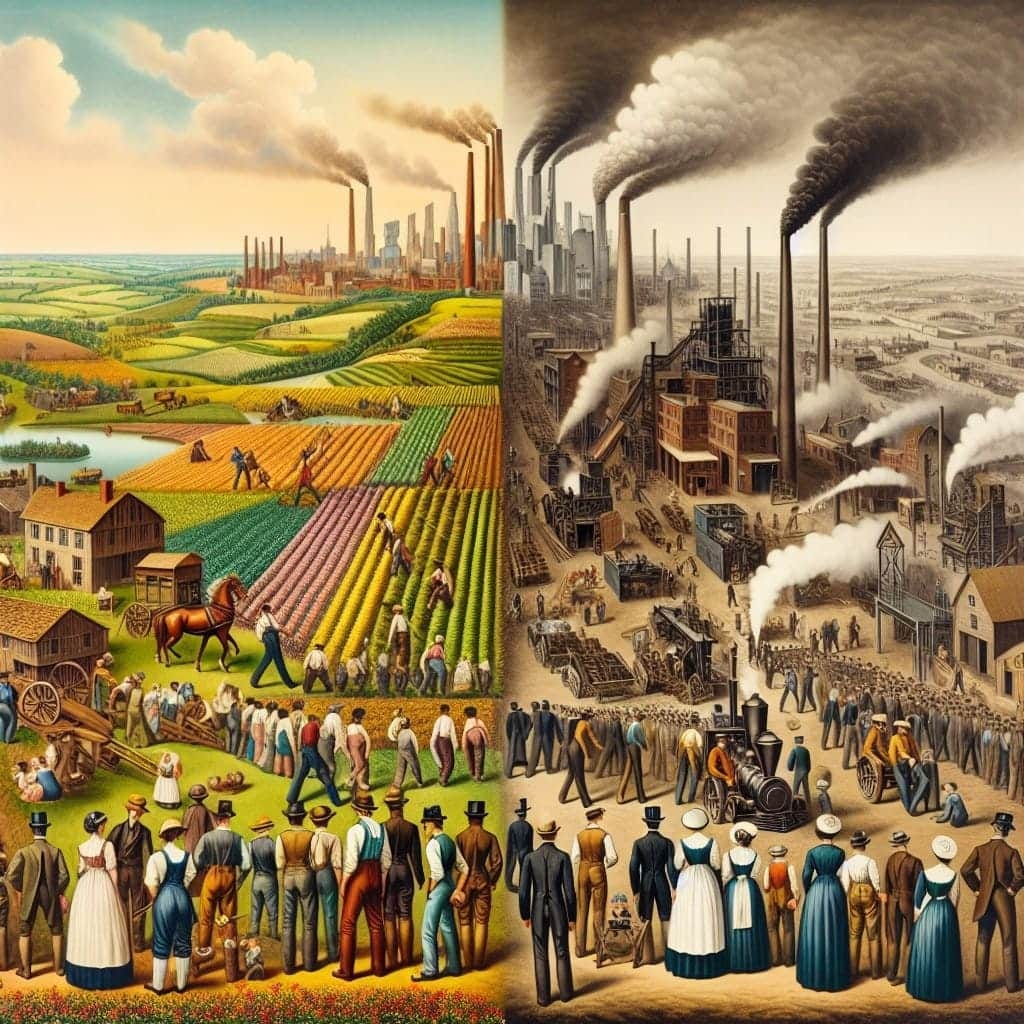
Images of industrial society
Sociologists who studied early industrial society emphasised how industrialisation changed social relations, work and everyday life. Karl Marx, Max Weber and Émile Durkheim all pointed to the connection between growing urbanisation, increasing specialisation of work and the decline of face-to-face, small-scale social ties. Industrial growth produced complex divisions of labour and new forms of organising production and social life.
- Alienation: Marx used this term to describe how, under industrial capitalism, many workers came to see work only as a means of survival rather than as a fulfilling activity. Workers were separated from the product of their labour, from the production process, from other people and, he argued, from their human potential.
- Early sociologists held mixed views on industrialisation, recognising both positive effects (economic growth, technological progress, greater mobility) and negative effects (dislocation, exploitation, loss of communities). By the mid-20th century, modernisation theory further popularised the idea that industrialisation and modern institutions were largely inevitable and beneficial for development.
- Industrialisation also altered social hierarchies. In some urban public spaces and workplaces, older social distinctions such as caste became less visible or less decisive in everyday interactions (for example, in trains, buses or cyber cafés), although such inequalities persisted in other spheres.
Try yourself: Which of the following is a characteristic of an industrial society?
Industrialisation in India
The Specification of Indian Industrialisation
India's path to industrialisation differed in important ways from the classical Western model, though it shared several features such as the early growth of factory production and railways. Historical and comparative studies show that there is no single model of industrial capitalism that fits every country; local political choices and colonial legacies mattered greatly in India.
- The first modern industries in India included cotton, jute, coal mining and the railways. These sectors laid the foundation for industrial employment and infrastructure.
- After independence, the government assumed responsibility for the so-called commanding heights of the economy - areas such as defence, rail and road transport, communications, power, and major mining and heavy industries - with the aim of ensuring planned, balanced development.
- Under the mixed economy model, the state kept exclusive control of certain sectors while allowing the private sector to operate in others. The licensing regime and industrial policy sought to promote industrial growth and also to disperse industries regionally.
- The state provided special support and incentives for small-scale industries because these were seen as important for employment generation and the protection of traditional crafts.
- Employment patterns in India contrast with developed countries: in many advanced economies fewer than 10% of people work in agriculture, while the majority are employed in industry and services. In India, historically, about 60% of the workforce has been in the primary sector (agriculture and mining), about 17% in the secondary sector (manufacturing, construction and utilities) and about 23% in the tertiary sector (trade, transport, financial and other services).
Formal or organised sector
The term organised sector (or formal sector) refers to enterprises that are registered with the government and typically employ at least ten persons on a regular basis. These firms generally provide job security, statutory benefits (such as provident fund, paid leave and social security where applicable), a clear hiring process and some formal channels to address grievances.
The relatively small size of the organised sector in India has important social consequences:
- Only a minority of people obtain the kind of stable employment that allows for regular interaction with a wide range of colleagues from different places and backgrounds; most Indians work in small units or as independent producers where such diversity of workplace ties is limited.
- Only a limited proportion of workers have access to secure, well-paid employment. Government jobs therefore have special appeal because they provide long-term security and benefits; for many others the absence of secure pensions or provident arrangements means heavy dependence on family and children in old age.
- Trade union membership and collective bargaining are concentrated in the organised sector. Because most workers are in the unorganised sector, few have experience of organising and bargaining for better wages and conditions; legal protections for unorganised workers often remain weak in practice because employers and contractors can control work arrangements.
Globalisation, Liberalisation and Changes in Indian Industry
- Since the early 1990s the Indian government introduced policies of liberalisation and globalisation intended to open the economy: encouraging private and foreign investment, reducing licence-permit raj controls, and easing restrictions on imports and foreign ownership in many sectors.
- Several sectors previously reserved for the public sector - for example, telecommunications, civil aviation and power - were opened up to private and foreign firms. Indian consumers also saw an increase in the variety of foreign goods available in markets.
- Many Indian enterprises entered into joint ventures or were acquired by multinational corporations. At the same time the government began a process of disinvestment (selling its stake in public sector enterprises) to raise resources and improve efficiency.
- Disinvestment and privatisation produced anxieties among public sector workers about job security and the terms of employment. For example, when Modern Foods - a government-established bakery company intended to supply affordable bread - was privatised, a substantial portion of the workforce (reported as about 60% in the years following privatisation) left or were retired within the first five years of private ownership, giving rise to debates about the social costs of privatisation.
Try yourself: Which of the following is a challenge faced by industrial societies?
How People Find Jobs?
- Only a small number of people get jobs through advertisements or employment exchanges.
- Many self-employed workers like plumbers, electricians, carpenters, tutors, architects, and freelance photographers find work through personal contacts and recommendations.
- These workers believe that good work helps them gain more customers, and tools like mobile phones help them connect with more people easily.
- In factories, workers earlier often got jobs through contractors or jobbers.
- In the Kanpur textile mills, these jobbers were called mistris, who were workers themselves but had the support of the factory owners.
- The mistris controlled and supervised workers, and since they belonged to the same region or community, they sometimes used social pressure on the workers.
- Today, the role of jobbers has reduced, and management and labour unions are also involved in the recruitment of workers.
- Many workers hope that their children will get jobs in the same factory after them.
- Some factories hire badli workers, who temporarily replace permanent workers when they are on leave.
- Many badli workers work for the same company for years but do not receive permanent status or job security. This system is known as contract work in the organised sector.
- Employment opportunities mainly exist in two forms:
- Jobs as casual labourers or regular salaried employees in organisations
- Self-employment
- The Government of India has introduced schemes such as MUDRA, Aatmanirbhar Bharat, and Make in India to increase job opportunities and promote self-employment, especially for SC, ST, and other backward groups.
- The contractor system is commonly seen in construction work, brick kilns, and similar labour-intensive jobs.
- Contractors often visit villages to recruit workers and offer them loans, which include travel expenses to reach the work site.
- This loan is treated as an advance wage, so workers must work until the loan amount is repaid.
- Earlier, agricultural labourers were tied to landlords through debt, but industrial work has given them some freedom to change employers.
- Workers can leave one contractor and find another job, giving them slightly more independence in industrial society.
- In many cases, entire families migrate for work, and children sometimes assist their parents in the work.
How is work carried out?
Work organisation in contemporary India ranges from large, mechanised factories and corporate offices to small workshops and home-based production. The management of work aims primarily to supervise employees and increase productivity. Broadly, there are two ways managers seek to raise output: extend working hours, or raise the amount produced within a fixed time.
- Scientific Management (Taylorism): Developed by Frederick Winslow Taylor in the late 19th and early 20th centuries, this method broke tasks into small, timed elements. Managers used stopwatches and time-and-motion studies to set performance standards and daily production targets. The worker became part of a rationalised, measured system of production.
- Assembly line production: Work was organised so that a product moved along a conveyor and workers performed specialised, repetitive tasks. Production speed could be controlled by the conveyor, increasing the pace of work and standardising output.
- Automation: Machines and automated systems can reduce the number of workers required, but those employed must often keep pace with machine-determined workflows.
- Just-in-time production and outsourcing: To reduce inventory and costs, firms may use just-in-time systems (receiving supplies only as needed) and outsource parts of production to contractors. While these reduce costs, they can increase stress on workers when delays occur and reduce job security.
Working Conditions?
Conditions vary greatly across industries. The following points illustrate issues faced particularly by miners and by home-based workers.
- The Mines Act, 1952 sets out safety regulations, limits on working hours and provisions for overtime pay and certain benefits for mining workers.
- In practice, contractors sometimes avoid formal liability by not maintaining proper employee records, which limits workers' access to legal protections and benefits.
- Mining companies are legally required to reclaim and restore mining sites after operations cease, but failures to fill open pits and rehabilitate land are commonly reported.
- Underground mining is hazardous: risks include flooding, fires, roof and wall collapses, sudden gas releases and poor ventilation.
- Miners face high rates of occupational illnesses such as silicosis and respiratory tuberculosis, and injuries from blasting, falling objects and exposure to extreme conditions.
- India has experienced a high incidence of mine accidents relative to many other countries, reflecting gaps in safety enforcement and resource constraints.
Home-Based Work?
- Home-based production contributes substantially to the informal economy. Typical items produced at home include carpets, bidi cigarettes, incense sticks (agarbatti), lace, zari and brocade embroidery, and many other hand-crafted goods.
- Women and children are often the primary workforce in many such household industries.
- Work is usually organised through intermediaries or agents who deliver raw materials to homes and collect finished goods for payment.
- Payments are typically on a piece-rate basis - workers are paid according to the number of items they complete rather than by time worked; this can lead to very low effective wages and no social security.
- The bidi industry is a common example: individual workers roll bidis at home for small payments per piece, often under the supervision of contractors or agents.
Strikes and Union
- A strike is an organised withdrawal of labour in which workers stop reporting for work to press for demands such as better wages, working conditions or job security.
- Calling a strike is a difficult decision: employers may attempt to employ substitute labour (lockouts or use of temporary workers), and striking workers forgo wages during the period of the strike, creating financial hardship for themselves and their families.
Try yourself: Which of the following is a social consequence of industrialization?
Conclusion
Industrialisation transformed Indian society by changing how goods are produced, how work is organised and by reshaping social relations. While industrial growth created opportunities for economic expansion and social mobility, it also produced new forms of inequality, insecure livelihoods for a large part of the workforce and pressing questions about labour rights, safety and social protection. Understanding these processes requires attention to both historical patterns (such as the legacy of early industries and state policies) and contemporary changes (such as liberalisation, automation and the growth of informal work).
FAQs on Chapter Notes - Change & Development in Industrial Society
| 1. What is industrial society? |  |
| 2. What are some of the key features of industrial society? | |
| 3. How did industrialization impact society and culture? | |
| 4. What are some of the negative consequences of industrialization? | |
| 5. How has industrial society changed over time? | |