Long Answer Questions: The Making of a Global World

Q1. What is globalisation? Explain.
Ans: Globalisation refers to the widening, deepening and speeding up of worldwide interconnectedness. It most often describes the free movement of capital, goods, services, technology, ideas and people across national boundaries. In a broader sense it also includes the exchange of cultures, languages and lifestyles. Recent advances in information technology and telecommunications have made global links faster and cheaper, increasing the intensity of contacts between countries. Important features of globalisation include:
(i) International trade and economic liberalisation that allow countries to buy and sell more freely.
(ii) Migration of workers and professionals in search of employment and better living conditions.
(iii) Cultural exchange, such as the spread of religions, ideas, art and knowledge across regions.
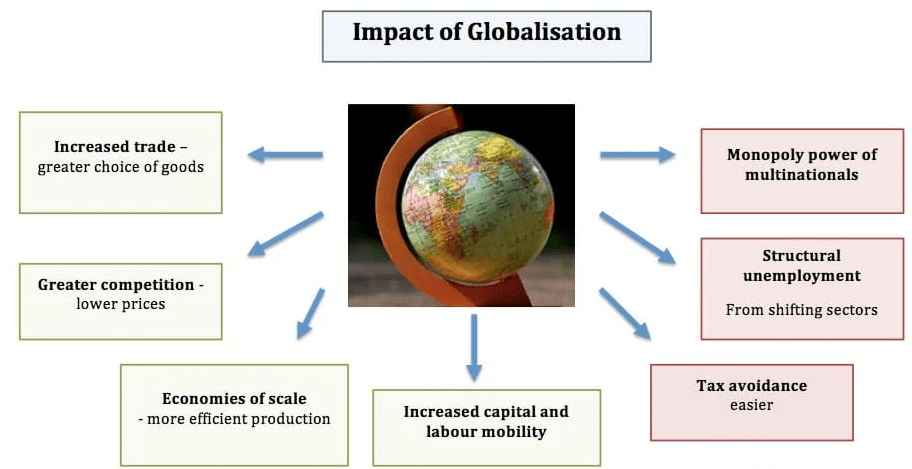
The interlinking of the world is a continuous process from the past. In earlier times, interlinking involved a relatively small number of travellers, traders, priests and pilgrims who covered vast distances for knowledge, trade, spiritual fulfilment or to escape persecution. In modern times interlinking is faster and involves millions of people, so the world appears to be shrinking in terms of communication and trade.
Q2. Trace the origin of Silk Route and its significance.
Ans: The Silk Route was a network of trade routes that connected China with Central Asia, the Middle East and parts of Europe. Its origin lies in early exchanges of goods and ideas between these regions from the first millennium BCE onwards. By the first century BCE, the route was used extensively for long-distance trade. The Romans learnt about China through Parthian middlemen around 53 BCE and referred to the Chinese as the "Seres" or silk people. The modern term "Silk Route" was coined by the German geographer Ferdinand von Richthofen in the nineteenth century. Although silk was a highly prized commodity on these routes, many other goods such as spices, precious stones, glassware and horses were traded.
Significance:
(i) It promoted long-distance trade, bringing wealth and a flow of goods between East and West.
(ii) It acted as a channel for cultural exchange, spreading religions (for example, Buddhism to China), art styles, and scientific knowledge.
(iii) It encouraged the growth of cities and caravan towns which became important centres of commerce and learning.
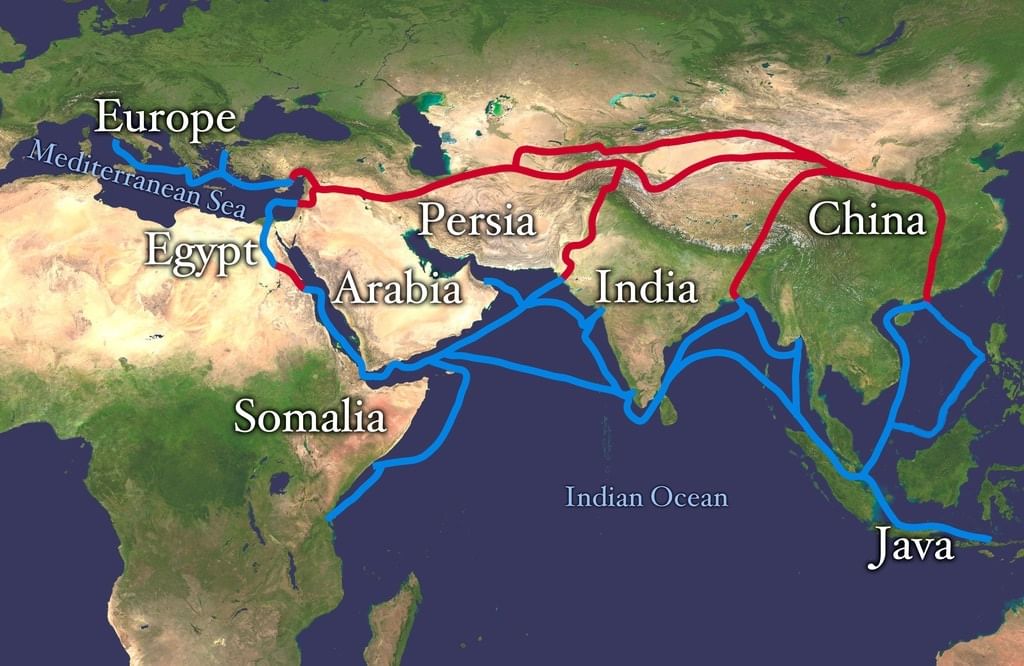 The Silk Route
Q3. How is culture a great agent of globalisation? Explain with example.
Ans: Culture spreads when people, goods and ideas move from one region to another. This movement links societies and contributes to globalisation in important ways. Examples and mechanisms include:
(i) Religious diffusion: Buddhism travelled from India to China along the Silk Route through monks and missionaries. They carried scriptures, artistic styles and religious practices which were adopted and adapted in China.
(ii) Art and ideas: Artistic techniques, literature and philosophies travelled with traders and travellers. Local cultures borrowed styles and ideas, leading to mixed cultural forms.
(iii) Missionaries and educators: Christian missionaries, Muslim preachers and later European educators and administrators carried beliefs, languages and institutions to other regions.
Through such contacts, cultural elements are exchanged, modified and spread, making culture a major agent of global interconnectedness.
Q4. Explain how Europe was able to leap ahead of other continents by the 18th century.
Ans: By the 18th century Europe moved ahead because of a combination of intellectual, technological, economic and political changes:
(i) Renaissance: The revival of classical learning and arts encouraged scientific inquiry and new thinking.
(ii) Scientific Revolution and Enlightenment: New methods of observation and reason led to inventions and improved knowledge.
(iii) Industrial Revolution: New machinery, use of coal, steam power and factory production greatly expanded manufacturing capacity.
(iv) Colonial expansion and trade: European control over colonies provided raw materials, markets and capital accumulation.
(v) Political competition: Rivalries between many small states encouraged innovation, investment and military improvements. Together, these factors created conditions for rapid economic growth and technological leadership in Europe.
Q5. Discuss why the Europeans were motivated to establish colonies.
Ans: Several motives drove European colonisation. These include economic, political, social and religious reasons:
(i) Search for wealth: Europeans sought gold, silver, spices and other valuable goods and wanted direct access to resources.
(ii) Markets and raw materials: The Industrial Revolution increased demand for raw materials and markets for manufactured goods.
(iii) Population and opportunity: Some people migrated to colonies to escape poverty or religious persecution; others sought new land and livelihoods.
(iv) Strategic and political power: Control of colonies increased a country's global influence and naval strength.
(v) Missionary zeal: Religious groups wished to convert local populations and spread their faith.
These motives combined to make colonisation attractive to European powers in the modern period.
Q6. Discuss one of the important causes and effects of the development of global agriculture.
Ans: Cause : One key cause was the abolition of the Corn Laws in Britain and the wider lowering of trade barriers. The Corn Laws had kept grain prices high through import restrictions. When these protections were removed, Britain began importing large quantities of cheaper agricultural produce from overseas. British farmers found it hard to compete; many left the land and moved to towns or emigrated overseas. This increased demand for food from countries such as Eastern Europe, Russia, the United States and Australia, which expanded their agricultural production to serve the global market.
Effects :
(i) Large-scale migration: Millions left Europe for the Americas and colonies in search of land and work. Estimates suggest nearly 50 million people moved from Europe to America and Australia in the nineteenth century, contributing to global labour flows.
(ii) Commercial agriculture: Many regions moved from subsistence farming to export-oriented production of wheat, meat and other commodities.
(iii) Urbanisation and industrial growth: Migration to towns provided labour for industries and helped urban expansion.
(iv) Integration of world markets: A global agricultural economy emerged, with improved transport and capital flows linking distant regions.
Q7. What were the effects of colonialism on Indian agricultural export in the nineteenth century?
Ans: Colonial policies transformed Indian agriculture from largely subsistence-based to an export-oriented system, with several harmful consequences:
(i) Deindustrialisation: Traditional cotton handloom industries could not compete with cheaper, machine-made British textiles, reducing local demand for Indian raw materials and handicrafts.
(ii) Unfavourable tariffs: High duties and trade rules made it hard for Indian goods to enter British markets, while British manufactured goods flooded India.
(iii) Cash crop emphasis: The expansion of indigo, jute and other cash crops replaced food crops in many areas, increasing vulnerability to food shortages and famine.
(iv) Rural exploitation: Moneylenders and landlords often exploited indebted farmers. Many smallholders lost land and became agricultural labourers.
Overall, colonial policies made Indian agriculture more vulnerable to price fluctuations and reduced rural self-sufficiency.
Q8. Explain how the world was transformed after the World War (1914-1918).
Ans: The First World War brought deep and wide-ranging changes:
(i) Human cost: Around 9 million soldiers died and about 20 million were wounded, removing a large portion of the young workforce.
(ii) Military and technological change: Warfare used machine guns, tanks, aircraft and chemical weapons on a large scale, changing how wars were fought.
(iii) Economic effects: Wartime production shifted industry toward military goods; many European countries became indebted and the United States emerged as a major creditor and economic power.
(iv) Social change: Women entered the workforce in larger numbers and social roles changed as societies mobilised for war.
(v) Political change: Empires weakened, new nations appeared from collapsed empires, and the Russian Revolution (1917) introduced communism as a major new political force. The war also set the stage for future global tensions and the reorganisation of international relations.
Q9. What were the immediate effects of the World War on European agriculture?
Ans:
Europe suffered greatly during and after the war, and agriculture felt several direct impacts:
(i) Supply disruptions: Pre-war suppliers such as Eastern Europe could not ship food during the conflict, so countries turned to imports from the USA, Canada and Australia.
(ii) Food shortages: Farming was disrupted by the mobilisation of labour, requisitioning of food for armies and damage to farmland, causing shortages.
(iii) Social upheaval: In Russia the strains of war contributed to the 1917 revolution and the collapse of the old order.
(iv) Post-war overproduction: When farming recovered in Eastern Europe after the war, grain supplies increased sharply. This caused prices to fall, reducing rural incomes and increasing farmer indebtedness.
Q10. Trace the different stages of development of the assembly line production.
Ans: The assembly line developed through a series of practical improvements that increased productivity:
(i) Inspiration: Henry Ford adapted methods he observed in a Chicago slaughterhouse where carcasses moved along hooks and workers performed a single repeated task.
(ii) Implementation: In his Detroit plant Ford introduced a moving conveyor and organised workers so each person performed a single operation. This divided production into small, repeatable tasks.
(iii) Result: The system dramatically sped up production. Ford's Model T cars rolled off the line every few minutes, lowering costs and making automobiles affordable to many.
(iv) Labour effects: The repetitive work was monotonous and led to high turnover. To reduce this, Ford doubled workers' wages to $5 a day in 1914, while also banning trade unions in his plants. He recovered increased labour costs through even greater production efficiency and faster line speeds.
The assembly line became a model for mass production in many industries worldwide.
Q11. Who profits from jute cultivation according to the jute growers' lament? Explain.
Ans: The jute growers' lament shows that the gains from jute cultivation often did not reach the peasants who produced it. Key points are:
(i) Traders and middlemen: These groups frequently benefited because they controlled trade, storage and sale of jute and could buy produce at low prices.
(ii) Industrial owners: Mill owners and manufacturers who processed jute earned profits from exported finished goods.
(iii) Peasants suffered: Farmers faced rising costs of cultivation, debts to moneylenders and falling prices for their produce. Colonial revenue demands remained, increasing rural hardship.
Thus, while jute production was profitable for traders and industrialists, small jute growers often remained poor and indebted.
Q12. Write down important causes and effects of the Second World War.
Ans: The Second World War (1939-1945) involved two main groups:
(i) The Allies: Britain, France, the USSR and the USA.
(ii) The Axis: Germany, Japan and Italy.
Causes:
The war grew out of unresolved problems after the First World War, the Great Depression, the failure of the League of Nations, and the rise of totalitarian regimes in Germany, Italy and Japan. Policies of expansionism, militarism and aggressive nationalism, together with the harsh terms of the Treaty of Versailles, pushed Europe and Asia towards renewed conflict.
Effects:
(i) Huge loss of life: About 3 per cent of the world's population died; millions were injured and many cities were destroyed by bombing.
(ii) Geopolitical change: The United States and the Soviet Union emerged as superpowers, setting the stage for the Cold War.
(iii) Institutional change: International organisations such as the United Nations were established to promote peace and cooperation.
(iv) Economic and social consequences: Wide-scale destruction required long reconstruction efforts; decolonisation movements accelerated after the war.
Q13. Discuss some important features of the International Monetary Fund and the World Bank.
Ans:
Role: The International Monetary Fund (IMF) was created to help countries manage balance of payments problems and to stabilise exchange rates. The World Bank (formally the International Bank for Reconstruction and Development, IBRD) was created to provide loans for post-war reconstruction and later for development projects.
The institutions began operations in 1947. Important features include:
(i) Governance: Decision-making was influenced by the major contributing countries, especially the United States, which had greater voting power and influence over policies.
(ii) Monetary system: Under the Bretton Woods arrangement currencies were pegged to the US dollar, and the dollar was convertible to gold at a fixed rate.
(iii) Financial support: The IMF provides short-term financial assistance and policy advice to stabilise economies; the World Bank provides long-term loans for infrastructure and development projects.
(iv) Conditionality: Loans often came with conditions aimed at ensuring macroeconomic stability and reforms in borrowing countries.
Q14. Explain the impact of the Great Depression on the Indian economy.
Or
Explain the impact of the Great Depression on Indian farmers in the early twentieth century.
Ans: (i) Impact on trade: The Great Depression sharply reduced global demand. India's exports and imports nearly halved between 1928 and 1934. International prices crashed and prices in India plunged; for example, wheat prices in India fell by about 50 per cent between 1928 and 1934.
(ii) Impact on farmers: Falling agricultural prices devastated poor farmers. Despite lower incomes, the colonial government continued to demand taxes in cash, so peasants who produced for world markets were worst affected. Many fell into debt or lost their land.
(iii) Impact on urban India: Urban salaried groups and landlords with fixed incomes sometimes benefited because falling prices reduced their costs. Some sections of the town-dwelling middle class found themselves relatively better off as consumer prices fell.
(iv) Industrial investment: Government protection and nationalist pressures led to increased tariff protection for Indian industries; industrial investment grew in some sectors.
(v) Political impact: The economic distress strengthened nationalist movements and helped leaders like Mahatma Gandhi launch movements such as the Civil Disobedience Movement.
Q15. What is meant by the Bretton Woods Agreement Explain.
Ans:The Bretton Woods Conference was held in July 1944 at Bretton Woods, New Hampshire, USA. It created the framework for the post-war international monetary order and led to the establishment of the International Monetary Fund (IMF) and the International Bank for Reconstruction and Development (IBRD or World Bank).
The main terms of the agreement were:
(i) Formation of the IMF and the IBRD (World Bank).
(ii) To promote monetary cooperation among member countries.
(iii) An adjustable peg system of exchange rates was established: currencies were fixed to the US dollar but could be adjusted in case of fundamental disequilibria. The US dollar was convertible to gold at a fixed price of $35 per ounce. Current account transactions were required to be largely convertible, while governments could control capital flows.
(iv) Member countries were required to subscribe to the IMF's capital and abide by agreed rules to maintain exchange rate stability.
FAQs on Long Answer Questions: The Making of a Global World
| 1. What are the key factors that contributed to the making of a global world? |  |
| 2. How did colonialism influence the global economy? | |
| 3. What role did the Industrial Revolution play in globalization? | |
| 4. How has globalization affected cultural exchange? | |
| 5. What are the challenges associated with a globalized world? | |





