Long Answer Questions: Minerals & Energy Resources

Q1. Name the two varieties of iron ore in India that have a high content of iron. Mention the names of places in India which have the richest iron ore deposits. Explain two effects on our economy due to the export of good quality ores in large quantities.
Ans: The two varieties of iron ore in India with high iron content are magnetite and hematite.
Rich deposits of iron ore are found in several regions of India:
- Odisha-Jharkhand belt: High-grade hematite occurs in Badampahar (Mayurbhanj and Keonjhar districts) and in Gua and Noamundi in Singhbhum district, Jharkhand.
- Durg-Bastar-Chandrapur belt: Located in Chhattisgarh and Maharashtra; the Bailadila range in Bastar district is noted for very high-grade hematite.
- Maharashtra-Goa belt: Includes deposits in Ratnagiri and Chandrapur in Maharashtra and Bicholim and Pali in Goa.
About half of India's iron ore production is exported, mainly to countries such as Japan, Korea and several European nations, through ports like Paradip, Vishakhapatnam, Mangalore and Marmagao.
Two important effects on the economy due to large-scale export of good-quality ores are:
- Positive effect: Exporting high-grade ore earns substantial foreign exchange. This income can be used for national development, importing essential goods and technology, and improving infrastructure in mining and port areas. Exports also generate employment and encourage investment in mining and transport facilities.
- Negative effect: Excessive export of good-quality ores can deprive domestic industries-particularly the iron and steel sector-of the best raw material. This forces local industry to use low-grade ore or import processed steel, which reduces opportunities for value addition and manufacturing within the country.
Q2. What are the differences between hydro-electricity and thermal electricity? What is nuclear electricity?
Ans:
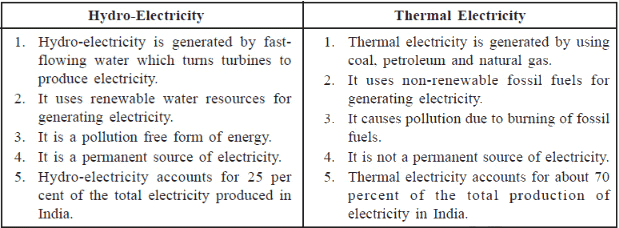
Differences between hydro-electricity and thermal electricity:
- Source of energy: Hydroelectricity uses the kinetic energy of flowing or falling water to turn turbines. Thermal electricity uses heat produced by burning fossil fuels (such as coal, oil or gas) to generate steam that drives turbines.
- Cost and operation: Hydroelectric plants have high initial construction costs (dams and reservoirs) but low running costs and long life. Thermal plants have lower initial costs but higher running costs because fuel must be purchased continuously.
- Environmental impact: Hydroelectricity is cleaner in terms of air pollution but can cause ecological changes and displacement due to reservoirs. Thermal electricity leads to air pollution and greenhouse gas emissions from fuel combustion.
- Dependability: Hydropower output can vary with seasonal water availability and droughts. Thermal plants are more controllable and can provide steady power as long as fuel is available.
- Location: Hydroelectric stations need suitable rivers and topography. Thermal stations are located near fuel supply or water for cooling and close to load centres.
Nuclear electricity, also called atomic energy, is produced by changing the structure of atoms in elements such as uranium and thorium. This process releases a large amount of heat that produces steam to drive turbines and generate electricity. Nuclear plants provide large-scale, steady power with low direct air pollution, but they require careful handling of radioactive materials and long-term management of nuclear waste.
Q3. Name the ore from which aluminium is obtained. Why is aluminium considered to be an important metal? Name the areas which have rich deposits of the ore of aluminium.
Ans: Aluminium is primarily obtained from bauxite. Bauxite is a reddish-brown, clay-like material from which alumina is extracted and then converted into aluminium.
Aluminium is considered important because of its useful properties:
- Light yet strong: It combines considerable strength with very low weight, making it ideal for aircraft, road and rail transport, and lightweight structures.
- Malleability and corrosion resistance: It is easily worked into sheets, foils and shapes and resists corrosion, so it is used for doors, windows, utensils and packaging.
- Conductivity and recyclability: Aluminium conducts electricity and is widely used in transmission lines. It is also highly recyclable, reducing the need for fresh bauxite.
Rich deposits of bauxite in India are mainly found in:
- Amarkantak Plateau
- Maikal Hills
- Bilaspur-Katni plateau region in Madhya Pradesh and Chhattisgarh
In addition, Odisha is the leading producer of bauxite in India, contributing about 45% of national production; the Panchpatmali deposits in Koraput district are particularly important.
Q4. State the facts about coal found in India with reference to the following :
(a) their total reserves
(b) its importance as a source of energy and as a source of raw material
(c) its main varieties
(d) distribution of coal in India
Ans: Coal is the most abundantly available and important fossil fuel in India.
(a) Total reserves of coal: India has approximately 214,000 million tonnes (about 214 billion tonnes) of coal reserves. These reserves are mainly of two geological ages:
- Gondwana: These are the largest deposits and formed about 200 million years ago.
- Tertiary: Younger deposits formed about 55 million years ago and found in north-eastern India.
(b) Importance as a source of energy and raw material:
- Coal is the primary fuel for power generation in India and supplies a large share of the country's electricity.
- It meets energy needs of industries and households where other fuels are not readily available.
- Coal is essential as a raw material in the iron and steel industry (coke is produced from coal) and in several chemical processes.
- It is used in the chemical industry to produce a variety of products and intermediates.
(c) Main varieties of coal:
- Anthracite: The highest quality hard coal with a high carbon content (over 80%) and high calorific value.
- Bituminous: The most commonly used coal with moderate to high carbon content (about 60-80%) and good heating value.
- Lignite: Low-grade brown coal with high moisture and lower carbon content (generally around 25-35%), used mainly for nearby power plants.
- Peat: The earliest stage of coal formation, with less than 50% carbon and low heating capacity; found in some marshy regions.
(d) Distribution of coal in India:
- Most coal in India is found in the eastern regions and central India.
- Major Gondwana coalfields lie in the Damodar Valley (West Bengal and Jharkhand) - Jharia, Raniganj and Bokaro are key centres.
- Other important coal basins include the Godavari, Mahanadi, Son and Wardha valleys.
- Tertiary (younger) coal deposits are found in the north-eastern states such as Meghalaya, Assam, Arunachal Pradesh and Nagaland.
Q5. How is petroleum an important source of both energy and raw material? Mention the names of the areas which have rich petroleum deposits.
Ans: Petroleum, also called mineral oil, is a vital energy resource and an important raw material for many industries.
Its importance as a source of energy:
- Petroleum provides fuels for transport (petrol, diesel, aviation turbine fuel), for heating and for generating thermal electricity.
- It is convenient to transport and store, making it central to modern energy systems.
Its importance as a raw material:
- Fractional distillation of crude oil yields a range of products used as raw materials in industries: fertilisers, insecticides, plastics, synthetic textiles and rubber and many petrochemicals.
- The petrochemical industry supports numerous manufacturing sectors, creating jobs and value addition.
Major petroleum production areas in India include:
- Mumbai High and Bassien (in the Arabian Sea): These offshore fields contribute a major share of India's oil production.
- Gujarat: Important onshore fields such as Ankaleshwar and Kalol are significant.
- Assam: The oldest oil-producing state with fields such as Digboi, Naharkatiya and Sibsagar.
- Other basins with discoveries include the Kaveri, Krishna and Godavari basins.
Q6. Why do we need to conserve our mineral resources? Explain any three methods of conservation of minerals.
Ans: Minerals are non-renewable resources that took millions of years to form. As current consumption rates are high, continued exploitation without care may exhaust easily accessible deposits, raise extraction costs and reduce availability for future generations. Therefore, conservation is essential to ensure sustainable use, economic stability and long-term industrial growth.
Three practical methods to conserve minerals are:
- Minimise waste during mining and processing: Adopt better mining methods and careful extraction to reduce loss of ore and avoid unnecessary destruction of surrounding land. Proper planning and improved handling reduce spoil and waste.
- Use advanced technologies to beneficiate and use low-grade ores economically: Investing in research and better processing (such as concentration and beneficiation) allows more of the mined material to be used and reduces the need to open new mines.
- Recycling and reuse: Promote the collection and recycling of scrap metals and other mineral products. Replacing virgin material with recycled material reduces demand for new mining and conserves reserves.
Q7. In recent years, the use of which fuel for transport vehicles is gaining popularity? What development has provided impetus to India's gas production?
Ans: In recent years, the use of Compressed Natural Gas (CNG) for transport vehicles has gained popularity. The reasons include:
- Environmental benefits: CNG burns cleaner than petrol and diesel, producing fewer pollutants and improving urban air quality.
- Cost advantages: In many cases CNG is cheaper than liquid fuels, making it economical for city transport and taxis.
- Policy support: Government measures in some cities (for example Delhi) have promoted CNG to reduce pollution and improve public health.
Development that boosted India's gas production: The construction of the 1,700 km Hazira-Bijapur-Jagdishpur (HVJ) cross-country gas pipeline has provided significant impetus to gas usage and supply. This pipeline:
- Links major gas fields such as Mumbai High and Bassein with industrial and fertiliser complexes inland.
- Facilitates the transport of natural gas from production areas to markets, supporting growth in the fertiliser and power sectors and encouraging wider use of gas as a cleaner fuel.
Overall, improved gas infrastructure such as long-distance pipelines has been crucial in making natural gas more widely available and in promoting cleaner fuel options for transport and industry.
FAQs on Long Answer Questions: Minerals & Energy Resources
| 1. What are the different types of minerals and their uses? |  |
| 2. How are energy resources classified? | |
| 3. What is the significance of mineral resources for economic development? | |
| 4. What are the environmental impacts of exploiting mineral and energy resources? | |
| 5. How can we promote sustainable use of minerals and energy resources? | |





