Key Concepts: Manufacturing Industries


Importance of Manufacturing
The manufacturing sector is often called the backbone of economic development because it transforms raw materials into finished goods, creates productive employment and supports other sectors of the economy. Its main contributions are:
- Modernising agriculture: Manufacturing supplies tools, machinery, fertilisers, pesticides and processed inputs that raise agricultural productivity and create demand for farm produce.
- Employment generation: It provides jobs in the secondary and tertiary sectors and absorbs labour from agriculture and other activities, helping to reduce unemployment.
- Poverty reduction: Regular industrial employment and wages help raise incomes and reduce poverty.
- Foreign exchange earnings: Export of manufactured goods expands trade and commerce and brings in much-needed foreign exchange.
- Economic growth: Manufacturing increases output, stimulates allied services (transport, banking, insurance), and gives a boost to the overall economy.
Classification of Industries
Industries may be classified using a variety of criteria. Common bases of classification include the industry's main role, capital investment, ownership, source of raw materials, and the bulk/weight of raw materials and finished goods.
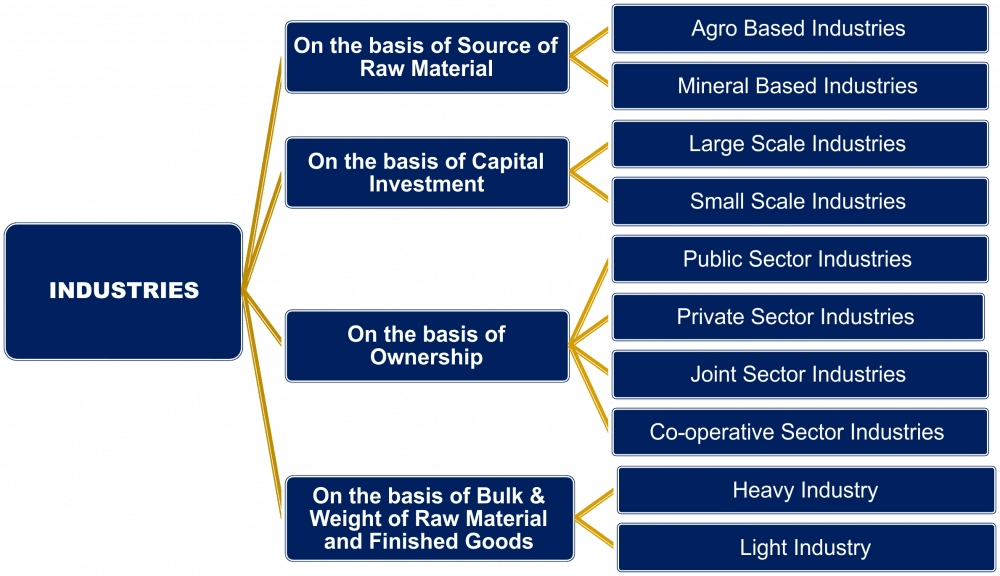
Agro-based Industries
Agro-based industries use agricultural produce as their raw materials. They add value to farm produce and provide employment in rural and semi-urban areas. Typical examples include textile units using cotton, jute mills, sugar mills and agro-processing units.
Cotton Textiles
- The cotton textile industry occupies a significant place in the economy, contributing about 14% of industrial production in the manufacturing sector and providing direct employment to around 35 million persons.
- Historically, major cotton textile centres were concentrated in Maharashtra and Gujarat; over time the industry has spread to many towns and cities across India (now located in roughly 80 towns and cities).
- Problems faced by the cotton textile industry include scarcity of good-quality cotton, obsolete machinery, erratic power supply, low labour productivity and stiff competition from synthetic fibres and imports.
Jute Textiles
India has around 70 jute mills, and most of the raw jute is produced in West Bengal, mainly in the Hugli basin. Jute cultivation and processing also occur in other states such as Bihar, Uttar Pradesh, Madhya Pradesh, Odisha, Assam and Tripura.
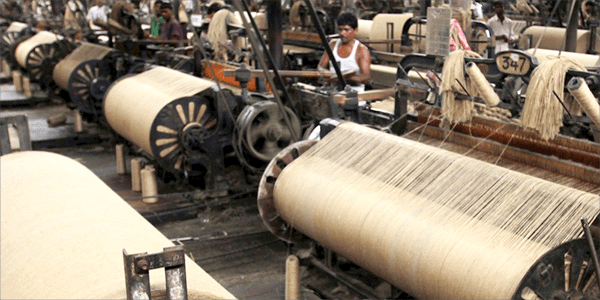 Jute Textiles
Sugar Industry
- There are about 460 sugar mills in the country; roughly half of these are located in Uttar Pradesh and Maharashtra.
- Other important sugar-producing states include Karnataka, Tamil Nadu, Andhra Pradesh and Gujarat.
Mineral-based and Heavy Industries
These industries use minerals and other non-agricultural raw materials. Examples include iron and steel, cement, chemical industries, aluminium and copper smelting, and fertiliser plants.
Iron and Steel Industry
- The first iron works in eastern India began in places like Kulti and Burnpur in the 19th century; the first modern steel plant was set up at Jamshedpur in 1907.
- Today the country has a number of primary integrated iron and steel plants and many mini steel plants; the industry uses raw materials such as iron ore, coal, limestone and manganese ore.
- The location of iron and steel plants is decided largely by the availability of these raw materials; many important plants are located in the eastern and central parts of the Indian peninsula close to mineral deposits.
- A few plants, such as Visakhapatnam, have coastal locations to ease import/export by sea.
- Several large plants are managed by the Steel Authority of India Ltd. (SAIL) and other public and private enterprises.
- India produces millions of tonnes of crude steel annually and ranks among the top world producers.
Aluminium Smelting
- Aluminium is an excellent conductor of heat and electricity and is widely used as a substitute for heavier metals such as steel, copper, zinc and lead.
- Production of one tonne of aluminium requires approximately 6 tonnes of bauxite and about 18,600 kWh of electricity; because of this, availability of bauxite and cheap electricity largely determines plant locations.
- The major aluminium plants are located in states such as Odisha, West Bengal, Kerala, Uttar Pradesh, Chhattisgarh, Maharashtra and Tamil Nadu.
- India's aluminium production has grown with the development of bauxite mining and expansion of smelting capacity.
Chemical Industry
- Heavy inorganic chemicals include substances such as sulphuric acid, nitric acid, caustic soda and soda ash. These are widely produced across the country because they are basic inputs for many industries.
- Sulphuric acid is used in the manufacture of fertilisers, synthetic fibres, plastics, paints and dyes.
- Soda ash is used in manufacturing glass, paper, soap and detergents.
- Heavy organic chemicals include petrochemicals used in the manufacture of synthetic fibres, synthetic rubber, plastics, dyes, drugs and pharmaceuticals; chemical plants producing petrochemicals are frequently located near oil refineries and existing petrochemical complexes.
- Chemical industries make a significant contribution to the total manufacturing output (about 14% of the production of the manufacturing sector as a whole).
Fertiliser Industry
- The first modern fertiliser plant was established at Ranipet in Tamil Nadu.
- With the setting up of a plant at Sindri by the Fertiliser Corporation of India (FCI) in 1951, fertiliser production in the country increased markedly.
- During and after the Green Revolution, fertiliser plants were established in states such as Gujarat, Tamil Nadu, Uttar Pradesh, Punjab and Kerala; other producing states include Andhra Pradesh, Odisha, Rajasthan, Bihar, Maharashtra, Assam, West Bengal, Goa, Delhi, Madhya Pradesh and Karnataka.
- There are many units producing different types of fertilisers: units producing nitrogenous fertilisers, urea plants, plants producing ammonium sulphate as a by-product and numerous smaller units producing single super phosphate and other formulations.
Cement Industry
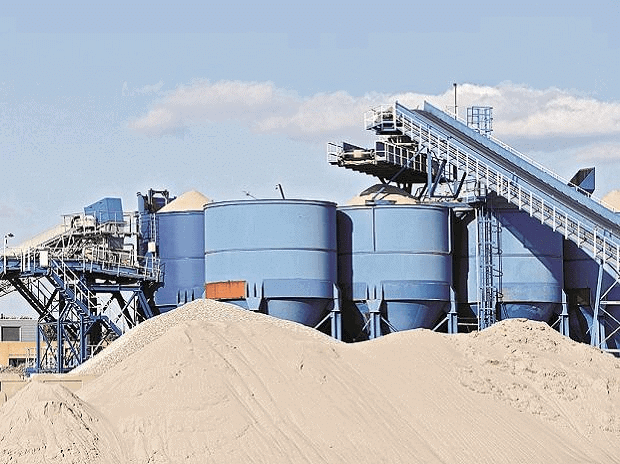 Cement Industry
- Cement is essential for construction - buildings, houses, factories, roads and dams.
- The raw materials for cement include limestone, silica, alumina and gypsum; production also requires fuel such as coal and electric power.
- The first cement plant in India was set up at Chennai in 1904. At present, the country has many large and mini cement plants to meet domestic and export demand.
- Indian cement is exported to countries in South and East Asia, the Middle East and Africa because of its good quality and competitive price.
Other Key Industries
Automobile Industry
- India produces a wide range of vehicles including trucks, passenger buses, cars, three-wheelers, motorcycles and scooters.
- India is among the world's largest producers of three-wheelers and is a major producer of two-wheelers.
- Automobile and ancillary industries are located across many industrial towns such as Delhi, Gurgaon, Mumbai, Pune, Chennai, Kolkata, Lucknow, Indore, Hyderabad, Jamshedpur and Bengaluru.
Electronic Industry
- Bengaluru has emerged as a major hub for electronic goods and information technology; other important centres include Hyderabad, Delhi, Mumbai, Chennai, Kolkata, Kanpur, Pune, Lucknow and Coimbatore.
- Several Software Technology Parks and electronics manufacturing clusters have developed to support production and exports.
Industrial Pollution and Environmental Degradation
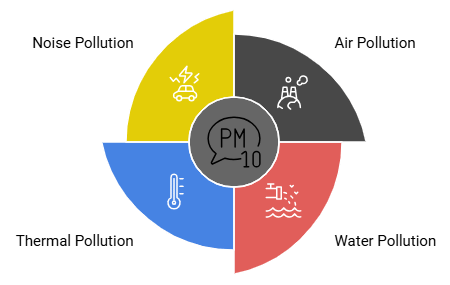
Industrial activity generates different kinds of pollution and can lead to long-term environmental degradation if not properly managed. The main types of industrial pollution are:
- Air pollution: Emission of gases such as sulphur dioxide and carbon monoxide, particulates and smoke from factories, refineries, smelting plants and the burning of fossil fuels. Air pollution harms human health, vegetation, animals, buildings and the atmosphere.
- Water pollution: Discharge of untreated or partially treated industrial effluents and wastes from paper, pulp, chemical, textile and dyeing units, petroleum refineries, tanneries and electroplating plants into rivers and lakes causes serious water pollution.
- Thermal pollution: Release of hot water from factories and thermal power plants into rivers and ponds raises water temperature and affects aquatic life.
- Noise pollution: High levels of industrial noise from machines, transport and plant operations cause irritation, stress, hearing impairment and adverse effects on human health and animal life.
- Land pollution: Improper disposal of solid industrial wastes, hazardous chemicals and slag can degrade soil quality and contaminate groundwater.
Measures to Control Environmental Degradation
Controlling industrial pollution requires a combination of technological, managerial and regulatory measures. Important measures include:
- Cleaner fuels and energy efficiency: Adopt cleaner fuels and energy-efficient processes; switch from coal to cleaner alternatives where feasible and reduce fuel consumption by improving process efficiency.
- Adoption of cleaner technology: Use modern machinery and pollution-control equipment (filters, scrubbers, electrostatic precipitators) to reduce emissions at source.
- Effluent treatment: All industrial effluents should be treated before disposal. Treatment typically involves three phases: Primary treatment - mechanical removal of solids; Secondary treatment - biological processes to remove dissolved organic matter; Tertiary treatment - chemical, physical or advanced biological processes to remove remaining nutrients and pollutants and to disinfect.
- Solid waste management: Collect wastes separately, dispose of inert wastes by sanitary landfilling and promote recycling and reuse of industrial by-products and packaging.
- Noise control: Use noise-damping equipment, proper enclosure of noisy machinery, periodic maintenance and enforcement of permissible noise levels in industrial areas.
- Regulation and enforcement: Implement and enforce pollution standards, require environmental impact assessments for new projects and monitor compliance through regular inspections and penalties for violations.
- Public awareness and corporate responsibility: Encourage industries to adopt corporate environmental responsibility, inform local communities about risks and mitigation measures, and involve stakeholders in environmental planning.

Conclusion
Manufacturing industries are essential for economic development, employment and trade. At the same time, industrial growth must be balanced with environmental protection. Sustainable industrialisation - through cleaner production techniques, efficient use of resources, proper waste treatment and strict regulation - ensures that industries continue to support prosperity without degrading the environment.
FAQs on Key Concepts: Manufacturing Industries
| 1. What are the key differences between agro-based and mineral-based industries? |  |
| 2. How does industrial pollution impact the environment? | |
| 3. What measures can be taken to control environmental degradation caused by industries? | |
| 4. Why is manufacturing important for economic development? | |
| 5. What are the main causes of environmental degradation in industrial sectors? | |





