Key Concepts: Political Parties


Overview
- Political parties are the principal vehicles for the distribution and exercise of political power in a federal democracy and act as mediators of social divisions within democratic politics.
- This chapter introduces the nature, role, types and organisation of national and regional political parties in India, their functions, and the challenges they face.
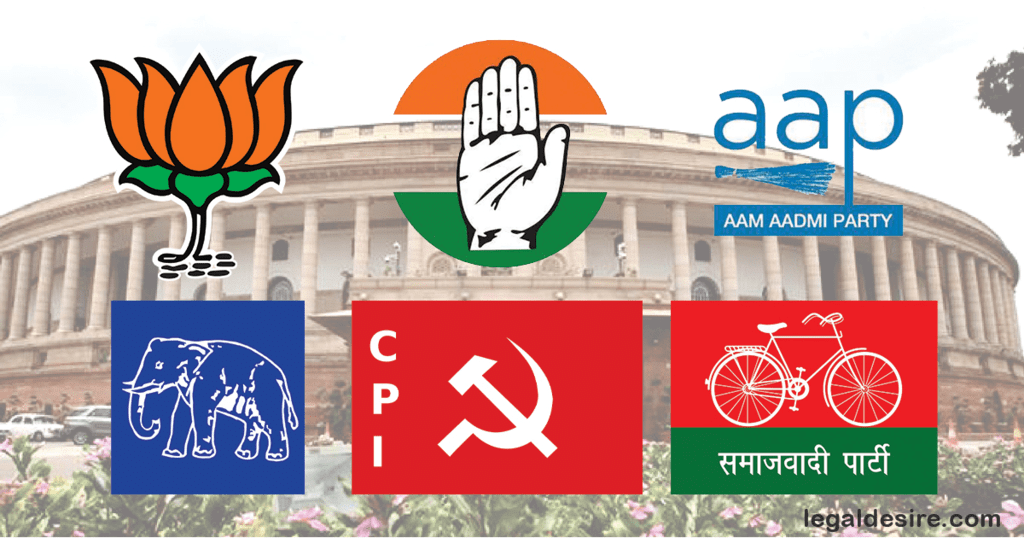 Symbols of Different Political Parties in India
Why do we need political parties?
Political parties perform many essential functions in a modern representative democracy. Without organised parties, elections and governance become fragmented and responsible government becomes difficult to achieve. The following points explain the practical problems that may arise in the absence of parties:
- Every candidate would be independent. There would be no organised set of commitments or clear policy programmes that voters could rely on.
- A government might be formed, but its long-term policy programme and collective responsibility would remain uncertain. Individual representatives would be accountable mainly for local work rather than national governance.
- Even where elections are officially non-party (for example to some Panchayats), local competition often takes the form of rival panels or groups. This shows the practical need for parties to structure political choice and co-ordinate governance.
Meaning of a Political Party
- Political party is a group of people who come together to contest elections and, if successful, to hold and exercise power in government.
- Parties agree on certain policies and programmes aimed at promoting some version of the collective good.
- Parties reflect political divisions in society. Thus,a party is identified by the policies it supports and the social interests it claims to represent.
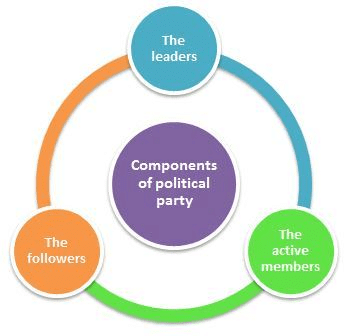
Components of a Political Party
- Leaders - those who occupy public office and make key decisions for the party.
- Active members - those who work within the party organisation, mobilise support, and run campaigns.
- Followers - ordinary voters who support the party and vote for it but are not organisationally active.
Functions of Political Parties
Political parties perform several inter-related functions that make representative democracy workable.
- Contest elections: Parties select and nominate candidates, organise campaigns and present voters with electoral choices.
- Offer policies and programmes: Parties put forward different policies and programmes and the voters choose from them.
- Form and run governments: Parties or coalitions that win legislative majorities form governments and implement policies.
- Legislative role: Parties shape law-making by proposing, debating and voting on laws in an organised manner.
- Opposition and accountability: Parties that lose elections act as opposition - they critique the government, offer alternatives and hold it accountable.
- Representation: Parties aggregate diverse social and economic interests and represent them in the political system.
- Political socialisation and leadership recruitment: Parties recruit leaders and train activists, helping people learn political skills and responsibilities.
- Shaping public opinion: Parties influence public debate, highlight issues and mobilise public support for policies.
- Access to government: Parties provide channels through which citizens can access government programmes and welfare schemes.
Necessity of Political Parties
- Political parties are essential because they carry out the functions listed above that are necessary for representative government to work.
- They bring together representatives to create cohesive governments capable of making and implementing collective decisions.
- They represent differing views to the government and act as mechanisms to support or restrain government power.
- In short, parties fulfil the organisational, representative and governing needs of any elected government.
How many parties should we have?
- In a democracy, any group of citizens is free to form a political party. In India, more than 750 parties are registered with the Election Commission of India, though not all are serious competitors.
- The question for democracies is how many major or effective parties are desirable - this depends on history, electoral systems and social cleavages.
- Some countries allow only one party to govern; others have two dominant parties; many democracies have multiple parties sharing power.
Popular Participation in Political Parties
- Level of active participation in party activities is relatively high in India compared with many advanced democracies (for example Canada, Japan, Spain and South Korea, where membership levels are lower).
- Many people in India feel close to a particular party and party membership has grown over time.
- Different countries exhibit different party systems depending on history, institutions and social divisions.
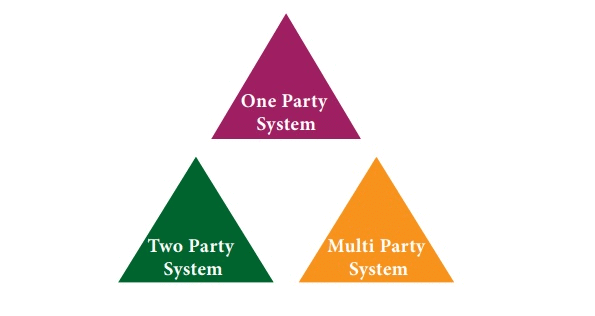
Party System
There are three broad types of party systems:
- One-party system
- Two-party system
- Multi-party system
One-Party System
- There is effectively no meaningful competition; a single party dominates political life.
- The lone party nominates the candidates and the voters have only two choices -
(i) Not to vote at all or
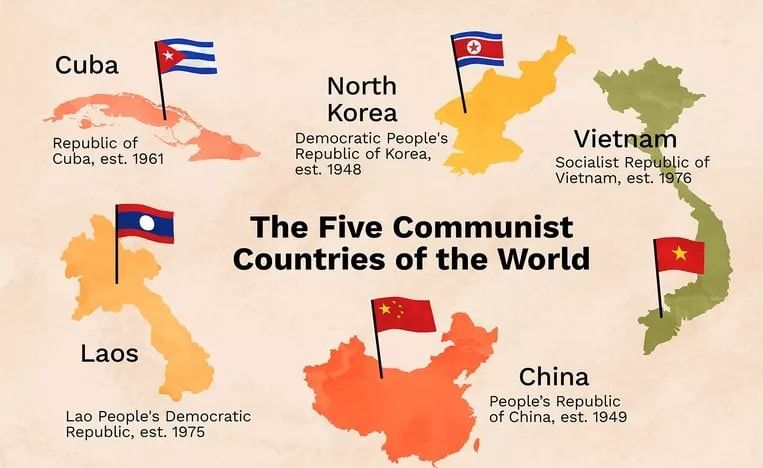
(ii) write 'yes' or 'no' against the name of the candidates nominated by the party. - This system exists in some authoritarian states or single-party communist systems - for example, historically in the Soviet Union, and presently in countries such as China, North Korea and Cuba.
Two-Party System
- Two major parties alternate in power; smaller parties have limited influence and often merge with or support one of the two main parties.
- Winning requires obtaining the largest number of votes (often a plurality rather than an absolute majority).
- Examples include the United Kingdom and Canada where two parties dominate parliamentary seats.
- Supporters argue it reduces fragmentation and helps create stable governments; critics say it limits representation of diverse views.
Multi-Party System
- It is the most common type of party system.
- In this system, three or more parties have the capacity to gain control of the government separately or in the coalition.
- When no single party has a legislative majority, parties form coalition governments by joining together.
- Supporters say multi-party systems allow wider representation of social groups and viewpoints; critics point to risks of political instability and short-lived coalitions.
Alliance
When several parties in a multi-party system join hands for contesting elections or forming a government, that grouping is called an alliance or a front. Alliances combine resources and vote-bases to improve electoral prospects and can be pre- or post-electoral.
India had prominent alliances in general elections, for example:
- National Democratic Alliance (NDA)
- United Progressive Alliance (UPA)
- Left Front
National Parties
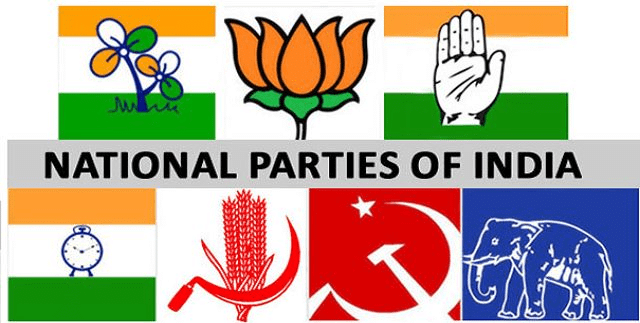
Criteria for recognition as a national party include the following (examples based on rules as stated up to 2014):
- The party wins 2 per cent of the seats in the Lok Sabha (as of 2014, 11 seats) from at least three different States; or
- At a General Election to the Lok Sabha or a Legislative Assembly, the party polls 6% of votes in four States and in addition wins 4 Lok Sabha seats from any State or States; or
- A party is recognised as a State Party in four or more States.
Difference between a National Party and a Regional (State) Party
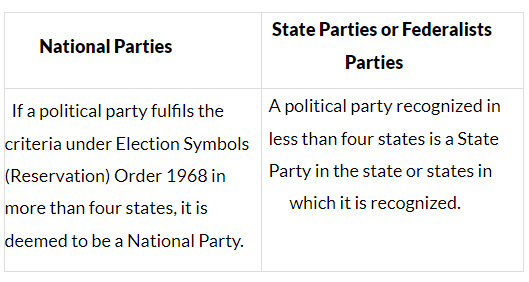
- A national party has influence across many states or throughout the country; a regional or state party has its main influence confined to one state or a few regions.
- National parties tend to address national interests and have to balance conflicting regional demands; regional parties mainly promote regional or state interests (for example, DMK or AIADMK in Tamil Nadu).
- Regional parties often demand greater autonomy for states; national parties must harmonise diverse regional interests in national policymaking.
- Election symbols reserved for a national party are valid throughout India; a regional party's symbol may be reserved only in the state(s) where it is recognised.
Election Commission
All political parties in India must register with the Election Commission of India. The Commission treats parties equally at the point of registration but grants special facilities - such as a reserved symbol and recognised status - to larger and well-established parties that meet recognition criteria.
 Logo of Election Commission of India
Introduction to Major Political Parties in India
Indian National Congress (INC)
 Symbol of INC
- Founded in 1885, the INC led the Indian national movement for independence and became the dominant political party after independence.
- In the first five general elections, Congress had a dominant position in Indian politics; it lost power in 1977 after the Emergency but returned to power in 1980 under Indira Gandhi and reached a peak in 1984.
- From the 1990s the party's dominance declined and other parties (including the BJP) rose; in May 2004 Congress returned to power leading the United Progressive Alliance (UPA).
- In its manifestoes the party has projected a vision of political unity, economic development, social justice and cultural harmony.
Bharatiya Janata Party (BJP)
 Symbol of Bharatiya Janata Party (BJP)
- Formed in 1980, the BJP promotes conservative social policies, a strong national defence and policies oriented to the political aspirations of the Hindu majority; it has been a principal rival of the INC.
- The BJP has allied with regional parties to build broader coalitions against Congress. Its political ideology is often described with the term Hindutva.
- Some of its policy positions include full territorial integration of Jammu and Kashmir with India and promotion of a uniform civil code.
- The BJP led a coalition government at the Centre between 1998 and 2004 and has been a leading force within the National Democratic Alliance (NDA).
Bahujan Samaj Party (BSP)
 Symbol of BSP
- The BSP was formed to represent the Bahujan - the socially marginalised groups including OBCs, Scheduled Castes, Scheduled Tribes and religious minorities.
- It was formed in 1984 by Kanshi Ram and was later led by Mayawati.
- The party's main base is in Uttar Pradesh; it also has presence in Madhya Pradesh, Chhattisgarh, Uttarakhand, Delhi and Punjab.
- The BSP draws inspiration from social reformers such as Sahu Maharaj, Mahatma Phule, Periyar Ramaswami Naicker and from Dr B.R. Ambedkar.
Communist Party of India (Marxist) - CPI(M)
 Symbol of CPI and CPI-M
 - CPI(M) split from the Communist Party of India in 1964 and follows Marxist-Leninist politics, supporting socialism, secularism and democracy while opposing imperialism and communalism.
- It has been strong historically in Kerala, West Bengal and Tripura; in West Bengal it held power for long periods.
- Its supporters include farmers, agricultural labourers and organised workers.
Communist Party of India (CPI)
- CPI was formed in 1925 and follows Marxist-Leninist principles, secularism and democratic politics.
- It supports parliamentary democracy as a means of furthering the interests of farmers and the working class.
- The split of 1964 that produced CPI(M) weakened CPI's position in some states; it retains presence in Kerala, Punjab, Andhra Pradesh, Tamil Nadu and elsewhere.
- CPI works to build unity among left parties and has often participated in United Left Fronts.
Nationalist Congress Party (NCP)
 Symbol of NCP
- The NCP was formed on 25 May 1999 by Sharad Pawar, P.A. Sangma and Tariq Anwar after differences with the Congress leadership over the question of leadership by a person of foreign origin.
- It has significant support in Maharashtra and claims to support democracy, Gandhian secularism, equity, social justice and federalism.
State Parties
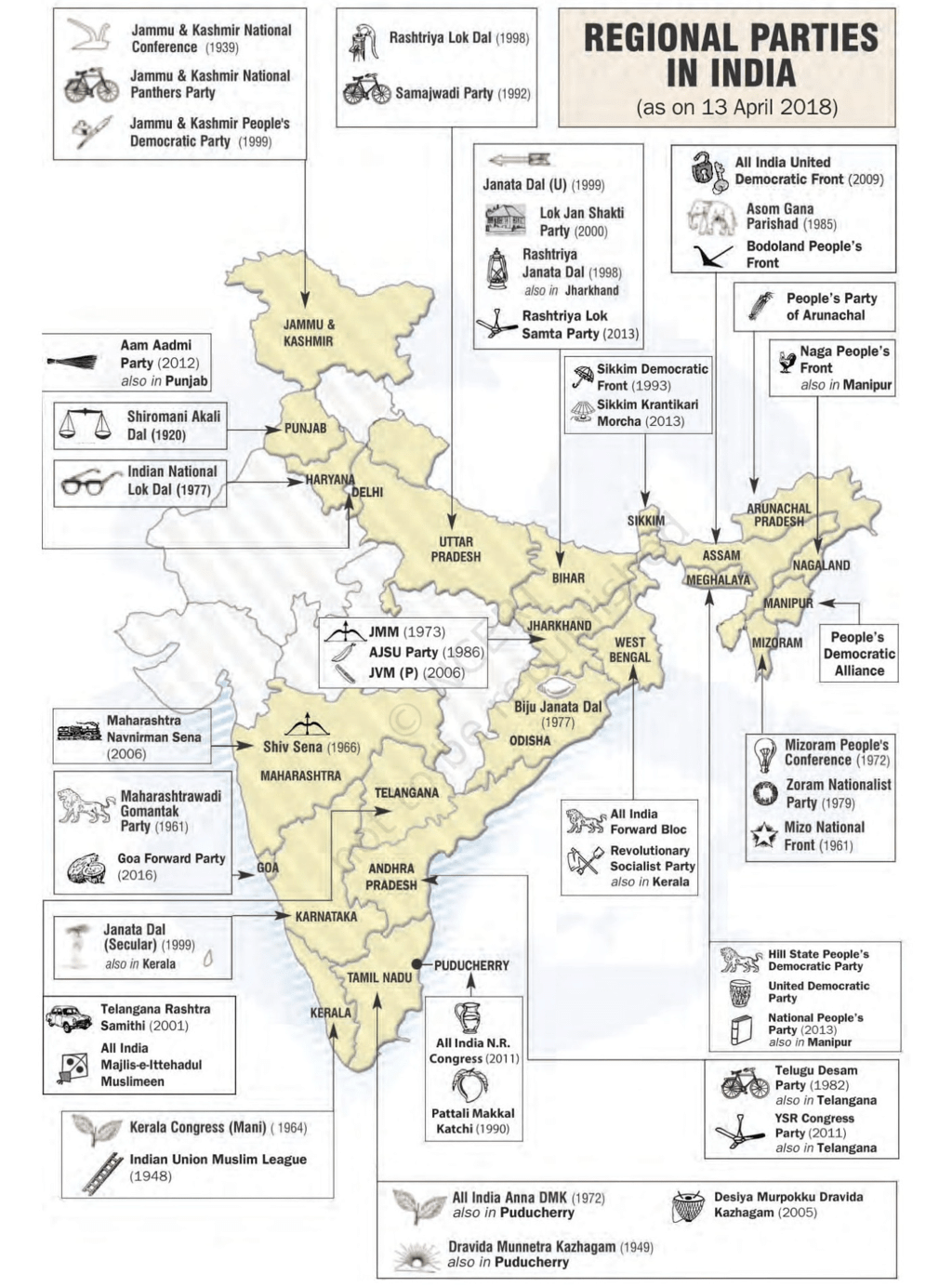
- Parties other than the recognised national parties are classified by the Election Commission as state parties (or regional parties). Many such parties have influence mainly within one state or a few states.
- Some parties have nationwide organisations but are electorally successful only in selected states (for example, Samajwadi Party, Rashtriya Janata Dal).
- Other parties have a clear state identity (for example, Biju Janata Dal, Sikkim Democratic Front, Mizo National Front).
- Since the 1960s and especially in recent decades, no single national party has usually secured an outright majority in the Lok Sabha without the support of regional parties; this has led to coalition governments and has strengthened federal accommodation and democratic pluralism.
Challenges to Political Parties
Political parties in India face several internal and external challenges that affect their functioning and the quality of democracy.
1. Lack of internal democracy
- Power is often concentrated in the hands of a few leaders.
- Many parties do not hold regular organisational meetings or maintain up-to-date membership registers.
- Internal elections are often absent or irregular, limiting the ability of ordinary members to influence party policy and leadership choices.
- Dissent within the party is frequently punished by removal or marginalisation.
2. Dynastic succession
- Leadership positions are sometimes passed within families, giving family members an unfair advantage.
- Top positions controlled by family networks undermine merit and are widely regarded as harmful for democratic renewal.
- This tendency is observed in many countries, not only in young democracies.
3. Money and muscle power
- Electoral competition can be heavily influenced by money and coercion.
- Candidates who can raise large sums are more likely to be nominated and to win.
- Wealthy donors and corporate interests that fund parties may influence party policies and public decisions.
4. Poor ideological differentiation and limited choice
- At times parties do not offer clear ideological alternatives; they may differ only on the details of implementation rather than on fundamental principles.
- Example: In Britain, critics have sometimes argued that the Labour Party and the Conservative Party differ more in emphasis than in central economic priorities at certain historical moments.
- In India, many parties have converged on similar positions on economic reforms and governance, reducing distinct policy choice for voters.
How can parties be reformed?
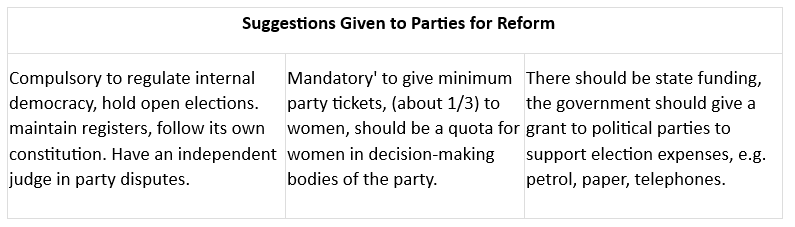
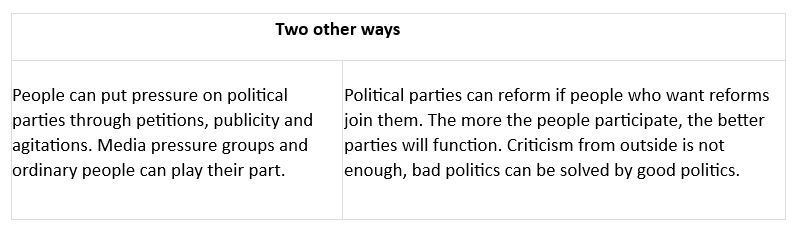
Several legal and institutional efforts have been made to reform party behaviour and improve democratic accountability.
- Anti-defection measures: The Constitution was amended to discourage defections; elected MPs and MLAs can lose their seats for defection under the anti-defection provisions (the Tenth Schedule inserted by a constitutional amendment). This reduces opportunistic switching of parties by legislators.
- Transparency and criminalisation: The Supreme Court and the Election Commission have taken steps to reduce criminalisation in politics. Candidates are required to file affidavits declaring their assets and pending criminal cases, making this information public for voters to judge.
- Election Commission and party regulation: The Election Commission has asked registered parties to maintain internal democracy, hold organisational elections and file details (including income tax returns and audited accounts). The Commission can grant recognised status and symbols to parties that meet norms and can take action on violations of electoral law.
Try yourself: What is the term used to classify parties that are successful only in some states in India?
FAQs on Key Concepts: Political Parties
| 1. Why do we need political parties? |  |
| 2. How many parties should we have? | |
| 3. What is the role of the Election Commission in India? | |
| 4. What are the challenges facing political parties in India? | |
| 5. What is the difference between national parties and state parties in India? | |





