Idioms and Phrases - Rules and Examples

What is an Idiom?
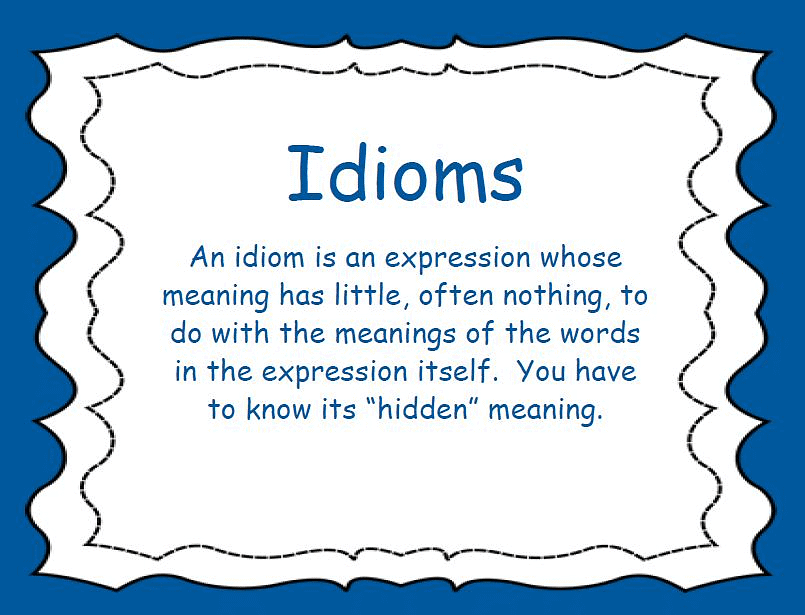
- Idioms are phrases or expressions that have a special meaning beyond their literal words.
- They're commonly used in language and add excitement and creativity to writing and speech.
- Idioms make communication more interesting and can be found in stories, poems, and everyday conversations.
- While we might not always know where idioms come from, they're thought to have originated from storytelling and creative writing, evolving over time.
Examples of idioms with their literal meaning and idiomatic meaning:
1. Break a LegExample: Before Peter went on the stage for the show, John told him to break a leg.
Literal meaning: I am telling you to break a bone in your leg and then you will probably have to go to the hospital afterward to get a cast put on your leg.
Idiomatic meaning: Do your best and good luck. A lot of actors and actresses tell each other to "break a leg" as they are about to go on stage to perform it is deemed to be good luck.
2. Bored to death
Meaning/Usage: Very bored
Explanation: Death is the worst thing, so using it to compare how you feel is telling someone that you are very bored.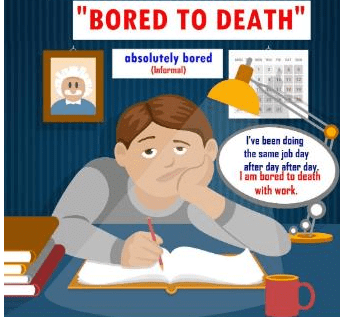
Example:
"I have nothing to do. I'm bored to death."
"I hate it when I'm bored to death."
"Would you rather be super busy or bored to death?"
Try yourself: What is the meaning of the following idiom? To keeps one's temper
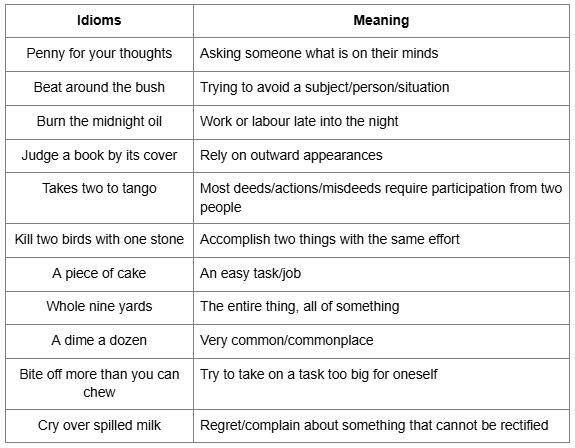
List of Idioms
What are Phrases?
- A phrase is a small group of words that function as a unit within a sentence or clause.
- Unlike idioms, phrases are straightforward and literal, meaning that the words convey their actual meaning without any figurative interpretation.
- Phrases lack a subject and a verb, so they don't form complete sentences on their own; rather, they are components of larger sentences.
- There are eight main types of phrases: noun, verb, infinitive, gerund, appositive, participial, prepositional, and absolute phrases.
Examples of phrases include:
- Deep down - deeper feelings
- Group of men and women - group of men and group of women
- Challenge of imagination - challenging to be imaginative
- Latin and Greek - some strange meaning
- The phone was on the table.
- The children were giggling and laughing when the teacher left the room.
- The nice neighbor offered him a glass of water.
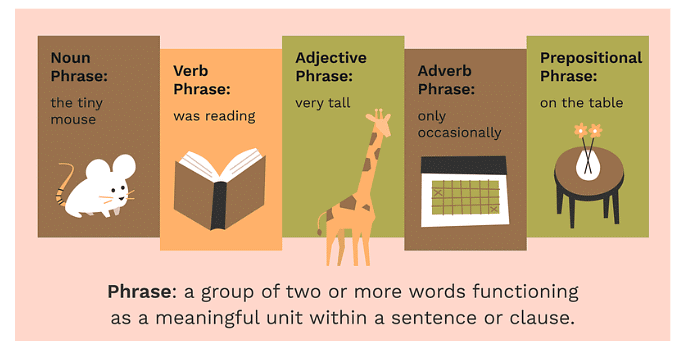
There are different types of Phrases in the English language.
1. Noun Phrase: A group of words that consists of nouns and any modifiers.
2. Verb Phrase: A group of words that consists of nouns and modifiers.
3. Prepositional Phrase: A group of words that begins with a preposition and helps to explain the relationship between two things.
Rules for Idioms and Phrases
- Idioms and Phrases are literal terms that induce a meaning that may be otherwise hidden behind the actual words.
- They have a cultural value attached to themselves.
- They are metaphorical in the sense that if you extract the literal meaning of all the words stated, then it would be too unusual to believe or even farcical.
- Idioms and phrases have the capacity to add flavor to boring prose or books and are used by authors to add something interesting or remove monotones from their writing.
- While reading and answering Idioms and Phrases, we can say that there is a slight difference in the two.
Differences Between Idioms and Phrases
The main difference between idioms and phrases lies in understanding their meanings:
- Idioms make sense on their own, whereas phrases make sense when incorporated into a sentence.
- Idioms are commonly used as slang or part of spoken language, while phrases are used in regular sentences.
- For idioms, we interpret their symbolic meaning, while for phrases, we take their literal meaning.
- An idiom can be a single word, but phrases are generally not single words.
- An idiom can be a phrase; if a phrase has a metaphorical meaning, it is considered an idiom.
List of Some Common Idioms and Phrases
1. Piece of cake: This means something very easy for you - as easy as eating a piece of cake.
Example: I thought I was going to fail the test, but it turned out to be a piece of cake!
2. Dressed to kill: This basically means you look great, or you're wearing clothes that are intended to make people notice you. It could also mean overdressing.
Example: A person doesn't go on vacation dressed to kill.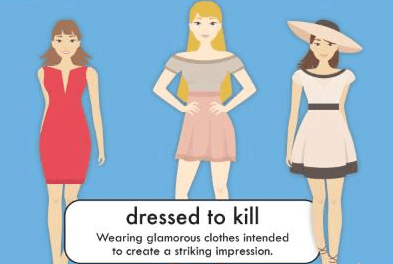
3. On the wane: This means something that is reducing or decreasing.
Example: The popularity of AAP in Delhi is on the wane.
4. Hitting below the belt: If you remember the stories from mythology, one of the rules of sword fights was that you were not supposed to strike the opponent below the waist level. If you hit someone below the waist level, it was considered unfair.
This is what hitting below the belt means - If a remark is below the belt, it is very insulting and unfair.
Example: You told them I was the one who ordered the wrong-size carpet. That's hitting me below the belt.
5. Gift of the gab: A gift is something good to receive. If you have the gift of the gab, it means the ability to speak easily and confidently in a way that makes people want to listen to you and believe you.
Example: She's got the gift of the gab - she should work in sales.
Try yourself: What is the meaning of the following idiom? To have an axe to grind
6. Face the music: When someone is criticising you, it is not exactly music to the ears, right? If you do something wrong, you may have to accept the unpleasant results of your actions, or in other words, face the music.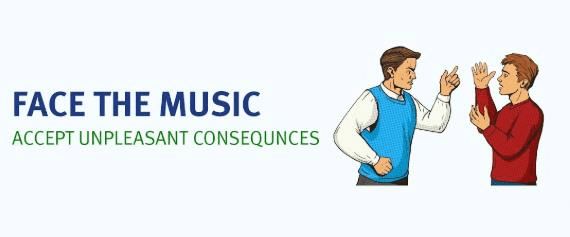 Example: After being caught on camera taking a bribe, the minister had to face the music. The party has expelled him and an enquiry has been commissioned.
7. At loggerheads: It means to strongly disagree with someone. If two people or groups are at loggerheads, they disagree strongly about something.
Example: They're constantly at loggerheads with the farmers' union.
8. Make hay while the sun shines: Hay is dried grass. To dry grass, you keep it under the sun. Would you keep the grass for drying in the afternoon or at night? You do it in the afternoon because you want to make the best use of the sunlight when it is the hottest and use it to dry your grass. In other words, If you have an opportunity to do something, do it before the opportunity expires.
Example: While my husband's out of town, I'm going to watch all the movies he wouldn't take me to see; after all, you have to make hay while the sun shines.
9. Throw in the towel: In boxing, to signal that a fighter can no longer continue fighting, a towel is thrown into the area where the fight takes place to stop the fight. So if someone wants to signal that they're going to quit, you could say they are going to throw in the towel.
Example: The union was forced to throw in the towel and settle their bitter dispute with the company.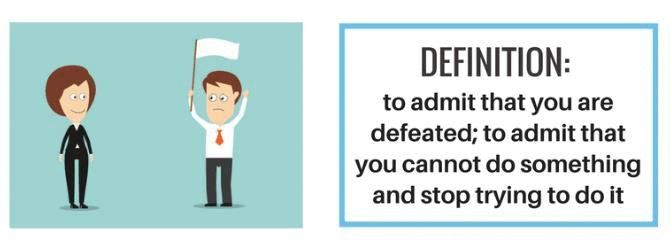
10. Burn your fingers: It means they suffer the unpleasant results of an action.
Example: Many investors burned their fingers on those stocks.
11. Throw out the baby with the bathwater: If you discard something valuable along with something not wanted, you throw out the baby with the bathwater.
Example: You can't close the airport because one airline has problems - that's just throwing out the baby with the bathwater.
12. Bolt from the blue: Lightning always catches you by surprise, especially if it happens when the sky is cloudless. Similarly, a sudden, shocking surprise or turn of events can be referred to as a bolt from the blue.
Example: The news that 500 and 1000 rupee notes were not legal tenders starting 8th November struck Indians as a bolt from the blue.
13. Spill the beans: This idiom is used when you want to convey that someone or something lets secret information become known.
Example: You and your parents were planning a surprise birthday party for your sister, but your cousin spilt the beans to your sister.
14. Weather the storm: When you are faced with a difficult situation and survive, it is like you survived a storm. Or in other words, something continues to exist and not be harmed during a difficult period and stays right despite experiencing serious problems or great difficulties. Thus it weathers the storm.
Example: If she can just weather the storm of that contract violation, she'll be fine.
15. Bite your lip: If you forcibly prevent yourself from exhibiting an outward reaction to something, especially that which makes one angry, irritated, or upset, you could say you bit your lip.
Example: I just had to bite my lip while the boss yelled at me for losing the account.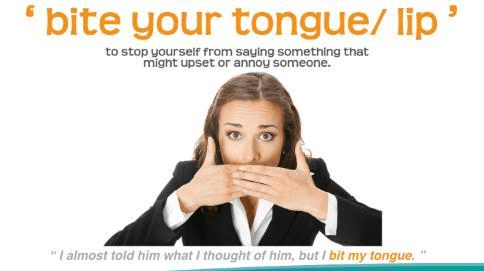 16. To talk one's head off: To talk excessively
Example: I would like to visit my grandfather more often, but he talks his head off every time I visit him.
17. To snap one's fingers: To become contemptuous of
Example: He was snapping his fingers in time with the music.
18. To save one's face: To evade disgrace
Example: His mother was more interested in saving face than accepting the truth about her mischievous son.
Try yourself: What does the idiom "Break a Leg" mean ?
19. To spill the beans: To reveal secret information
Example: My brother spilt the beans about the surprise party planned for our parents by telling them during a conversation last night.
20. Beat around the bush: This means avoiding talking about what is important.
Example: Stop beating around the bush and tell me what's going on.
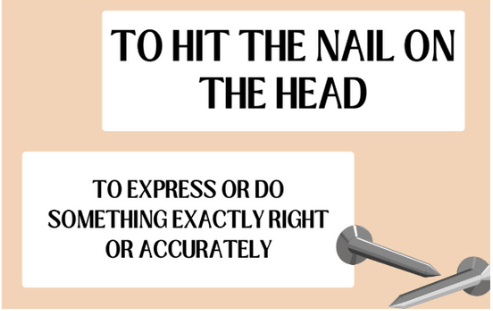
21. Hit the nail on the head: To say or do something exactly right.
Example: When she said the project was a waste of time, she hit the nail on the head.
22. Bite off more than you can chew: To take on a task that is too big.
Example: He bit off more than he could chew when he agreed to take on that extra work.
23. Pull someone's leg: To joke or tease someone.
Example: I was just pulling your leg when I said I had lost your phone.
24. Under the weather: To feel ill or unwell.
Example: I'm feeling a bit under the weather, so I think I'll stay home today.
25. Burn the midnight oil: To work late into the night.
Example: She's been burning the midnight oil to finish her thesis.
26. Cry over spilt milk: To waste time worrying about something that has already happened.
Example: There's no use crying over spilt milk; we need to find a solution.
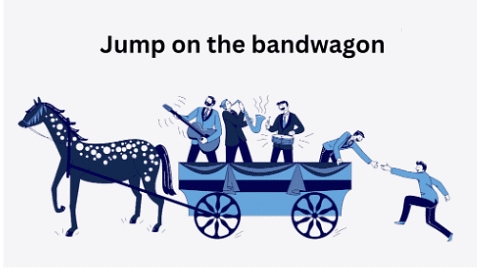
27. Jump on the bandwagon: To join others in doing something that is currently popular.
Example: Everyone is jumping on the bandwagon of electric cars these days.
28. Let the cat out of the bag: To reveal a secret or surprise by accident.
Example: I accidentally let the cat out of the bag about the surprise party.
29. Kill two birds with one stone: To achieve two things with one action.
Example: By visiting my parents, I killed two birds with one stone, as I also managed to see my old friends.
30. Cut corners: To do something in the easiest or cheapest way, often sacrificing quality.
Example: The company cut corners to save money, but the product suffered as a result.
31. To buck the trend: To behave differently from what is currently popular or common.
Example: Although the share market is not doing well, a few companies are bucking the trend and delivering good returns.
32. Toying with something: Thinking about an idea casually, without serious commitment.
Example: We are toying with the idea of starting our own business.
33. Rise up against: To rebel or protest against authority.
Example: Citizens rose up against the corrupt regime.
34. Gave birth to: To cause something to begin or come into existence.
Example: His small startup eventually gave birth to a global company.
35. Unleash the army of: To trigger a large-scale attack, backlash, or aggressive response.
Example: The controversial tweet unleashed an army of online trolls.
36. Bear that out: To prove that something is true.
Example: The data bear out the claim that online learning improves access to education.
37. Stay in business: To remain operational or profitable.
Example: Companies must innovate to stay in business.
38. Public square: A place (physical or digital) where people freely exchange ideas.
Example: Social media has become the new public square for debate.
39. Put something down: To write something or to stop something firmly.
Example: The manager put down the rumours with an official statement.
40. The lion's share: The largest portion of something.
Example: She received the lion's share of the credit.
41. In the palm of one's hand: To have complete control or influence over someone.
Example: The leader has the entire party in the palm of his hand.
42. Look up to someone: To admire or respect someone.
Example: Young athletes look up to successful players.
43. Stumble over / stumble across: To discover something by accident.
Example: Researchers stumbled across new evidence during the experiment.
FAQs on Idioms and Phrases - Rules and Examples
| 1. What's the difference between idioms and phrases in English grammar? |  |
| 2. How do I identify and use common idioms correctly for competitive exams? | |
| 3. What are the main rules for using phrasal verbs and idiomatic expressions in sentences? | |
| 4. Why do idioms and phrases cause confusion in reading comprehension sections? | |
| 5. Can I find example-based practice and rules for idioms in one study resource? | |