Chapter Notes: Confronting Marginalisation

In this chapter, we will explore how various groups and individuals challenge existing inequalities in society. Adivasis, Dalits, Muslims, women, and other marginalized communities assert that as citizens of a democratic country, they have equal rights that must be upheld. Many of these groups turn to the Constitution of India to seek justice and address their concerns. 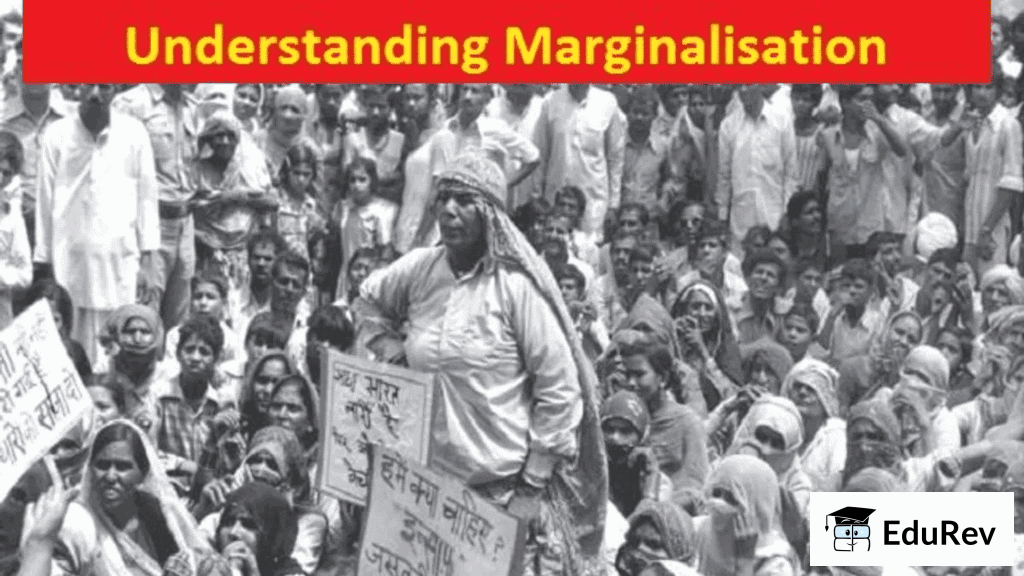
We will examine why the Constitution plays a crucial role in the struggles of marginalized groups. Additionally, we will discuss how rights are transformed into laws that protect these groups from ongoing exploitation, and how the government creates policies to enhance their access to development opportunities.
Invoking Fundamental Rights
Fundamental rights are available to all Indians equally. As far as the marginalised are concerned, they have drawn on these rights in two ways
- They assert their Fundamental Rights, pushing the government to recognize injustices.
- They demand the enforcement of these laws, sometimes influencing the creation of new laws aligned with Fundamental Rights.
The problems faced by people who have fewer opportunities have made the government create new rules that match the main ideas of Fundamental Rights.
Important articles
Article 17 of the Constitution state that in a democratic government, untouchability is banned, giving Dalits the right to go to school, visit temples, and use public places. The Constitution also punishes anyone who practices untouchability.
Article 15 prohibits discrimination based on religion, race, caste, sex, or place of birth, empowering Dalits to seek equality where denied.
- Dalits and other small groups use their basic rights when they are treated badly by people, groups, or the government
- They ask the Indian government to follow the rules in the Constitution to be fair.
- Minority groups also use their rights for religion and culture.
- Different cultural and religious groups like Muslims and Parsis can protect and decide how to keep their traditions.
- The Constitution makes sure everyone has cultural rights, stopping the majority from controlling or wiping out the cultures of smaller groups.
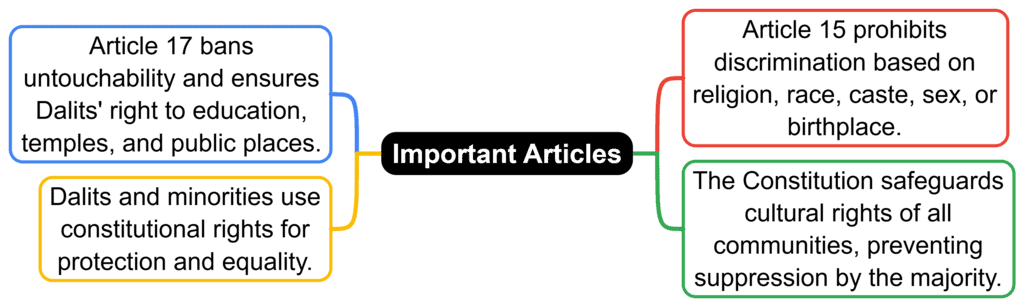
Hence, Dalits can use a Fundamental Right when they believe they've been treated unfairly by someone, a group, or even the government. They've asked the Indian government to follow the Constitution and treat them fairly.
Laws for the Marginalised
The government makes laws for everyone and also for groups that need extra help. Sometimes, these rules come from things like making a group or asking people questions. Then, the government tries to make these rules known to help these groups. The government works hard to support these policies to give chances to certain groups.
Promoting Social Justice
- Governments make special plans in areas with many tribal or Dalit people, following the rules in the Constitution.
- For example, they give free or cheaper hostels to Dalit and Adivasi students so they can go to schools that aren't in their areas.
- Also, the government makes laws like the reservation policy, saving places in schools and government jobs for these groups. This helps fix unfairness from the past.
Reservation Policy
- Governments keep lists of Scheduled Castes, Scheduled Tribes, and backward/most backward castes. People need proof of their caste or tribe for school and government job applications.
- People from these listed castes or tribes can get help from reservation policies.
- For college admissions, especially in professional institutes, they use 'cut-off' marks. This helps Dalit and tribal candidates who are eligible to qualify. Governments also give scholarships to these students.
 Reservation Policy
Protecting the Rights of Dalits and Adivasis
In Jakmalgur, Rathnam's refusal to perform a discriminatory ritual upset both the powerful castes in his village and some within his own community. Despite threats and even having his home set on fire, Rathnam stood firm and reported the injustice to the police under the Scheduled Castes and the Scheduled Tribes (Prevention of Atrocities) Act, 1989. His bravery caught the attention of the media, and the ritual was canceled. However, his family was still shunned by the village, forcing them to leave. This story shows the courage it takes to stand up against unfair traditions and fight for equal rights.

The Scheduled Castes and the Scheduled Tribes (Prevention of Atrocities) Act, 1989
- Rathnam used this law to fight against the power and violence of strong groups in his village.
- Started in 1989 because Dalit and tribal people wanted it, the law deals with ongoing bad treatment, especially the violent events in the late 1970s and 1980s.
- Dalit groups asked for strong laws that show violence against them, because they wanted fair treatment after taking strong actions.
- Adivasi people also asked for rights and land back. They faced violence from strong groups while they were organizing.
- The law lists many terrible crimes to deal with the very bad things done to Dalits and Adivasis. It tries to change how society thinks and acts about these issues.
Levels of Crimes
Humiliation and Dehumanization - Punishes acts such as forcing Dalits or Adivasis to consume inedible substances, stripping them, parading them naked, or committing other degrading acts.
Dispossession and Exploitation - Penalizes wrongful occupation of land owned by Dalits and Adivasis or forcing them into slave labor.
Gender-Specific Crimes - Recognizes and punishes assaults on Dalit and tribal women intended to dishonor them.
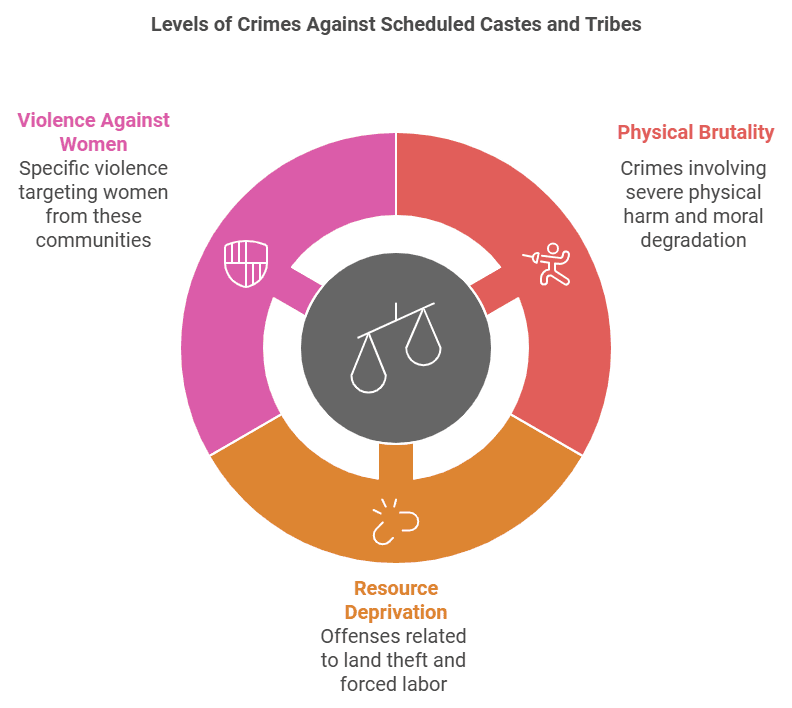
Adivasi Demands and the 1989 Act
- The 1989 law is important for Adivasi activists. They use it to protect their right to take back their old lands.
- Adivasis don't want to be moved from their homes and ask for punishment for people who take their lands using this law.
- They say the law is like the Constitution and helps stop non-tribal people from buying or selling tribal lands.
- C.K. Janu, an Adivasi activist, says the government lets non-tribal people use tribal lands, and she wants payment and help for Adivasis who had to move.
- She asks why governments don't spend money to help Adivasis who moved, when they spend lots on projects in tribal lands.
Conclusion
- Just having rights, laws, or rules written down doesn't mean they're followed in real life. We need to work on making them the guiding principles for how people, even leaders, act.
- People have always tried to achieve equality, dignity, and respect. This has happened in different ways throughout history, as we see in this chapter.
- Even in a democratic society, there's always a need for ongoing efforts like fighting, speaking up, discussing, and organizing to make things fair.
FAQs on Chapter Notes: Confronting Marginalisation
| 1. What does marginalisation mean and how does it affect different groups in society? |  |
| 2. How do scheduled castes and scheduled tribes experience marginalisation in India? | |
| 3. What role do gender discrimination and patriarchal practices play in marginalising women? | |
| 4. Why do religious minorities sometimes face marginalisation and social exclusion? | |
| 5. What practical steps can individuals and communities take to confront and reduce marginalisation? | |