SSC CGL Exam  >  SSC CGL Notes  >   Tier 2 - Study Material, Online Tests, Previous Year  >  NCERT Solution (Part - 1) - Financial Statements-I

NCERT Solution (Part - 1) - Financial Statements-I

Page Number: 376


Numerical questions

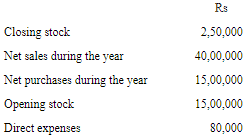
Question.1: From the following balances taken from the books of Simmi and Vimmi Ltd. for the year ending March 31, 2003, calculate the gross profit.
 

Numerical questions

Answer :

Numerical questions

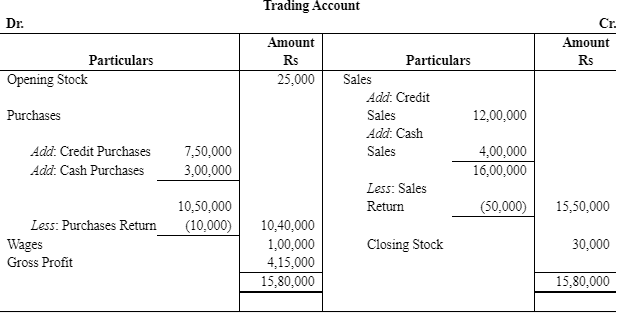
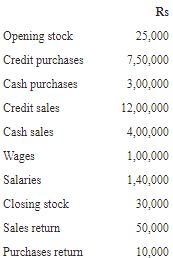
Question.2: From the following balances extracted from the books of M/s Ahuja and Nanda. Calculate the amount of:
(a) Cost of goods available for sale
(b) Cost of goods sold during the year
(c) Gross Profit
Numerical questions
 

Answer :
(a) Cost of Goods Available for Sale
Cost of Goods Available for Sale (or Cost of Goods Manufactured) = Opening Stock + Net Purchases + Wages
= Rs 25,000 + Rs 10,40,000 + Rs 1,00,000
= Rs 11,65,000
(b) Cost of Goods Sold during the year
Cost of Goods Sold = Opening Stock + Net Purchases + Wages - Closing Stock
= Rs 25,000 + Rs 10,40,000 + Rs 1,00,000 - Rs 30,000
= Rs 11,35,000
Or, using the relationship between sales and gross profit:
Cost of Goods Sold = Net Sales - Gross Profit
= Rs 15,50,000 - Rs 4,15,000
= Rs 11,35,000
(c) Gross Profit

Numerical questions

Gross Profit = Rs 4,15,000

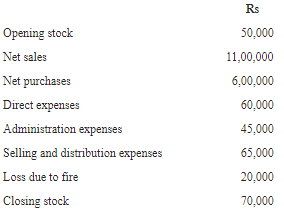
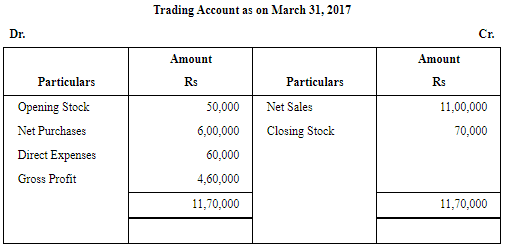
Question.3: Calculate the amount of gross profit and operating profit on the basis of the following balances extracted from the books of M/s Rajiv and Sons for the year ended March 31, 2005.
Numerical questions

Answer :

Numerical questions

Gross profit is shown in the trading account above.
Operating Profit = Sales - (Opening Stock + Net Purchases + Direct Expenses + Administration Expenses + Selling and Distribution Expenses) + Closing Stock
= Rs 11,00,000 - (Rs 50,000 + Rs 6,00,000 + Rs 60,000 + Rs 45,000 + Rs 65,000) + Rs 70,000
= Rs 11,00,000 - Rs 8,20,000 + Rs 70,000
= Rs 3,50,000
Question 4:  Operating profit earned by M/s Arora and Sachdeva in 2005-06 was Rs 17,00,000. Its nonoperating incomes were Rs 1,50,000 and non-operating expenses were Rs 3,75,000.  Calculate the amount of net profit earned by the firm.

Answer : 
Net Profit = Operating Profit + Non-operating Income - Non-operating Expenses
= Rs 17,00,000 + Rs 1,50,000 - Rs 3,75,000
= Rs 14,75,000
Net profit earned by M/s Arora and Sachdeva in 2005-06 is Rs 14,75,000.

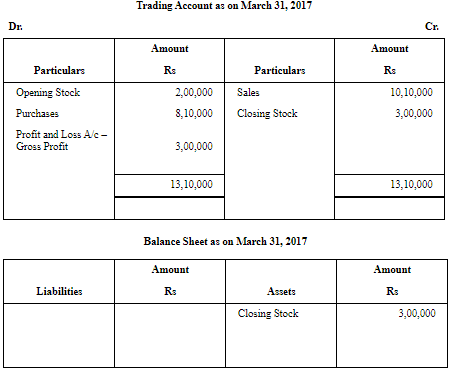
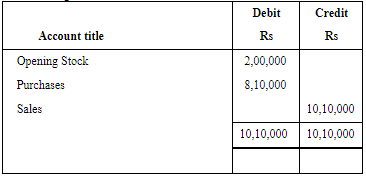
Question.5: The following are the extracts from the trial balance of M/s Bhola and Sons as on March 31, 2005
Numerical questions

(Only relevant items)
Closing Stock as on date was valued at Rs 3,00,000.
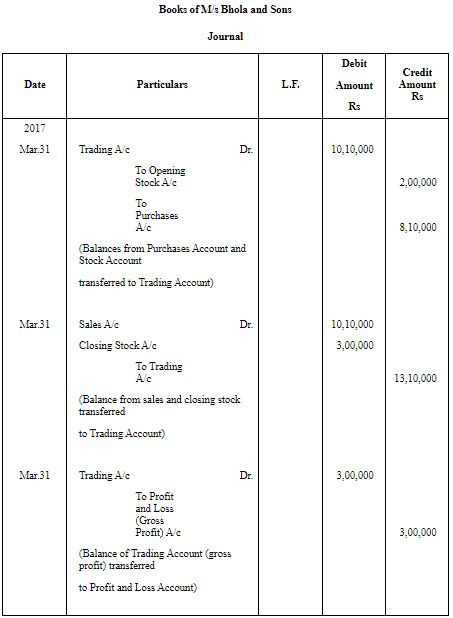
You are required to record the necessary journal entries and show how the above items will appear in the trading and profit and loss account and balance sheet of M/s Bhola and Sons.

Answer :
Numerical questions

Numerical questions

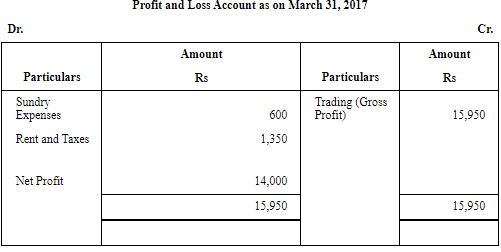
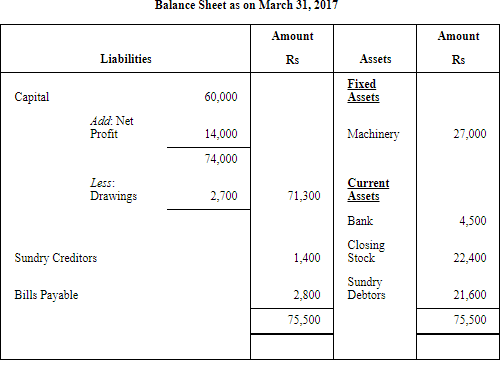
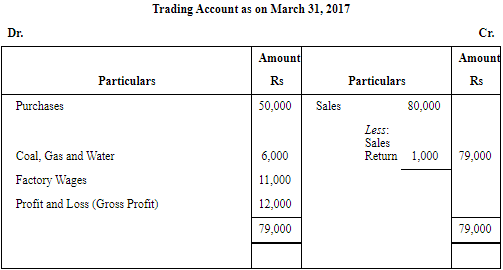
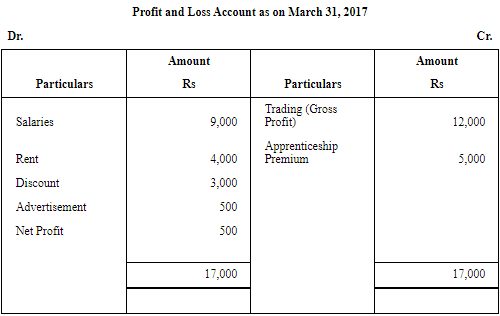
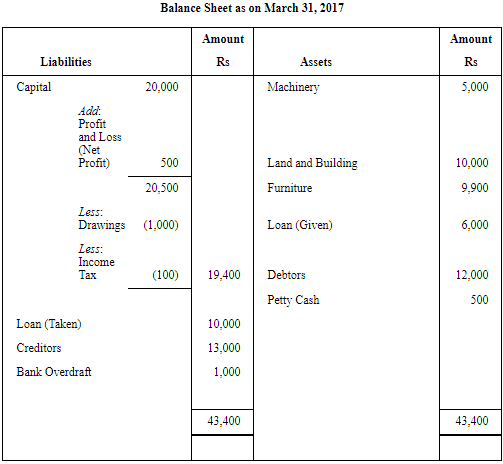
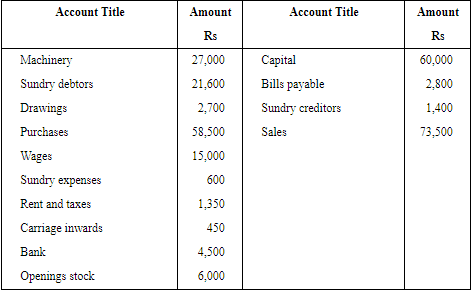
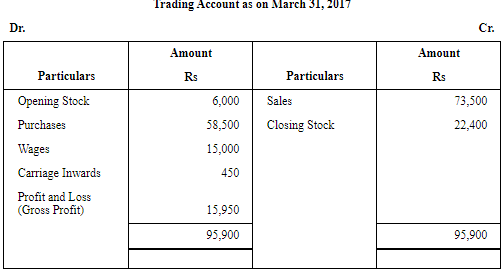
Question.6 : Prepare trading and profit and loss account and balance sheet, as on March 31, 2017 : 
Numerical questions

Closing stock, as on March 31, 2017 Rs 22,400. 

Answer :
Numerical questions

Numerical questions

Numerical questions

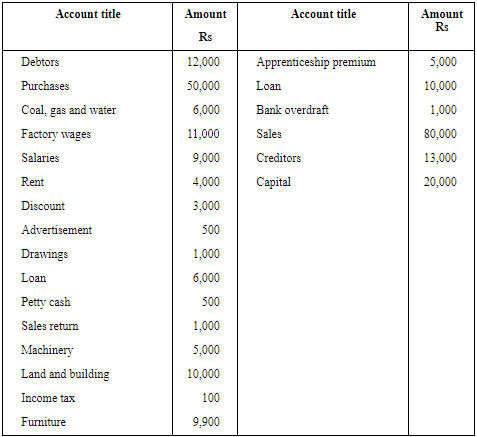
Question.7: The following trial balance is extracted from the books of M/s Ram on March 31, 2017. You are required to prepare trading and profit and loss account and the balance sheet as on date: 
Numerical questions

Answer :

Numerical questions

Numerical questions

Numerical questions

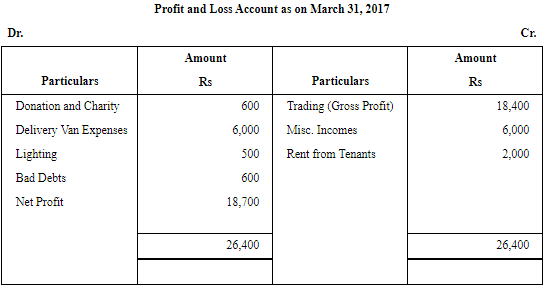
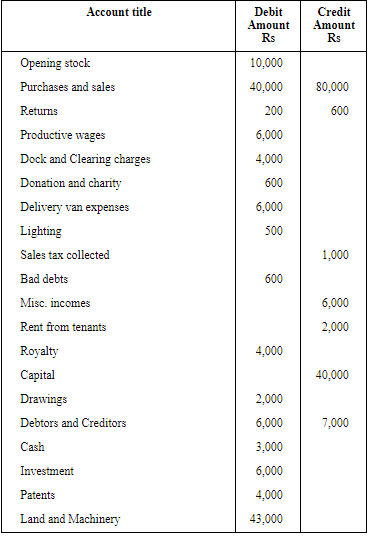
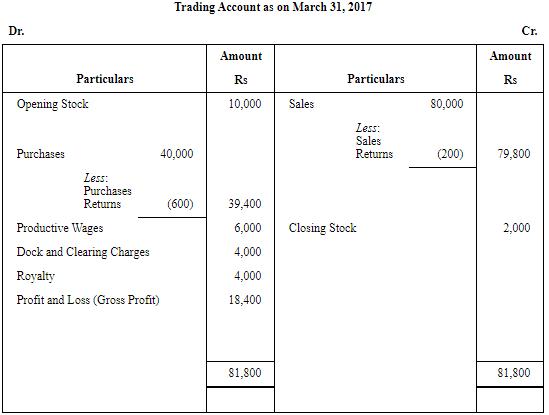
Question.8 : The following is the trial balance of Manju Chawla on March 31, 2017. You are required to prepare trading and profit and loss account and a balance sheet as on date: 
Numerical questions
 
Closing stock Rs 2,000. 

Answer :

Numerical questions

Numerical questions

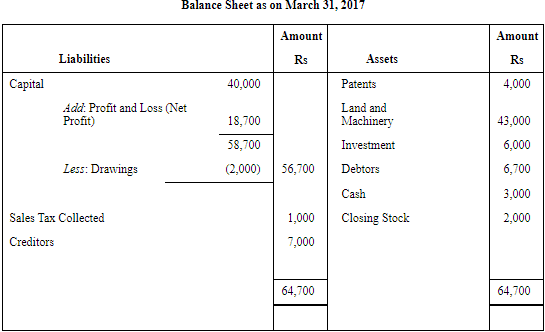
Note: As per the solution, net profit is Rs 18,700; however, the answer given in the book is Rs 18,400.
Numerical questions

Note: There is a misprint in the trial balance given in the question. In order to match the trial balance, debtors have been taken as Rs 6,700; however, the debtors shown in the trial balance are Rs 60,000.
The document NCERT Solution (Part - 1) - Financial Statements-I is a part of the SSC CGL Course SSC CGL Tier 2 - Study Material, Online Tests, Previous Year.
All you need of SSC CGL at this link: SSC CGL

FAQs on NCERT Solution (Part - 1) - Financial Statements-I

1. What are the main components of financial statements that I need to understand for SSC CGL Tier 2?
Ans. Financial statements consist of four primary components: the Balance Sheet, Income Statement, Cash Flow Statement, and Statement of Changes in Equity. The Balance Sheet shows assets, liabilities, and capital at a specific date. The Income Statement displays revenues and expenses over a period. Cash Flow Statement tracks cash movements, while the Statement of Changes in Equity reflects capital changes. Understanding these interconnected elements is essential for accounting-related SSC CGL questions and real-world financial analysis.
2. How do I differentiate between revenue expenditure and capital expenditure in financial statements?
Ans. Revenue expenditure generates benefits within the same accounting period and appears in the Income Statement, reducing profit immediately. Capital expenditure creates long-term assets benefiting multiple periods and is recorded on the Balance Sheet as an asset. Revenue items include salaries and utilities; capital items include machinery and building purchases. This distinction directly impacts profit calculation and asset valuation-a frequently tested concept in SSC CGL Tier 2 accounting modules.
3. Why is matching principle important when preparing financial statements?
Ans. The matching principle requires expenses to be recorded in the same period as their corresponding revenues, ensuring accurate profit measurement. Without this principle, financial statements become misleading as expenses might not align with income-generating activities. This principle strengthens the reliability of reported earnings and asset values, making financial analysis meaningful. It's fundamental to NCERT-based accounting standards and commonly appears in SSC CGL examination questions on accounting concepts.
4. What's the difference between accrual accounting and cash accounting in financial reporting?
Ans. Accrual accounting records transactions when they occur regardless of cash movement, providing a true financial position. Cash accounting records only actual cash receipts and payments. Accrual accounting follows NCERT standards and generally accepted accounting principles, offering superior accuracy for financial analysis. Most organisations and SSC CGL examination contexts prefer accrual accounting because it prevents revenue and expense distortions caused by timing differences between transactions and cash flows.
5. How should I classify items on the Balance Sheet to ensure accuracy in financial statements?
Ans. Balance Sheet items are classified into three main categories: assets (current and non-current), liabilities (current and non-current), and equity. Current assets and liabilities convert to cash within one year; non-current items take longer. Proper classification ensures stakeholders understand liquidity and solvency positions. Refer to mind maps and flashcards available on EduRev to visualise balance sheet structure and classification principles, helping you retain these distinctions for SSC CGL Tier 2 examinations effectively.
Explore Courses for SSC CGL exam
Get EduRev Notes directly in your Google search
Related Searches
NCERT Solution (Part - 1) - Financial Statements-I, Viva Questions, Sample Paper, study material, NCERT Solution (Part - 1) - Financial Statements-I, mock tests for examination, Objective type Questions, Semester Notes, MCQs, ppt, Summary, past year papers, Extra Questions, Exam, Free, pdf , practice quizzes, Important questions, video lectures, Previous Year Questions with Solutions, NCERT Solution (Part - 1) - Financial Statements-I, shortcuts and tricks;