Electrical Engineering (EE) Exam > Electrical Engineering (EE) Notes > GATE Mock Test Series 2027 > Syllabus: Electrical Engineering, GATE 2027
Syllabus: Electrical Engineering, GATE 2027

Introduction About GATE 2027
- Candidates are advised to refer to the EE syllabus while preparing for GATE. The GATE 2027 Electrical Engineering syllabus will help the candidates boost their preparation since they are made familiar with the topics asked in the exam.
- Along with the GATE syllabus for electrical engineering, the candidates are also advised to check the exam pattern of GATE 2027 for preparation purposes.
Table: The overview of the GATE 2027 exam pattern for EEE.
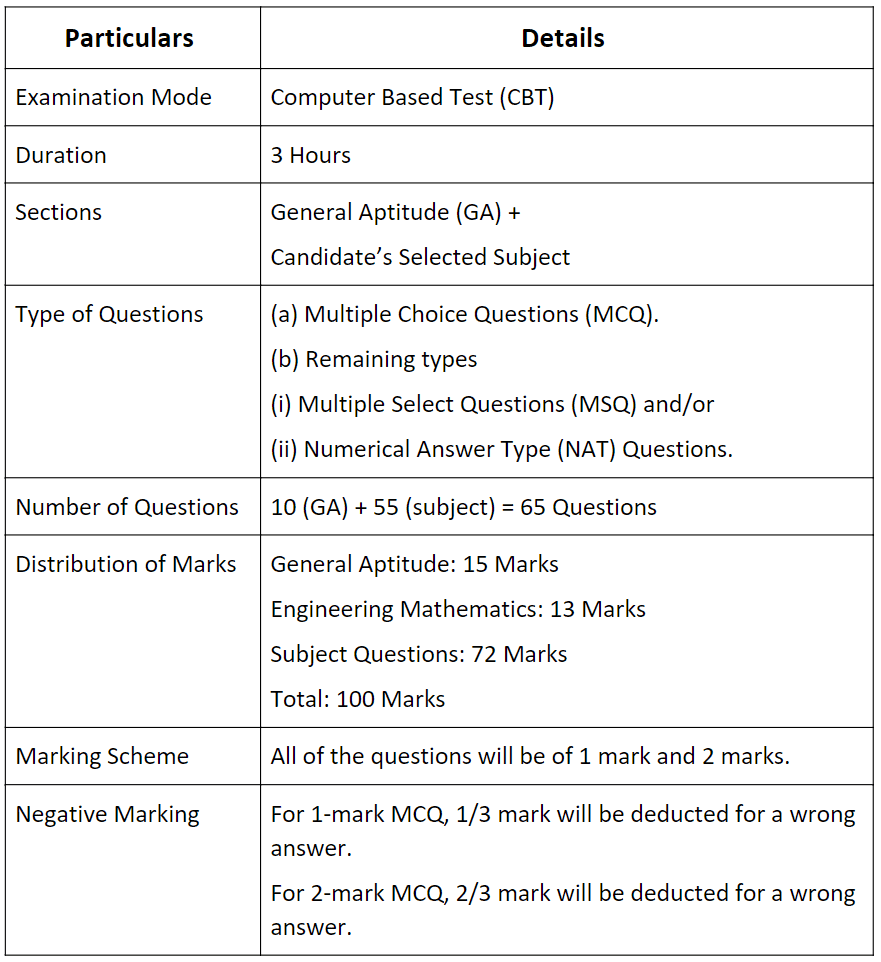
The three sections of the GATE EE paper are:
(i) General Aptitude
(ii) Engineering Mathematics
(iii) Subject-Specific Section
Syllabus for Electrical Engineering Subjects
- Linear Algebra: Matrix Algebra, Systems of linear equations, Eigenvalues, Eigenvectors.
- Calculus: Mean value theorems, Theorems of integral calculus, Evaluation of definite and improper integrals, Partial Derivatives, Maxima and minima, Multiple integrals, Fourier series, Vector identities, Directional derivatives, Line integral, Surface integral, Volume integral, Stokes's theorem, Gauss's theorem, Divergence theorem, Green's theorem.
- Differential Equations: First order equations (linear and nonlinear), Higher order linear differential equations with constant coefficients, Method of variation of parameters, Cauchy's equation, Euler's equation, Initial and boundary value problems, Partial Differential Equations, Method of separation of variables.
- Complex Variables: Analytic functions, Cauchy's integral theorem, Cauchy's integral formula, Taylor series, Laurent series, Residue theorem, Solution integrals.
- Probability and Statistics: Sampling theorems, Conditional probability, Mean, Median, Mode, Standard Deviation, Random variables, Discrete and Continuous distributions, Poisson distribution, Normal distribution, Binomial distribution, Correlation analysis, Regression analysis.
- You can prepare Engineering Mathematics for GATE through EduRev's Engineering Mathematics Course covering all the topics along with tests.
- Network elements: ideal voltage and current sources, dependent sources, R, L, C, M elements.
- Network solution methods: KCL, KVL, Node, and Mesh analysis;
- Network Theorems: Thevenin's, Norton's, Superposition and Maximum Power Transfer theorem,
- Transient response of dc and ac networks
- Sinusoldal Steady State Analysis
- Resonance
- Two-Port Networks
- Balanced three- phase Circuits: Star-delta transformation, Complex power
- A.C. Analysis: Power factor in ac circuits
- Electrostatic: Coulomb's Law, Electric Field Intensity, Electric Flux Density, Gauss's Law, Divergence, Electric field and potential due to point, line, plane, and spherical charge distributions, Effect of the dielectric medium, Capacitance of simple configurations.
- Magnetostatics: Biot‐Savart's law, Ampere's law, Curl, Faraday's law, Lorentz force, Inductance, Magnetomotive force, Reluctance.
- Time Varying Electromagnetic Fields: Magnetic circuits, Self and Mutual inductance of simple configurations.
- Introduction to Signal & Systems: Representation of continuous and discrete‐time signals, Shifting and scaling properties. Linear Time-Invariant and Causal systems
- Fourier Series representation of continuous and discrete-time periodic signals
- Sampling Theorem
- Applications of Fourier Transform for continuous and discrete-time signals,
- Laplace Transform
- z-Transform
- Single-phase transformers: equivalent circuit, phasor diagram, open circuit, and short circuit tests, regulation, and efficiency.
- Three-phase transformers: connections, vector groups, parallel operation; Auto-transformer, Electromechanical energy conversion principles.
- DC Machines: separately excited, series and shunt, motoring and generating mode of operation and their characteristics, speed control of dc motors.
- Three-phase induction machines: the principle of operation, types, performance, torque-speed characteristics, no-load and blocked-rotor tests, equivalent circuit, starting, and speed control. Operating principle of single-phase induction motors.
- Synchronous machines: cylindrical and salient pole machines, performance and characteristics, regulation and parallel operation of generators, starting of synchronous motors.
- Types of losses and efficiency calculations of electric machines.
- Basic concepts of electrical power generation, ac and dc transmission concepts, Models and performance of transmission lines and cables, Series and shunt compensation, Electric field distribution and insulators.
- Distribution Systems
- Load Flow Studies: Per‐unit quantities, Bus admittance matrix, Gauss-Seidel, and Newton-Raphson load flow methods.
- Voltage and Frequency Control, Power factor correction.
- Symmetrical Components
- Symmetrical Fault Analysis
- Unsymmetrical fault analysis
- Principles of overcurrent, differential, directional, and distance protection.
- Circuit breakers, System stability concepts, Equal area criterion, Economic Load Dispatch (with and without considering transmission losses).
- Basic of Control system & Transfer function: Mathematical modeling and representation of systems, Feedback principle, transfer function.
- Block diagram & Signal flow graphs
- Time Response Analysis: Transient and Steady‐state analysis of linear time-invariant systems
- Frequency Domain Analysis: Stability analysis using Routh-Hurwitz, and Nyquist criteria, Bode plots, root loci.
- Controller & Compensators: P, PI, and PID controllers, Lag, Lead and Lead‐Lag compensators.
- State Space Analysis: State-space model, Solution of state equations of LTI systems, R.M.S. value, average value calculation for any general periodic waveform.
8. Electrical and Electronic Measurements
- Measurement & Measuring System: Measurement of voltage, current, power, energy and power factor, error analysis.
- Cathode Ray Oscilloscopes
- Bridge Measurement (AC & DC): Bridges and Potentiometers
- Instrument transformers
- Digital Voltmeters (DVM) and multimeters, Phase, Time and Frequency measurement.
9. Analog and Digital Electronics
- Simple diode circuits: clipping, clamping, rectifiers; Amplifiers: biasing, equivalent circuit and frequency response. oscillators and feedback amplifiers; operational amplifiers: characteristics and applications.
- Single-stage active filters, Sallen Key, Butterworth, VCOs and timers, combinatorial and sequential logic circuits, multiplexers, demultiplexers, Schmitt triggers, sample and hold circuits, A/D and D/A converters.
- Thyristor: Static V-I characteristics and firing/gating circuits for Thyristor, MOSFET, IGBT
- Choppers: Buck, Boost, and Buck-Boost Converters.
- Rectifiers: Single and three-phase configuration of uncontrolled rectifiers.
- Voltage and Current commutated Thyristor-based converters
- Bidirectional ac to dc voltage source converters.
- Magnitude and Phase of line current harmonics for uncontrolled and thyristor-based converters.
- Power factor and Distortion Factor of ac to dc converters.
- Inverters: Single-phase and three-phase voltage and current source inverters, sinusoidal pulse width modulation.
Syllabus for General Aptitude (GA) (Common to all Papers)
Syllabus for General Aptitude (GA) (Common to all Papers)
1. Verbal Aptitude
- Basic English grammar: tenses, articles, adjectives, prepositions, conjunctions, verb-noun agreement, and other parts of speech.
- Basic vocabulary: words, idioms, and phrases in context.
- Reading Comprehension
- Narrative Sequencing
2. Quantitative Aptitude
- Data interpretation: data graphs (bar graphs, pie charts, and other graphs representing data), 2- and 3-dimensional plots, maps, and tables.
- Numerical computation and estimation: ratios, percentages, powers, exponents and logarithms, permutations and combinations, and series.
- Mensuration and Geometry
- Elementary Statistics and Probability
3. Analytical Aptitude
4. Spatial Aptitude
(a) Transformation of shapes:
- Translation
- Rotation
- Scaling
- Mirroring
- Assembling
- Grouping
(b) Paper folding
(c) Cutting
The document Syllabus: Electrical Engineering, GATE 2027 is a part of the Electrical Engineering (EE) Course GATE Electrical Engineering (EE) Mock Test Series 2027.
All you need of Electrical Engineering (EE) at this link: Electrical Engineering (EE)
FAQs on Syllabus: Electrical Engineering, GATE 2027
| 1. What are the main topics I need to study for GATE Electrical Engineering 2027? |  |
Ans. GATE EE 2027 syllabus covers Electric Circuits, Electromagnetic Theory, Signals and Systems, Electrical Machines, Power Systems, Control Systems, and Power Electronics as core pillars. Students must also prepare Digital Electronics, Analog Electronics, and Measurements. Each subject carries substantial weightage; mastering fundamentals in circuit analysis, transformer theory, and AC-DC machines is essential for scoring well in the examination.
| 2. How do I prepare for the Power Systems and Power Electronics sections in GATE EE? | |
Ans. Power Systems demands focus on load flow analysis, fault calculations, and transmission line parameters, while Power Electronics emphasises converter topologies and switching characteristics. Study steady-state and transient stability concepts thoroughly. Reference mind maps and flashcards available on EduRev to visualise complex interconnections between components. Practice numerical problems on three-phase systems and thyristor-based circuits regularly.
| 3. Which topics under Control Systems are most frequently asked in GATE Electrical Engineering exams? | |
Ans. Frequency response analysis, Bode plots, Nyquist stability criterion, and state-space representation appear consistently in GATE EE question papers. Root locus technique and compensator design also carry high importance. Clarity on transfer function concepts and feedback system behaviour is crucial. Candidates should solve previous year problems focusing on stability margins and transient response calculations.
| 4. What's the difference between studying Electromagnetic Theory and Electric Circuits for GATE 2027? | |
Ans. Electric Circuits emphasises Kirchhoff's laws, network theorems, and AC circuit analysis using phasor methods. Electromagnetic Theory addresses Maxwell's equations, wave propagation, and field concepts. While circuits focus on component-level behaviour, electromagnetic theory explains underlying physical phenomena. Both are interconnected; understanding field theory strengthens circuit comprehension and vice versa.
| 5. How should I approach studying Digital Electronics and Analog Electronics together for GATE EE preparation? | |
Ans. Study Analog Electronics fundamentals-amplifiers, oscillators, and operational amplifiers-before advancing to Digital Electronics topics like logic gates and combinational circuits. These subjects often overlap in practical applications like ADC/DAC converters and signal conditioning. Create separate flashcards for digital logic families and analog circuit configurations to avoid conceptual overlap while recognising their interdependencies.
About this Document

32.1K Views

4.73/5 Rating

Apr 18, 2026 Last updated
Related Exams
Document Description: Syllabus: Electrical Engineering, GATE 2027 for Electrical Engineering (EE) 2026 is part of GATE Electrical Engineering (EE) Mock Test Series 2027 preparation. The notes and questions for Syllabus: Electrical Engineering, GATE 2027 have been prepared according to the Electrical Engineering (EE) exam syllabus. Information about Syllabus: Electrical Engineering, GATE 2027 covers topics like and Syllabus: Electrical Engineering, GATE 2027 Example, for Electrical Engineering (EE) 2026 Exam. Find important definitions, questions, notes, meanings, examples, exercises and tests below for Syllabus: Electrical Engineering, GATE 2027.
Introduction of Syllabus: Electrical Engineering, GATE 2027 in English is available as part of our GATE Electrical Engineering (EE) Mock Test Series 2027 for Electrical Engineering (EE) & Syllabus: Electrical Engineering, GATE 2027 in Hindi for GATE Electrical Engineering (EE) Mock Test Series 2027 course. Download more important topics related with notes, lectures and mock test series for Electrical Engineering (EE) Exam by signing up for free. Electrical Engineering (EE): Syllabus: Electrical Engineering, GATE 2027
Description
Syllabus: Electrical Engineering, GATE 2027 of GATE Electrical Engineering covers all the important topics, helping you prepare for the Electrical Engineering (EE) exam on EduRev.
Information about Syllabus: Electrical Engineering, GATE 2027
In this doc you can find the meaning of Syllabus: Electrical Engineering, GATE 2027 defined & explained in the simplest way possible. Besides explaining types of Syllabus: Electrical Engineering, GATE 2027 theory, EduRev gives you an ample number of questions to practice Syllabus: Electrical Engineering, GATE 2027 tests, examples and also practice Electrical Engineering (EE) tests
 | Explore Courses for Electrical Engineering (EE) exam |  |
 | Get EduRev Notes directly in your Google search | |
Related Searches
study material, Syllabus: Electrical Engineering, ppt, Exam, Objective type Questions, Free, GATE 2027, GATE 2027, shortcuts and tricks, Sample Paper, mock tests for examination, Important questions, Summary, Syllabus: Electrical Engineering, Viva Questions, Extra Questions, Syllabus: Electrical Engineering, practice quizzes, MCQs, Semester Notes, video lectures, GATE 2027, past year papers, pdf , Previous Year Questions with Solutions;