Case Studies - Nature and Significance of Management


Q.1. Dheeraj is working as 'Operations Manager' in Tifco Ltd. Name the managerial level at which he is working. State any four functions he will perform as 'Operations Manager' in this company. (5 marks)
Ans. Dheeraj is working at the middle management level as an Operations Manager in Tifco Ltd.
Four functions he will perform as an Operations Manager in this company include:
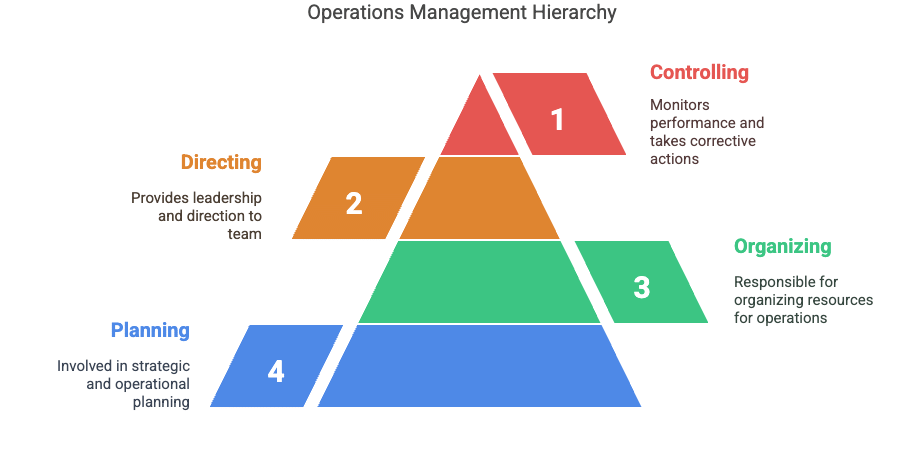
Planning: He will prepare operational plans for production and operations, set short-term targets and schedules, and decide how resources will be used to meet organisational objectives.
Organising: He will arrange and assign work, group activities, and allocate resources - manpower, machines and materials - to ensure smooth flow of operations.
Directing: He will lead and supervise the operations team, give instructions, motivate employees and resolve day-to-day problems to keep production on track.
Controlling: He will monitor performance against standards, check quality and costs, identify deviations and take corrective action - for example, introducing quality checks or cost-saving measures.
Q.2. Volvo Ltd's target is to produce 10000 shirts per month at a cost of Rs. 100/- per shirt. The Production Manager achieved this target at a cost of Rs. 90/- per shirt. Do you think the 'Production Manager' is effective? Give one reason in support of your answer. (1 mark)
Ans. Yes. He is effective because he achieved the target of producing 10,000 shirts. He is also efficient since he reduced the cost per shirt from Rs. 100 to Rs. 90, thereby using resources more economically.
Q.3. Aman, Ahmad and Ally are partners in a firm engaged in the distribution of dairy products in Maharashtra state. Aman is a holder of Senior Secondary School Certificate from the Central Board of Secondary Education with Business Studies as one of his elective subjects. Ahmad had done his post-graduation in History and Ally in dairy farming. One day, there was a serious discussion between Ahmad and Ally regarding the nature of management. Ahmad argued that management was a profession, whereas Ally argued against it, saying that the legal and medical professions are the only professions because they fulfil all the conditions of a profession.
Aman, on the basis of his knowledge of business studies, explained the nature of management as a profession to Ahmad and Ally.
Explain how Aman would have satisfied both Ahmad and Ally. (6 marks)
Ans. Aman would have satisfied Ahmad and Ally with the following points.
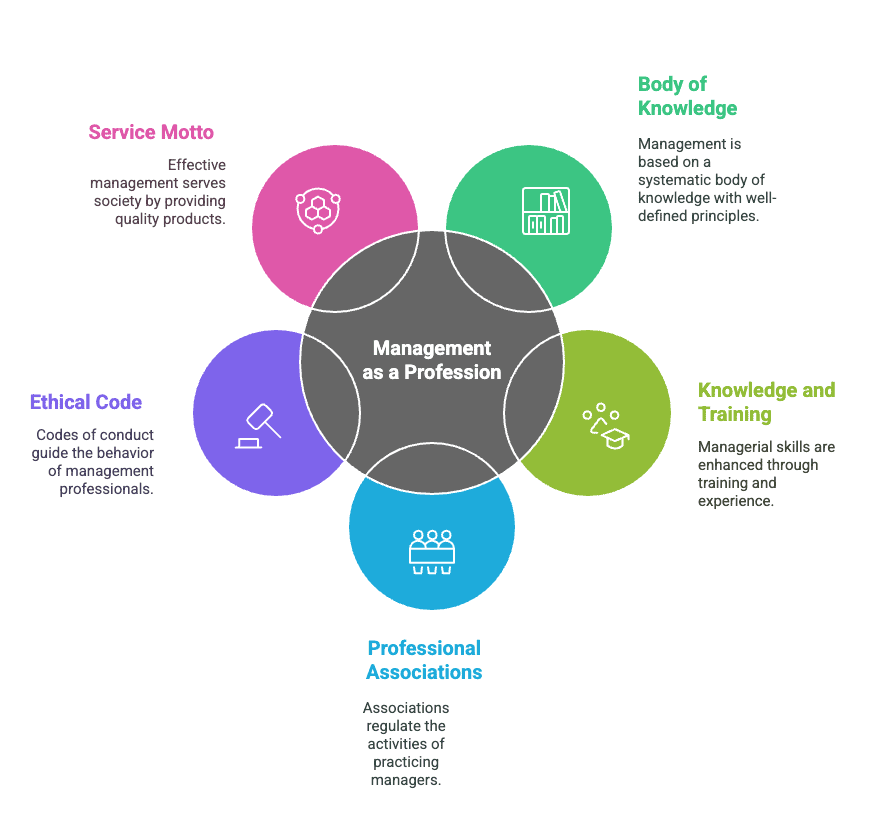
(i) Existence of a body of knowledge: Management is based on a systematic body of knowledge - principles and theories - that is taught in colleges and professional institutes and is available in books and journals.
(ii) Acquisition of knowledge, training and experience: Managerial skills can be developed through formal education, training programmes and practical experience; many practising managers enhance their competence by continuous learning.
(iii) Establishment of professional associations: There are professional bodies such as AIMA (All India Management Association) and other management institutes that bring practitioners together and promote professional standards.
(iv) Ethical code of conduct: Management associations and organisations promote ethical behaviour and codes of conduct for managers.
(v) Service motive: Management often has a service orientation - delivering value to customers and society; a well-managed organisation provides goods and services that benefit people.
Using these points, Aman can show Ahmad that management has professional features, and explain to Ally why management still differs in some respects from traditional professions (for example, variability in certification and licensing).
Q.4. To meet the objectives of the firm, the management of Bhavya Ltd. offers employment to physically challenged persons. Identify the organisational objective it is trying to achieve. Give a reason in support of your answer. (1 mark)
Ans. Social responsibility, since offering employment to physically challenged persons, reflects the company's commitment to social welfare and inclusion rather than only profit maximisation.
Q.5. B Ltd. wants to modify its existing product, CD players, in the market due to decreasing sales. What decisions/steps should each level of management take to give effort to this decision? (6 marks)
Ans.
1. Top management:
Decision: Set strategic direction for product modification.
Steps:
- Assess market trends and decide the strategic objective (e.g., enter new segment, add features).
- Allocate budget for research, development and marketing of the modified product.
- Approve major design changes and partnerships needed for new technology or distribution.
2. Middle management:
Decision: Prepare and implement operational plans to meet the top management's strategy.
Steps:
- Coordinate product development, production and marketing teams to design required modifications.
- Arrange testing, pilot production and feedback collection from target customers.
- Work with suppliers for necessary components and plan production schedules.
3. Lower management / Supervisory level:
Decision: Carry out day-to-day tasks to produce the modified players.
Steps:
- Assign specific tasks to workers and ensure quality standards are met on the shop floor.
- Monitor production progress, report problems and suggest minor improvements.
- Collect frontline feedback on production issues and customer reactions for quick corrective action.
Q.6. H. Tech Ltd. is a company that produces IT services. The company's profits are enough for survival and growth. The management of the company believes that a satisfied employee creates a satisfied customer, who in turn creates profits that lead to satisfied shareholders. So, it pays competitive salaries and perks to all its employees. All the employees are happy working in the organisation because of personal growth and development.
The company has a strong sense of social responsibility. It has set up an engineering college in which one-third of the students are girls, to whom the company gives a 50% scholarship.
Is the management of H. Tech Ltd. fulfilling its objectives? Justify your answer by giving reasons. (6 marks)
Ans. Yes. The management of H. Tech Ltd. is fulfilling multiple objectives:
- Employee welfare and motivation: By paying competitive salaries and offering perks, the company ensures satisfied employees who grow personally and professionally, which supports productivity and retention.
- Customer satisfaction: Satisfied employees deliver better service, helping the company meet customer needs and maintain service quality.
- Social responsibility: Establishing an engineering college and providing scholarships to girls shows commitment to education and social welfare, enhancing community goodwill.
- Shareholder value: Profits sufficient for survival and growth indicate that organisational and social objectives coexist with financial health, which satisfies shareholders.
Q.7. Govinda Ltd. is a highly reputable company. Different functions are performed by different individuals in this company, who are bound together in a hierarchy of relationships. Every individual in the hierarchy is responsible for the successful completion of a particular task. Mr. Gauranga is responsible for the welfare and survival of the organisation. He formulates overall organisational goals and strategies for their achievement. MR. Nityanand ensures that the quality of output is maintained, wastage of materials is minimised, and safety standards are maintained. Mr. Sanatan assigns necessary duties and responsibilities to the personnel and motivates them to achieve the desired objectives. At what levels of management are MR. Gauranga, Mr. Nityanand and Mr. Sanatan working in Govinda Ltd.? Justify your answer. (3 marks)
Ans.
1. Mr. Gauranga - top-level management. He is responsible for the welfare and survival of the organisation and formulates overall goals and strategies.
2. Mr. Nityanand - supervisory / lower-level management. He ensures quality of output, minimises material wastage and maintains safety standards; these are day-to-day operational responsibilities.
3. Mr. Sanatan - middle-level management. He assigns duties to staff and motivates them, linking top management plans with supervisory execution.
Q.8. Nishtha is the marketing manager of a company selling laptops. She plans the target sale of 2000 laptops per month. She allocates the necessary resources to carry out the plan. She has six salesmen working under her. She works with them, guiding and motivating them to achieve the target sales. At the end of the month, after comparison of actual sales with the target sales, she found that actual sales exceeded the target sales. She rewards the efficient employees to motivate them.
1. How does Nishtha prove the importance of management? Explain.
2. Also state any two values which she wants to communicate to society through her behaviour. (5 marks)
Ans.
Nishtha proves the importance of management through the managerial functions she performs:
- Planning: She sets a clear sales target of 2,000 laptops per month.
- Organising: She allocates resources and assigns six salesmen to achieve the target.
- Leading/directing: She guides and motivates her team, providing support for their work.
- Controlling: She compares actual sales with targets and rewards those who perform well.
Two values communicated by Nishtha:
- Efficiency and merit: By rewarding efficient employees she promotes merit-based recognition.
- Fairness and equity: She shows fairness by acknowledging performance and motivating the team.
Q.9. "Anju and Manju are good friends. Considering the fact that the activities involved in managing an enterprise are common to all organisations, after completing their master's in business management, both of them take up a job at the managerial level in different organisations as per their individual areas of interest. Anju takes up a marketing job in a retail company and strives to increase sales, whereas Manju joins an NGO and works diligently to realise its objective related to providing employment to specially abled persons. Both of them have to perform a series of continuous, composite, but separate functions. On some days, Anju may spend more time planning a future display layout and on other days, she may spend time in sorting out an employee's problem. Both Anju and Manju make conscious efforts to build a feeling of team spirit and coordination among diverse individuals with different needs who work under them. The effect of their management is noticeable in their respective departments as the targets are met according to plans, employees are happy and satisfied, and there is orderliness in its functioning rather than chaos\".
In the context of the above case:
Identify the various features of management highlighted in the above paragraph by quoting lines from it.
Ans.
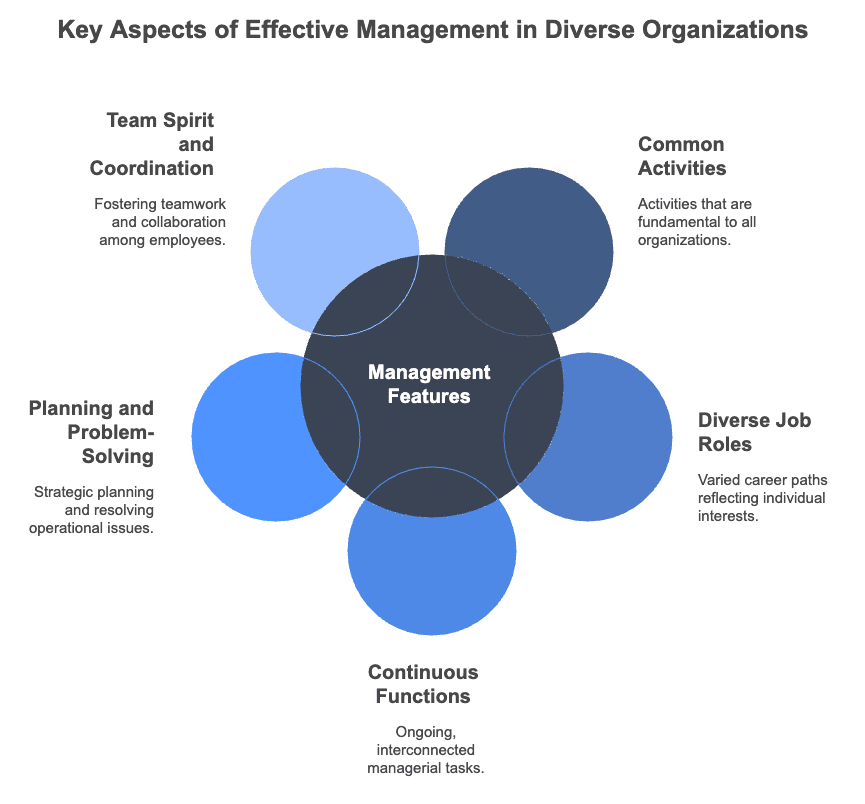
Universality of management activities: "Considering the fact that the activities involved in managing an enterprise are common to all organisations..."
Diversity of managerial roles: "Anju takes up a marketing job... whereas Manju joins an NGO..." - shows management is applied across sectors.
Continuous and composite functions: "Both of them have to perform a series of continuous, composite, but separate functions."
Planning and problem-solving: "On some days, Anju may spend more time in planning a future display layout and on another day... sorting out an employee's problem."
Team building and coordination: "Both Anju and Manju make conscious efforts to build a feeling of team spirit and coordination among diverse individuals..."
Q.10. Real Alliance Ltd. is a well-known cement company in India. It is able to earn adequate revenues to cover costs. Its capital base, number of employees, and production turnover have increased manifold over the years. The rate of profitability of the business is also creditable. The employees of the company are happy and satisfied with their remuneration, working conditions, promotion policy, etc. As a part of its moral obligation, the company has taken many initiatives for providing employment to specially abled persons and promoting literacy in the villages adopted by it.
In the context of the above case:
1. Identify and explain the various types of objectives of management being fulfilled by Real Alliance Ltd by quoting lines from the paragraph.
2. List any two values that Real Alliance Ltd. wants to communicate to society.
Ans.
Objectives of management fulfilled by Real Alliance Ltd:
- Profitability and growth: "It is able to earn adequate revenues to cover costs." and increased capital, employees and turnover show growth and profitability objectives are met.
- Employee welfare: "The employees of the company are happy and satisfied with their remuneration, working conditions, promotion policy, etc."
- Social responsibility: "As a part of its moral obligation, the company has taken many initiatives for providing employment to specially abled persons and promoting literacy in the villages adopted by it."
Values communicated to society:
- Social responsibility - by supporting specially abled persons and village literacy.
- Employee welfare - by ensuring fair remuneration and good working conditions.
Q.11. Esha works as the cost and risk management head of a company in the power sector. As a result of her excellent managerial competence, the company is able to reduce costs and increase productivity. The company belongs to the infrastructure sector, where regular amendments are made to government regulations and policies. She holds regular meetings to ensure that people in her department are not only aware of the related changes but are also able to adapt to these changes effectively. This helps the company to maintain its competitive edge. She motivates and leads her team in such a manner that individual members are able to achieve personal goals while contributing to the overall organisational objective. In the process of fulfilling her duties for the growth of the organisation, she helps in providing competitive services, adopting new technology, creating more employment opportunities, etc., for the greater good of the people at large.
In the context of the above case, identify the various reasons that have made management so important by quoting lines from the paragraph.
Ans. The various reasons mentioned in the above paragraph that have made management so important are stated below:
1. Management increases efficiency: "As a result of her excellent managerial competence, the company is able to reduce costs and increase productivity."
2. Management creates a dynamic organisation: "The company belongs to the infrastructure sector, wherein regular amendments are made in the government regulations and policies. She holds regular meetings to ensure that people in her department are not only aware of the related changes but are also able to adapt to these changes effectively. This helps the company to maintain its competitive edge."
3. Management helps achieve personal objectives: "She motivates and leads her team in such a manner that individual members are able to achieve personal goals while contributing to the overall organisational objective."
4. Management contributes to social development: "...she helps in providing competitive services, adopting new technology, creating more employment opportunities, etc., for the greater good of the people at large."
Q.12. Ramarjuna joins an IT firm as a system analyst after completing his masters in Computer Science. As the nature of his work demands, he has to work in very close coordination with all the departmental heads in the firm. Very soon, Ramarjuna realises that each departmental head has their own individual style of working. They differ greatly in their day-to-day approach to work. They tend to deal with a given situation, an issue or a problem through a combination of their own experience, creativity, imagination, initiative and innovation.
In the context of the above case, identify and explain the nature of management highlighted in the above case.
Ans. In the above case, management is presented as an art.
Explanation:
- Personalised application: Managers apply knowledge using their personal skill, creativity and judgement - as departmental heads use experience, imagination and initiative.
- Skill and practice: Like any art, management requires practice and skill to apply principles effectively in varying situations.
- Not purely formulaic: Outcomes depend on the manager's creativity and style, not only on theory.
Q.13. Dharam is a well-known businessman in the field of publishing. He owes the success of his business to his own education in business management and his team of certified management consultants. Therefore, he decides to send both his children, Danush and Damini, abroad to acquire a degree in business management in their individual areas of expertise. He feels that all over the world, there is marked growth in management as a discipline, but still, it is not considered to be a full-fledged profession for certain reasons.
In the context of the above case:
1. Explain the reasons why Dharam considers management as a discipline.
2. Critically examine the various reasons why management is not considered to be a full-fledged profession.
Ans.
1. Dharam considers management as a discipline because it has a well-developed body of knowledge, theories and principles studied in colleges and applied in practice. Management is taught as a distinct subject and uses systematic study and research.
2. Reasons why management is not considered a full-fledged profession:
- Lack of uniform entry standards: There is no single, mandatory qualification required everywhere to practise as a manager.
- Absence of a licensing authority: Unlike medicine or law, there is no universally accepted licensing body that grants exclusive legal rights to practise management.
- Variable practice and certification: Managers may differ widely in training and experience, and professional certification is not uniformly required across sectors.
These factors mean management has many features of a profession but does not fully meet all traditional criteria of a regulated profession.
Q.14. Kartik joins a garment factory as a plant supervisor in Lucknow. He observes that the output of some workers is very low as compared to the standards set for their performance. On analysing the reasons for the same, he finds out that a lot of time of the workers is wasted in getting the requisite materials issued from the store. Whereas on asking, the storekeeper complains that there is no harmony in the working of the production department as a whole. Every day, the workers approach him at the last minute to procure different kinds of threads, laces, mirrors, buttons, etc., if it is not available in the store, then he has to place an order with the purchase officer. As a result, a lot of time of the workers is wasted. So, in order to integrate the various production activities, henceforth, Kartik ensures that the storekeeper is informed well three days in advance about the requisite materials. Consequently, the storekeeper can keep the materials ready for the workers every morning according to their requirements.
In the context of the above case:
1. Identify and explain the quality of management that Kartik has introduced in the working of the production department as a corrective measure to control the output of the workers.
2. State briefly two points highlighting the importance of the quality of management identified in part (a).
Ans.
1. Coordination - Kartik introduced coordination by ensuring that the storekeeper is informed three days in advance so materials are available when needed. Coordination integrates the activities of production and stores to remove delays and wastage of workers' time.
2. Two important points highlighting the importance of coordination:
- Improves efficiency: By synchronising activities, time is saved and production flows smoothly, improving worker output.
- Reduces conflicts and delays: Coordination prevents last-minute requests and confusion between departments, leading to orderly work and better utilisation of resources.
Q.15. Sridhar's father is working as a section-in-charge in a government office. Identify the level of management at which he is working. State any five functions that he has to perform at this level.
Ans. Sridhar's father is working at the lower / supervisory level of management.
He has to perform the following functions at this level:
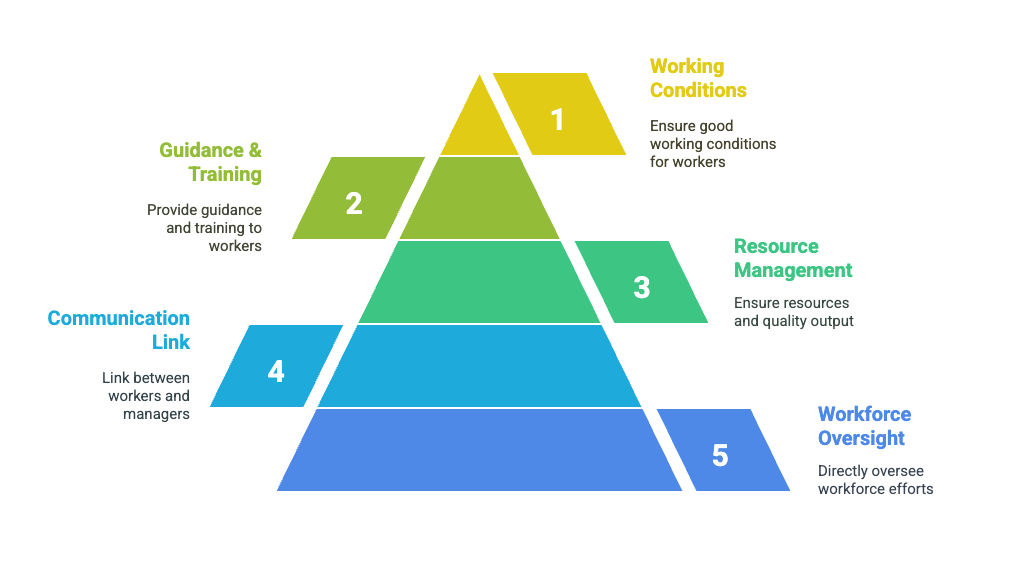
1. Directly supervise and oversee the day-to-day work of employees.
2. Act as a link between workers and middle management by reporting problems and implementing instructions.
3. Ensure the availability of resources and maintain the required quality of output.
4. Provide on-the-job guidance and training to workers.
5. Maintain good working conditions and enforce discipline among staff.
Q.16. Geetika is working in a private sector bank. One of her key functions relates to the formulation of the overall organisational goals and strategies of the bank. Identify the level of management at which she is working. State any three other functions that she has to perform at this level.
Ans. Geetika is working at the top level of management in a private sector bank.
The three other functions she has to perform at this level are:
1. She is responsible for the overall success and failure of the organisation.
2. She frames policies and guides the impact of business activities on society and stakeholders.
3. She coordinates the activities of different departments and provides strategic direction to achieve organisational goals.
Q.17. Arundhati has been promoted to the post of Marketing Division Head of a soft drink company. Identify the level of management at which she will be working henceforth. State any four functions that she will have to perform at this level.
Ans. Arundhati will be working at the middle level of management.
The four functions she will have to perform are:
1. Ensure the department has required staff and resources.
2. Assign duties and responsibilities to departmental employees.
3. Motivate and lead her team to achieve marketing targets.
4. Coordinate with other departments (production, finance, HR) for effective functioning.
Q.18. Bhuvan argues that management is required in all kinds of organisations where whereas Piyush feels that management is not required in non-business organisations such as schools, clubs, hospitals, etc. Who is right?
Ans. Bhuvan is right. Management is pervasive - it is required in all types of organisations, including schools, clubs and hospitals, since they all need planning, organising, directing and controlling.
Q.19. Mohan has retired from the post of a foreman in a factory. At what level of management is he working?
Ans. Mohan worked at the supervisory / operational level of management, as a foreman directly supervised workers and their daily tasks.
Q.20. 'Sonu Nigam', the famous playback singer, always spends time for practice and adds his creativity to his singing.
Like Sonu Nigam, Mr. Rajiv, manager of Headlines Ltd., uses his creativity and practice management principles under different situations to manage the business. The employees are happy and satisfied as he every day reward employees for their punctuality and efficiency.
1. Identify the nature of management highlighted above.
2. Name the other two aspects of the nature of management.
3. Identify the values followed by Mr. Rajiv.
Ans.
1. The nature of management highlighted is management as an art - it requires practice, creativity and personal skill.
2. The other two aspects are:
(i) Management as a science (it has systematic principles and methods).
(ii) Management as a profession (it has specialised knowledge and professional bodies).
3. Values followed by Mr. Rajiv include recognition of merit (rewarding punctuality and efficiency) and encouragement (motivating employees through praise and rewards).
Q.21. Bhuvan Ltd., a garment manufacturing Company, set the target production of 100 garments per month at the estimated cost of Rs. 200 per garment. Mohan, a worker, worked a double shift and manufactured around 150 garments, but at an estimated cost of Rs. 230 per garment. On the other hand, Ravi, another worker, focuses on cost and handles resources very carefully, so he manufactured 90 garments but at an estimated cost of Rs. 190 per garment. The third worker maintained the balance and achieved the target of 100 garments at an estimated cost of Rs. 200 per garment.
1. Identify the quality possessed by Ravi, Mohan and what they are lacking.
2. What quality is possessed by the third worker?
3. Which worker is preferred by management?
Ans.
1. Mohan is effective (he exceeded the quantity target) but he lacks efficiency (higher cost). Ravi is efficient (lower cost) but lacks effectiveness (did not meet the target).
2. The third worker possesses both effectiveness and efficiency - he met the target at the estimated cost.
3. Management prefers the third worker because management values achieving objectives while using resources economically (both effectiveness and efficiency).
Q.22. Management of Alpha Ltd. has installed a special recycling plant to recycle the waste instead of dumping the waste in the ground. It is also providing employment opportunities to local residents. The company started a school nearby for the children of their employees.
1. Identify the objectives the company is fulfilling.
2. Quote the lines from the above para which indicate those objectives.
Ans.
1. The company is fulfilling social objectives and personal/employee welfare objectives.
2. Lines indicating objectives:
- "installed a special recycling plant to recycle the waste instead of dumping the waste in the ground." - shows concern for the environment and social responsibility.
- "providing employment opportunities to local residents" - shows social and community development.
- "started a school nearby for the children of their employees." - indicates personal/employee welfare objective.
Q.23. Directors of Bhuvan Ltd. assigned the task of implementing the plans and policies framed by the board to all the departmental heads. Departmental head appointed supervisors, superintendent, executives, etc., so that work can be assigned to workers as per the plan supervisors kept a check on workers as per the plan.
1. Identify the feature of management highlighted in the above para.
2. Explain that feature.
Ans. The feature highlighted is management is a group activity.
Explanation: Management involves the coordinated effort of many people - directors, departmental heads, supervisors and workers - to implement plans. Tasks are divided and assigned so that collective action achieves organisational objectives.
Q.24. Alpha Ltd. is a Company that manufactures mobile phones and accessories. Its profits are declining nowadays. The sales department blames the production department for low quality, the production department blames the purchase department for not supplying good quality parts.
1. What quality of management is lacking in the above case?
2. Explain the nature of the concept.
Ans.
(a) The quality lacking is coordination.
(b) Nature of coordination: Coordination is the deliberate effort to harmonise activities and resolve conflicts among departments. It ensures that different functions work together, share information and resources, and move towards common goals instead of blaming each other.
Q.25. A group of people believes that management is a systematic body of knowledge that explains certain general truths and is based on logical observation.
Identify and explain the nature of management discussed in the above case.
Ans. That view describes management as a science. It suggests management has systematic principles, uses observation and analysis, and develops general rules that can guide managerial practice.
Q.26. Unique enterprises is able to achieve the target production of 5,000 units within the prescribed time; however, to achieve this target, they hired extra workers on an ad-hoc basis and spent around 40,000 extra to pay the ad-hoc workers so that the target production can be achieved on time.
1. Do you think a unique enterprise is effective or efficient?
2. Was their decision to hire ad hoc workers to achieve the target correct?
3. Explain the concept of management highlighted above.
Ans.
1. Unique enterprises is effective but not efficient - it achieved the production target (effectiveness) but with additional unplanned cost (inefficient use of resources).
2. The decision to hire ad-hoc workers and incur extra cost is not correct from an efficiency viewpoint; it solved the short-term problem but reduced cost-efficiency.
3. The concept highlighted is the balance between effectiveness and efficiency - management should aim to achieve organisational goals (effectiveness) while using resources economically (efficiency).
Q.27. In an organisation sales department wants to increase sales by 20% so the sales department plans to offer extra discounts to customers. The finance department raised objections to it as they said it would result in a loss of revenue, and the company may face a liquidity problem.
1. Name the importance of coordination referred to here.
2. State the other two important aspects of coordination.
Ans.
1. The importance referred to is functional differentiation - different departments have different objectives and must be coordinated to avoid conflicts.
2. Two other important aspects are:
- Size - as organisations grow, coordination becomes more important to manage complexity.
- Specialisation - when work is specialised, coordination ensures different specialists' efforts are combined effectively.
Q.28. Mr. Rajiv and Arun are responsible for the welfare of the whole organisation. Their job is very complex; they have to develop long-term objectives, policies and review the work of different heads at different levels. Mr. John and Mr. Singh are responsible for the working of the department they are heading. They formulate short-term departmental objectives in accordance with organisational objectives.
Mr. Philip, Mrs. Archana, Mrs. Kamlesh and Mrs. Kavita are in direct contact with the workforce consisting of various employees and workers. They are responsible for the quality of work and providing good working conditions to workers.
1. State the three levels of management.
2. Name the persons who are involved at different levels from the above para.
Ans.
1. Top-level, middle-level and supervisory (lower) level of management.
2.
(a) Top-level - Mr. Rajiv and Arun.
(b) Middle-level - Mr. John and Mr. Singh.
(c) Supervisory level - Mr. Philip, Mrs. Archana, Mrs. Kamlesh and Mrs. Kavita.
Q.29. The manager of Alpha Ltd. is very efficient and effective and makes sure all the employees and workers in his team perform the task on time with minimum cost. His main focus is on cost-cutting, so he never listens to the demand of workers for increasing wages. He even gives no opportunity to workers for promotion. As a result, workers started becoming frustrated and disheartened all the time.
1. Which objective of management could not be achieved by the manager?
2. State the other two objectives of management.
3. State any one value ignored by the manager.
Ans.
1. The personal / human (individual) objective of management - employee welfare and satisfaction - is not achieved.
2. Two other objectives are:
(i) Economic - earning profit and ensuring financial stability.
(ii) Social - acting responsibly towards society and stakeholders.
3. One value ignored by the manager is humanity / care for employees (fair treatment and opportunity for growth).
Q.30. The management of Amaira Ltd. strongly believes that the members of the organisation should work toward fulfilling the common organisational goals. This requires teamwork and integration of the efforts of all individuals, departments, and specialists. This is because all the individuals and departments depend on each other for information and resources to perform their respective activities. The manager needs to reconcile differences in approach, timing, efforts and interest. At the same time, it should enable all its members to grow and develop. Thus, there is a need to harmonise individual goals and organisational goals.
1. State the concept of management discussed above.
2. State any three features of the concept identified in the above para.
3. State value referred to in the above para.
Ans.
1. Coordination.
2. Three features of coordination:
- Integration of efforts of different persons and departments.
- Interdependence among different functions requiring harmonisation.
- Reconciliation of differences in approach, timing and effort.
3. Value referred to: Harmony between employees and management, enabling collective growth and development.
FAQs on Case Studies - Nature and Significance of Management
| 1. What exactly does "nature of management" mean in Business Studies, and why is it important for exams? |  |
| 2. How do case studies on management help explain real business problems differently than textbook theory? | |
| 3. What are the main characteristics of management that appear in CBSE case studies and exam questions? | |
| 4. Why do management functions like planning and controlling matter more when solving case study problems? | |
| 5. How should I identify management principles being applied when I'm reading a case study scenario? | |