Scanner - Producer Equilibrium

N.C.E.R.T Questions
(Q1) Show that a perfectly competitive firm maximizes its profit only when Price = MC?
(Q2) What is meant by producer equilibrium ?
(Q3) What is condition of producer equilibrium or profit maximising for a competitive firm ?
(Q4) What is general condition of producer equilibrium or profit maximising of a firm ?
(Q5-6) Find out max profit by comparing MR and MC for (a) and (b) part. What is market price for
(c) part
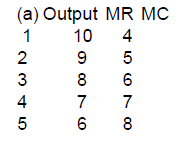
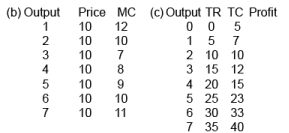
(Q7) What condition must hold good if a profit - maximising firm produces positive output in a competitive market ?
(Q8) Can there be a positive level of output that a profit-maximising firm produces in a competitive market at which market price is not equal to marginal cost ? Explain
(Q9) Will a profit- maximising firm in a competitive market ever produce a positive level of output in the short run if the market price is less than minimum of AVC ? Give an explanation
(Q10) Will a profit- maximising firm in a competitive market ever produce a positive level of output in the range where the marginal cost is falling ? Give an explanation
(Q11) "A producer will increase his profit by reducing production when his MC is greater than his MR." Explain.
(Q12) In a state of equilibrium . price greater than MC is ruled out for a perfectly competitive firm. Show diagrammatically
CBSE Questions
(Q1) The price of commodity X is Rs. 20 per unit and it remains constant. Given below is the cost schedule of one of its producers. Find out the level of output at which this producer is in equilibrium. Give reasons for your answer.
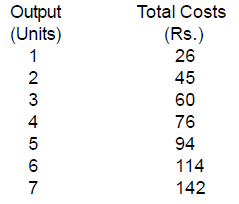
(Q2) Find out the level of output at which this producer is in equilibrium. Give reasons for your answer.
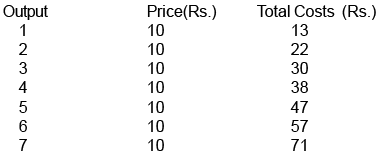
CBSE + Sample Paper Questions
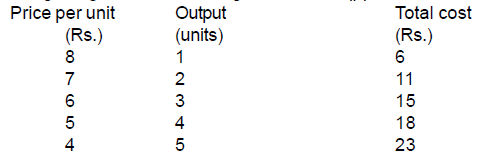
(Q1) From the following schedule find out the level of output at which the producer is in equilibrium,using marginal cost and marginal revenue qpproach. Give reasons for your answer. (6M)
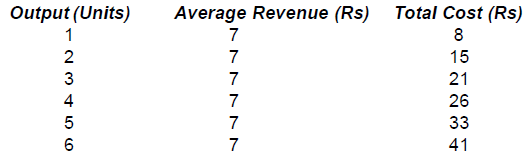
(Q2) On the basis of the information given below, determine the level of output at which the producer will be in equilibrium. Use the marginal cost - marginal revenue approach. Give reasons for your answer.
CBSE Questions
(Q1) What is producer's equilibrium ? Explain the conditions of producer's equilibrium through the 'marginal cost and marginal revenue' approach. Use diagram. (6 marks)
OR
What is producer's equilibrium ? Explain the conditions of producer's equilibrium through the 'marginal cost and marginal revenue' approach. Use a schedule. (6 marks)
C.B.S.E & Sample Paper Questions
(Q1) From the following table, find out the level of output at which the producer will be in equilibrium.Give reasons for your answer.

(Q2) Explain the conditions of equilibrium of a firm based on marginal revenue. Use diagram.(6 M)
C.B.S.E Paper Questions
(Q1) From the following information about a firm, find the firm's equilibrium output in terms of marginal cost and marginal revenue. Give reasons. Also find profit at this output.
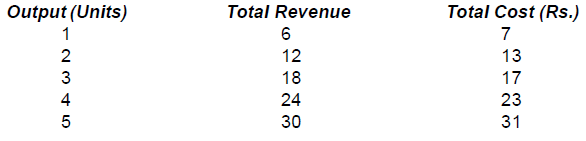
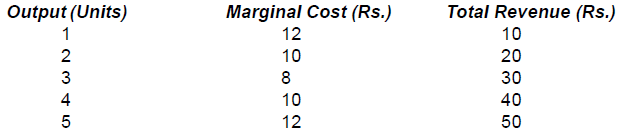
(Q2) Using MC-MR method in the following table, find out the level of output at which the producer is in equilibrium. Give reasons for your answer. (4 marks)
Sample Paper Questions
(Q1) Explain the condition of equilibrium of a firm based on marginal cost and marginal revenue.
(6 M)
Extra Numerical
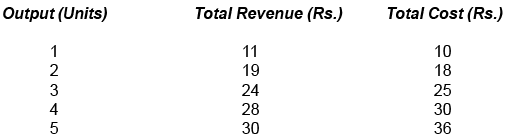
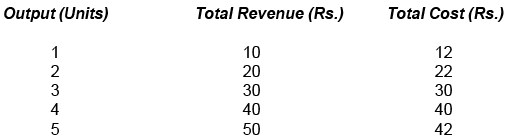
Using MC-MR method in the following tables, find out the level of output at which the producer is in
equilibrium. Give reasons for your answer.
(Q1)
(Q2)
(Q3) Determine producer's equilibrium from the following data through MC-MR approach . Give reasons for your answer.

C.B.S.E Paper Questions
(Q1) Explain why will a producer not be in equi. if the conditions of equilibrium are not met.(6M)
(Q2) Elaborate the implication of the conditions of equilibrium of a firm.(4M)
(Q3) Give the meaning of producers equilibrium. A producer produces that quantity of his product at which marginal cost and marginal revenue are equal. Is he earning maximum profits ? Give reasons for your answers.
(Q4) Why is the equality between marginal cost and marginal revenue necessary for a firm to be in equilibrium? Is it sufficient to ensure equilibrium? Explain.
(Q5) Explain the rationale behind the conditions of equilibrium of a producer.
CBSE paper Questions
(Q1) Explain the conditions of producer's equilibrium with the help of a numerical example. Use marginal cost and marginal revenue approach?
(Q2) From the following data find out the level of output that will give the producer maximum profit (use marginal cost and marginal revenue approach). Give reasons for your answer. (6M)
Output (units) 1 2 3 4 5
Total Cost (Rs.) 9 17 24 29 36
Total Revenue (Rs.) 11 20 27 32 35
Ans: The firm is in equilibrium at the 4th unit of output. Maximum profit at this output is Rs. 3.
Calculate marginal revenue (MR) and marginal cost (MC) for each additional unit of output:
MR1=11, MC1=9;
MR2=9, MC2=8;
MR3=7, MC3=7;
MR4=5, MC4=5;
MR5=3, MC5=7.
Reasoning: MR exceeds MC up to the third unit so the firm will increase output. At the fourth unit MR equals MC, and producing the fifth unit would make MC (7) greater than MR (3). Therefore the second-order condition (MC > MR beyond equilibrium) is satisfied at the fourth unit, confirming profit maximisation.
Profit at 4 units = Total Revenue - Total Cost = Rs. 32 - Rs. 29 = Rs. 3.
(Q3) From the following total cost and total revenue schedule of a firm, find out the level of output, using marginal cost and marginal revenue approach, at which the firm would be in equilibrium. Give reasons for your answer. (6M)
Output (units) 1 2 3 4 5
Total Revenue (Rs.) 16 30 42 52 60
Total Cost (Rs.) 14 27 39 49 61
Q4) Given below is the cost schedule of a product produced by a firm. The market price per unit of the product at all levels of output is Rs. 12. Using marginal cost and marginal revenue approach, find out the level of equilibrium output. Give reasons for your answer :
Output (Units) 1 2 3 4 5 6
Average Cost (Rs.) 12 11 10 10 10.4 11
(Q5) Using marginal cost and marginal revenue approach, find out the level of output at which producer will be in equilibrium. Give reasons for your answer.
Output (Units) 1 2 3 4 5 6
Average Revenue (Rs.) 20 20 20 20 20 20
Total Cost (Rs.) 22 42 60 76 96 120
(Q6) Using marginal cost and marginal revenue approach, find out the level of output at which producer will be in equilibrium. Give reasons for your answer.
Price 6 6 6 6 6
Output (Units) 1 2 3 4 5
Total Cost (Rs.) 20 15 21 28 37
CBSE paper Questions
(Q1) Explain the conditions of producer's equilibrium in terms of marginal revenue and marginal cost.
(Q2) Explain the conditions of producer's equilibrium under perfect competition. (4M)
FAQs on Scanner - Producer Equilibrium
| 1. What is producer equilibrium in commerce? |  |
| 2. How is producer equilibrium determined? | |
| 3. What factors can shift the producer equilibrium? | |
| 4. How does producer equilibrium affect market supply? | |
| 5. Can producer equilibrium be achieved in the long run? | |