NCERT Solution: Accounting for Partnership-Basic Concepts

Short Question Answers
Q1: Define Partnership Deed.
Ans: A partnership deed is a written agreement among the partners of a partnership firm. It records the terms and conditions accepted by the partners, such as profit-sharing ratio, partners' salaries and commissions, interest on partners' capital and drawings, and interest on loans given to or taken from the firm. A partnership deed commonly contains the following details.
1. Objective of the firm
2. Name and address of the firm
3. Name and address of all partners
4. Profit and loss sharing ratio
5. Contribution to capital by each partner
6. Rights, duties and roles of partners
7. Duration of partnership
8. Rate of interest on capital, drawings and loans
9. Salaries and commission, if payable to partners
10. Rules regarding admission, retirement, death and dissolution of the firm, etc.
Q2: Why is it desirable to make the partnership agreement in writing. Explain in 50 words.
Ans: Although the Partnership Act, 1932 does not require a partnership agreement to be written, a written partnership deed is desirable. It reduces misunderstandings, provides clear guidance on partners' rights and duties, and serves as evidence in case of disputes. Registered deeds carry greater legal weight in court.
Q3: List the items which may be debited or credited in the capital accounts of the partners when:
(i) Capitals are fixed
(ii) Capitals are fluctuating
Ans:
(i) When capitals are fixed
The following items are credited to a partner's Capital Account when capitals are fixed:
(a) Opening balance of capital
(b) Additional capital introduced during the year
The following items are debited in the partner's Capital Account when capitals are fixed:
(a) Part of capital permanently withdrawn
(b) Closing balance of capital
(ii)When capitals are fluctuating
The following items are credited to a partner's Capital Account when capitals are fluctuating:
(a) Opening balance of capital
(b) Additional capital introduced during the accounting year
(c) Partner's salary (if adjusted in capital/current account)
(d) Interest on capital
(e) Share of profit
(f) Commission and bonus to partner
The following items are debited in the partner's Capital Account when capitals are fluctuating:
(a) Drawings made during the accounting period
(b) Interest on drawings
(c) Share of loss
(d) Closing balance of capital
Q4: Why is Profit and Loss Adjustment Account prepared? Explain.
Ans: The Profit and Loss Adjustment Account is prepared for two main reasons.
1. To record omitted items and rectify errors - If an error or omission is discovered after preparing the Profit and Loss Account and Balance Sheet, the correction is made in the subsequent period by opening a Profit and Loss Adjustment Account. This avoids altering previously prepared final accounts.
2. To distribute profit or loss between partners - When adjustments affect partner shares, this account is used (in place of Profit and Loss Appropriation Account) to distribute the corrected profit or loss among partners. The account helps ascertain the true profit or loss after adjustments.
Q5:Give two circumstances under which the fixed capitals of partners may change.
Ans:
The fixed capital of a partner may change under the following circumstances:
(i) When a partner introduces additional capital during the year.
(ii) When a partner permanently withdraws part of the capital from the firm.
Q6: If a fixed amount is withdrawn on the first day of every quarter, for what period the interest on total amount withdrawn will be calculated?
Ans: If a fixed amount is withdrawn on the first day of every quarter, then the interest is calculated on the amount withdrawn for a period of seven and half ( )months.
Example: If a partner withdraws Rs. 5,000 in the beginning of each quarter and the interest is charged @ 10% on the drawings, then interest on drawings is calculated as:
Total drawings made by the partner during the whole year are Rs 20,000, i.e. Rs 5000× 4.
Interest on drawings = 
Q7: In the absence of partnership deed, specify the rules relating to the following:
(i) Sharing of profits and losses.
(ii) Interest on partner's capital.
(iii) Interest on Partner's drawings.
(iv) Interest on Partner's loan
(v) Salary to a partner.
Ans:
(i) Sharing of profits and losses: If the partnership deed is silent on sharing of profits and losses, the Partnership Act, 1932 provides that partners share profits and losses equally.
(ii) Interest on partner's capital: If there is no agreement regarding interest on capital, partners are not entitled to any interest on capital under the Partnership Act, 1932.
(iii) Interest on partner's drawings: If the deed is silent about interest on drawings, no interest is to be charged on drawings.
(iv)Interest on partner's loan: In the absence of an agreement, partners are entitled to interest at 6% p.a. on any loan advanced by them to the firm.
(v) Salary to a partner: If the deed is silent about remuneration, partners are not entitled to any salary or remuneration for taking part in the conduct of business.
Long Question Answers
Q1: What is meant by partnership? Explain its chief characteristics? Explain
Ans: According to Section 4 of the Partnership Act, 1932, a partnership is an agreement between two or more persons who agree to carry on a business and share its profits. The persons who form the partnership are called partners and together they form a firm. The chief characteristics of partnership are:
- Two or more persons: A partnership requires at least two persons. For most businesses the maximum number of partners is 20 (for banking business it is 10).
- Partnership deed: The relationship arises from an agreement between the partners. The written document recording terms and conditions is called the partnership deed.
- Business: The agreement must be to carry on a lawful business; an illegal business cannot form a valid partnership.
- Profit and loss sharing: Partners share profits and losses in a ratio agreed upon; if no ratio is specified, they share equally.
- Liability: Partners generally have unlimited liability, so personal assets may be used to meet firm liabilities in case of shortfall.
Q2: Discuss the main provisions of the Indian Partnership Act 1932 that are relevant to partnership accounts if there is no partnership deed.
Ans: When there is no partnership deed, the Indian Partnership Act, 1932 provides default rules relevant to partnership accounting as follows.
(i) Sharing of profits and losses: Partners share profits and losses equally.
(ii) Interest on partners' capital: No interest is allowed on capital unless agreed; interest on capital is payable out of profits only when agreed.
(iii) Interest on partner's drawings: No interest is charged on drawings unless agreed otherwise.
(iv) Interest on partner's loan or advances: Interest at 6% p.a. is allowed on loans advanced by partners if there is no agreement.
(v) Right to remuneration: Partners are not entitled to salary, commission or remuneration for managing the business unless there is an agreement to that effect.
Q3: Explain why it is considered better to make a partnership agreement in writing.
Ans: A written partnership deed provides clarity of terms and prevents future disputes. It records partners' rights, duties and financial arrangements and may be produced as evidence in court. Even when partners trust each other, relations may change over time; a written deed preserves continuity and legal certainty.
Q4: Illustrate how interest on drawings will be calculated under various situations.
Ans: Interest on drawings represents income of the firm and is charged where partners withdraw funds for personal use. Calculation depends on timing and frequency of drawings:
- If amounts, dates and rate are given, calculate interest for each withdrawal for the exact period and total them.
- If only the amount and annual rate are given but no dates, assume an average period of six months.
- If a fixed amount is withdrawn regularly:
- At the beginning of each month: interest is calculated for 6.5 months on average.
- In the middle of each month: interest is for 5.5 months.
- At the end of each month: interest is for 6 months on average.
- At the beginning of each quarter: interest is for 7.5 months on average.
- At the end of each quarter: interest is for 4.5 months on average. - If withdrawals are irregular, use the product method: sum (amount withdrawn × number of months outstanding) and apply the rate accordingly.
Q5: How will you deal with a change in profit sharing ratio among existing partners? Take imaginary figures to illustrate your answer.
Ans: When the profit-sharing ratio changes among existing partners (for example on re-constitution), gaining partners must compensate sacrificing partners for their loss of share. Steps generally followed:
1. Determine old and new profit ratios.
2. Compute the sacrifice or gain of each partner as Old Ratio - New Ratio (negative value implies gain, positive value implies sacrifice).
3. Calculate goodwill of the firm (if applicable) and distribute the amount according to sacrificing/gaining ratio.
4. Pass journal entries: the gaining partner pays the sacrifice amount to the sacrificing partner(s) (credit to sacrificing partner's capital account; debit to gaining partner's capital account).
Example: X and Y share profits 3:1 and agree to change to 5:3. Goodwill is valued at Rs. 2,40,000.
Old ratio: X = 3/4, Y = 1/4. New ratio: X = 5/8, Y = 3/8.
Change: X = 3/4 - 5/8 = 1/8 (sacrifice). Y = 3/8 - 1/4 = 1/8 (gain).
Y pays X 1/8 of 240,000 = 30,000.
Journal:
Y's Capital A/c Dr. ...30,000
To X's Capital A/c ...30,000
Numerical Question Answers:
Q1: Triphati and Chauhan are partners in a firm sharing profits and losses in the ratio of 3:2. Their capitals were Rs. 60,000 and Rs. 40,000 as on January 01, 2005. During the year they earned a profit of Rs. 30,000. According to the partnership deed both the partners are entitled to Rs. 1,000 per month as Salary and 5% interest on their capital. They are also to be charged an interest of 5% on their drawings, irrespective of the period, which is Rs. 12,000 for Tripathi, Rs. 8,000 for Chauhan. Prepare Partner's Accounts when, capitals are fixed.
Ans: a) If interest on capital, partners' salaries and interest on drawings are charged against profit, the solution will be as:
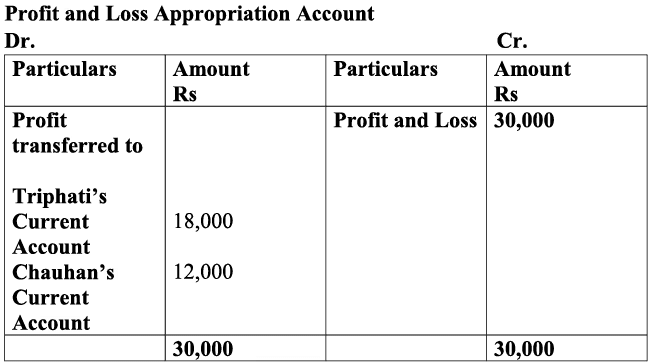
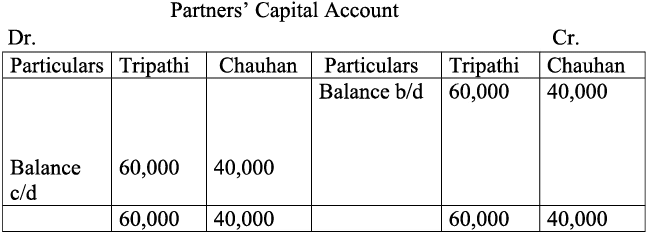
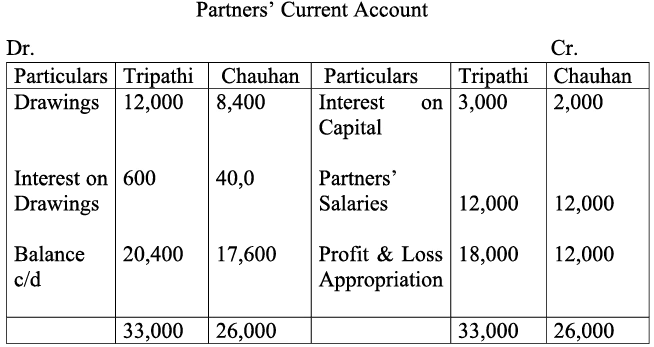
b) If interest on capital, partners' salaries and interest on drawings are distributed out of profit, the solution will be as:
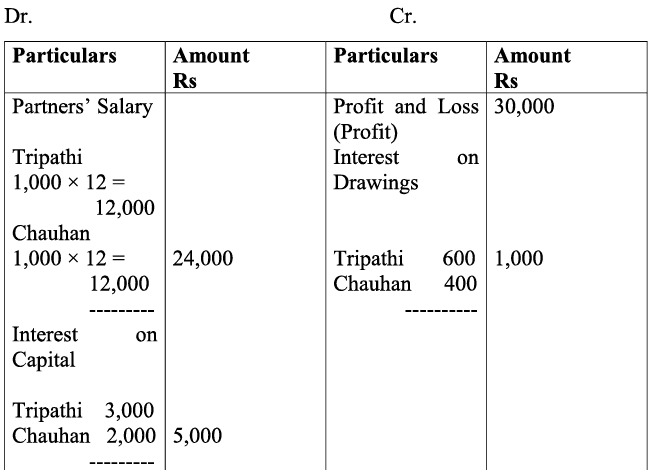
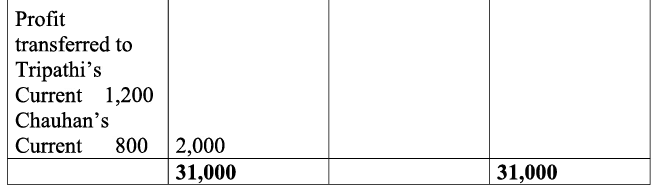
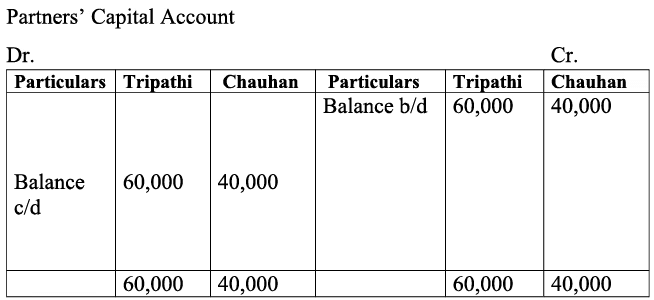
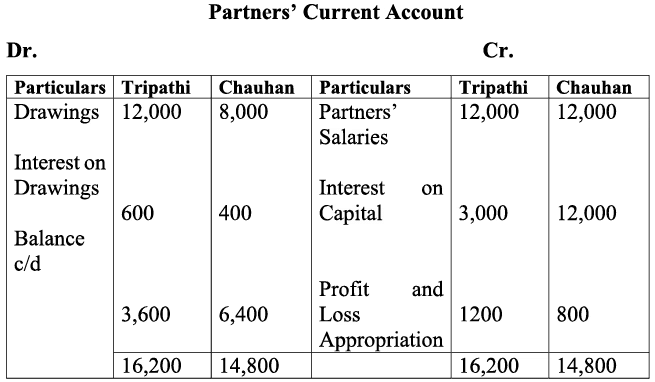
As the question is silent about the treatment of interest on capital, salary and interest on drawings, both methods are shown so students understand the two treatments. Usually, if not specified, the out of profits method is followed. Under that method the closing balances would be:
Tripathi's Current A/c balance: Rs. 3,600
Chauhan's Current A/c balance: Rs. 6,400.
Q2: Anubha and Kajal are partners of a firm sharing profits and losses in the ratio of 2:1. Their capitals were Rs. 90,000 and Rs. 60,000. The profit during the year was Rs. 45,000. According to partnership deed, both partners are allowed salary, Rs. 700 per month to Anubha and Rs. 500 per month to Kajal. Interest allowed on capital @ 5% p.a. The drawings at the end of the period were Rs. 8,500 for Anubha and Rs. 6,500 for Kajal. Interest is to be charged @ 5% p.a. on drawings. Prepare partners capital accounts, assuming that the capital accounts are fluctuating.
Ans:
a) Note: If partners' salaries, interest on capital and interest on drawings have already been adjusted in the Profit and Loss Account, the solution will be as shown below.
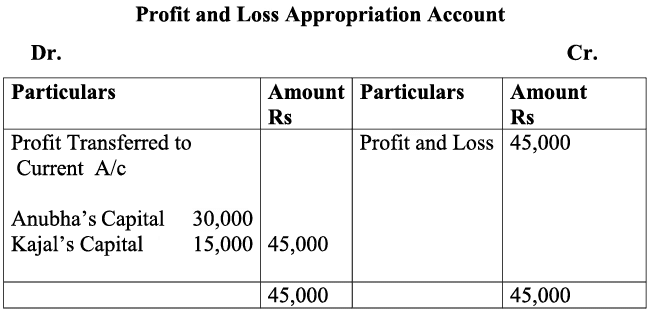
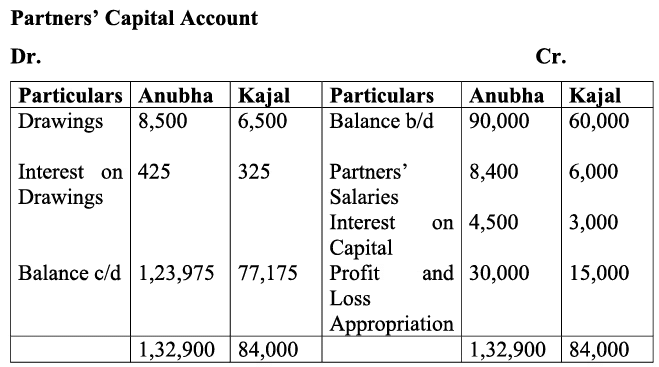
b) Alternative
Note: If partners' salaries, interest on capital and interest on drawings are adjusted in the Profit and Loss Appropriation Account, the solution will be as follows.
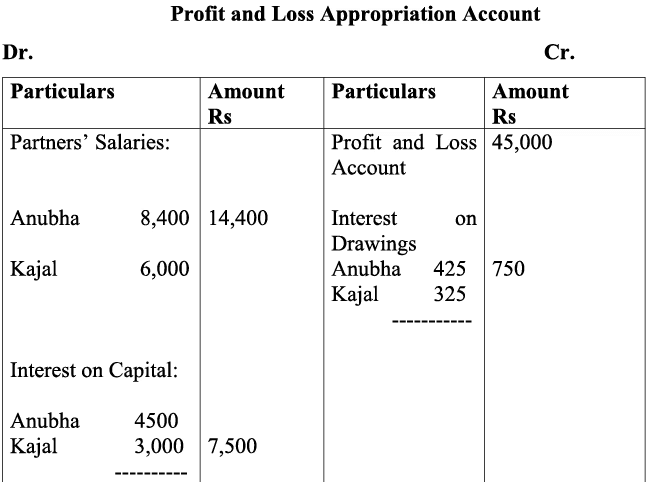
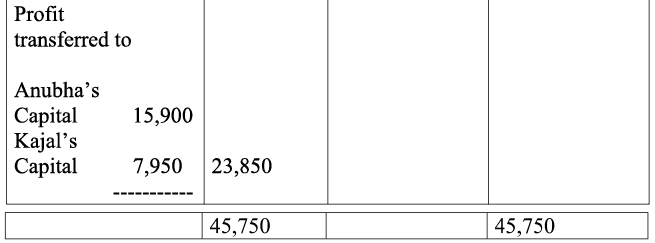
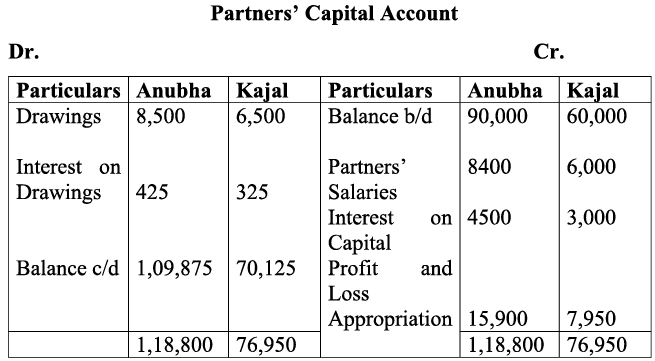
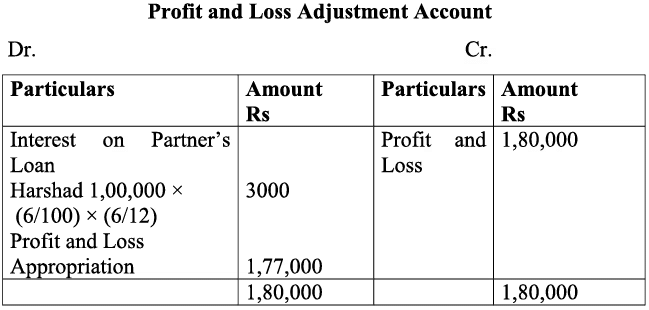
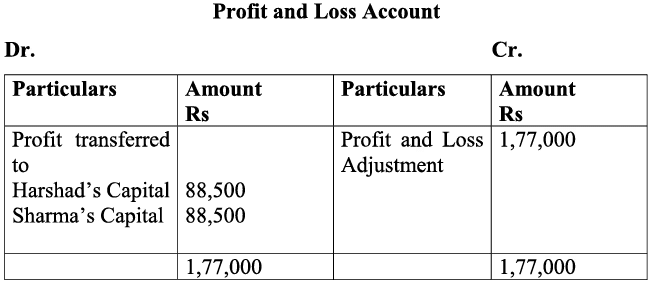
Q3: Harshad and Dhiman are in partnership since April 01, 2019. No partnership agreement was made. They contributed Rs. 4,00,000 and 1,00,000 respectively as capital. In addition, Harshad advanced an amount of Rs. 1,00,000 to the firm, on October 01, 2019. Due to long illness, Harshad could not participate in business activities from August 1 to September 30, 2019. The profits for the year ended March 31, 2020 amounted to Rs. 1,80,000. A dispute has arisen between Harshad and Dhiman.
Harshad Claims:
(i) He should be given interest @ 10% per annum on capital and loan;
(ii) Profit should be distributed in proportion to capital;
Dhiman Claims:
(i) Profits should be distributed equally;
(ii) He should be allowed Rs. 2,000 p.m. as remuneration for the period he managed the business, in the absence of Harshad;
(iii) Interest on capital and loan should be allowed @ 6% p.a.
You are required to settle the dispute between Harshad and Dhiman. Also prepare Profit and Loss Appropriation Account.
Ans:
DISTRIBUTION OF PROFITS
Harshad Claims:
Decisions
(i) Where there is no agreement on interest on capital, the Partnership Act, 1932 provides that no interest on capital is to be allowed.
(ii) Where profit-sharing ratio is not specified, profits are to be shared equally under the Act.
Dhiman Claims:
Decisions
(i) Dhiman is correct: in the absence of an agreement, profits are shared equally.
(ii) No salary is payable to Dhiman for managing the business, because there is no agreement on remuneration.
(iii) Interest on capital is not allowed (no agreement), but interest on loan advanced by a partner is allowed at 6% p.a. by default. The Profit and Loss Appropriation Account and distribution will reflect these rules.
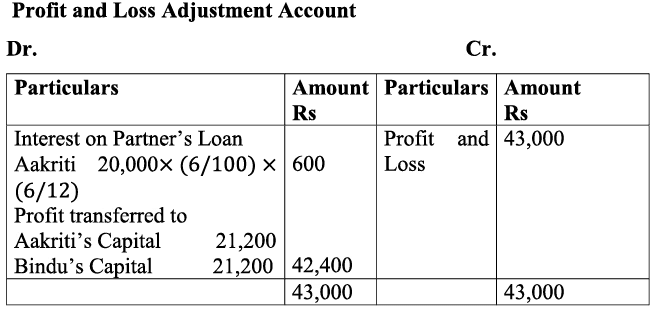
Q4: Aakriti and Bindu entered into partnership for making garments on April 01, 2019 without any partnership agreement. They introduced capitals of Rs. 5,00,000 and Rs. 3,00,000 respectively on October 01, 2019. Aakriti advanced Rs. 20,000 by way of loan to the firm without any agreement as to interest. Profit and Loss account for the year ended March 31, 2020 showed profit of Rs. 43,000. Partners could not agree upon the question of interest and the basis of division of profit. You are required to divide the profits between them by preparing Profit and Loss Appropriation Account. Also give reasons in support of your answer.
Ans:
Reason:
a) Interest on partner's loan shall be allowed at 6% p.a. because there is no partnership agreement specifying otherwise.
b) Interest on capital shall not be allowed because no agreement exists to pay interest on capital.
c) Profit shall be distributed equally because profit-sharing ratio has not been specified.
Q5: Rakhi and Shikha are partners in a firm, with capitals of Rs. 2,00,000 and Rs. 3,00,000 respectively. The profit of the firm for the year ended 2016-17 is Rs. 23,200. As per the partnership agreement, they share the profit in their capital ratio, after allowing a salary of Rs. 5,000 per month to Shikha and interest on partners' capital at the rate of 10% p.a. During the year Rakhi withdrew Rs. 7,000 and Shikha Rs. 10,000 for their personal use. As per partnership deed, salary and interest on capital are treated as charge on profit. Prepare Profit and Loss Appropriation Account and partners' capital accounts.
Ans:
If interest on capital and partners' salaries are provided even if the firm makes a loss, the entries are recorded accordingly.
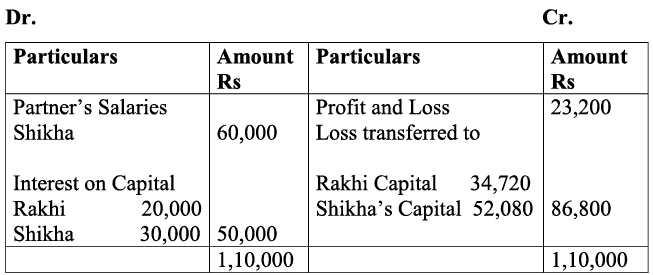
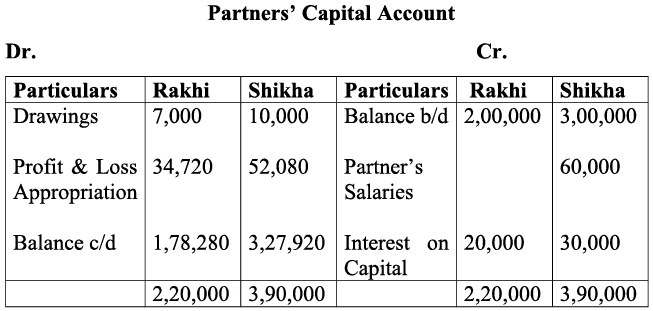
If these items are provided out of profit, the Profit and Loss Appropriation Account will appear as follows.
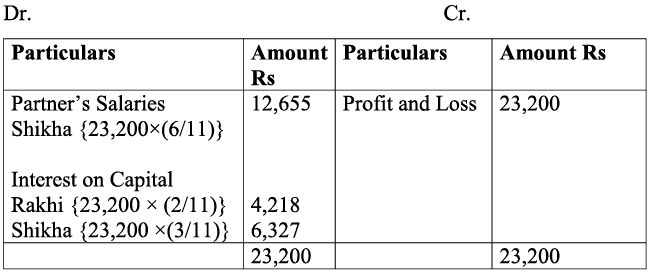
If distributable profit is less than the sum of appropriation items, distribution among partners is made in proportion to those items.
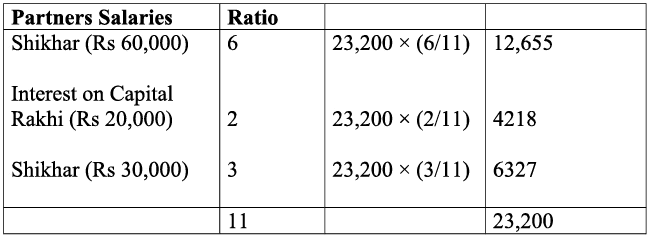
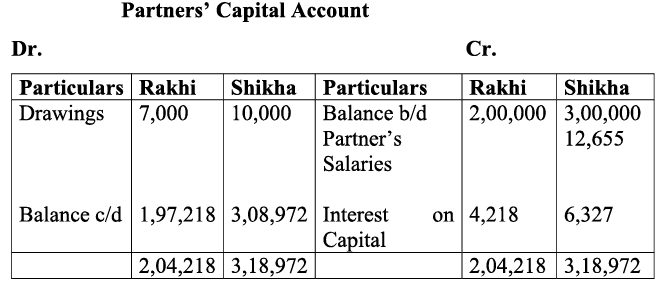
Q6: Lokesh and Azad are partners sharing profits in the ratio 3:2, with capitals of Rs. 50,000 and 30,000 respectively. Interest on capital is agreed to be paid @ 6% p.a. Azad is allowed a salary of Rs. 2,500 p.a. During 2016, the profits prior to the calculation of interest on capital but after charging Azad's salary amounted to Rs. 12,500. A provision of 5% of profits is to be made in respect of manager's commission. Prepare partners' capital accounts and Profit and Loss Appropriation Account.
Ans:
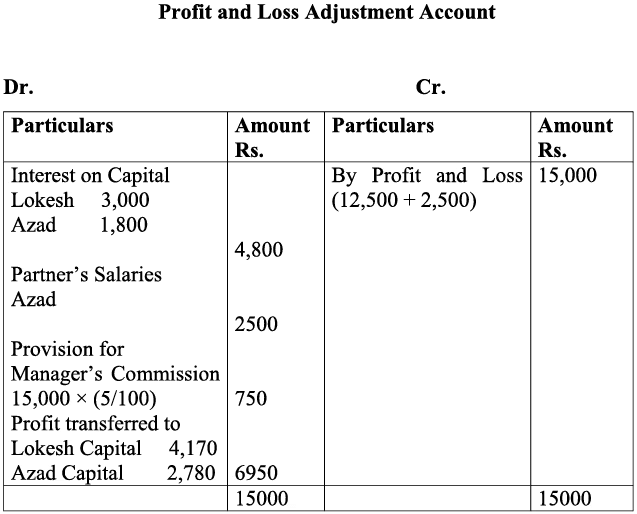
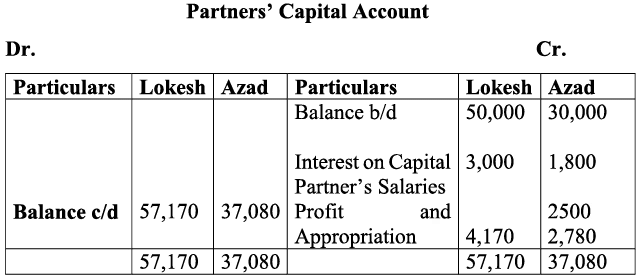
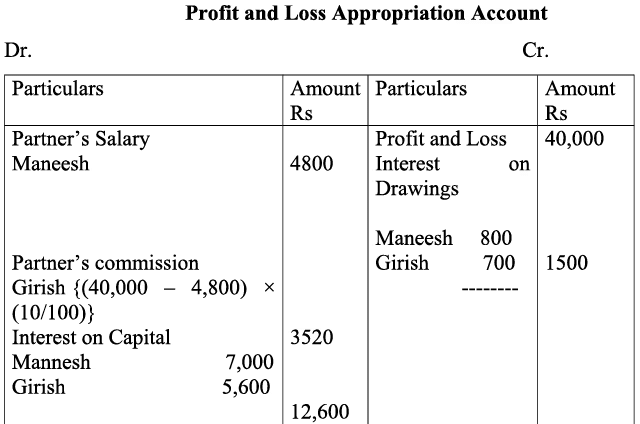
Q7: The partnership agreement between Maneesh and Girish provides that:
(i) Profits will be shared equally;
(ii) Maneesh will be allowed a salary of Rs. 400 p.m;
(iii) Girish who manages the sales department will be allowed a commission equal to 10% of the net profits, after allowing Maneesh's salary;
(iv) 7% p.a. interest will be allowed on partner's fixed capital;
(v) 5% p.a. interest will be charged on partner's annual drawings;
(vi) The fixed capitals of Maneesh and Girish are Rs. 1,00,000 and Rs. 80,000, respectively. Their annual drawings were Rs. 16,000 and 14,000, respectively. The net profit for the year ending March 31, 2019 amounted to Rs. 40,000;
Ans:

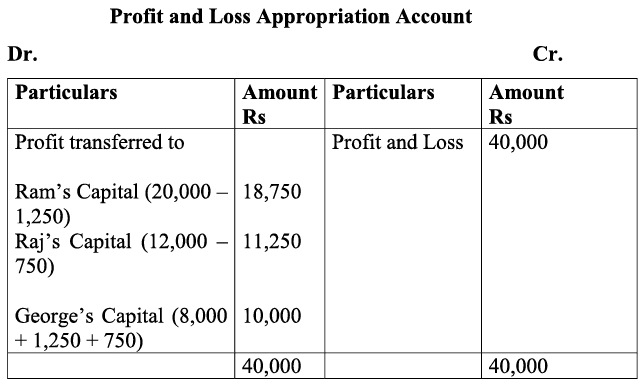
Q8: Ram, Raj and George are partners sharing profits in the ratio 5 : 3 : 2. According to the partnership agreement George is to get a minimum amount of Rs. 10,000 as his share of profits every year. The net profit for the year 2013 amounted to Rs. 40,000. Prepare the Profit and Loss Appropriation Account.
Ans:
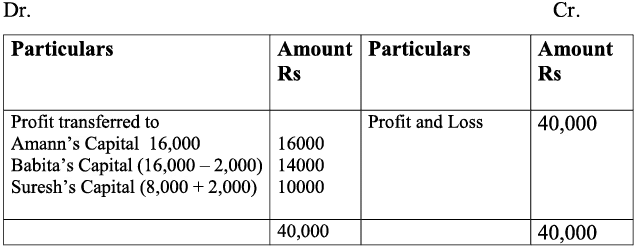
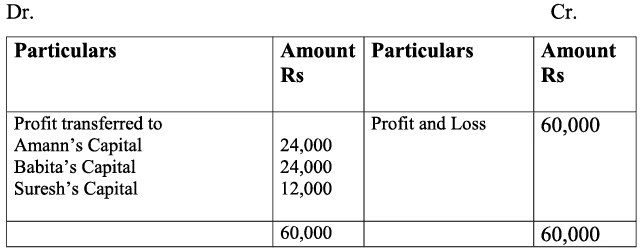
Q9: Aman, Babita and Suresh are partners in a firm. Their profit sharing ratio is 2:2:1. Suresh is guaranteed a minimum amount of Rs. 10,000 as share of profit every year. Any deficiency on that account shall be met by Babita. The profits for two years ending December 31, 2019 and December 31, 2020 were Rs. 40,000 and Rs. 60,000, respectively. Prepare the Profit and Loss Appropriation Account for the two years.
Ans: Profit and Loss Appropriation Account for the year ended 31st March 2019
Profit and Loss Appropriation Account for the year ended 31st March 2020
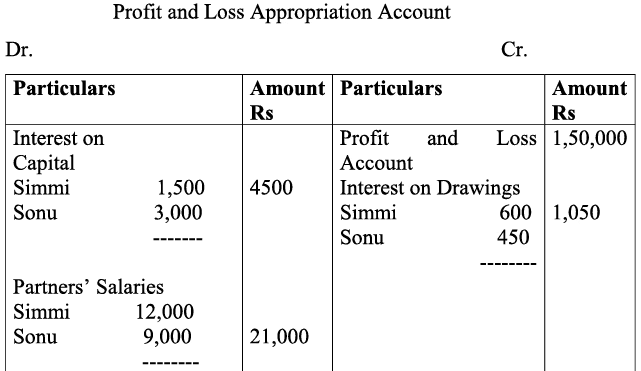
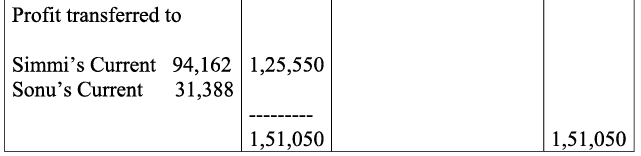
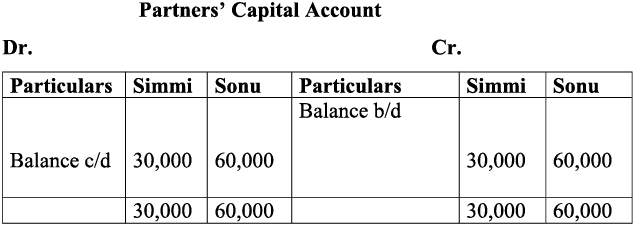
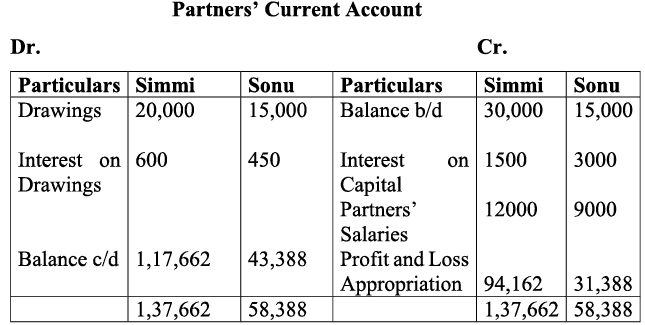
Q10: Simmi and Sonu are partners in a firm, sharing profits and losses in the ratio of 3:1. The profit and loss account of the firm for the year ending March 31, 2020 shows a net profit of Rs. 1,50,050. Prepare the Profit and Loss Appropriation Account and partners current account by taking into consideration the following information:
(i) Partners capital on April 1, 2019
Simmi, Rs 30,000; Sonu, Rs 60,000;
(ii) Current accounts balances on April 1, 2019;
Simmi, Rs 30,000 (cr.); Sonu, Rs 15,000 (cr.);
(iii) Partners drawings during the year amounted to
Simmi, Rs 20,000; Sonu, Rs. 15,000;
(iv) Interest on capital was allowed @ 5% p.a.;
(v) Interest on drawing was to be charged @ 6% p.a. at an average of six months;
(vi) Partners' salaries : Simmi Rs. 12,000 and Sonu Rs. 9,000. Also show the partners' current accounts.
Ans:
Q11: Arvind and Anand are partners sharing profits and losses in the ratio 8 : 3 : 1. Balances in their capital accounts on April 01, 2019 were, Arvind- Rs. 4,40,000 and Anand Rs. 2,60,000. As per their agreement, partners were entitled to interest on capital @ 5% p.a., and interest on drawings was to be charged @ 6% p.a. Arvind was allowed an annual salary of Rs. 35,000/- for the additional responsibilities taken up by him. Partners drawings for the year were, Arvind Rs. 40,000 and Anand Rs. 28,000. Profit and loss account of the firm for the year ending March 31, 2020 showed a Net Loss of Rs. 32,400. Prepare Profit and Loss Appropriation Account.
Ans:
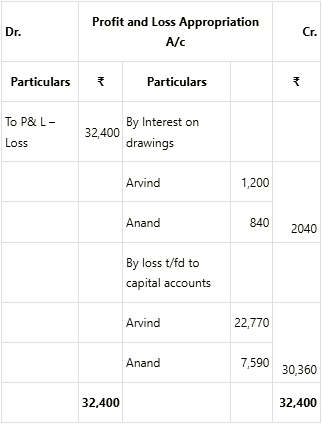
No salary and interest on capital will be allowed in case of loss. Interest on drawings:
Arvind = 40,000 × 6/100 × 6/12 = Rs. 1,200
Anand = 28,000 × 6/100 × 6/12 = Rs. 840
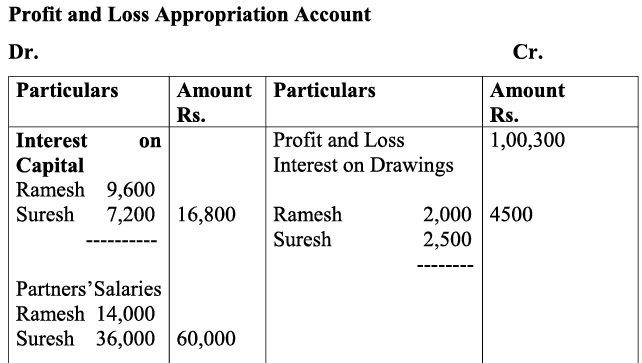
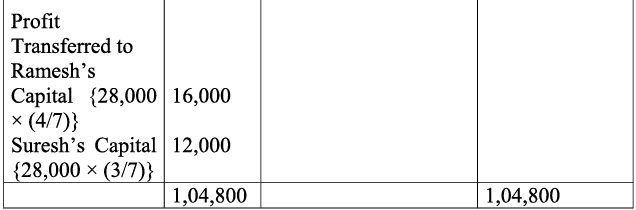
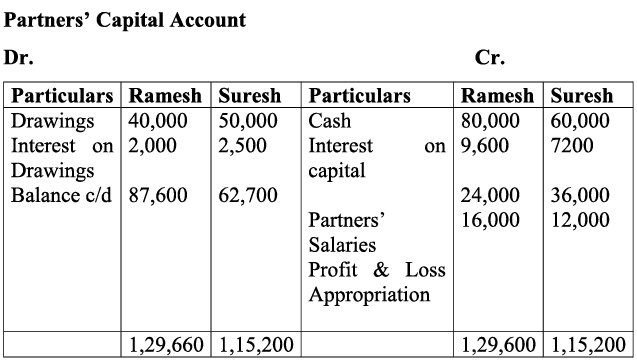
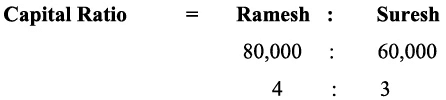
Q12: Ramesh and Suresh were partners in a firm sharing profits in the ratio of their capitals contributed on commencement of business which were Rs 80,000 and Rs 60,000 respectively. The firm started business on April 1, 2016. According to the partnership agreement, interest on capital and drawings are 12% and 10% p.a., respectively. Ramesh and Suresh are to get a monthly salary of Rs 2,000 and Rs. 3,000, respectively.
The profits for year ended March 31, 2017 before making above appropriations was Rs. 1,00,300. The drawings of Ramesh and Suresh were Rs. 40,000 and Rs. 50,000, respectively. Interest on drawings amounted to Rs. 2,000 for Ramesh and Rs. 2,500 for Suresh. Prepare Profit and Loss Appropriation Account and partners' capital accounts, assuming that their capitals are fluctuating.
Ans:
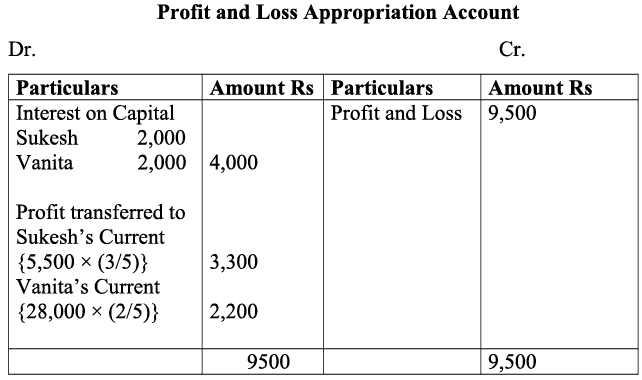
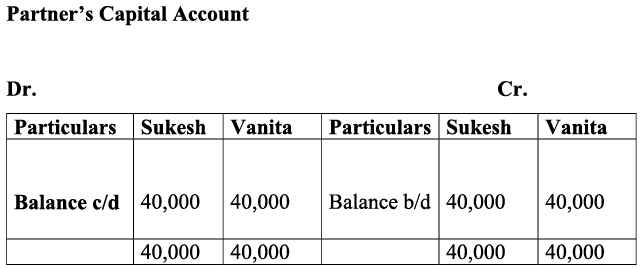
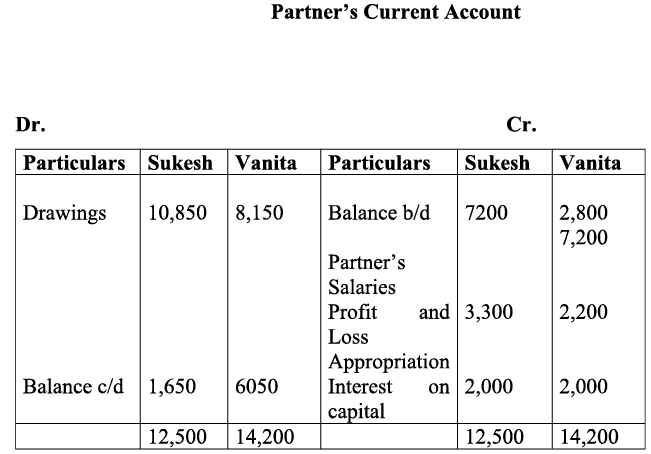
Q13: Sukesh and Vanita were partners in a firm. Their partnership agreement provides that:
(i) Profits would be shared by Sukesh and Vanita in the ratio of 3:2;
(ii) 5% interest is to be allowed on capital;
(iii) Vanita should be paid a monthly salary of Rs 600.
The following balances are extracted from the books of the firm, on December 31, 2017.
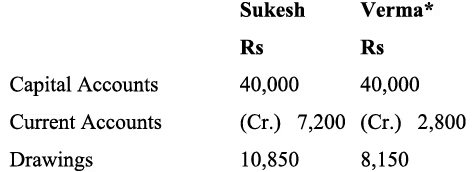
Net profit for the year, before charging interest on capital and after charging partner's salary was Rs 9,500. Prepare the Profit and Loss Appropriation Account and the Partner's Current Accounts.
Ans:
Q14: Rahul, Rohit and Karan started partnership business on April 1, 2019 with capitals of Rs. 20,00,000, Rs. 18,00,000 and Rs. 16,00,000, respectively. The profit for the year ended March 2020 amounted to Rs.1,35,000 and the partner's drawings had been Rahul Rs. 50,000, Rohit Rs. 50,000 and Karan Rs. 40,000. The profits are distributed among partners in the ratio of 3:2:1.
Calculate the interest on capital @ 5% p.a.
Ans:
Interest on Capital
Rahul = 20,00,000 × 5/100 = Rs 1,00,000
Rohit = 18,00,000 × 5/100 = Rs 90,000
Karan = 16,00,000 × 5/100 = Rs 80,000
Q15: Sunflower and Pink Rose started partnership business on April 01, 20019 with capitals of Rs 2,50,000 and Rs 1,50,000, respectively. On October 01, 2019, they decided that their capitals should be Rs 2,00,000 each. The necessary adjustments in the capitals are made by introducing or withdrawing cash. Interest on capital is to be allowed @ 10% p.a. Calculate interest on capital as on March 31, 2020.
Ans:
Product Method
Sunflower
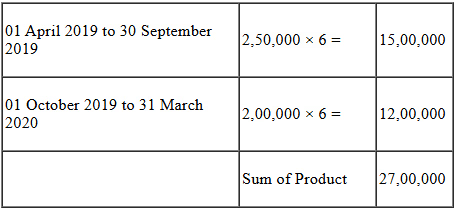
Pink Rose
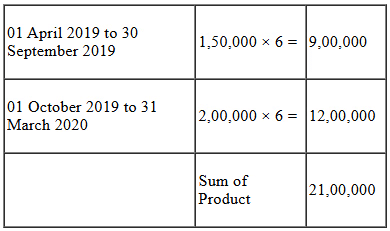
Interest on Capital =

Interest on Sunflower's Capital =

Interest on Pink Rose's Capital =

Q16: On March 31, 2017 after the close of accounts, the capitals of Mountain, Hill and Rock stood in the books of the firm at Rs. 4,00,000, Rs.3,00,000 and Rs. 2,00,000, respectively. Subsequently, it was discovered that the interest on capital @ 10% p.a. had been omitted. The profit for the year amounted to Rs. 1,50,000 and the partner's drawings had been Mountain: Rs. 20,000, Hill Rs. 15,000 and Rock Rs. 10,000. Calculate interest on capital.
Ans:
Generally interest on capital is calculated on opening balance of capital if no additional capital is introduced.
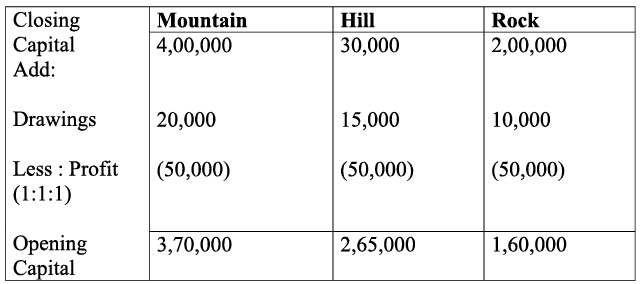
Interest on Capital
Mountain = 3,70,000 × (10/100) = Rs. 37,000
Hill = 2,65,000 × (10/100) = Rs. 26,500
Rock = 1,60,000 × (10/100) = Rs. 16,000
Q17: Following is the extract of the Balance Sheet of, Neelkant and Mahadev as on March 31, 2020:
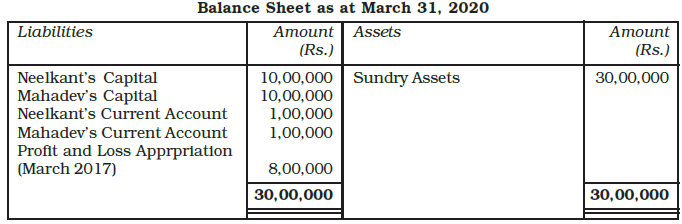
During the year Mahadev's drawings were Rs 30,000. Profits during 2019-20 is Rs 10,00,000. Calculate interest on capital @ 5% p.a for the year ending March 31, 2020.
Answer:
Interest on Capital
Neelkant = 10,00,000 × (5/100) = Rs 50,000
Mahadev = 10,00,000 × (5/100) = Rs 50,000
Note: In this question, both partners' capital and current account balances are given, so it is assumed that capitals are fixed. Thus, drawings and interest on capital do not change the capital balances but affect current accounts. Therefore interest on capital is calculated on the fixed capital balances shown in the Balance Sheet.
Q18: Rishi is a partner in a firm. He withdrew the following amounts during the year ended March 31, 2020.
May 01, 2019 - Rs. 12,000
July 31, 2019 - Rs. 6,000
September 30, 2019 - Rs. 9,000
November 30, 2019 - Rs. 12,000
January 01, 2020 - Rs. 8,000
March 31, 2020 - Rs. 7,000
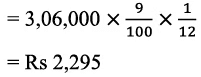
Interest on drawings is charged @ 9% p.a. Calculate interest on drawings
Ans:
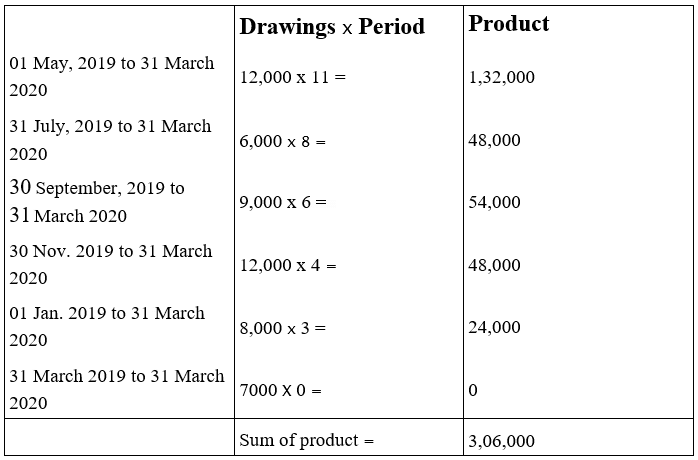
Here the formula will be

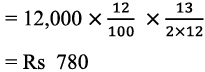
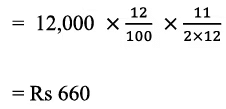
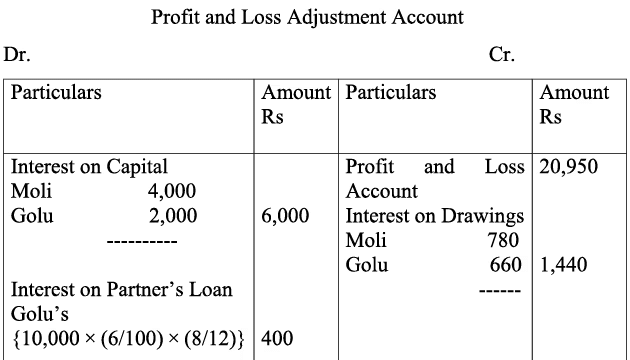
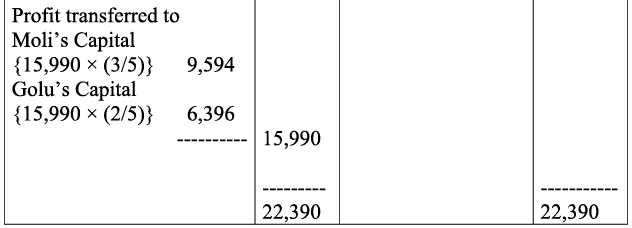
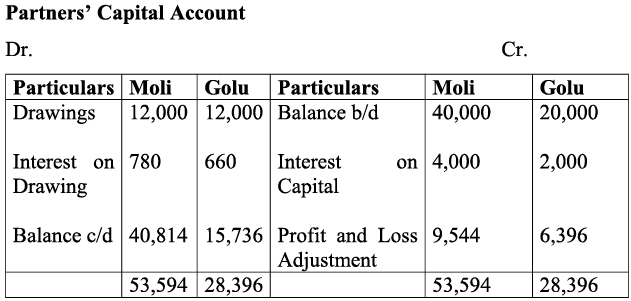
Q19: The capital accounts of Moli and Golu showed balances of Rs.40,000 and Rs. 20,000 as on April 01, 2019. They shared profits in the ratio of 3:2. They allowed interest on capital @ 10% p.a. and interest on drawings, @ 12% p.a. Golu advanced a loan of Rs. 10,000 to the firm on August 01, 2019. During the year, Moli withdrew Rs. 1,000 per month at the beginning of every month whereas Golu withdrew Rs. 1,000 per month at the end of every month. Profit for the year, before the above mentioned adjustments was Rs.20,950. Calculate interest on drawings, show distribution of profits and prepare partner's capital accounts.
Ans:
Interest on Moli's drawings

Interest on Golu's drawings

Q20: Rakesh and Roshan are partners, sharing profits in the ratio of 3:2 with capitals of Rs. 40,000 and Rs. 30,000, respectively. They withdrew from the firm the following amounts, for their personal use:
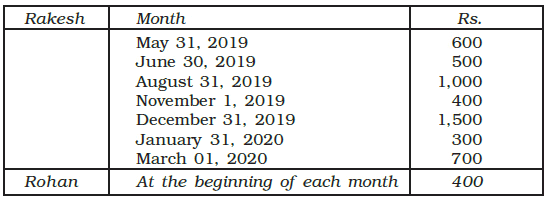
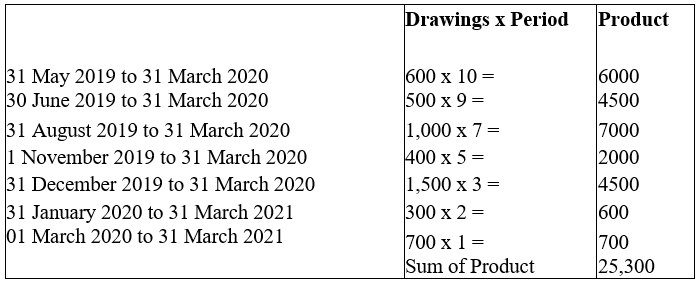
Interest on drawings is to be charged @ 6% p.a. Calculate interest on drawings, assuming that books of accounts are closed on March 31, 2020, every year.
Ans:
Rakesh's Interest on Drawings
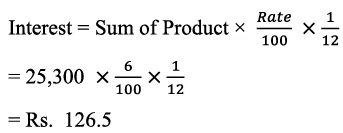
Interest on Roshan's Capital
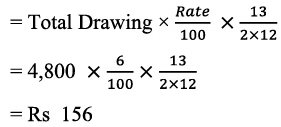
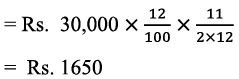
Q21: Himanshu withdrew Rs. 2,500 at the end of each month. The Partnership deed provides for charging interest on drawings @ 12% p.a. Calculate interest on Himanshu's drawings for the year ending March 31, 2017.
Ans:
Total drawings of Himanshu = Rs 2,500 × 12 = Rs 30,000

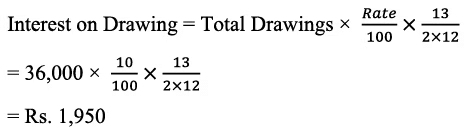
Q22: Bharam is a partner in a firm. He withdraws Rs. 3,000 at the starting of each month for 12 months. The books of the firm are closed on March 31 every year. Calculate interest on drawings if the rate of interest is 10% p.a.
Ans:
Total drawings of Bharam = Rs 3,000 × 12 = Rs 36,000
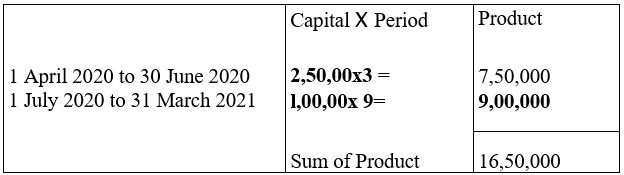
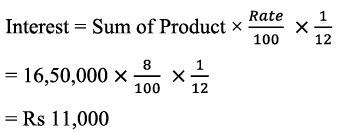
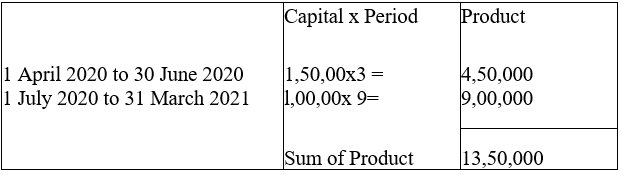
Q23: Raj and Neeraj are partners in a firm. Their capitals as on April 01, 2019 were Rs. 2,50,000 and Rs. 1,50,000, respectively. They share profits equally. On July 01, 2019, they decided that their capitals should be Rs. 1,00,000 each. The necessary adjustment in the capitals were made by introducing or withdrawing cash by the partners. Interest on capital is allowed @ 8% p.a. Compute interest on capital for both the partners for the year ending on March 31, 2020.
Ans: Interest on Capital
Raj
Neeraj

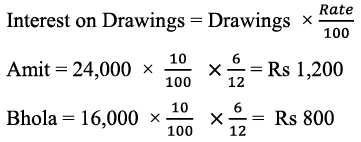
Q24: Amit and Bhola are partners in a firm. They share profits in the ratio of 3:2. As per their partnership agreement, interest on drawings is to be charged @ 10% p.a. Their drawings during 2019 were Rs. 24,000 and Rs. 16,000, respectively. Calculate interest on drawings based on the assumption that the amounts were withdrawn evenly throughout the year.
Ans:
Q26: Menon and Thomas are partners in a firm. They share profits equally. Their monthly drawings are Rs. 2,000 each. Interest on drawings is to be charged @ 10% p.a. Calculate interest on Menon's drawings for the year 2006, assuming that money is withdrawn:
(i) in the beginning of every month,
(ii) in the middle of every month, and
(iii) at the end of every month.
Ans:
(i) If they withdraw money at the beginning of each month: Interest on drawing = Total drawings × Rate × 13/(2 × 12)
Menon = 24,000 × 10/100 × 13/(2 × 12) = Rs. 1,300
Thomas = 24,000 × 10/100 × 13/(2 × 12) = Rs. 1,300
(ii) If they withdraw in the middle of every month: Interest on drawing = Total drawings × Rate × 6/12
Menon = 24,000 × 10/100 × 6/12 = Rs. 1,200
Thomas = 24,000 × 10/100 × 6/12 = Rs. 1,200
(iii) If they withdraw at the end of every month: Interest on drawing = Total drawings × Rate × 11/(2 × 12)
Menon = 24,000 × 10/100 × 11/(2 × 12) = Rs. 1,100
Thomas = 24,000 × 10/100 × 11/(2 × 12) = Rs. 1,100
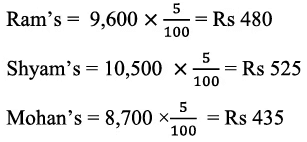
Q27: On March 31, 2017, after the close of books of accounts, the capital accounts of Ram, Shyam and Mohan showed balances of Rs. 24,000 Rs. 18,000 and Rs. 12,000, respectively. It was later discovered that interest on capital @ 5% had been omitted. The profit for the year ended March 31, 2017, amounted to Rs. 36,000 and the partners' drawings had been Ram, Rs. 3,600; Shyam, Rs. 4,500 and Mohan, Rs. 2,700. The profit sharing ratio of Ram, Shyam and Mohan was 3:2:1. Calculate interest on capital.
Ans:
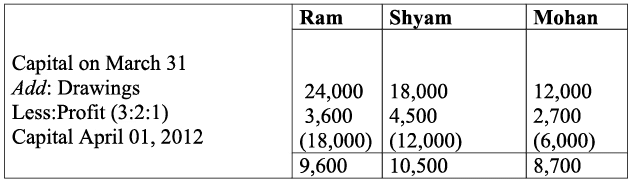
Here, Interest on Capital = Opening Capital × (Rate/100)
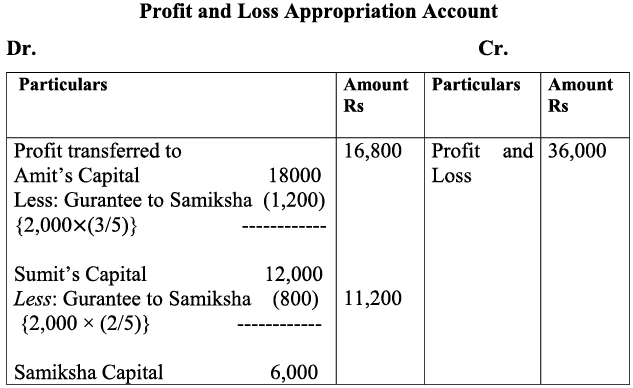
Q28: Amit, Sumit and Samiksha are in partnership sharing profits in the ratio of 3:2:1. Samiksha's share in profit has been guaranteed by Amit and Sumit to be a minimum sum of Rs. 8,000. Profits for the year ended March 31, 2017 was Rs. 36,000. Divide profit among the partners by preparing profit and loss appropriation account.
Ans: Guarantee of Profit to the partners

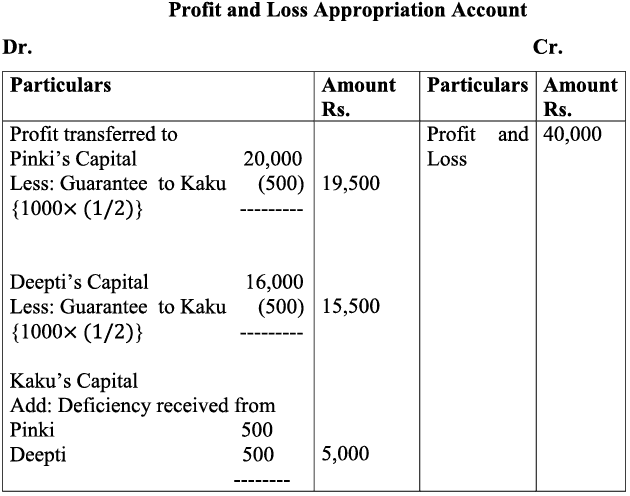
Q29: Pinki, Deepti and Kaku are partners sharing profits in the ratio of 5:4:1. Kaku is given a guarantee that his share of profits in any given year would not be less than Rs. 5,000. Deficiency, if any, would be borne by Pinki and Deepti equally. Profits for the year amounted to Rs. 40,000. Record necessary journal entries in the books of the firm showing the distribution of profit.
Ans:

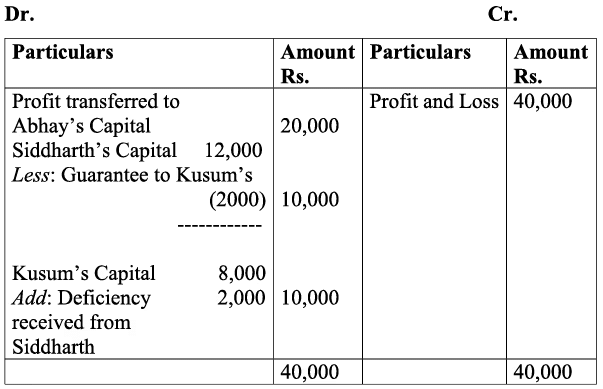
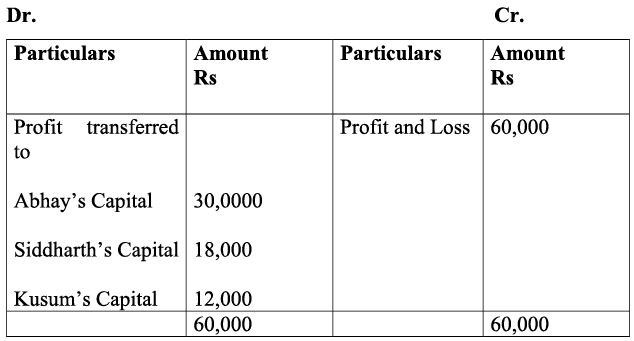
Q30: Abhay, Siddharth and Kusum are partners in a firm, sharing profits in the ratio of 5:3:2. Kusum is guaranteed Rs. 10,000 as her share in the profits. Any deficiency arising on that account shall be met by Siddharth. Profits for the years ending March 31, 2016 and 2017 are Rs. 40,000 and 60,000 respectively. Prepare Profit and Loss Appropriation Account.
Ans:
Profit and Loss Appropriation Account as on March 31, 2016
Profit and Loss Appropriation Account as on March 31, 2017
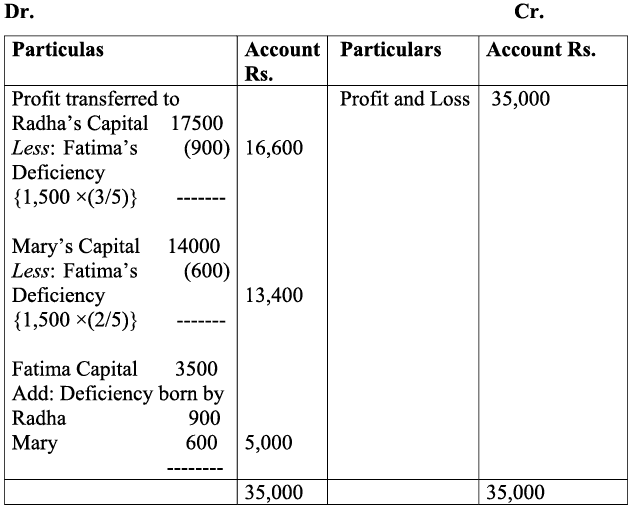
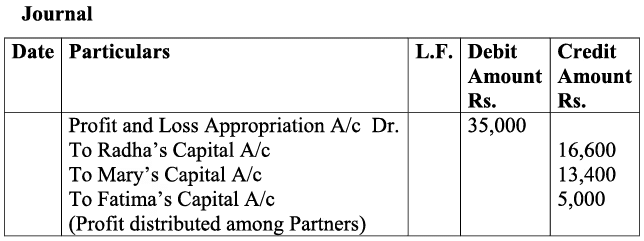
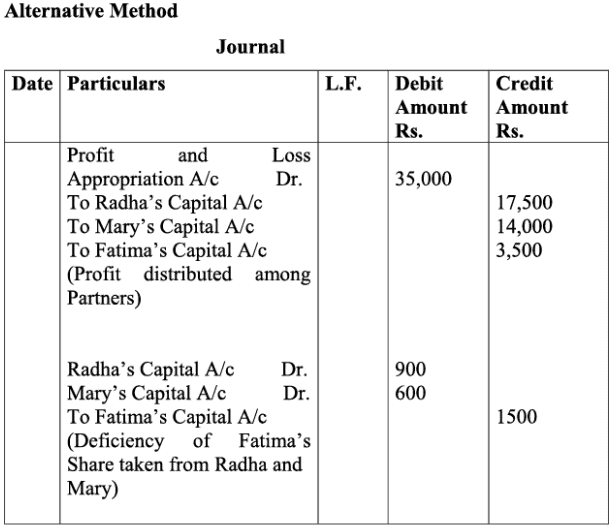
Q31: Radha, Mary and Fatima are partners sharing profits in the ratio of 5:4:1. Fatima is given a guarantee that her share of profit, in any year will not be less than Rs. 5,000. The profits for the year ending March 31, 2020 amounted to Rs. 35,000. Shortfall if any, in the profits guaranteed to Fatima is to be borne by Radha and Mary in the ratio of 3:2. Record necessary journal entry to show distribution of profit among the partners.
Ans:
Profit and Loss Appropriation Account
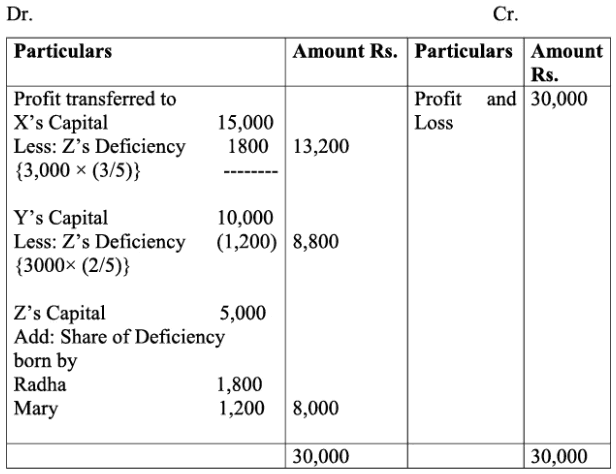
Q32: X, Y and Z are in Partnership, sharing profits and losses in the ratio of 3 : 2 : 1, respectively. Z's share in the profit is guaranteed by X and Y to be a minimum of Rs. 8,000. The net profit for the year ended March 31, 2020 was Rs. 30,000. Prepare Profit and Loss Appropriation Account.
Ans:
Profit and Loss Appropriation Account as on March 31, 2017
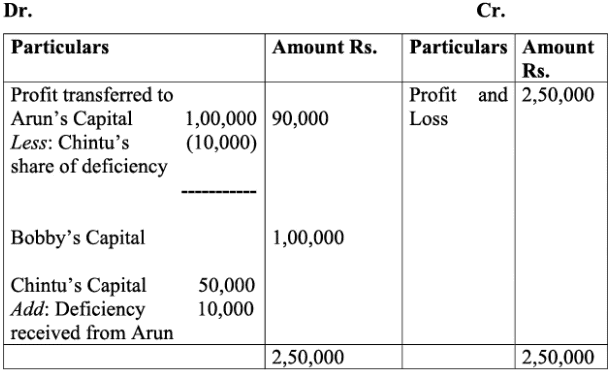
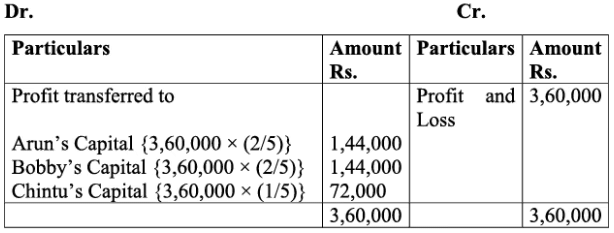
Q33: Arun, Boby and Chintu are partners in a firm sharing profit in the ratio or 2:2:1. According to the terms of the partnership agreement, Chintu has to get a minimum of Rs. 60,000, irrespective of the profits of the firm. Any deficiency to Chintu on account of such guarantee shall be borne by Arun. Prepare the Profit and Loss Appropriation Account showing distribution of profits among the partners in case the profits for year 2015 are:
(i) Rs. 2,50,000;
(ii) Rs. 3,60,000.
Case (i) Profit and Loss Appropriation Account as on March 31, 2015
Case (ii) Profit and Loss Appropriation Account as on March 31,2015
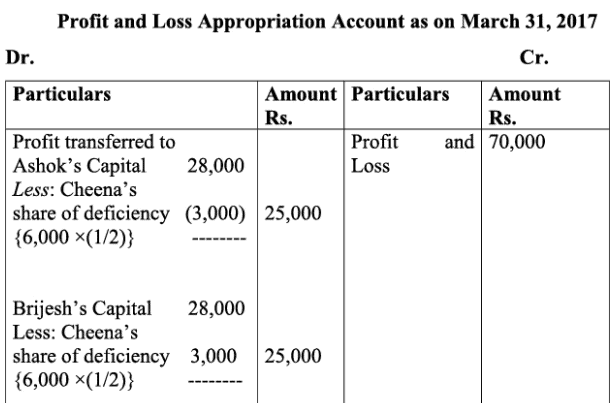
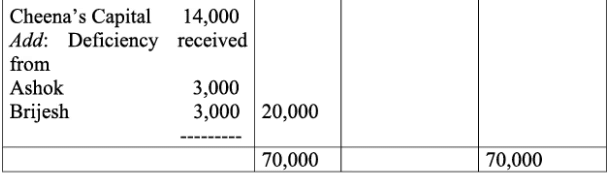
Q34: Ashok, Brijesh and Cheena are partners sharing profits and losses in the ratio of 2 : 2 : 1. Ashok and Brijesh have guaranteed that Cheena's share in any year shall be Rs. 20,000. The net profit for the year ended March 31, 2017 amounted to Rs. 70,000. Prepare Profit and Loss Appropriation Account.
Ans:
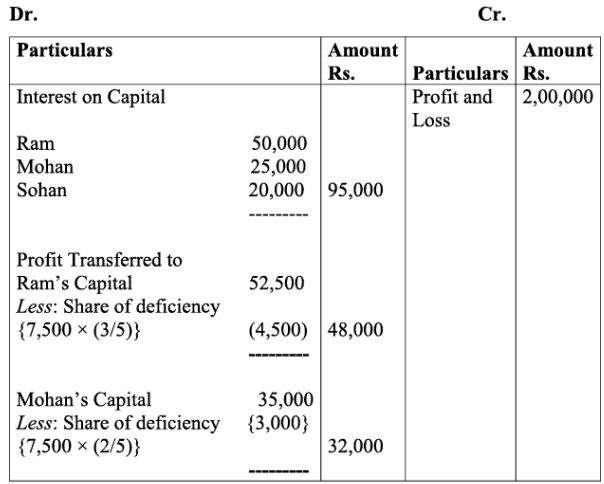
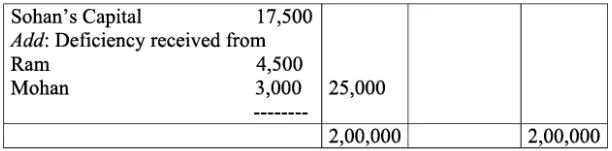
Q35: Ram, Mohan and Sohan are partners with capitals of Rs. 5,00,000, Rs. 2,50,000 and 2,00,000 respectively. After providing interest on capital @ 10% p.a. the profits are divisible as follows: Ram 1/2 , Mohan 1/3 and Sohan 1/6 . Ram and Mohan have guaranteed that Sohan's share in the profit shall not be less than Rs. 25,000, in any year. The net profit for the year ended March 31, 2017 is Rs. 2,00,000, before charging interest on capital. You are required to show distribution of profit by preparing P & L Appropriation Account.
Ans:
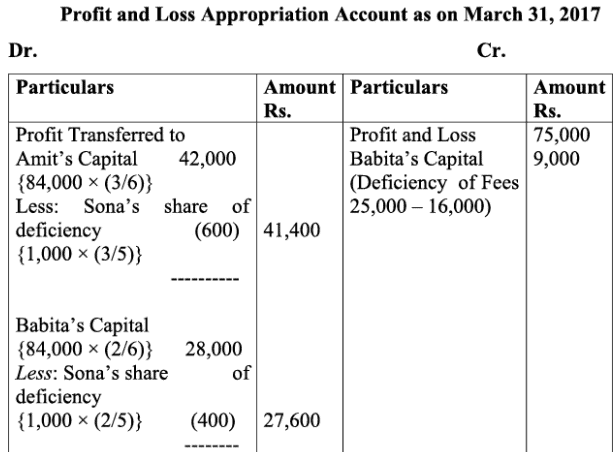
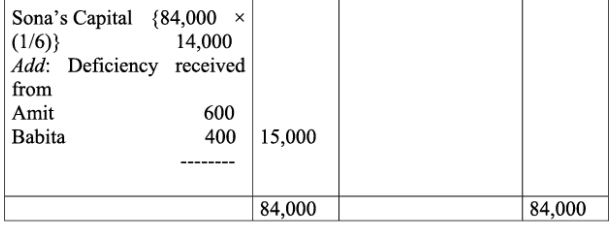
Q36: Amit, Babita and Sona form a partnership firm, sharing profits in the ratio of 3 : 2 : 1, subject to the following :
(i) Sona's share in the profits is guaranteed to be not less than Rs. 15,000 in any year.
(ii) Babita gave guarantee to the effect that gross fee earned by her for the firm shall be equal to her average gross fee of the preceding five years, when she was carrying on profession alone (which is Rs. 25,000). The net profit for the year ended March 31, 2017 is Rs. 75,000. The gross fee earned by Babita for the firm was Rs. 16,000. You are required to prepare Profit and Loss Appropriation Account.
Ans:
Q37: The net profit of X, Y and Z for the year ended March 31, 2020 was Rs. 60,000 and the same was distributed among them in their agreed ratio of 3 : 1 : 1. It was subsequently discovered that the undermentioned transactions were not recorded in the books :
(i) Interest on Capital @ 5% p.a.
(ii) Interest on drawings amounting to X Rs. 700, Y Rs. 500 and Z Rs. 300.
(iii) Partner's Salary : X Rs. 1000, Y Rs. 1500 p.a.
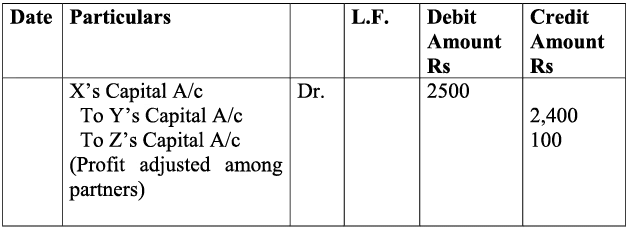
The capital accounts of partners were fixed as : X Rs. 1,00,000, Y Rs. 80,000 and Z Rs. 60,000. Record the adjustment entry.
Ans:
Past Adjustment
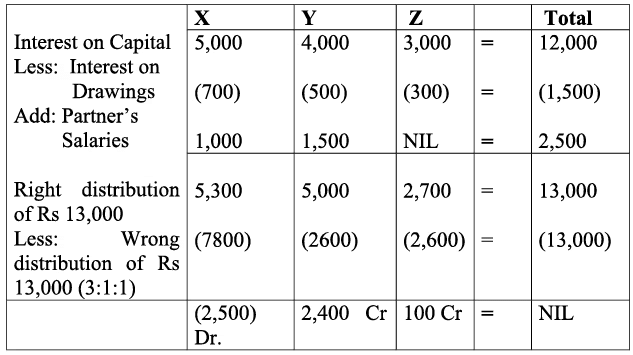
Explanation: Capital accounts have credit balances. If an amount is to be deducted, the capital account is debited; if an amount is to be added, the capital account is credited. Here X's share was taken in excess by Rs. 2,500 and must be deducted from X's capital account. Y and Z were taken less than due, so their capital accounts will be credited.
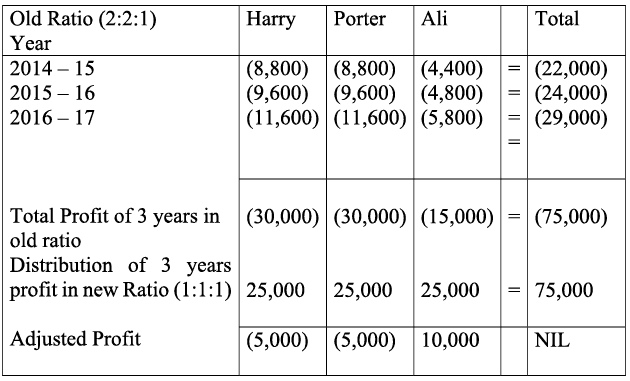
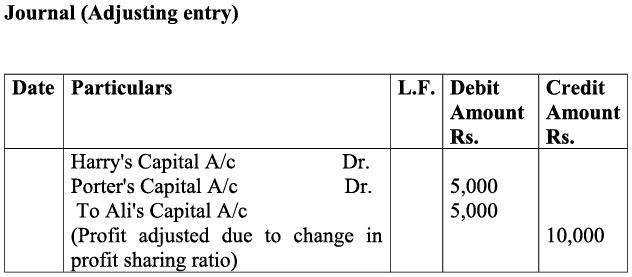
Q38: The firm of Harry, Porter and Ali, who have been sharing profits in the ratio of 2 : 2 : 1, have existed for some years. Ali wants that he should get equal share in the profits with Harry and Porter and he further wishes that the change in the profit sharing ratio should come into effect retrospectively for the last three years. Harry and Porter have agreed on this account.
The profits for the last three years were:
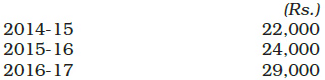
Show adjustment of profits by means of a single adjustment journal entry.
Ans:
Distribution of Profit
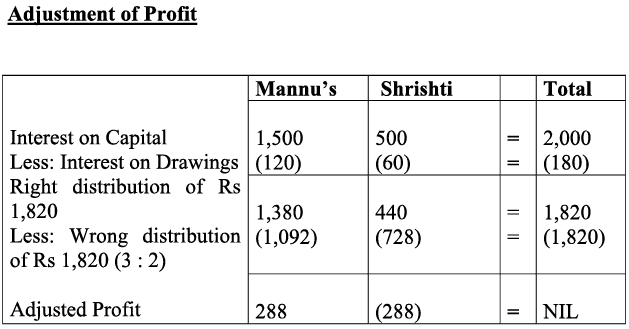
Q39: Mannu and Shristhi are partners in a firm sharing profit in the ratio of 3 : 2. Following is the balance sheet of the firm as on March 31, 2017.
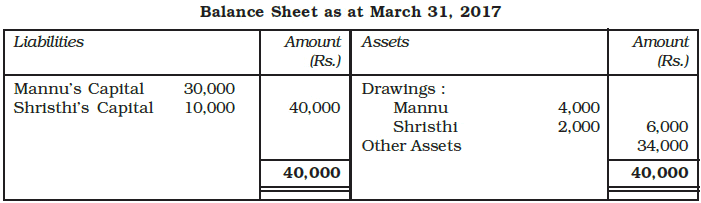
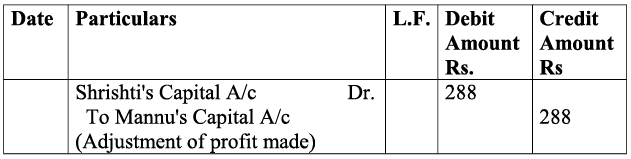
Profit for the year ended March 31, 2017 was Rs. 5,000 which was divided in the agreed ratio, but interest @ 5% p.a. on capital and @ 6% p.a. on drawings was omitted. Adjust interest on drawings on an average basis for 6 months. Give the adjustment entry.
Ans:
Adjusting Journal Entry
Q40: On March 31, 2017 the balance in the capital accounts of Eluin, Monu and Ahmed, after making adjustments for profits, drawings, etc; were Rs. 80,000, Rs. 60,000 and Rs. 40,000 respectively. Subsequently, it was discovered that interest on capital and interest on drawings had been omitted. The partners were entitled to interest on capital @ 5% p.a. The drawings during the year were Eluin Rs. 20,000; Monu, Rs. 15,000 and Ahmed, Rs. 9,000. Interest on drawings chargeable to partners were Eluin Rs, 500, Monu Rs. 360 and Ahmed Rs. 200. The net profit during the year amounted to Rs. 1,20,000. The profit sharing ratio was 3 : 2 : 1. Record necessary adjustment entry.
Ans: In this question interest on capital shall be calculated on opening capital
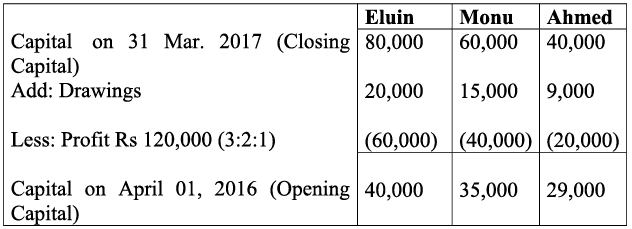
Adjustment of Profit


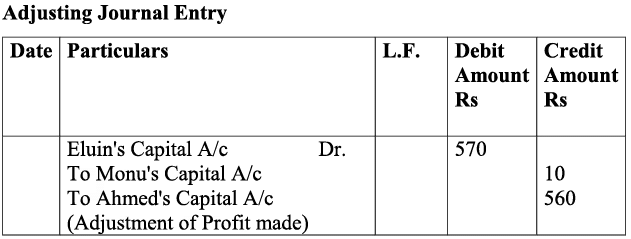
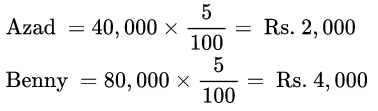
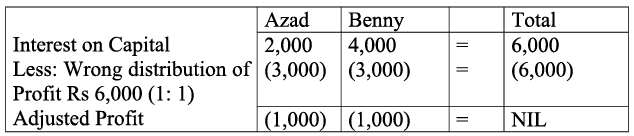
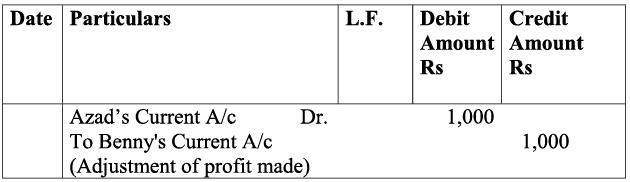
Q41: Azad and Benny are equal partners. Their fixed capitals are Rs. 40,000 and Rs. 80,000, respectively. After the accounts for the year have been prepared it is discovered that interest at 5% p.a. as provided in the partnership agreement, has not been credited to the capital accounts before distribution of profits. It is decided to make an adjustment entry at the beginning of the next year. Record the necessary journal entry.
Ans:
Interest on Capital
Adjustment of Profit
Adjusting Journal Entry
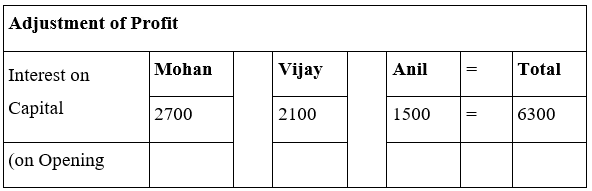
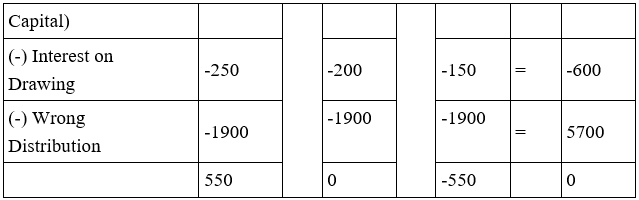
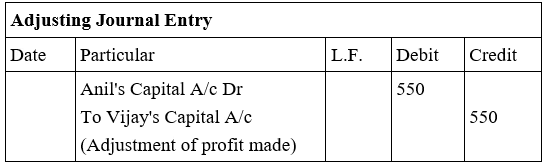
Q42: Mohan, Vijay and Anil are partners, the balances in their capital accounts being Rs. 30,000, Rs. 25,000 and Rs. 20,000 respectively. In arriving at these figures, the profits for the year ended March 31, 2017 amounting to Rupees 24,000 had been credited to partners in the proportion in which they shared profits. During the year the drawings of Mohan, Vijay and Anil were Rs. 5,000, Rs. 4,000 and Rs. 3,000, respectively. Subsequently, the following omissions were noticed:
(a) Interest on Capital, at the rate of 10% p.a., was not charged.
(b) Interest on Drawings: Mohan Rs. 250, Vijay Rs. 200, Anil Rs. 150 was not recorded in the books.
Record necessary corrections through journal entries.
Ans:
Interest on capital shall be calculated on opening capital:
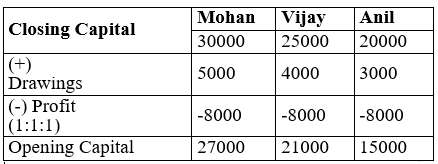
Interest on Capital Mohan = 27,000 × 10/100 = 2,700 Vijay = 21,000 × 10/100 = 2,100
Anil = 15,000 × 10/100 = 1,500
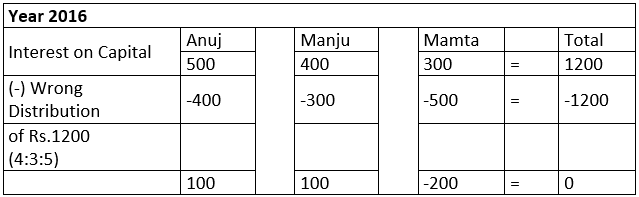
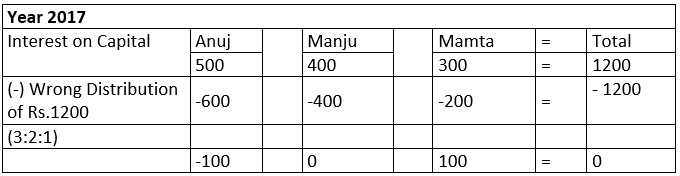
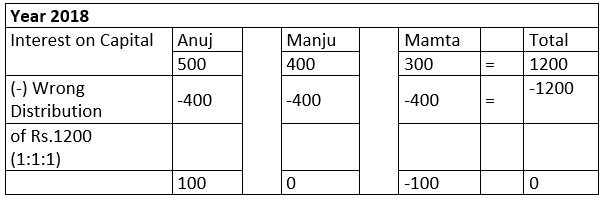
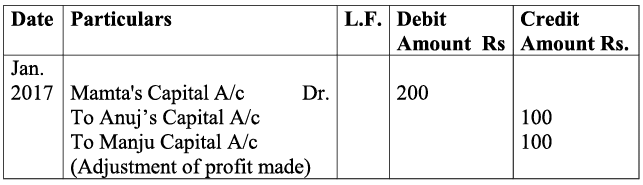
Q43: Anju, Manju and Mamta are partners whose fixed capitals were Rs. 10,000, Rs. 8,000 and Rs. 6,000, respectively. As per the partnership agreement, there is a provision for allowing interest on capitals @ 5% p.a. but entries for the same have not been made for the last three years. The profit sharing ratio during three years remained as follows:
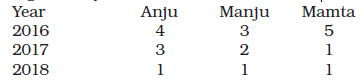
Make necessary adjustment entry at the beginning of the fourth year i.e. April 2019.
Ans:
Interest on Capital
Anju = 10,000 × 5/100 = 500
Manju = 8,000 × 5/100 = 400
Mamta = 6,000 × 5/100 = 300
Adjustment of Profit
Adjusting Journal Entry
FAQs on NCERT Solution: Accounting for Partnership-Basic Concepts
| 1. What are the basic concepts of accounting for partnership firms? |  |
| 2. How is the profit-sharing ratio determined in a partnership? | |
| 3. What is the significance of maintaining capital accounts in partnership accounting? | |
| 4. How is goodwill treated in partnership accounts? | |
| 5. What are the accounting entries for admitting a new partner in a partnership? | |