NCERT Solutions: Electoral Politics

Q1. Which of the following statements about the reasons for conducting elections are false?
(a) Elections enable people to judge the performance of the government.
(b) People select the representative of their choice in an election.
(c) Elections enable people to evaluate the performance of the judiciary.
(d) People can indicate which policies they prefer.
Ans: (c)
Explanation: Elections allow voters to choose political representatives and to assess how well the government and its policies are working. The judiciary, however, functions independently of the electoral process and is not evaluated through elections; therefore statement (c) is false.
Q2. Which of these is not a good reason to say that Indian elections are democratic?
(a) India has the largest number of voters in the world.
(b) India's Election Commission is very powerful.
(c) In India, everyone above the age of 18 has a right to vote.
(d) In India, the losing parties accept the electoral verdict.
Ans: (a)
Explanation: Having a large number of voters does not by itself prove that elections are democratic. Democratic elections require universal adult franchise, an independent and effective election authority, free competition among parties, and acceptance of results. India fulfils many of these conditions-such as an autonomous Election Commission and the right to vote for all adults-so statement (a) is not a good reason to claim Indian elections are democratic.
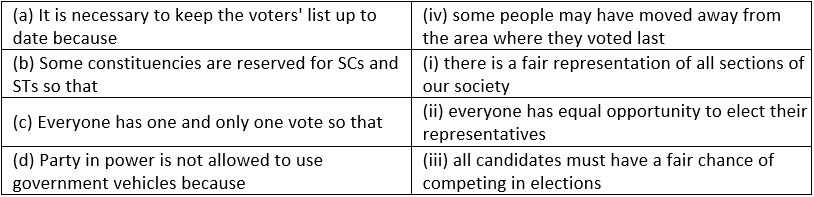
Q3. Match the following

Ans:
Q4. List all the different election-related activities mentioned in the chapter and arrange them in a time sequence, beginning with the first activity and ending with the last. Some of these activities are given below: releasing election manifestos; counting of votes; making of voters' list; election campaign; declaration of election results; casting of votes; ordering of re-poll; announcing election schedule; filing nomination.
Ans: Election-related activities in time sequence:
(i) Announcing the election schedule
(ii) Filing nominations
(iii) Making of voters' list
(iv) Releasing election manifestos
(v) Election campaign
(vi) Casting of votes
(vii) Counting of votes
(viii) Declaration of election results
(ix) Ordering of re-poll
Q5. Surekha is an officer in-charge of ensuring free and fair elections in an assembly constituency in a state. Describe what should she focus on for each of the following stages of election:
(a) Election Campaign
(b) Polling Day
(c) Counting Day
Ans:
(a) Election Campaign
- Ensure no candidate or party uses bribery, threats, or appeals to caste or religion to influence voters.
- Prevent misuse of government resources: ministers must not use official vehicles or take major policy decisions after elections are announced.
- Monitor campaign expenditure to stop excessive spending and ensure places of worship are not used for campaigning.
(b) Polling Day
- Verify the voters' list at polling stations and check voters' identity cards to ensure only eligible persons vote.
- Prevent rigging, booth capturing and interference by unauthorised persons; ensure polling staff are impartial and polling booths are secure.
(c) Counting Day
- Allow authorised polling agents to be present, supervise the counting process for transparency, and ensure proper handling and custody of ballot papers or EVMs.
- Arrange secure venue, adequate staff, and clear procedures so counting is accurate and disputes can be dealt with promptly.
Q6. The table below gives the proportion of different communities among the candidates who won elections to the US Congress. Compare these to the proportion of these communities in the population of the US. Based on this, would you suggest a system of reservations in the US Congress? If yes, why and for which communities? If no, why not?

Ans:
Yes. If certain communities (for example, Hispanic and Black groups) have a much smaller share of seats in Congress than their share of the population, a system of reservations could be considered to improve proportional representation. Such reservations would aim to make the legislature reflect the population more fairly. Communities that are already represented in proportion to, or above, their population share (for example, the White community as shown) would not require reservations.
Q7. Can we draw the following conclusions from the information given in this chapter? Give two facts to support your position for each of these.
(a) Election Commission of India does not have enough powers to conduct free and fair elections in the country.
(b) There is a high level of popular participation in the elections in our country.
(c) It is very easy for the party in power to win an election.
(d) Many reforms are needed to make our elections completely free and fair.
Ans:
(a) This conclusion is incorrect.
- The Election Commission of India issues and enforces the Model Code of Conduct and can take action against candidates or parties that violate rules.
- During elections, officials perform duties under the supervision of the Election Commission, reducing direct government control over the electoral process.
(b) This conclusion is correct.
- Voter turnout has generally increased over time, indicating greater participation by citizens in elections.
- More citizens take part in election-related activities such as campaigning, voting and monitoring, showing wider popular engagement.
(c) This conclusion is incorrect.
- Ruling parties have often lost elections, showing incumbency does not guarantee victory.
- High spending or wealth does not always secure electoral success; many wealthy candidates have lost despite large expenditures.
(d) This conclusion is correct.
- Large election expenditures by some candidates give them an unfair advantage, indicating need for stricter regulation of campaign finance.
- The presence of candidates with criminal links who intimidate voters shows reforms are necessary to ensure fairness and safety.
Q8. Chinappa was convicted for torturing his wife for dowry. Satbir was held guilty of practicing untouchability. The court did not allow either of them to contest elections. Does this decision go against the principles of democratic elections?
Ans: No. Disqualifying persons convicted of serious offences does not violate democratic principles. It helps protect the integrity of elected bodies and ensures that those who represent citizens meet basic standards of conduct and lawfulness.
Q9. Here are some reports of electoral malpractices from different parts of the world. Is there anything that these countries can learn from India to improve their elections? What would you suggest in each case?
(a) During an election in Nigeria, the officer in charge of counting votes deliberately increased the votes of one candidate and declared him elected. The court later found out that more than five lakh votes cast for one candidate were counted in favour of another.
(b) Just before elections in Fiji, a pamphlet was distributed warning voters that a vote for former Prime Minister, Mahendra Chaudhry will lead to bloodshed. This was a threat to voters of Indian origin.
(c) In the US, each state has its own method of voting, its own procedure of counting and its own authority for conducting elections. Authorities in the state of Florida took many controversial decisions that favoured Mr Bush in the presidential elections in 2000. But no one could change those decisions.
Ans:
(a) Ensure that representatives of each candidate are present during counting and that counting is done in a transparent venue with clear procedures and secure record-keeping so tampering can be detected and corrected.
(b) Investigate such intimidatory propaganda promptly, take legal action against those who distributed it, and run public information campaigns to reassure targeted communities and protect voters from threats.
(c) Adopt a single, independent electoral authority with uniform procedures to ensure consistency, impartiality and the ability to review disputed decisions across the whole country.
Q10. Here are some reports of malpractices in the Indian elections. Identify what the problem in each case is. What should be done to correct the situation?
(a) Following the announcement of elections, the minister promised to provide financial aid to reopen the closed sugar mill.
(b) Opposition parties alleged that their statements and campaign was not given due attention in Doordarshan and All India Radio.
(c) An inquiry by the Election Commission showed that electoral rolls of a state contain the name of 20 lakh fake voters.
(d) The hoodlums of a political party were moving with guns, physically preventing supporters of other political parties to meet the voters and attacking meetings of other parties.
Ans:
(a) Problem: The minister announced a policy decision after the elections were announced, which gives the ruling side an unfair advantage.
Corrective action: The Election Commission should prevent such policy announcements and consider restricting the minister's candidature if the action violates the Model Code of Conduct.
(b) Problem: State-controlled media gave unequal coverage, creating an unfair advantage for the ruling party.
Corrective action: Allocate equal and impartial broadcast time to all parties on national media and enforce rules that ensure fair reporting during elections.
(c) Problem: Electoral rolls with large numbers of fake voters indicate manipulation and threaten the fairness of elections.
Corrective action: The Election Commission should supervise and conduct a thorough revision and verification of the electoral rolls, removing fraudulent entries and strengthening registration checks.
(d) Problem: Use of violence and intimidation by party hoodlums prevents free campaigning and free choice by voters.
Corrective action: The Election Commission should order arrests, ensure adequate policing at sensitive areas, and, if necessary, disqualify candidates or parties that use violence to influence elections.
Q11. Ramesh was not in class when this chapter was being taught. He came the next day and repeated what he had heard from his father. Can you tell Ramesh what is wrong with these statements?
(a) Women always vote the way men tell them to. So what is the point of giving them the right to vote?
(b) Party politics creates tension in society. Elections should be decided by consensus, not by competition.
(c) Only graduates should be allowed to stand as candidates for elections.
Ans:
(a) This is incorrect. The secret ballot allows each voter, including women, to choose freely without pressure; many women vote independently and make their own choices.
(b) While party politics can cause tension, competition in elections ensures that representatives are held accountable and that different ideas are debated; deciding everything by consensus would limit choice and democratic accountability.
(c) Requiring graduates would unfairly exclude many capable leaders who understand local needs; formal education is not the only measure of a person's ability to represent others.
FAQs on NCERT Solutions: Electoral Politics
| 1. What is the difference between a general election and a by-election in India? |  |
| 2. How does the first-past-the-post system work in CBSE Class 9 Electoral Politics? | |
| 3. Why do candidates need to file nominations and deposits before elections? | |
| 4. What are the main responsibilities of the Election Commission in conducting fair elections? | |
| 5. How do constituencies affect representation and campaigning strategies in Indian elections? | |





