NCERT Solutions: Working of Institutions

Q1. If you are elected as the President of India which of the following decisions can you take on your own?
(a) Select the person you like as Prime Minister.
(b) Dismiss a Prime Minister who has a majority in Lok Sabha.
(c) Ask for reconsideration of a bill passed by both the Houses.
(d) Nominate the leaders of your choice to the Council of Ministers.
Ans: (c) Ask for reconsideration of a bill passed by both Houses.
Explanation: The President can ask Parliament to reconsider a bill and may delay giving assent temporarily. If both Houses pass the bill again, the President must give assent. The President cannot independently choose the Prime Minister when there is a majority in Lok Sabha, cannot remove a Prime Minister who enjoys Lok Sabha majority, and cannot unilaterally nominate members of the Council of Ministers. These powers keep the President's role largely ceremonial in such matters while allowing a constitutional check by asking for reconsideration.
Q2. Who among the following is a part of the political executive?
(a) District Collector
(b) Secretary of the Ministry of Home Affairs
(c) Home Minister
(d) Director General of Police
Ans: (c) Home Minister
Explanation: The Home Minister is an elected political leader and is part of the political executive, which makes policy and takes political decisions. The District Collector, the Secretary of the Ministry, and the Director General of Police are members of the bureaucracy or civil services; they belong to the administrative executive and implement policies made by the political executive.
Q3. Which of the following statements about the judiciary is false?
(a) Every law passed by the Parliament needs the approval of the Supreme Court.
(b) Judiciary can strike down a law if it goes against the spirit of the Constitution.
(c) Judiciary is independent of the Executive.
(d) Any citizen can approach the courts if her rights are violated
Ans: (a) Every law passed by the Parliament needs the approval of the Supreme Court.
Explanation: Laws passed by Parliament do not require prior approval from the Supreme Court. The judiciary, however, has the power of judicial review - it can examine laws and strike them down if they violate the Constitution. The judiciary is independent of the executive, and citizens can approach the courts to seek protection of their rights.
Q4. Which of the following institutions can make changes to an existing law of the country?
(a) The Supreme Court
(b) The President
(c) The Prime Minister
(d) The Parliament
Ans: (d) The Parliament
Explanation: Only Parliament has the legislative authority to make, amend, or repeal laws. The Supreme Court can interpret laws and declare them unconstitutional, but it does not directly change the text of laws. The President and the Prime Minister cannot unilaterally amend laws; they may influence law-making but the formal power rests with Parliament.
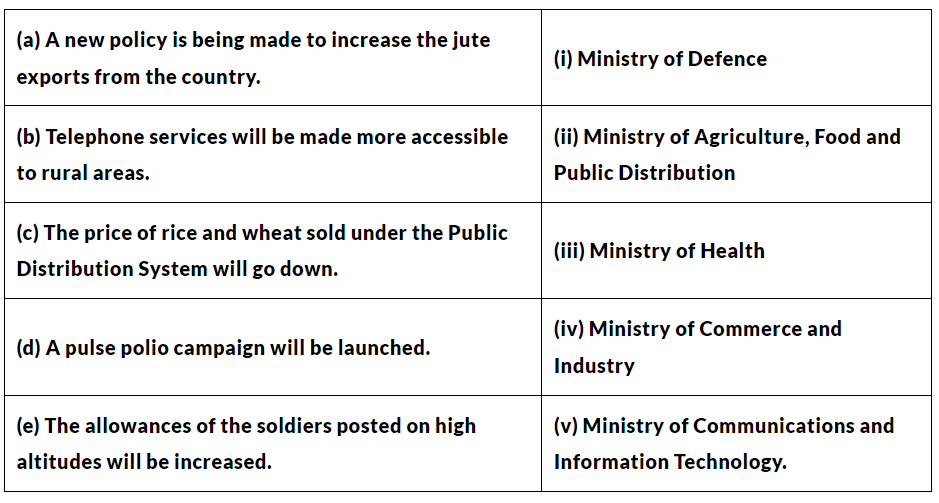
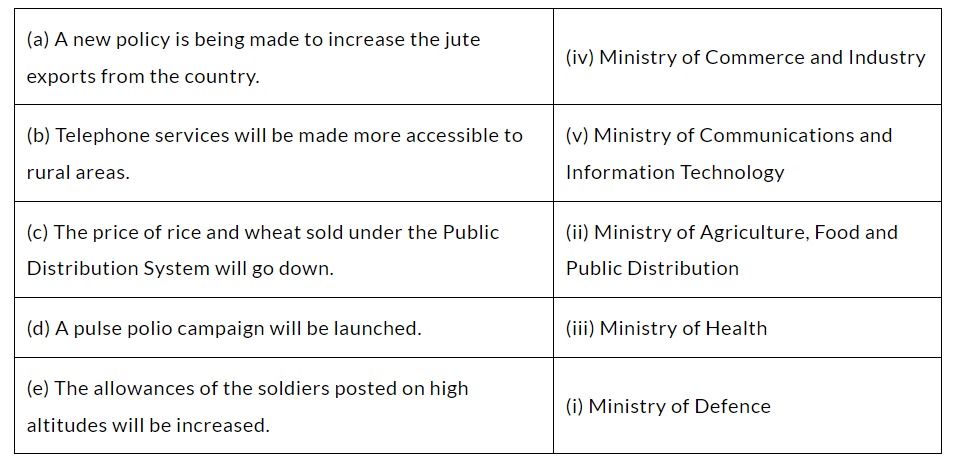
Q5. Match the ministry with the news that the ministry may have released:
Ans:
Q6. Of all the institutions that we have studied in this chapter, name the one that exercises the powers on each of the following matters.
(a) Decision on allocation of money for developing infrastructure like roads, irrigation etc. and different welfare activities for the citizens.
(b) Considers the recommendation of a Committee on a law to regulate the stock exchange.
(c) Decides on a legal dispute between two state governments.
(d) Implements the decision to provide relief for the victims of an earthquake.
Ans:
(a) Lok Sabha (through the Finance Ministry) decides the allocation of money for developing infrastructure such as roads and irrigation, and for various welfare activities for citizens.
(b) The Parliament (via its committees and sessions) considers recommendations of a committee on a law to regulate the stock exchange and can pass the law.
(c) The Supreme Court settles legal disputes between two state governments by interpreting the Constitution and laws.
(d) The Executive (central and state administration) is responsible for implementing relief measures for victims of an earthquake.
Q7. Why is the Prime Minister in India not directly elected by the people?
Choose the most appropriate answer and give reasons for your choice.
(a) In a Parliamentary democracy only the leader of the majority party in the Lok Sabha can become the Prime Minister.
(b) Lok Sabha can remove the Prime Minister and the Council of Ministers even before the expiry of their term.
(c) Since the Prime Minister is appointed by the President there is no need for it.
(d) Direct election of the Prime Minister will involve lot of expenditure on election.
Ans: (a)
Explanation: In a Parliamentary democracy the Prime Minister is the leader of the party (or coalition) that has majority support in the Lok Sabha. This system ensures that the head of government has the confidence of the directly elected representatives who control legislation and budgets. The arrangement also provides collective responsibility through the Council of Ministers; if the Lok Sabha loses confidence in the government it can remove the Prime Minister and the Council of Ministers, which keeps the executive accountable to the elected house.
Q8. Three friends went to watch a film that showed the hero becoming Chief Minister for a day and making big changes in the state. Imran said this is what the country needs. Rizwan said this kind of personal rule without institutions is dangerous. Shankar said all this is a fantasy. No minister can do anything in one day. What would be your reaction to such a film?
Ans:
- The film is unrealistic; major reforms need planning, consultation and time.
- Personal rule without strong institutions is dangerous because institutions ensure fairness, transparency and checks on arbitrary action.
- Many decisions require legal processes, budgets and administrative work, so a single person cannot implement large changes in one day.
Q9. A teacher was making preparations for a mock parliament. She called two students to act as leaders of two political parties. She gave them an option: Each one could choose to have a majority either in the mock Lok Sabha or in the mock Rajya Sabha. If this choice was given to you. Which one would you choose and why?
Ans:
- I would choose a majority in the Lok Sabha because it holds greater power in practical terms.
- The Lok Sabha can prevail in a joint sitting owing to its larger membership, so it effectively decides on bills when disagreements arise between the two Houses.
- The Lok Sabha has stronger control over money bills and the budget; the Rajya Sabha cannot reject money bills.
- The Council of Ministers is responsible to the Lok Sabha; a government must retain the confidence of the Lok Sabha to stay in office.
Q10. After reading the example of the reservation order, three students had different reactions about the role of the judiciary. Which view, according to you, is a correct reading of the role of judiciary?
(a) Srinivas argues that since the Supreme Court agreed with the government, it is not independent.
(b) Anjaiah says that judiciary is independent because it could have given a verdict against the government order. The Supreme Court did direct the government to modify it.
(c) Vijaya thinks that the judiciary is neither independent nor conformist, but acts as a mediator between opposing parties. The court struck a good balance between those who supported and those who opposed the order.
Ans: (b)
Explanation: Anjaiah's view best reflects the judiciary's role. The judiciary is independent and has the authority to examine executive or legislative actions. By directing modification of the government order rather than simply accepting or wholly rejecting it, the Supreme Court demonstrated its ability to check government power while ensuring constitutional principles are followed. This shows judicial review and a willingness to correct or guide government action rather than automatic conformity.
FAQs on NCERT Solutions: Working of Institutions
| 1. What are the key institutions that make up the Indian political system? |  |
| 2. How does the Parliament function in India? | |
| 3. What is the role of the President in the Indian political system? | |
| 4. How does the Judiciary function as a check on the other institutions? | |
| 5. What is the significance of local self-governments in the Indian political system? | |





